Table of Contents
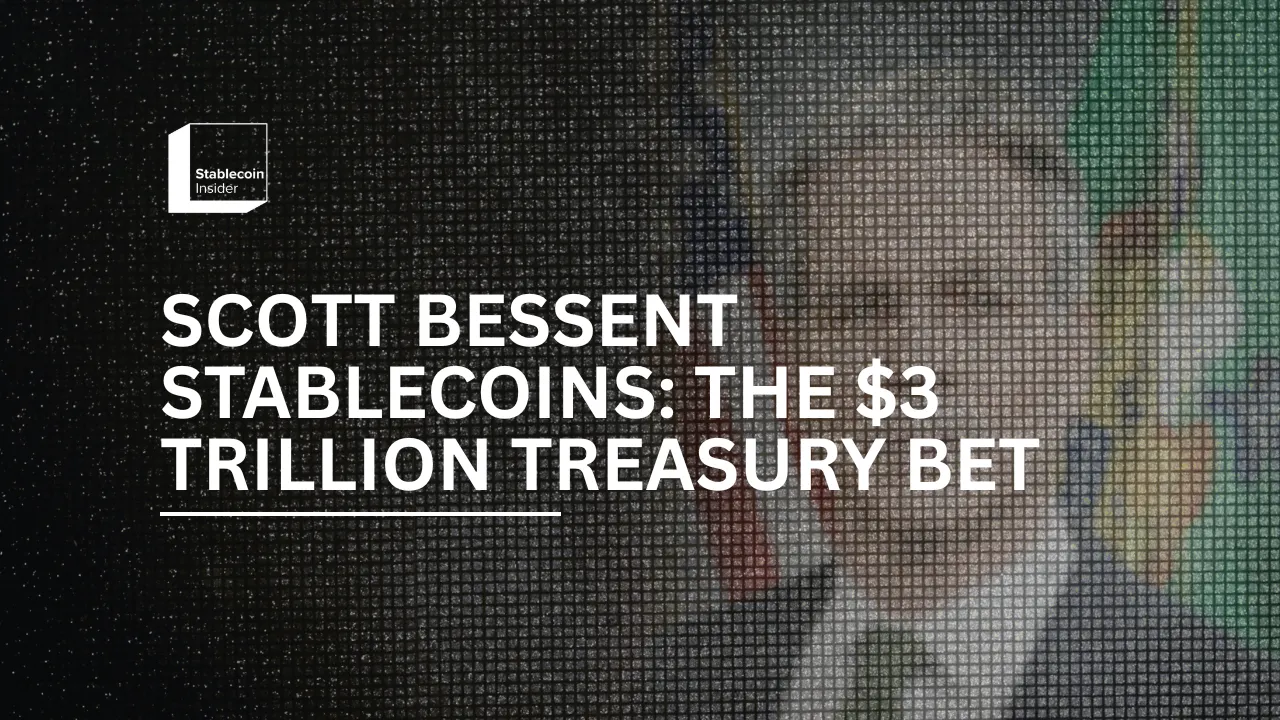
Treasury Secretary Scott Bessent wants dollar stablecoins to do a job for the US government: buy its debt. On 27 October 2026 he told Ripple's Swell conference in New York that stablecoins backed by US government assets are "going to be an important source of funding for the Treasury" (American Banker).
That makes scott bessent stablecoins one of the most consequential policy threads in crypto. In the same conversation with Ripple CEO Brad Garlinghouse, he said the United States will "win in the digital asset stack" and noted that over 90% of stablecoins in circulation are pegged to the dollar (Crypto Briefing).
This profile covers who Scott Bessent is, how a former Soros Fund Management chief investment officer became the most senior US official selling stablecoins, and what his own numbers say. Stablecoin Insider built a career and GENIUS Act timeline, a claims scorecard and a $3 trillion pace check from Treasury releases and DefiLlama data, so you can judge the strategy yourself.
Key Takeaways
- Bessent was confirmed as the 79th US Treasury Secretary by a 68 to 29 Senate vote on 27 January 2025, after a hedge fund career at Soros Fund Management and Key Square Group (Wikipedia).
- In November 2025 he said the roughly $300 billion stablecoin market could grow tenfold by the end of the decade (US Treasury).
- At Swell on 27 October 2026 he called dollar stablecoins a future Treasury funding source and an answer to central bank digital currencies (American Banker).
- DefiLlama data shows total stablecoin supply of about $297.7 billion on 3 November 2026, about 2% below its level on the day of the tenfold speech (DefiLlama).
- The GENIUS Act's expected effective date is 18 January 2027, when issuing a payment stablecoin in the US will generally require a federal or state license (US Treasury).
Who is Scott Bessent?
Scott Bessent is the 79th Secretary of the Treasury of the United States. Treasury's official biography says he has more than 40 years in global investment management and has engaged with international leaders and central bankers across at least 60 countries (US Treasury).
He was born in Conway, South Carolina, in 1962 and graduated from Yale in 1984. After early roles at Brown Brothers Harriman, Olayan Group and Kynikos Associates, he moved to Soros Fund Management in 1991, returned to the firm as chief investment officer from 2011 to 2015, and then launched his own hedge fund, Key Square Group, in 2015 (Wikipedia).
The Senate confirmed him on 27 January 2025 by a 68 to 29 vote, and he was sworn in the next day. Wikipedia describes him as pro-crypto and a supporter of federal stablecoin regulation and the US Strategic Bitcoin Reserve (Wikipedia).
That background explains how he talks about stablecoins. A macro investor thinks in flows: who buys the currency, who buys the bonds, and what happens when a central bank loses control of either. Bessent's stablecoin pitch is a flows argument, not a technology argument.
Scott Bessent career and stablecoin timeline
| Date | Milestone | Source |
|---|---|---|
| 1984 | Graduates from Yale | Wikipedia |
| 1991 | Joins Soros Fund Management | Wikipedia |
| 2011 to 2015 | Chief investment officer of Soros Fund Management | Wikipedia |
| 2015 | Launches Key Square Group | Wikipedia |
| 27 Jan 2025 | Confirmed as Treasury Secretary, 68 to 29; sworn in 28 Jan | Wikipedia |
| 18 Jul 2025 | GENIUS Act enacted; Bessent calls stablecoins "a revolution in digital finance" | US Treasury |
| 18 Sep 2025 | Treasury issues a GENIUS Act advance notice of proposed rulemaking | US Treasury |
| 12 Nov 2025 | Says the stablecoin market could grow tenfold by the end of the decade | US Treasury |
| 17 Aug 2026 | Treasury proposes its section 3 GENIUS Act rule | US Treasury |
| 18 Aug 2026 | Proposed rule published in the Federal Register | Federal Register |
| 21 Oct 2026 | OCC finalizes its GENIUS Act rule; Bessent compares the law to the National Currency Act of 1863 | OCC |
| 27 Oct 2026 | Swell conference remarks on Treasury funding, Brazil and CBDCs | American Banker |
| 18 Jan 2027 | Expected GENIUS Act effective date and licensing start | US Treasury |
Read top to bottom, the timeline shows a Treasury Secretary who moved from praising a law to forecasting a market to pitching that market as a buyer of government debt. For the statute itself, see Stablecoin Insider's GENIUS Act guide.
What Bessent said at Swell
The Swell remarks had four themes. The first was dollar dominance. "Everyone likes to predict the end of dollar dominance, and every single time something new has happened that has increased or fortified our position," Bessent said, adding that a US regime respecting the rule of law would bring "a big uptick in stablecoins backed by our assets" (American Banker).
The second was technology competition with China. "We will keep our military umbrella, but I think more and more it's becoming a technology umbrella," he said, putting digital assets next to artificial intelligence and semiconductors (Private Wealth Daily).
The third was emerging markets. Pointing to Brazil after President Lula's re-election, he said: "Yesterday we had the single biggest move in the history of the Brazilian Real," and called instant access to a dollar asset "a game-changer" for small holders in high inflation economies. He then argued that stablecoins backed by US regulation but issued by private firms are "the answer to central bank digital currencies" (American Banker).
The fourth was the gap left by Congress. American Banker reported that lawmakers failed in September to move forward the CLARITY Act market structure bill, and that Bessent said regulators could "convene" to provide a dependable framework instead. On debanking he said: "That would have been one of the strong points of CLARITY. It would have prevented that from happening again" (American Banker).
What he did not say matters too. American Banker noted that Bessent offered no prediction of how much stablecoins might add to Treasury demand or when it might show up (American Banker). The Ripple angle is covered in Stablecoin Insider's report on Ripple's national trust bank approval.
Scorecard: Bessent's stablecoin claims vs the data
Stablecoin Insider lined up Bessent's main public stablecoin claims since July 2025 against the record. Supply figures are DefiLlama totals for all stablecoins on the date shown (DefiLlama).
| Claim | When | What the record shows | Status | Source |
|---|---|---|---|---|
| Stablecoins will lead to "a surge in demand for US Treasuries" | 18 Jul 2025 | Tether alone reports $132.4 billion of direct and indirect T-bill holdings | Partly supported | US Treasury; Tether |
| Market of about $300 billion could grow tenfold by 2030 | 12 Nov 2025 | Supply of $303.69 billion that day vs $297.66 billion on 3 Nov 2026 | Behind pace | US Treasury; DefiLlama |
| Over 90% of stablecoins are dollar-pegged | 27 Oct 2026 | USD-pegged coins are 99.4% of supply on DefiLlama | Supported | Crypto Briefing; DefiLlama |
| Treasury is "moving quickly" to implement GENIUS | 17 Aug 2026 | Section 3 rule still at proposal stage; OCC rule final on 21 Oct 2026 | In progress | US Treasury; OCC |
| Stablecoins will be a Treasury funding source | 27 Oct 2026 | No size or timing estimate given | Unquantified | American Banker |
Status labels are Stablecoin Insider's reading of the cited sources. The one claim that is clearly true today is dollar dominance inside the stablecoin market: of about $297.66 billion in supply, about $295.88 billion is pegged to the US dollar on DefiLlama (DefiLlama). The claim that is furthest from the data is the growth forecast.
The $3 trillion pace check
DL News reported in November 2025 that Bessent's tenfold comment implied a $3 trillion market by 2030, raising an earlier $2 trillion projection by 50% (DL News). Stablecoin Insider measured supply against that target using DefiLlama daily totals (DefiLlama).
| Measure | Value | Source |
|---|---|---|
| Total supply, 28 Jan 2025 (sworn in) | $215.76 billion | DefiLlama |
| Total supply, 18 Jul 2025 (GENIUS Act enacted) | $258.58 billion | DefiLlama |
| Total supply, 12 Nov 2025 (tenfold speech) | $303.69 billion | DefiLlama |
| Total supply, 3 Nov 2026 | $297.66 billion | DefiLlama |
| Change since he was sworn in | up 38.0% | DefiLlama; SCI calculation |
| Change since the tenfold speech | down 2.0% | DefiLlama; SCI calculation |
| Growth needed to reach $3 trillion by end of 2030 | about 74% a year (10.1x in 4.2 years) | DL News; SCI calculation |
| Same target by end of 2029 | about 108% a year | DL News; SCI calculation |
Calculations are Stablecoin Insider's, from DefiLlama data read on 3 November 2026 (DefiLlama). Supply grew about 38% between his swearing in and today, but almost all of that came before the tenfold speech. Hitting $3 trillion by the end of 2030 would need supply to compound at about 4.7% a month for more than four years.
The largest issuer shows the stall. Tether says USDT issuance held broadly steady at $184 billion across the first three quarters of 2026 (Tether). Stablecoin Insider's analysis of the US push to export dollar stablecoins notes that Bloomberg reported contractions in both USDT and USDC in the first half of 2026, and that an overseas push reads as an attempt to restart growth from outside the US.
Why Treasury cares: the T-bill math
In the same November 2025 speech, Bessent put money market funds at about $7.5 trillion and said both they and stablecoins are large buyers of Treasury bills (US Treasury). A $3 trillion stablecoin market would be about 40% of that money market fund figure, on Stablecoin Insider's calculation.
Tether shows what reserve demand looks like in practice. Its Q3 2026 report lists total reserve assets of $191.5 billion and direct and indirect T-bill holdings of $132.4 billion, about 69% of reserves (Tether). Stablecoin Insider's Tether Q3 2026 attestation breakdown covers the rest of the balance sheet.
If a $3 trillion market held T-bills in the same 69% proportion as Tether, issuers would own about $2.07 trillion of bills. That is an illustration, not a forecast: GENIUS Act reserve rules, issuer mix and rates will decide the real figure, and the OCC rule sets its own reserve and redemption standards (OCC).
The questions Scott Bessent faces
The first is rulemaking speed. Treasury's section 3 proposal opened a 60 day comment window after Federal Register publication on 18 August 2026, and licensing is expected to start on 18 January 2027 (US Treasury; Federal Register). The OCC finished its rule on 21 October 2026, and Stablecoin Insider's OCC final rule explainer and profile of Comptroller Jonathan Gould cover that side.
The second is market structure. With CLARITY stalled, Bessent is relying on regulators to coordinate. Crypto Briefing reported that he stressed cooperation among the Treasury, the SEC and the CFTC to close gaps between agencies (Crypto Briefing). Coordination is not a statute, and a future administration could change it.
The third is the reception abroad. Dollar stablecoins that help a saver in Brazil also drain demand from the local currency, which is why recipient governments may resist an export push. What Stablecoin Insider doesn't know: how large a Treasury funding role Bessent expects, whether Treasury will publish an estimate, and when its own final section 3 rule will land.
What Bessent's stablecoin bet means for the market
- Stablecoins are now fiscal policy. The Treasury Secretary talks about them in the same breath as T-bill demand and money market funds.
- Dollar share is not the problem. Dollar-pegged coins already make up nearly all supply, so growth has to come from new users, not from displacing other currencies.
- The forecast needs a new demand engine. Flat supply since late 2025 means payments, remittances or an overseas push must do the work.
- January 2027 is the next test. Licensing under the GENIUS Act should show which issuers commit to the US regime.
Following the regulators behind dollar stablecoins? See how Comptroller Jonathan Gould went from Bitfury to writing the OCC's GENIUS Act rule.
FAQ: Scott Bessent and stablecoins
Who is Scott Bessent?
Scott Bessent is the 79th US Treasury Secretary, confirmed on 27 January 2025. He was previously chief investment officer of Soros Fund Management and founder of Key Square Group (Wikipedia).
What does Scott Bessent think about stablecoins?
He says regulated dollar stablecoins will strengthen the dollar, widen access to it in emerging markets and become an important source of Treasury funding (American Banker).
How big does Bessent think the stablecoin market will get?
In November 2025 he said the roughly $300 billion market could grow tenfold by the end of the decade (US Treasury), which DL News reported as about $3 trillion by 2030 (DL News).
What did Bessent say about the GENIUS Act?
He compared it to Abraham Lincoln's National Currency Act of 1863, saying it creates a federal framework for payment stablecoins (OCC).
When does the GENIUS Act take effect?
Treasury gives 18 January 2027 as the expected effective date, after which issuing a payment stablecoin in the US generally requires a federal or state license (US Treasury).
What to watch next
- Treasury's final section 3 GENIUS Act rule, after comments on the August proposal (US Treasury).
- Licensing applications ahead of the expected 18 January 2027 effective date (US Treasury).
- Whether total stablecoin supply breaks out of its range near $300 billion (DefiLlama).
- Any formal US program to promote dollar stablecoins overseas (Stablecoin Insider).
This content is provided for informational and educational purposes only and does not constitute financial, investment, legal or tax advice. Stablecoin supply, Treasury forecasts and GENIUS Act rules can change, so check the latest Treasury, OCC and Federal Register documents before relying on any figure here. Quotes and opinions in this profile are attributed to their sources. No material herein should be interpreted as a recommendation, endorsement, or solicitation to buy or sell any security or digital asset, including any stablecoin or US Treasury security.