
Table of Contents
Last updated: September 28, 2026
The US dollar still dominates stablecoins. On DefiLlama’s peg data for September 28, 2026, dollar-pegged tokens make up about 99.5% of supply, leaving roughly $1.6B across every other currency combined (DefiLlama). That small slice is where most of the regulatory and banking activity is happening, from euro tokens under MiCA to yen coins in Japan and new licences in Hong Kong.
This report was first published in June 2026 as a newsletter. It has been rebuilt as a reference, with September 2026 supply figures from DefiLlama and the latest regulatory milestones from primary sources. Figures from the original that could not be verified have been removed.
Key Takeaways
- Non-dollar stablecoins total about $1.6B, roughly 0.5% of the market (DefiLlama).
- Euro coins are the largest regulated group, led by EURC at about $456.5M (DefiLlama).
- Japan’s three megabanks plan live transactions with a jointly issued yen stablecoin during the fiscal year ending March 2027 (MUFG).
- The 37-bank Qivalis euro stablecoin is still waiting for a Dutch e-money licence (CoinDesk).
- The largest single non-dollar token, ruble-linked A7A5, is under US, UK and EU sanctions, which inflates the non-USD total.
Multi-Currency Stablecoin Status Table (September 2026)
Supply figures are DefiLlama’s circulating values in US dollar terms on September 28, 2026. Statuses reflect the sources linked in each section below.
| Token | Currency | Issuer | Status, Sep 2026 | Supply |
|---|---|---|---|---|
| EURC | Euro | Circle | MiCA e-money token, live | $456.5M |
| EURCV | Euro | SG-Forge (Société Générale) | MiCA e-money token, live | $189.5M |
| EURI | Euro | Banking Circle | MiCA e-money token, live | $37.7M |
| EURe | Euro | Monerium | E-money token, live | $34.1M |
| EURAU | Euro | AllUnity | MiCA e-money token, early | $0.3M |
| Qivalis euro coin | Euro | Qivalis (bank consortium) | Awaiting Dutch EMI licence, not issued | None yet |
| JPYSC | Yen | SBI Shinsei Trust & Banking | Trust-type stablecoin, live | $127.3M |
| JPYC | Yen | JPYC Inc. | Electronic payment instrument, live | $24.0M |
| Megabank yen coin | Yen | MUFG, SMBC, Mizuho | Live transactions targeted by March 2027 | None yet |
| XSGD | Singapore dollar | StraitsX | Live; MAS framework being legislated | $12.9M |
| HKDAP | Hong Kong dollar | Anchorpoint | HKMA licence April 2026, early rollout | $0.13M |
| BRLA | Brazilian real | Avenia | Live, PIX-connected | $32.0M |
| tGBP | British pound | Tokenised GBP | Live | $26.6M |
| TRYB | Turkish lira | BiLira | Live | $8.1M |
| A7A5 | Russian ruble | A7-linked issuer | Sanctioned by US, UK and EU | $464.6M |
| PYUSD (for comparison) | US dollar | Paxos for PayPal | Live | $2.71B |
Europe: Euro Stablecoins Under MiCA
MiCA splits stablecoins into e-money tokens (EMTs), which reference one official currency, and asset-referenced tokens (ARTs), which reference baskets or other assets (ESMA). Euro stablecoins are issued as EMTs by licensed banks or e-money institutions, and MiCA’s transitional period for existing crypto-asset service providers ended on July 1, 2026.
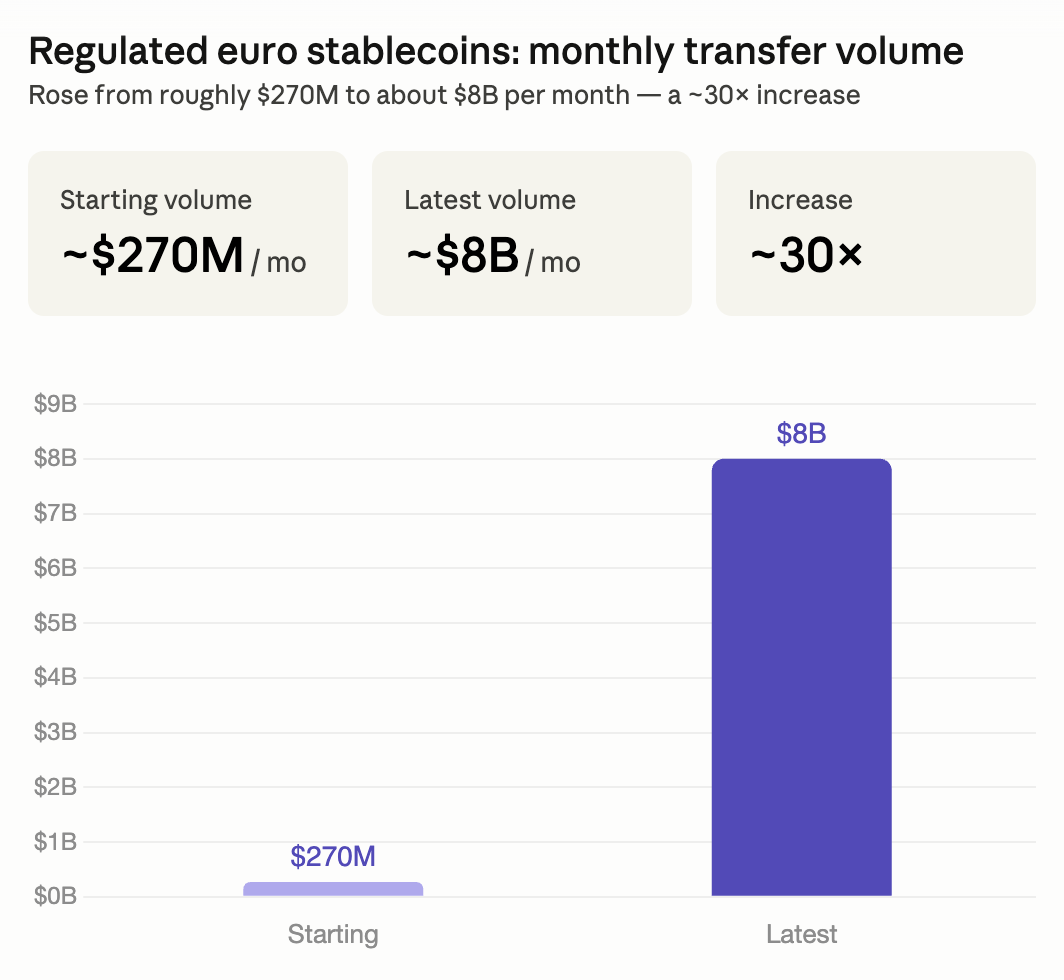
Euro-pegged tokens total about $802.9M on DefiLlama, making the euro the largest non-dollar peg by a wide margin (DefiLlama). Circle’s EURC leads, followed by Société Générale-Forge’s EURCV, Banking Circle’s EURI and Monerium’s EURe. AllUnity, backed by DWS, Galaxy and Flow Traders, issues EURAU but is still small (AllUnity).
Qivalis: the bank consortium coin
Qivalis is an Amsterdam-based joint venture that has grown to 37 European banks. It told CoinDesk in September 2026 that it is close to securing an e-money licence from De Nederlandsche Bank and aims to launch before the end of 2026 (CoinDesk). No token has been issued yet. We covered its choice of public Ethereum in our Qivalis report.
Japan: Trust Banks, JPYC and the Megabanks
Japan has three distinct yen stablecoin tracks. JPYC is issued as an electronic payment instrument redeemable for yen, with about $24.0M in circulation (DefiLlama). JPYSC, a trust-type coin issued by SBI Shinsei Trust & Banking, is larger at about $127.3M (DefiLlama).
The third track is the big banks. On June 10, 2026, MUFG Bank, Mizuho Bank and Sumitomo Mitsui Banking Corporation said they aim to conduct live commercial transactions during fiscal year 2026 with a stablecoin issued under a trust structure, and signed a memorandum to set up a council on operations and governance (MUFG). The project grew out of an FSA-supported proof of concept, and the trustee has not yet been chosen (Ledger Insights).
Singapore and Hong Kong
StraitsX issues XSGD, a Singapore dollar stablecoin, with about $12.9M in circulation (DefiLlama). The Monetary Authority of Singapore opened a consultation on legislative amendments to implement its stablecoin framework in September 2026 (MAS).
In Hong Kong, the HKMA granted the first stablecoin issuer licences to Anchorpoint and HSBC on April 10, 2026 (HKMA). Anchorpoint’s HKD stablecoin HKDAP is live but tiny so far, at about $0.13M (DefiLlama).
Emerging Markets: Brazil, Turkey and Beyond
Brazil’s BRLA, issued by Avenia, is connected to the PIX instant payment system, which lets users move between reais in a bank account and the token. Its supply is about $32.0M (DefiLlama). In Turkey, BiLira’s TRYB has about $8.1M in circulation (DefiLlama).
The ruble is a special case. A7A5 is the largest non-dollar stablecoin by supply at about $464.6M (DefiLlama), but it has been designated by the US and UK and banned by the EU because of its links to sanctions evasion. See our A7A5 explainer for the details. Excluding it, the non-dollar market is closer to $1.1B.
Why Non-Dollar Stablecoins Stay Small
- Dollar demand: most stablecoin use outside the US is about getting dollar exposure, which a local-currency coin cannot offer.
- Liquidity: trading pairs, DeFi pools and exchange listings are concentrated in USDT and USDC, so non-dollar coins face wider spreads.
- Reserve markets: issuers need deep, liquid short-term government debt or bank deposits in the currency they back, and few markets match US Treasuries.
- Regulation: licensing takes time, and rules differ between MiCA, Japan, Singapore and Hong Kong, which makes multi-market coins harder to run.
What to Watch for the Rest of 2026
- Whether Qivalis receives its Dutch licence and launches before year end (CoinDesk).
- Progress on the Japanese megabank coin ahead of the March 2027 deadline (MUFG).
- Singapore’s final legislation after the MAS consultation (MAS).
- US GENIUS Act rules: Treasury proposed issuance rules in August 2026 (Federal Register), which will shape how foreign and non-dollar issuers can reach US users.
Conclusion
Multi-currency stablecoins are growing from a very small base. The euro group is the most established thanks to MiCA, Japan is moving from startups to its largest banks, and Hong Kong and Singapore now have licensing regimes. But the numbers are a reminder of scale: all non-dollar coins together are worth less than one mid-sized dollar stablecoin. The developments worth watching are bank-issued coins with real payment integrations, not headline supply.
FAQs:
1. What is a multi-currency stablecoin?
In this report, the term means stablecoins pegged to currencies other than the US dollar, such as the euro, yen or real. A few projects also offer baskets, which MiCA treats as asset-referenced tokens.
2. What is the largest euro stablecoin?
Circle’s EURC, with about $456.5M in circulation in September 2026 (DefiLlama).
3. Are Japanese banks issuing a yen stablecoin?
MUFG, SMBC and Mizuho plan live transactions with a jointly issued yen stablecoin by March 2027. It has not launched yet.
4. Why is the ruble in the non-dollar total?
Because DefiLlama tracks A7A5, a sanctioned ruble-linked token. It accounts for a large share of non-dollar supply.
5. Will non-dollar stablecoins catch up with USD coins?
Not soon. They are growing, but dollar coins hold about 99.5% of supply and benefit from deeper liquidity and demand for dollars.
Related Reports
Partner/Advertise with Stablecoin Insider
Fill out this form to partner and advertise on the only publication, dedicated entirely to the Stablecoin ecosystem.

)