Table of Contents
If Q1 was acceleration, Q2 was graduation.
The stablecoin market entered April as a fast-growing crypto vertical and exited June as mainstream institutional financial infrastructure.
Here's your quarter in review.
The Numbers That Matter
- Total stablecoin supply hit a record of about $322 billion on May 17 (DefiLlama).
- Supply opened Q2 above $315 billion, first topped $320 billion on April 18, and closed June near $311 billion (DefiLlama).
- USDC surpassed USDT in adjusted transaction volume for the first time ever.
- Open USD's June 30 unveiling put Visa, Mastercard, Stripe and BlackRock behind a zero-fee rival to USDC.
- Tokenized Treasuries kept growing, led by BlackRock's BUIDL.
- Tron dominated retail transactions; Solana grew fastest in institutional payments.
The Story of the Quarter: Open USD
On June 30, the Open Standard consortium unveiled Open USD (OUSD) with 140+ founding partners such as Visa, Mastercard, Amex, Stripe, BlackRock, Coinbase, Google, Shopify, DoorDash, BNY Mellon, Ripple, and more.

The model: zero-fee mint and redeem, with reserve yield shared among partners. Stripe committed to OUSD as the default stablecoin for Stripe-powered businesses. Circle stock fell 18% on the news (Crypto Briefing).
The stablecoin race is now an ecosystem contest and every payment network has to pick a side.
Regulation: Two Deadlines Reshaped the Map
United States.
GENIUS Act implementation dominated the quarter.
The FDIC approved its proposed PPSI rulemaking April 7; FinCEN and OFAC followed April 8 with full BSA/AML and sanctions obligations for issuers; and on June 22, five agencies jointly proposed Customer Identification Program rules.
All eyes now turn to the July 18 statutory deadline for final federal rules.
Europe.
MiCA's transition period ended July 1 with no extensions.
Coinbase, Kraken, Crypto.com, and Binance's EU entity all delisted or restricted USDT spot trading for EU users, the largest European delisting wave in history.
USDC, EURC, EURI, and EURCV are fully authorized; ~12 euro EMTs across 14 issuers now operate under MiCA. The Bank of England also published draft rules with an aggregate issuance guardrail and a 2027 target.
Launches & Institutional Moves
- SoFiUSD (with Paxos) - first branded stablecoin from a US national bank charter holder.

- USAT - Revolut US with Anchorage Digital, the first neobank bank-license-backed stablecoin.
- EURXT - Crédit Agricole's MiCA-compliant euro stablecoin via CACEIS, live on Ethereum.
- USDPT - Western Union and Crossmint put a legacy money transfer giant on stablecoin rails.
- Reserve funds arrived as an asset class: Fidelity (June 19), State Street's SSCXX (June 17), and Invesco (filed June 26) all launched GENIUS Act-aligned stablecoin reserve money market funds in a single month.
- RLUSD went live in Japan June 25 as the first Type 4 electronic payment instrument, and Ripple invested in Flutterwave to embed RLUSD in African payment flows.
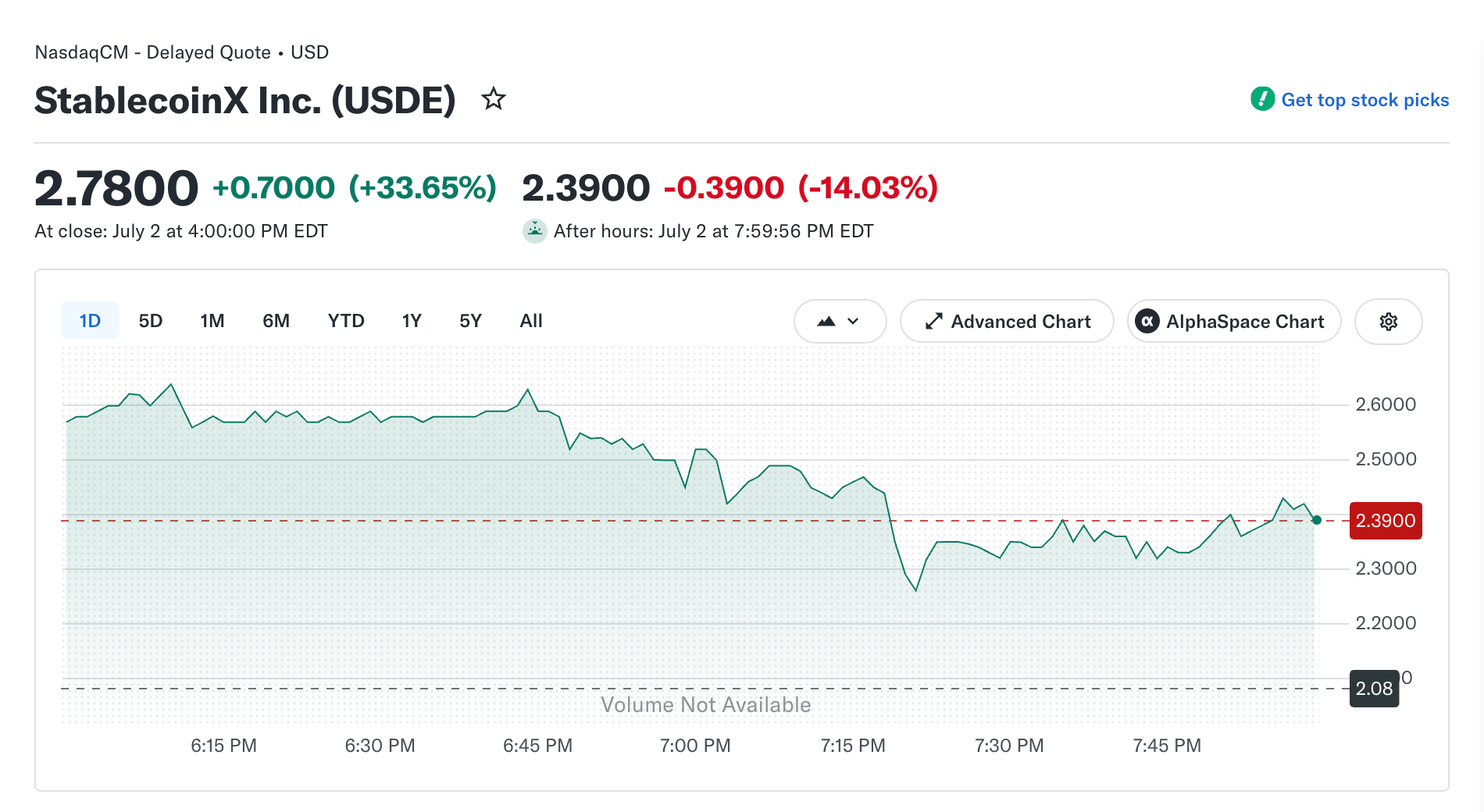
- StablecoinX began trading on Nasdaq (ticker: USDE) June 26.
- MetaMask launched its Money Account, pairing yield on mUSD with Mastercard spending.
- Japan's three megabanks (MUFG, SMBC, Mizuho) signed an MOU for a joint yen stablecoin targeting March 2027.
Funding Roundup: Capital Chased the Rails, Not the Coins
Q2's venture money went almost entirely to infrastructure with corridors, clearing, and issuance rails rather than consumer apps:
- Rain's $250M Series C at a $1.95B valuation, closed in January as its third round in under a year, set the tone and cemented stablecoin card issuance as one of fintech's hottest categories (Crunchbase News).

- Fasset raised a $51M Series B (SBI Group, Investcorp, Arz Portföy) to expand its stablecoin-powered neobank across Asia, Africa, and the Middle East (Fasset).
- Trace Finance closed a $32M Series A led by CoinFund for regulated Brazil–US corridor banking (Trace).
- JPYC secured ~¥5 billion in its Series B, targeting mass adoption of the yen stablecoin and machine-to-machine payments (FinTech Observer).
- Daya pulled in a $2.4M pre-seed led by Hivemind Capital for African stablecoin rails, and Y Combinator began letting startups take their funding in stablecoins starting Spring 2026 (Unchained).
The pattern is unmistakable: investors have moved from consumer crypto to enterprise backbone, the picks and shovels of the digital dollar economy.
M&A and Public Markets: Consolidation Season Opens
- StablecoinX became the first publicly listed stablecoin infrastructure company, trading on Nasdaq under ticker USDE since June 26 with ~3 billion ENA in treasury.
- Ripple's investment in Flutterwave was the quarter's biggest strategic deal, less an investment than a distribution play that embeds RLUSD in African payments.
- The macro backdrop helps: cheap exits and expensive entries favor sellers in this category, so expect more consolidation.
What to Expect in Q3
July 18:
Six US federal agencies must publish final GENIUS Act rules with capital, reserves, liquidity, redemption. The single most consequential regulatory date of the year.
MiCA fallout:
Watch USDT liquidity fragment between regulated EU venues and offshore/DeFi markets; a two-tier market is forming.
Open USD's rollout:
Can 140 partners govern one product? Q3 is the first real test, and the first supply numbers will tell us whether OUSD is a USDC-killer or a press release.
August 20:
Wyoming's WYST targets mainnet as the first state-issued stablecoin under the finalized federal framework. Italy's EUR.BANK pilot also kicks off.
The growth question:
Supply dipped in June after May's record. Q3 flows will show whether bank and Fortune 500 entries can restart growth.
Q2 2026 will be remembered as the quarter stablecoins stopped asking for permission.
Q3 decides who wins.
FAQ
How big was the stablecoin market in Q2 2026?
Total stablecoin supply hit a record of about $322 billion on May 17 and closed June near $311 billion, according to DefiLlama.
What was the biggest stablecoin story of Q2 2026?
The June 30 unveiling of Open USD (OUSD) by the Open Standard consortium, backed by partners including Visa, Mastercard, Stripe, BlackRock and Coinbase, with zero-fee mint and redeem and reserve yield shared among partners.
Which regulatory deadlines shaped Q2 2026?
In the US, GENIUS Act rulemaking from the FDIC, FinCEN, OFAC and a joint Customer Identification Program proposal ran toward the July 18 deadline for final rules. In Europe, MiCA's transition period ended July 1, and major exchanges delisted or restricted USDT for EU users.
Related Reports
Partner/Advertise with Stablecoin Insider
Fill out this form to partner and advertise on the only publication, dedicated entirely to the Stablecoin ecosystem.
See you next week,
- The Stablecoin Insider team