
Table of Contents
Take a look at the stablecoin ecosystem right now and you’ll notice a familiar pattern repeating.
Everyone talks about “programmability” and “adoption,” but most flows still run through the same two or three tokens.
Then something like USDF lands, and the conversation quietly shifts.
On May 20, Coinbase and Flipcash launched the first live custom stablecoin on Coinbase’s new issuance platform.
It’s a small moment with large implications.
USDF is a Solana-native token, 1:1 backed by USDC, purpose-built as the settlement layer for Flipcash’s community currency system. Founded by Ted Livingston of Kik, Flipcash lets users mint and trade fixed-supply tokens.
Until now, those tokens needed an external dollar anchor. USDF brings that anchor inside the house.
What matters is what it represents: the beginning of a layer where brands and platforms stop renting someone else’s money and start issuing their own without having to become full reserve managers or compliance shops.
This newsletter was sponsored by Rise Payroll

What USDF Actually Changes
For most applications, USDC and USDT have been good enough.
They move value, they’re liquid, and everyone already holds them. But they offer zero differentiation. No branding. No native loyalty mechanics. No ability to tune the economics of your own closed loop.
USDF flips that equation. Users inside Flipcash now price, buy, and settle community tokens in an asset that feels native to the platform while staying fully redeemable into USDC.
The branding belongs to Flipcash. The operational burden belongs to Coinbase. That division of labor is the real product here.
It’s early, but it's clear what's coming next.
Companies that once integrated USDC as a neutral rail are now asking whether they should own a branded version layered on top of it.
How Coinbase’s Custom Stablecoin Platform Actually Works
A partner gets their own branded stablecoin, fully backed by USDC (and potentially other USD assets later). Coinbase handles issuance, redemption, custody, smart contracts, compliance, and multi-chain operations. The partner focuses on distribution, user experience, rewards, and product integration.
What comes with it?
- Permissionless on-chain swaps back to base USDC
- API access for minting, burning, and treasury functions
- Multi-chain support (Solana first, with Base and others expected)
- Shared regulatory posture under Coinbase’s institutional framework

This compresses what used to be a multi-year, high-capital project into something measured in months.
That speed is attractive, but it comes with necessary trade-offs.
You gain credibility and infrastructure, yet you inherit dependence on Coinbase and Circle’s rails. Your token is only as strong as their reserve management and regulatory standing.
Why This Wave Is Building in Mid-2026
The timing is not accidental. GENIUS Act rulemaking is clarifying the guardrails. Infrastructure has matured enough that issuance no longer requires building everything from scratch. And market demand is shifting toward more controlled experiences.
Generic stablecoins solved the “how do I get dollars on-chain” problem. Custom stablecoins address the next layer: “How do I make dollars work harder inside my ecosystem?”
Early signals suggest more are coming. Mentions of Solflare and R2 exploring similar paths indicate this is not a one-off experiment.
Custom vs. Traditional Stablecoins: Where the Real Trade-offs Live
It’s tempting to frame this as replacement. It isn’t. It’s layering.
Traditional stablecoins (USDC, USDT) remain unmatched for open-market liquidity, broad treasury use, and neutral global transfers. Custom stablecoins trade some of that openness for tighter control and product depth.
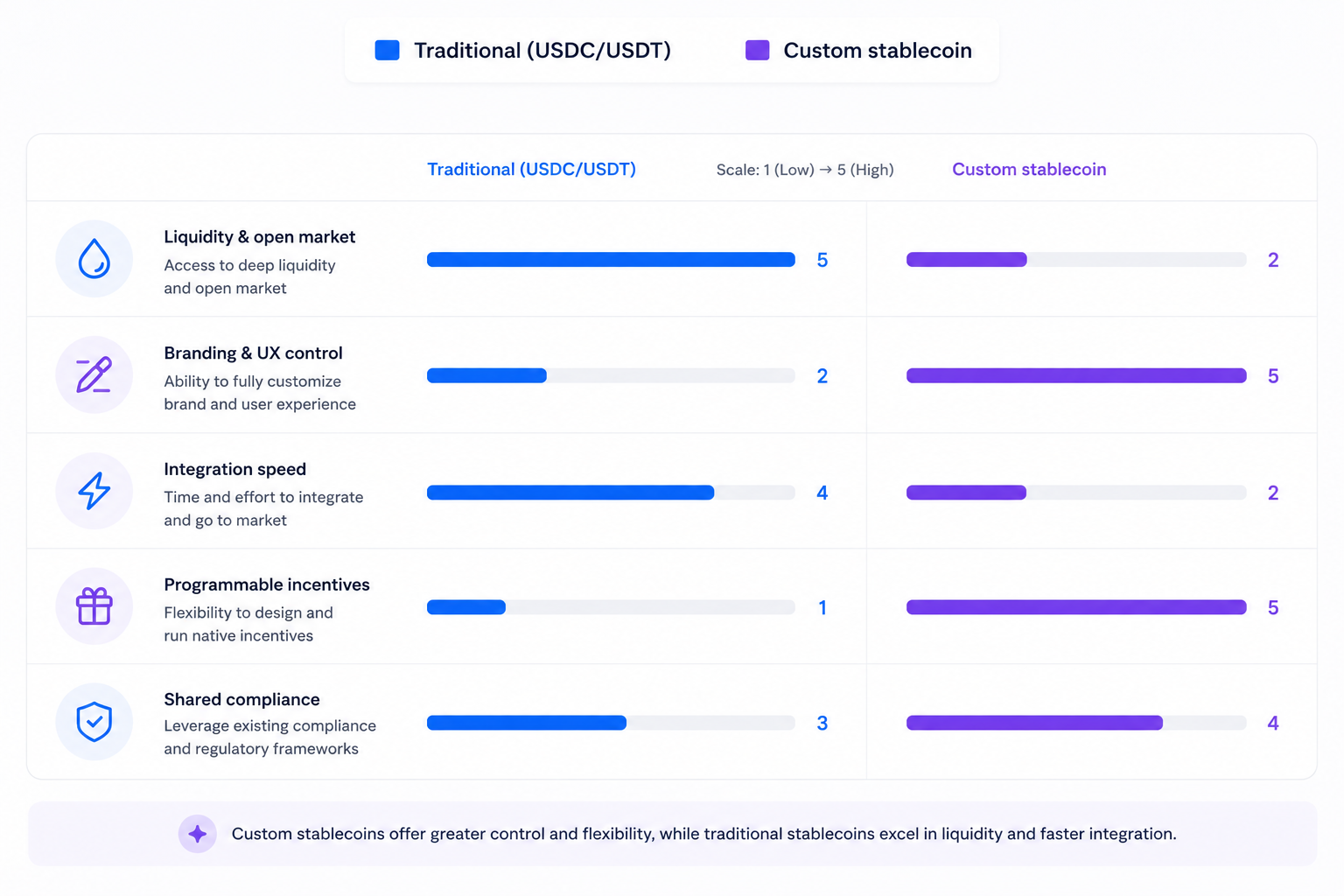
Here’s how they compare in practice:
- Branding & User Experience: Traditional offers neutral rails with no ownership. Custom delivers a fully branded dollar that strengthens identity and retention.
- Economic Control: Traditional provides limited ability to embed incentives. Custom allows programmable loyalty, rewards, cashback, or gated mechanics.
- Time & Cost: Traditional wins on instant integration. Custom requires more upfront coordination but far less than independent issuance.
- Compliance & Risk: Traditional keeps the burden on the user. Custom shares it with Coinbase while still exposing partners to GENIUS Act outcomes.
- Best Use Cases: Traditional dominates open flows and cross-border. Custom shines in closed-loop systems, community platforms, and enterprise-specific workflows.
The smartest teams won’t choose one over the other. They’ll use both (generic for liquidity, custom for differentiation).
What This Means for Institutional Readers and Builders
For allocators and corporate treasurers, the question is no longer just “which stablecoin has the best liquidity?” It’s becoming “which parts of our stack should be generic versus proprietary?”
Founders should treat custom stablecoins as a strategic option, but not the default.
They work best when you have real transaction density, retention challenges, or the ability to create meaningful closed-loop economics. Without that, you’re adding complexity for marginal gain.
The next 12-18 months will test how many of these custom tokens actually find product-market fit versus becoming vanity experiments. Those that succeed will likely sit on top of strong base stablecoins rather than trying to replace them.
The generic era delivered accessibility. The custom era tests whether companies can turn money itself into a competitive advantage.
Upcoming Events
Related Reports
- Is All Stablecoin Infrastructure Actually the Same?
- Q1 2026 Stablecoin Report: Acceleration Continues
Partner/Advertise with Stablecoin Insider
Fill out this form to partner and advertise on the only publication, dedicated entirely to the Stablecoin ecosystem.
See you next week,
- The Stablecoin Insider team