Table of Contents
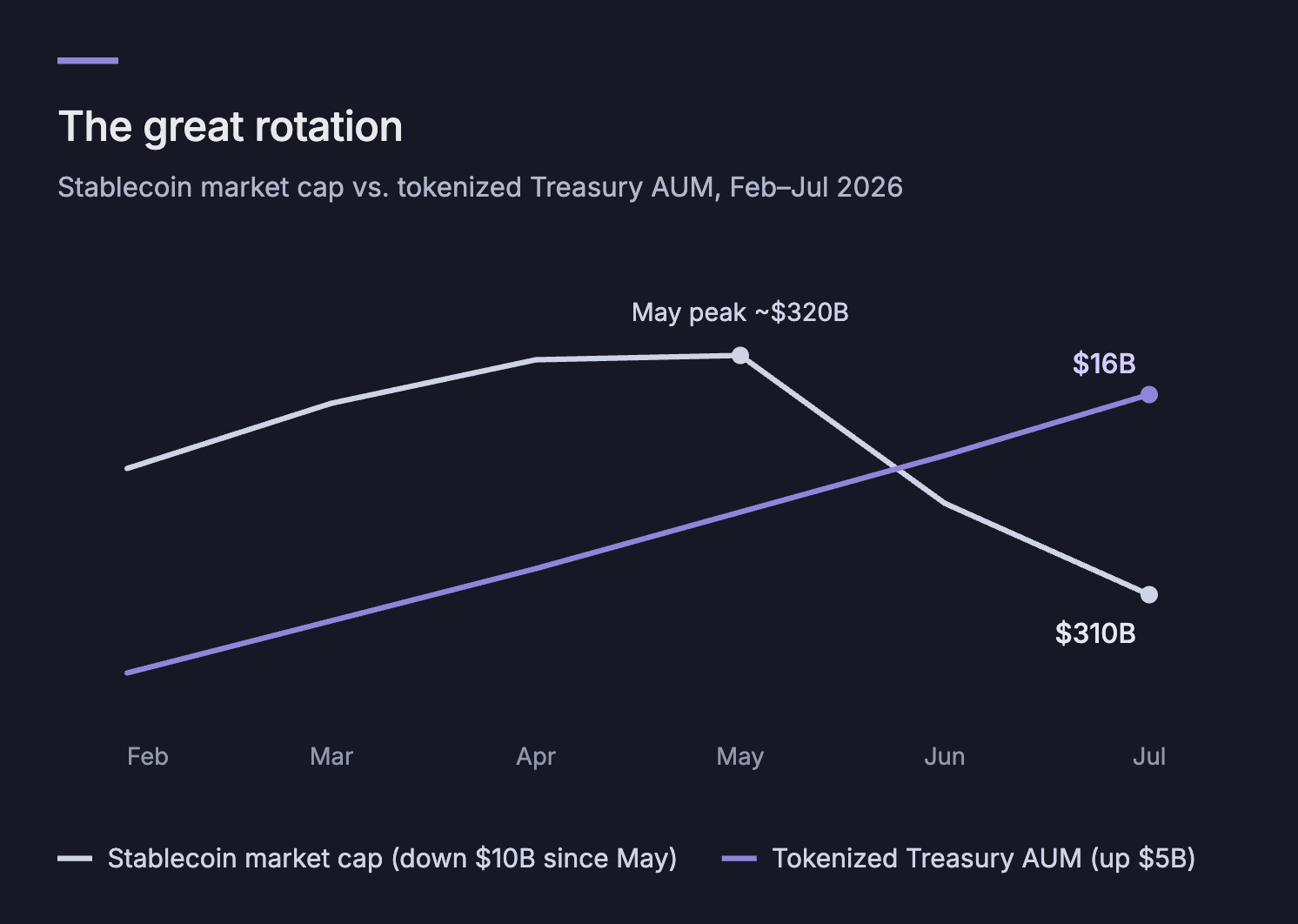
The total stablecoin market cap has contracted to roughly $310 billion, down more than $10 billion from its May peak, the largest monthly decline since the Terra collapse in May 2022.
If that's all you saw, you'd call it a retreat. It isn't.
Over the same period, adjusted stablecoin transaction volume hit $1.79 trillion in June, up 63% month-over-month.
Velocity, a measure of how hard each dollar works, has been climbing since Q4 2025.
The balance sheet is shrinking while throughput explodes.
What's actually happening: a yield-driven rotation, not an exit.
The GENIUS Act's ban on issuers paying interest on payment stablecoins did exactly what the banking lobby hoped and exactly what treasurers should have expected: idle balances went looking for yield. They found it next door.
- Tokenized Treasury products grew from $11 billion to $16 billion in five months
- Circle's USYC has overtaken BlackRock's BUIDL as the segment's largest fund. BUIDL itself sits near $2.9 billion across Ethereum, Avalanche, and Solana, after nearly doubling its Avalanche AUM in a single week in July
- JPMorgan's competing product grew 87% in one month
Meanwhile the losses aren't evenly distributed.
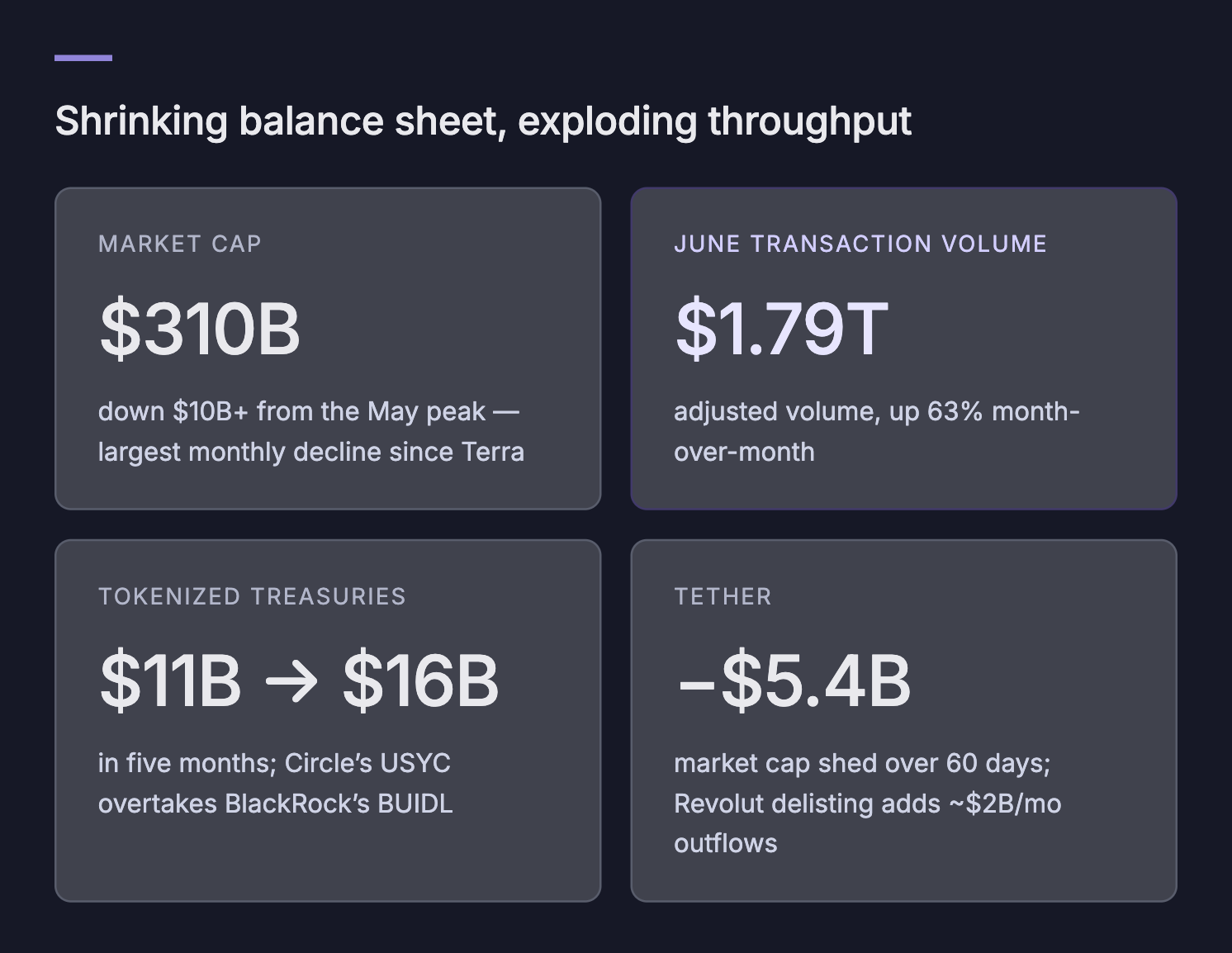
Tether has shed roughly $5.4 billion in market cap over 60 days, and Sky Dollar (USDS) has led weekly percentage declines among the top 15.
One idiosyncratic accelerant: Revolut's USDT delisting triggered an estimated $2 billion in monthly outflows ahead of its August 31 deadline.
The takeaway for treasurers:
Stablecoins are specializing.
The "park cash and wait" use case is migrating to tokenized money-market funds. What remains in stablecoins is working capital: payments, settlement, FX.
A smaller, faster stablecoin market is not a weaker one.
But if you're benchmarking counterparty exposure by market cap alone, you're now measuring the wrong thing.
Stablecoin market cap (down $10B since May) vs. tokenized Treasury AUM (up $5B in five months), plotted on the same timeline. One line falls as the other rises.
INSTITUTIONAL BLOCK
Visa just became a stablecoin issuer's back office
Visa launched the Visa Stablecoin Platform (VSP), a managed environment where banks, fintechs, and crypto firms can mint, redeem, hold, and transfer stablecoins through a single interface.
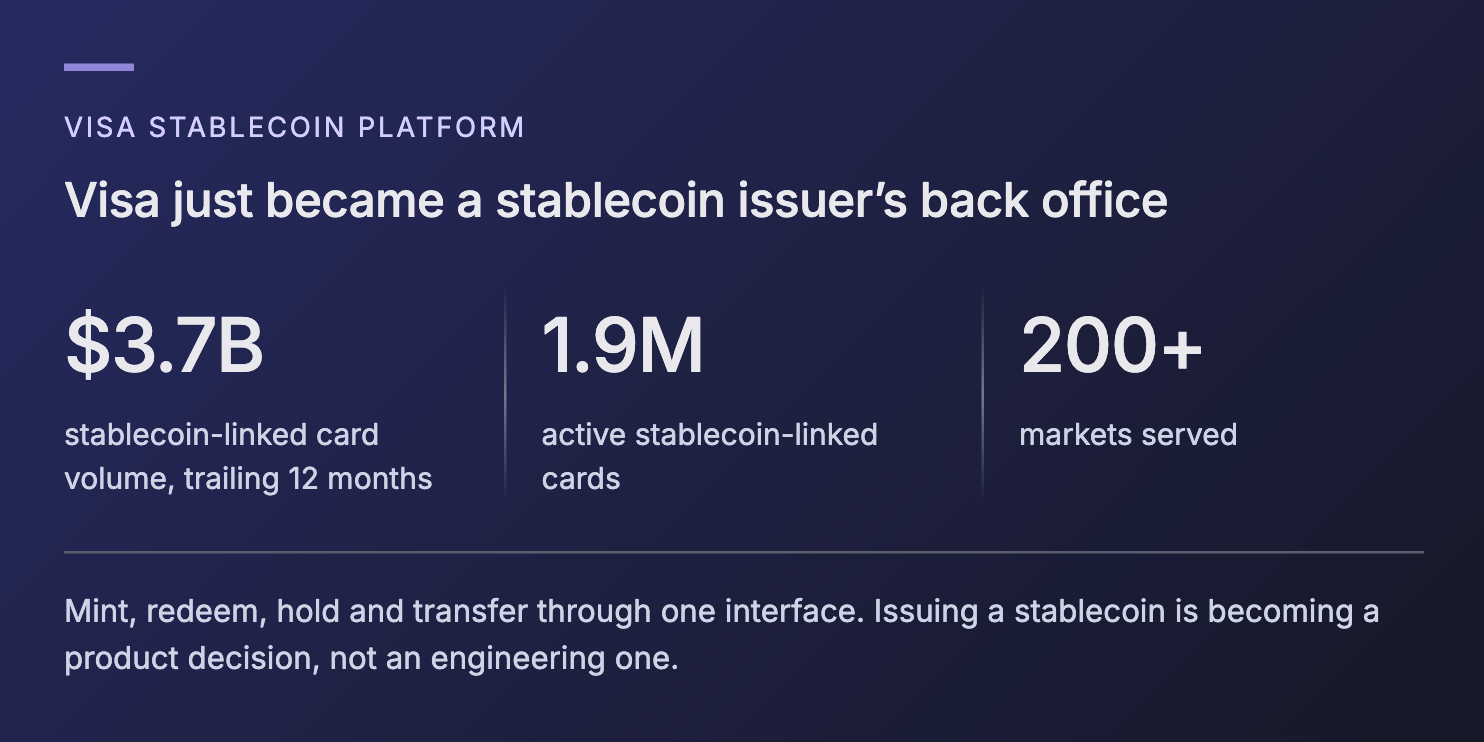
It landed alongside a telling disclosure: Visa has processed $3.7 billion in stablecoin-linked card volume over the trailing twelve months, across 1.9 million active cards in 200+ markets.
The pattern to watch: the infrastructure layer is consolidating around incumbents. Issuing a stablecoin is becoming a product decision, not an engineering one.
The yield war goes to Washington
Goldman Sachs CEO David Solomon broke ranks with banking trade groups to back the Digital Asset Market Clarity Act, while the Bank Policy Institute and five other associations formally opposed it, warning that interest-like yields on stablecoins "will siphon commercial bank deposits." Senate Majority Leader John Thune confirmed no market-structure vote before the August recess.
Follow the incentives: the fight over the Clarity Act is really a fight over who gets to pay yield on dollars. (See lead story for what happens when the answer is "nobody.")
DEALS & FUNDING
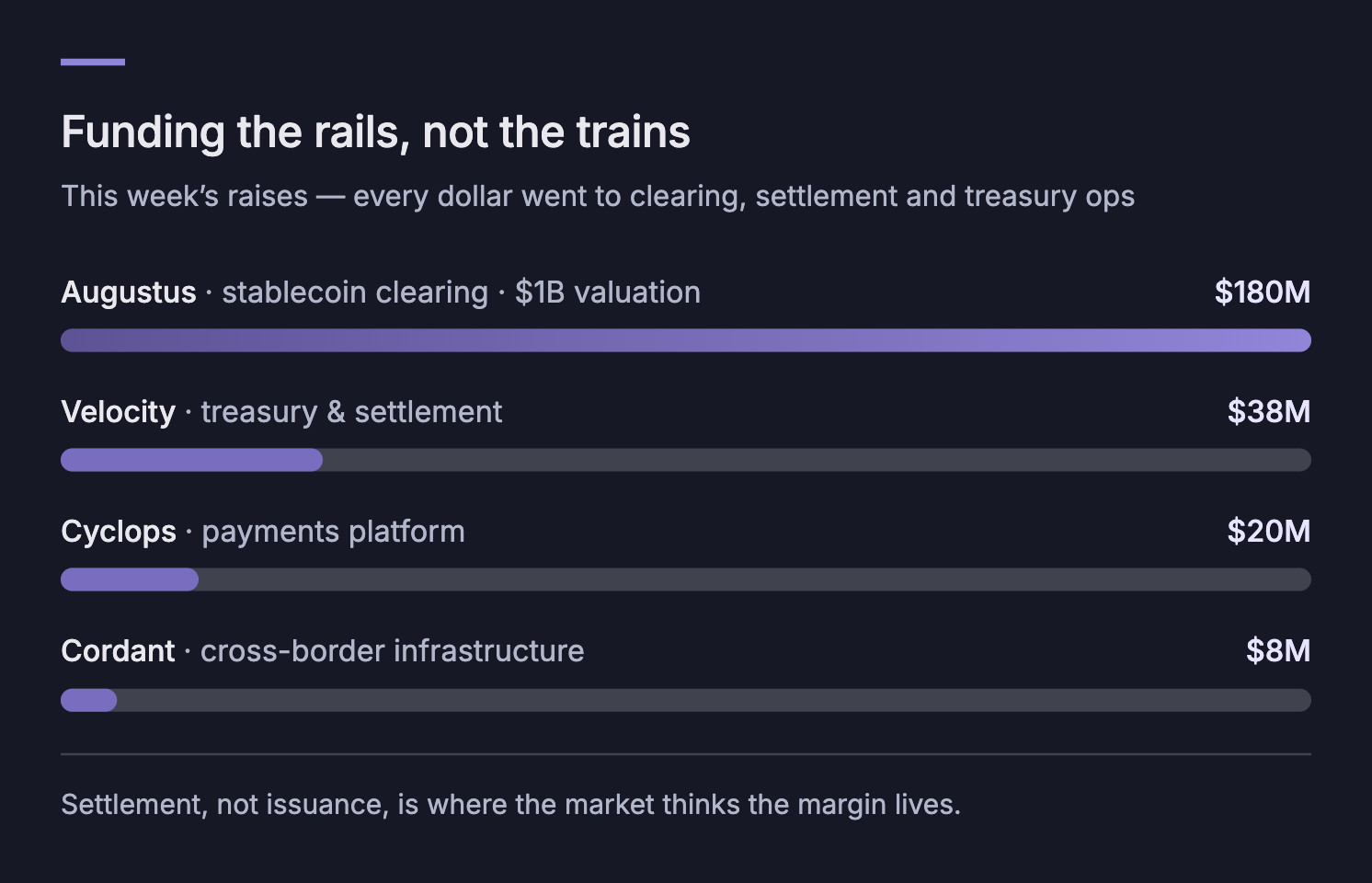
- Augustus, $180M at a $1B valuation. The stablecoin clearing bank's round was led by Tiger Global, with QED, Hummingbird, and founders from Nubank, Ramp, Circle, and Deel participating. Augustus is building 24/7 programmable stablecoin settlement between traditional payment rails and blockchains, and already serves Kraken. A billion-dollar valuation for a clearing layer says the market believes settlement, not issuance, is where the margin lives.
- Velocity, $38M Series A. The London-based stablecoin treasury and settlement platform was co-led by Dragonfly and FirstMark, with Capital One Ventures, QED, Coinbase Ventures, Wintermute, and Ripple joining. Roughly $50M raised since its May 2025 founding.
- Cyclops, $20M to scale its stablecoin platform for payments firms.
- Cordant, $8M seed for stablecoin and digital asset infrastructure serving banking and cross-border payments.
- M&A corner: Mirae Asset completed its acquisition of a 92% stake in Korean exchange Korbit for 133.4 billion won, and SBI Holdings won regulatory approval to acquire Singapore's Coinhako. Korean exchanges are becoming acquisition hotspots ahead of the Digital Asset Basic Act (see below).
The through-line: nearly every dollar raised this week went to plumbing (clearing, settlement, treasury ops) rather than new coins. Investors are funding the rails, not the trains.
RISK WATCH: WEMIX$ goes to zero
Wemade's WEMIX$ stablecoin collapsed from $1 to $0.0008 after a smart-contract breach enabled unauthorized minting of roughly $5.2 million in tokens.
Your periodic reminder that reserve quality and contract security are different risks. WEMIX$ didn't fail because the backing was bad. It failed because the mint function was. Reserve attestations tell you nothing about code.
INTERNATIONAL QUICK HITS
- South Korea: E-commerce giant Coupang and Woori Bank announced a won-backed stablecoin partnership for real-time merchant payouts, while the FSC consolidates 10 pending crypto bills into a single Digital Asset Basic Act.
- Tether goes multichain with USAT: The GENIUS-compliant stablecoin launched on Celo, its first deployment beyond Ethereum.
- Vanuatu appointed Jackson Miake as its first Commissioner of Stablecoins. Small jurisdiction, notable precedent: a dedicated stablecoin regulator, not a crypto regulator.
- Europe: Banque de France leaned into digital-euro deployment explicitly as a counter to stablecoin growth, citing the roughly $300B market.
REGULATORY RADAR
One year after the GENIUS Act became law, final rules are still pending. This week's movements:
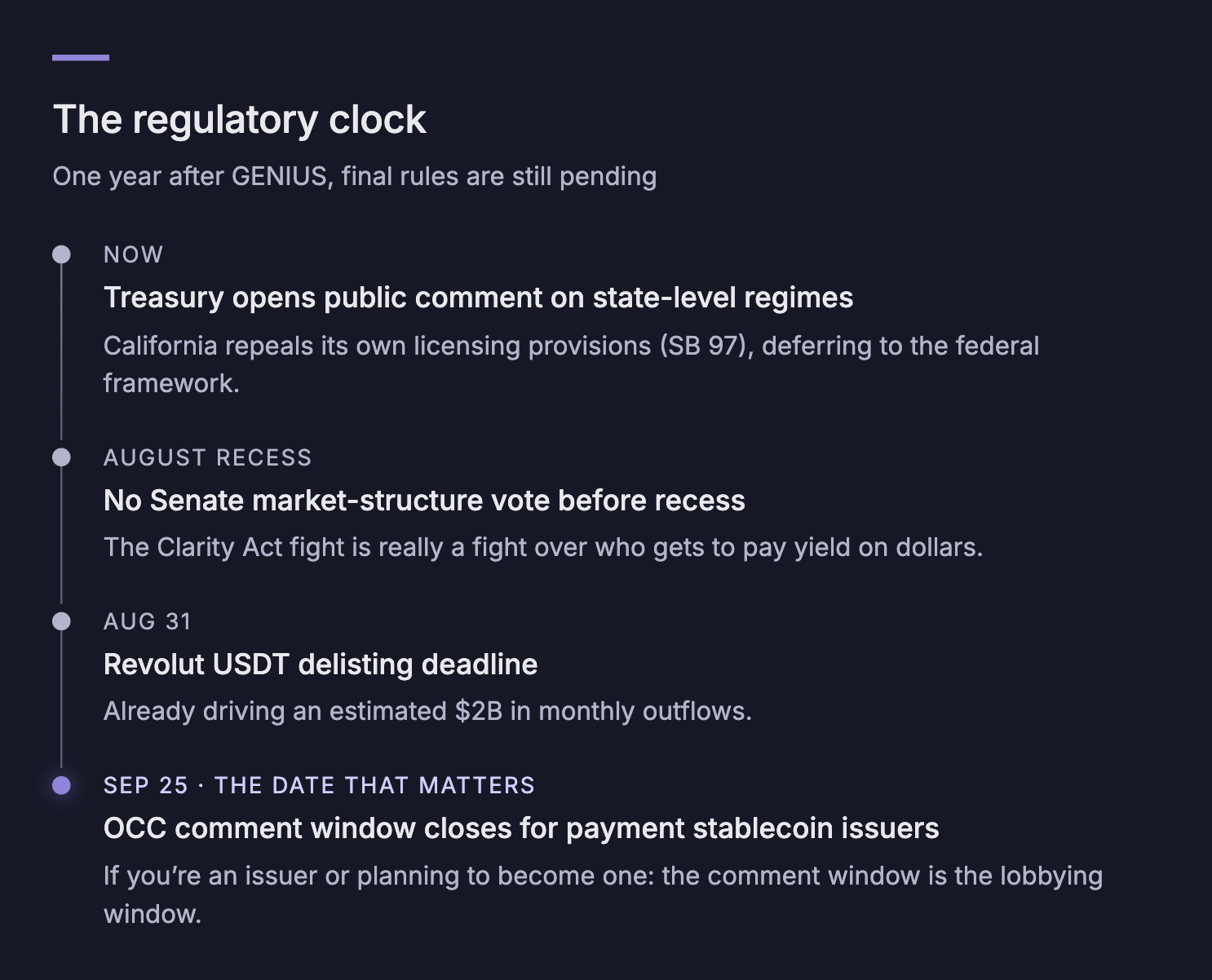
- Treasury opened public comment on its proposed rulemaking for state-level regulatory regimes
- The OCC published proposed application and information requirements for payment stablecoin issuers. Comment window closes September 25
- California repealed its own state stablecoin licensing provisions (SB 97), deferring to the incoming federal framework
If you're an issuer or planning to become one: the comment window is the lobbying window. September 25 is the date that matters.
ALSO WORTH KNOWING
- Samsung demoed USDC send and receive in Samsung Wallet at Galaxy Unpacked. Over 1B devices of potential reach, but no launch date. Demo is not distribution.
- Circle acquired 680+ patent families from IBM's blockchain portfolio, becoming the largest US holder of blockchain IP, the same week Bernstein cut its CRCL target to $140 on soft USDC supply growth.
- BIS Project Agorá: 28 global banks settled a live cross-border test across six currencies in roughly 80 seconds average.
Related Reports
Partner/Advertise with Stablecoin Insider
Fill out this form to partner and advertise on the only publication, dedicated entirely to the Stablecoin ecosystem.
See you next week,
- The Stablecoin Insider team