Table of Contents
Africa is where stablecoin payments stopped being a thesis and became plumbing, and the providers serving it are not interchangeable in the way a vendor list usually implies.
The hard part was never moving a dollar token. It is the last mile, meaning whether a provider can actually put local currency into a specific mobile money wallet in a specific country, or take it out again.
So this compares six providers on that axis rather than on chain support, which is close to solved across all of them. Who reaches which rail, under which licence, and what each one openly does not do.
Chain coverage is not the differentiator. The question is whether a provider terminates into the mobile money network your counterparties actually use, and whether it is licensed to do so.
Key Takeaways
- Mobile money reach, not chain support, separates these providers.
- Yellow Card spans 50-plus fiat currencies and 30-plus chains.
- Onafriq claims 40-plus markets and a billion mobile wallets.
- Kotani Pay specialises narrowly in last-mile payouts.
- Almost none of them publishes fees or settlement times.
What Separates a Ramp From an Exchange
Three capabilities decide whether something is genuinely a ramp for a business, and plenty of listings conflate them.
The first is local termination, meaning a payout that lands in a named bank or mobile money account rather than in a wallet the recipient must then manage. The second is programmatic access, since a business moving money weekly needs an API and a sandbox rather than a trading screen.
The third is a licence that covers the activity in the market being served, which in this region is where most of the operational risk sits. Identity verification is the related constraint, and our analysis of whether stablecoins have a KYC problem covers why proof-of-address rules designed elsewhere fail across much of the continent.
What to note: a provider that can only deliver into a self-custody wallet has solved the easy half of the problem.
Best Stablecoin Ramps in Africa
1. Yellow Card
Does the job: the broadest pan-African coverage with a documented API.
Yellow Card positions itself as digital asset and fiat payment infrastructure for Africa and emerging markets, and the documentation is the most complete of the group.
- More than 50 fiat currencies, with USD, Nigerian naira and Kenyan shilling named
- USDT and USDC plus other stablecoins, moving across more than 30 blockchains including Ethereum, Tron and Solana
- Collections and payouts as distinct documented flows, plus custodial and custom wallets
- Use cases spanning remittances, supplier payments and local currency acceptance
- Global USD payments and invoice settlement described as reaching nearly 200 countries
Two caveats. Virtual USD and EUR accounts are marked as coming soon rather than live, and neither fees nor settlement times are published, so pricing is a sales conversation.
Best for businesses wanting one integration across many African markets, and our Yellow Card review goes deeper on the stack.
2. Onafriq
Does the job: the incumbent payment network, now settling in stablecoins.
Onafriq is the opposite profile to a crypto-native ramp, being an established African payments gateway that added stablecoin settlement rather than the reverse.
- A network spanning more than 40 African markets
- Claimed reach of around a billion mobile money wallets and 500 million bank accounts
- More than 400,000 agents in Nigeria
- Domestic and cross-border disbursements and collections, card issuing, agency banking and treasury services
- A Circle partnership piloting USDC-powered settlement inside that network
The reach figures are the company's own and describe addressable endpoints rather than live stablecoin corridors, which is an important distinction when the USDC work began as a pilot.
Best for businesses that need distribution breadth and are comfortable buying from an incumbent rather than a specialist.
3. Conduit
Does the job: the treasury and corridor layer behind other providers.
Conduit sits one level up from the last mile, which is why it appears as a supplier to networks rather than as a consumer brand.
- Cross-border payments built on dollar tokens, with the product launched in 2023
- African customer count reported up 80% between the third and fourth quarters of 2025
- Used for funding accounts and rebalancing treasury holdings
- Payouts to partners abroad, and converting USDC into dollars through off-ramp channels
- A single provider fee rather than the stacked intermediary fees of a correspondent banking route
It is not a local termination provider on its own, and the companies themselves note that stablecoin rails still need local banking partners to reach domestic systems.
Best for treasury movement and corridor settlement rather than paying an individual in local currency.
4. Kotani Pay
Does the job: last-mile mobile money payouts, deliberately and only.
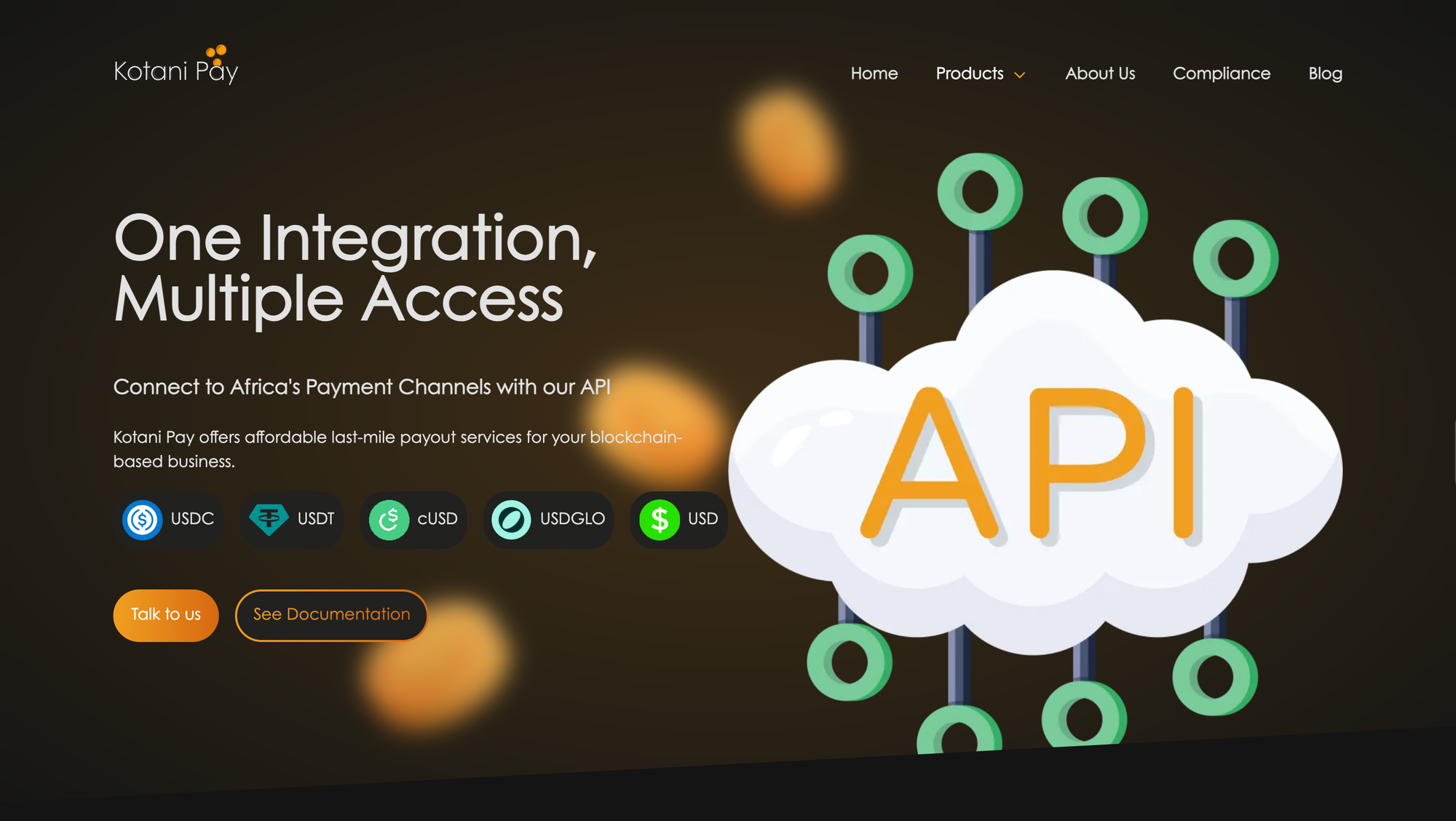
Kotani Pay describes itself as last-mile payout services for blockchain-based businesses, and the narrowness is the product rather than a limitation.
- Currencies named include the Kenyan shilling, Ghanaian cedi and Central African franc
- Stablecoins USDC, USDT, cUSD and USDGLO
- Chains including Polygon, Celo, Optimism, Stellar, Arbitrum, Avalanche, Cardano, Lisk and the Lightning Network
- Mobile money as the named payout rail, with a white-label API
- Onboarding covering identity checks, business verification, anti-money-laundering screening and legal agreements
- Registration as a Financial Service Provider with South Africa's conduct authority under licence 53594
Note a small documentation inconsistency, since a heading claims more than fifteen supported chains while the page lists ten. No fees, limits or settlement times are published.
Best for protocols, gig platforms and NGOs that need money to arrive in a phone wallet rather than a crypto wallet.
5. Fonbnk
Does the job: consumer-side ramping where bank access is the obstacle.
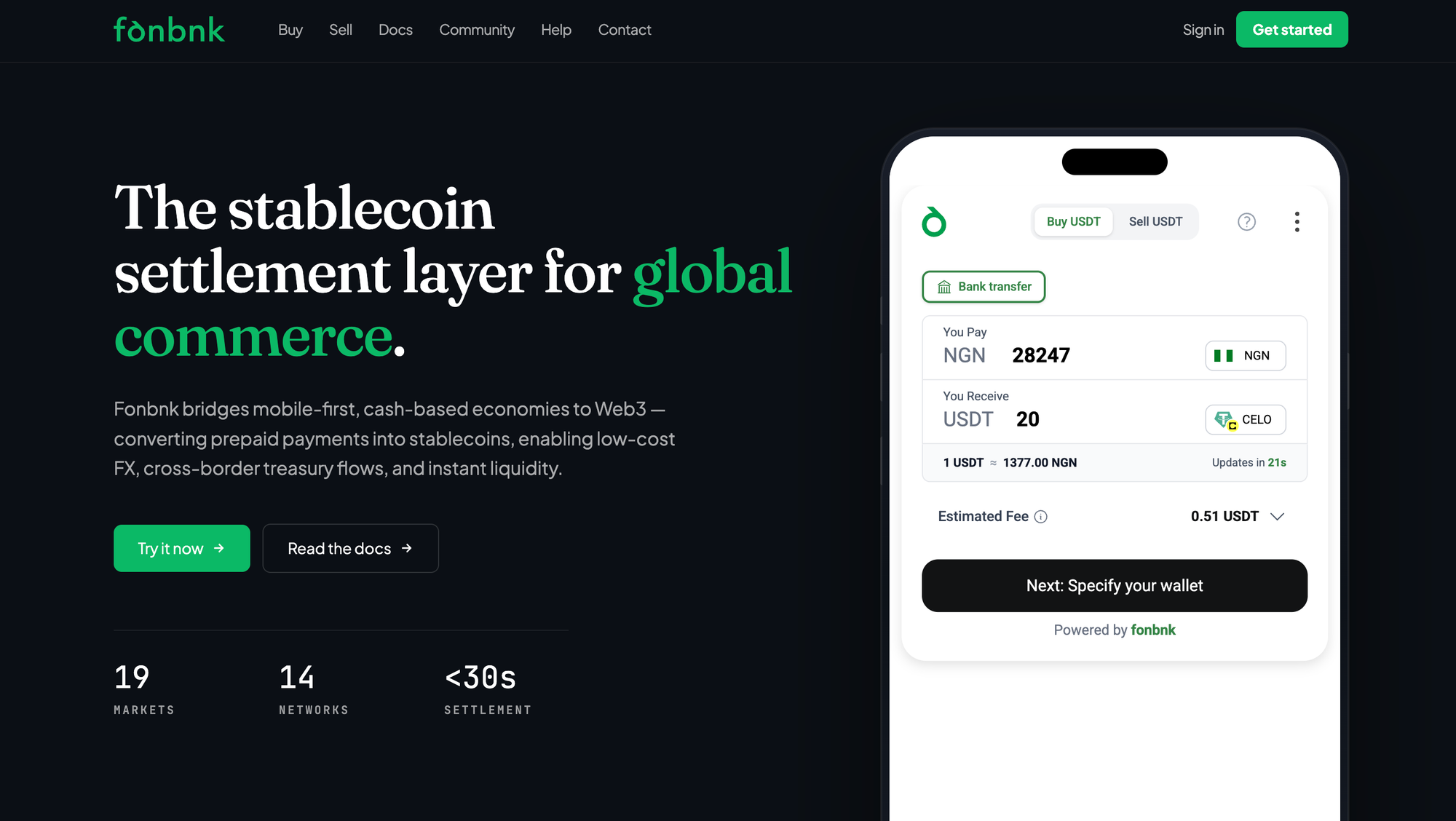
Fonbnk is the most distinctive entry here because of what it accepts as payment, rather than what it pays out.
- On-ramp and off-ramp across Africa, Latin America and South East Asia
- Operations in 20 countries
- Payment by bank transfer, mobile money, digital wallet or airtime
- Off-ramp paying local currency into a bank or mobile money account
- A server-to-server REST API plus a hosted widget that handles identity checks for you
- Counterparty matching, rate holding, verification and settlement handled by Fonbnk
Accepting prepaid airtime as an input is genuinely unusual and matters in markets where a phone balance is more accessible than a bank account.
Best for apps serving users without reliable bank access, and for teams that want the hosted option rather than owning verification.
6. VALR
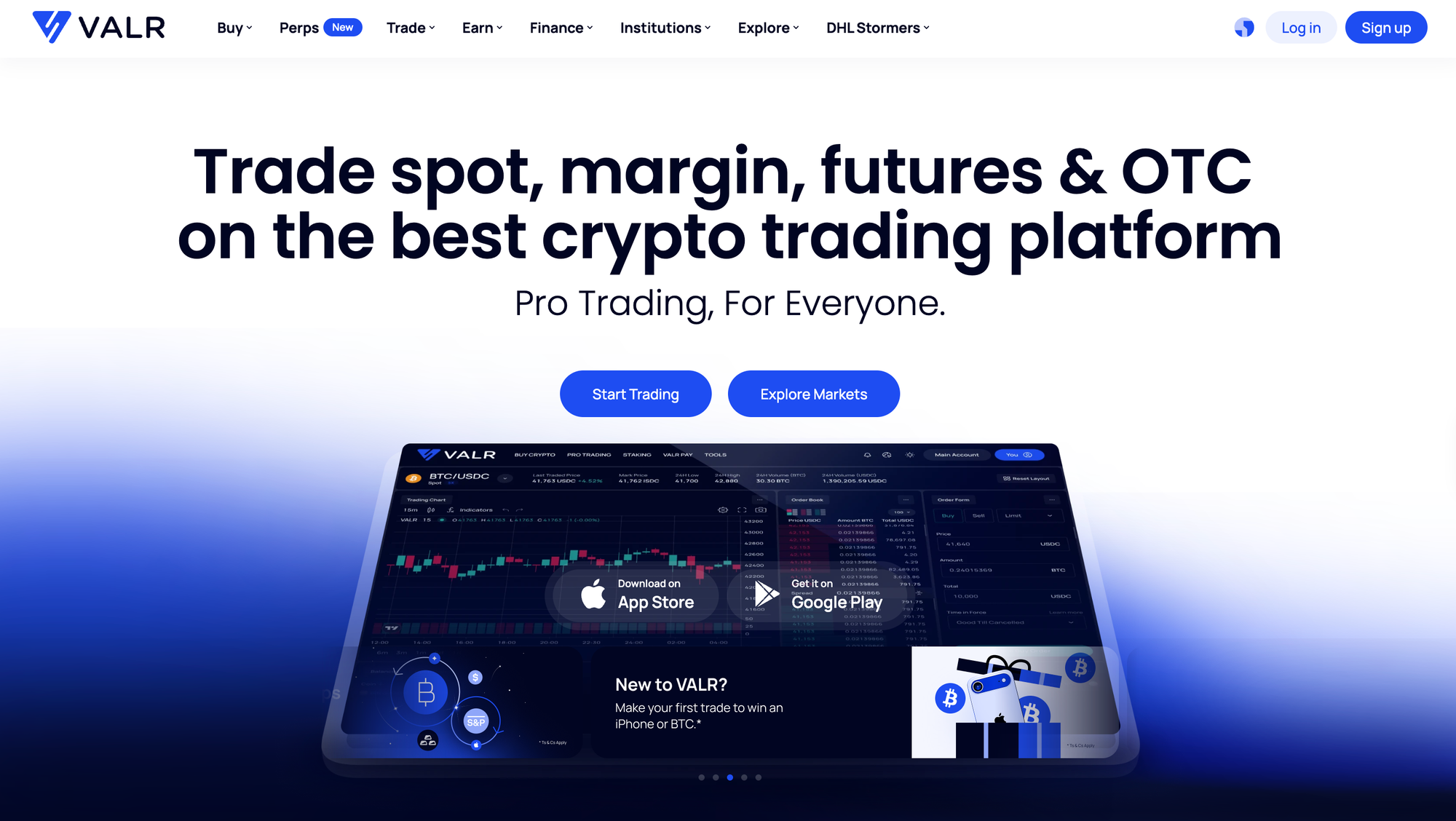
Does the job: South African liquidity, business accounts and merchant acceptance.
VALR is an exchange rather than a ramp aggregator, and in its home market that distinction matters less than the depth it brings.
- A South African crypto licence plus a derivatives provider licence from the conduct authority, under financial services provider number 53308
- More than 100 assets, with the dollar stablecoin to rand pair among the most traded
- A business arm, an over-the-counter desk and documented API access to liquidity, pricing and custody
- Merchant payments reaching roughly 31,000 stores and 700,000 locations through local payment integrations
- More than 1.7 million registered users claimed
Those figures come from the company's own review of its year and have not been independently verified. Coverage is also concentrated in South Africa rather than continent-wide.
Best for South African businesses needing rand liquidity and local merchant acceptance in one provider.
Compared
| Provider | Primary job | Coverage claimed | Local termination | Published pricing |
|---|---|---|---|---|
| Yellow Card | Pan-African infrastructure API | 50+ currencies, 30+ chains | Yes, collections and payouts | No |
| Onafriq | Incumbent network with USDC settlement | 40+ African markets | Yes, via existing network | No |
| Conduit | Corridor and treasury rail | Cross-border, partner-dependent | No, needs local partners | No |
| Kotani Pay | Last-mile mobile money payouts | KES, GHC, XAF named | Yes, mobile money | No |
| Fonbnk | Consumer on and off-ramp | 20 countries, three regions | Yes, bank and mobile money | No |
| VALR | Exchange liquidity and merchant acceptance | South Africa focused | Yes, in South Africa | Partially |
The final column is the most useful finding in this comparison. Almost nobody in this category publishes a rate card, which means every quote is negotiated and no published comparison of cost is possible.
What to note: ask for an all-in quote including the foreign exchange spread rather than the transaction fee, because the spread is where the cost usually sits.
How to Choose
1. Start from the destination account
Name the country, the currency and whether money must land in a bank account or a mobile money wallet. That single sentence eliminates most of this list.
2. Ask who holds the licence for that activity
Some providers hold their own authorisation and some operate through partners. Both can be fine, and you should know which you are buying.
3. Price the spread, not the fee
Request a quote on a real amount in a real corridor and compare the delivered local currency amount. A headline percentage without the rate tells you nothing.
4. Test identity verification with real users
Onboarding failure is the most common reason a corridor underperforms, so run a small cohort through before committing volume, and treat business verification as part of the same work set out in our guide to onboarding merchants.
5. Keep a second provider live per corridor
Mobile money outages, licence changes and corridor suspensions are routine here. A tested fallback is cheaper than a stalled payout run.
What to note: run a small live transfer in every corridor before launch, since documentation coverage and actual coverage diverge in this region more than anywhere else.
How This List Was Built
Inclusion required three things, so that the comparison means something.
- Documented capability, meaning public technical or product documentation rather than a landing page
- Local termination in at least one African market, or an explicitly stated role in the chain that reaches it
- A stated regulatory position, whether a held licence or a named partner arrangement
Several providers serving this region are not here, either because capabilities are not publicly documented or because coverage could not be verified at the time of writing. Operators who believe they meet the three criteria above are welcome to send documentation for consideration in the next update.
What to note: last reviewed against provider documentation in October 2026, and this category changes quickly enough to deserve a quarterly re-check.
Risks and Limitations
- Coverage and reach figures are company claims and often describe addressable endpoints rather than live corridors.
- Pricing is almost universally unpublished, so cost comparison requires quotes on identical amounts.
- Licensing varies by country and by activity, and a licence in one market says nothing about another.
- Mobile money termination depends on operator relationships that can change without notice.
- Stablecoin settlement still relies on local banking partners to reach domestic systems.
Conclusion
The best stablecoin ramp in Africa is the one that terminates into the account your counterparty actually uses, which makes this a corridor decision rather than a vendor decision.
Yellow Card is the broadest single integration and the best documented. Onafriq brings incumbent distribution and Conduit the corridor and treasury layer behind it. Kotani Pay is the specialist when money must reach a phone wallet, Fonbnk is the choice where bank access is the obstacle, and VALR is the South African answer.
Two habits matter more than the choice. Price the foreign exchange spread rather than the transaction fee, and keep a tested second provider per corridor, because in this region coverage on paper and coverage in production are not the same thing.
Read Next:
FAQs:
1. What is a stablecoin off-ramp in Africa?
A service that converts a dollar token into local currency and delivers it into a bank account or mobile money wallet. The conversion is the easy part, and the delivery into a named local account is what separates providers.
2. Which provider covers the most African markets?
On claimed coverage, Onafriq cites a network spanning more than 40 African markets, while Yellow Card documents more than 50 fiat currencies and payment reach described as nearly 200 countries. Both are company figures describing addressable reach rather than verified live corridors.
3. Can a business get these services through an API?
Yes. Yellow Card documents collections and payout flows with a sandbox, Kotani Pay offers a white-label payout API, Fonbnk provides a server-to-server REST API alongside a hosted widget, and VALR documents API access to liquidity, pricing and custody.
4. What do these providers charge?
Almost none publishes a rate card, so pricing is quoted rather than listed. Request an all-in quote on a specific amount in a specific corridor and compare the local currency actually delivered, since the foreign exchange spread usually matters more than the stated fee.
5. Are these providers licensed?
Positions differ and should be checked per market. Kotani Pay states registration as a Financial Service Provider with South Africa's conduct authority under licence 53594, and VALR cites a South African crypto licence plus a derivatives provider licence under provider number 53308, while others operate through partner arrangements.
Disclaimer:
This content is provided for informational and educational purposes only and does not constitute financial, investment, legal, or tax advice; no material herein should be interpreted as a recommendation, endorsement, or solicitation to buy or sell any financial instrument, and readers should conduct their own independent research or consult a qualified professional. Coverage, currency and chain support, licensing status and reach figures are drawn from each provider's own documentation or announcements at the time of writing, are not independently verified here, and change frequently; confirm current capabilities, licensing and pricing directly with each provider, and with qualified counsel in the relevant market, before moving funds.