Table of Contents
For most of card issuing’s history, launching a program in a new country meant a local bank account, a local BIN sponsor, and pre-funded balances sitting idle in every market. Stablecoins are changing that model. A business can now hold a dollar stablecoin balance, issue cards against it, and settle with the network on-chain, 24/7.
Growth has followed. Stablecoin card spend is up 673% year over year, and Visa reports that payment volume on stablecoin-linked cards grew nearly 200% year over year, across more than 160 live programs. Business and commercial programs already account for about 17% of Visa’s stablecoin-linked card volume in fiscal 2026.
No single company runs the whole stack. A stablecoin-backed card depends on a settlement rail, an issuer or processor, and a card network working together.
This article maps the eight providers that make up the current stablecoin card stack, which layer each one occupies, who they partner with, and where they operate.
Key Takeaways
- Stablecoin-backed cards require at least three distinct infrastructure layers working together: the stablecoin settlement rail, the card issuer or processor, and the network (Visa or Mastercard).
- BVNK’s card issuing on Mastercard, with a broader launch due in Q1 2027, shows how the rail-plus-network model works: fintechs issue stablecoin-backed cards in 130-plus countries that are accepted anywhere Mastercard is, and merchants change nothing about how they accept payments.
- Businesses evaluating a card program need to map which of the eight providers below sit on which layer before comparing pricing or geographic coverage.
Why Stablecoin-Backed Cards Need Specialized Infrastructure
The Settlement Layer Problem
A card swipe is a fiat event for the merchant. The merchant expects local currency, and the network expects settlement in fiat on its normal schedule. A stablecoin balance cannot simply be plugged into that flow.
Something has to sit between the cardholder’s stablecoin balance and the network: converting at the point of authorization or settlement, managing liquidity, and handling the on-chain leg. That is the job of the stablecoin settlement layer, and it is why cards cannot plug into any wallet directly.
As covered in our guide to the infrastructure behind stablecoin cards, this layer has become the main point of differentiation between card programs.
Compliance and Card Network Requirements
Every card program needs a regulated issuer, either a principal member of the network or a bank BIN sponsor working with a program manager. On top of that, the stablecoin side carries its own compliance load: money transmission or e-money licensing, AML and sanctions screening, and Travel Rule obligations on on-chain transfers.
A corporate card program adds spend controls, multi-entity reporting, and reconciliation requirements that consumer programs do not need.
What Issuers and Cardholders Gain
For cardholders, a stablecoin-backed card means spending from a stablecoin balance anywhere cards are accepted, without manually off-ramping first. For businesses, it means funding a global card program from one stablecoin treasury instead of pre-funded accounts in each country.
For issuers, stablecoin settlement can run 24/7, including weekends, which reduces the working capital tied up waiting for traditional settlement windows.
Where Latin America and Emerging Markets Fit as the Proving Ground
Latin America has been the testing ground. Bridge and Visa launched their stablecoin card product there in 2025, and Reap became a Visa principal issuer in Mexico in May 2026. High inflation, currency controls, and expensive cross-border payments make dollar-denominated cards that settle in stablecoins especially useful in these markets.
The 8 Infrastructure Providers
1. BVNK
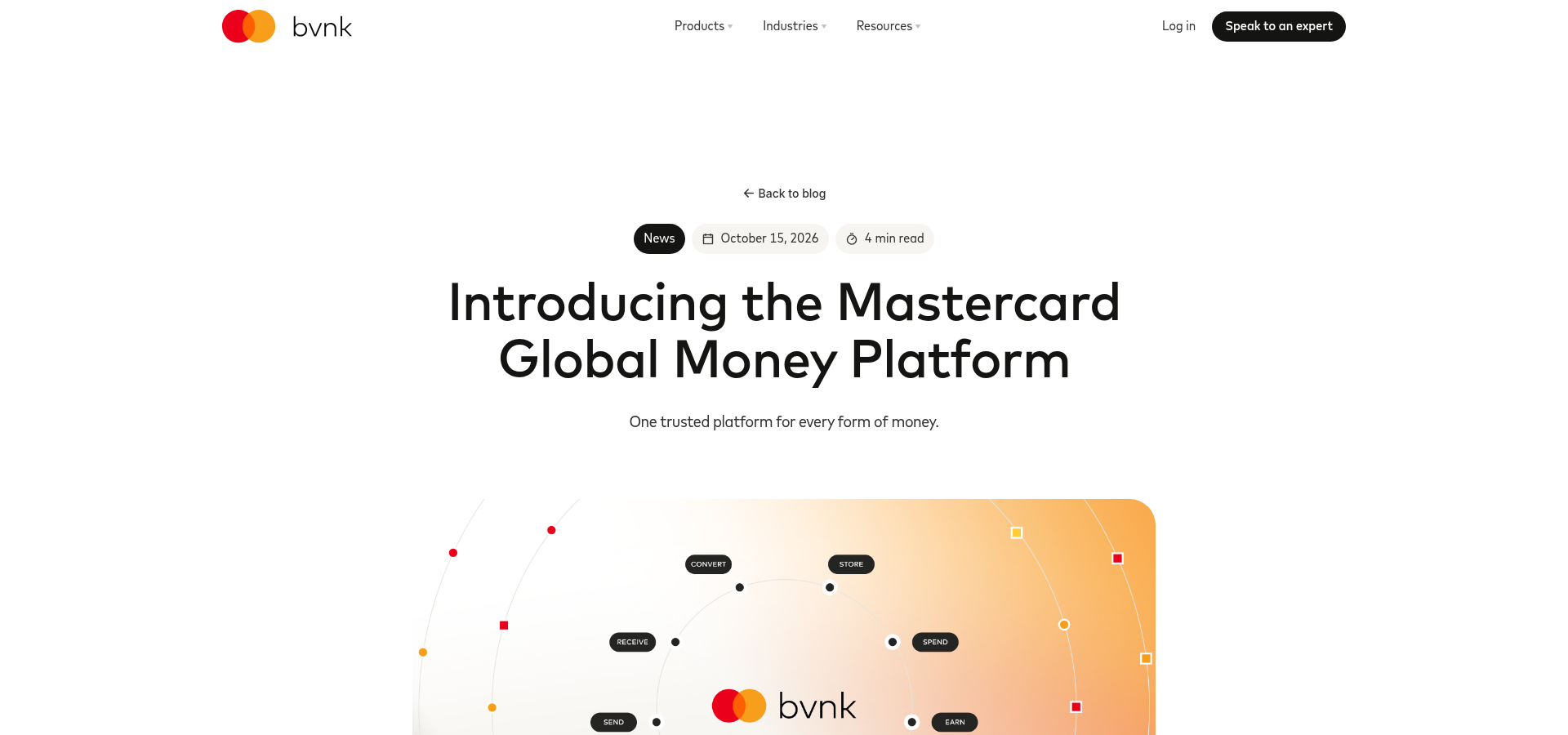
BVNK is the stablecoin infrastructure provider behind the Mastercard Global Money Platform. Mastercard completed its acquisition of BVNK in August 2026.
Role in the Card Stack
BVNK covers the stablecoin settlement layer and virtual card issuing. Its global money accounts hold fiat and stablecoins side by side, and those balances can fund card spend directly. Businesses issue stablecoin-backed cards through the same API they use for accounts, payouts, and FX.
Network and Issuer Partnerships
BVNK’s card issuing runs on Mastercard’s network. Spending from stablecoin balances is accepted across Mastercard’s global network of hundreds of millions of merchant locations.
Card issuers also build on BVNK’s infrastructure for their own programs. Marqeta, a BVNK customer, partnered with BVNK in September 2026 so that its customers can issue stablecoin-backed cards, and is among the first companies integrating Global Money Platform.
Geographic Coverage
BVNK’s card issuance coverage spans 130-plus countries, compared with Bridge’s stated target of 100-plus. Acceptance coverage, meaning where a cardholder can spend, extends to anywhere Mastercard is accepted, across more than 200 countries and territories.
BVNK backs this with 40-plus licenses and registrations and more than $50 billion in annualized payment volume. Its card product is scheduled for a broader launch in Q1 2027.
Pros
- Card issuance across 130-plus countries, with spending accepted wherever Mastercard is
- Cards draw directly on the same global money account that holds fiat and stablecoins
- Accounts, payouts, FX, and cards come through one API
- 40-plus licenses and registrations behind the card program
- Owned by Mastercard, the network the cards run on
Cons
- The card product is still ramping toward a broader Q1 2027 launch
- Pricing is not published
2. Bridge
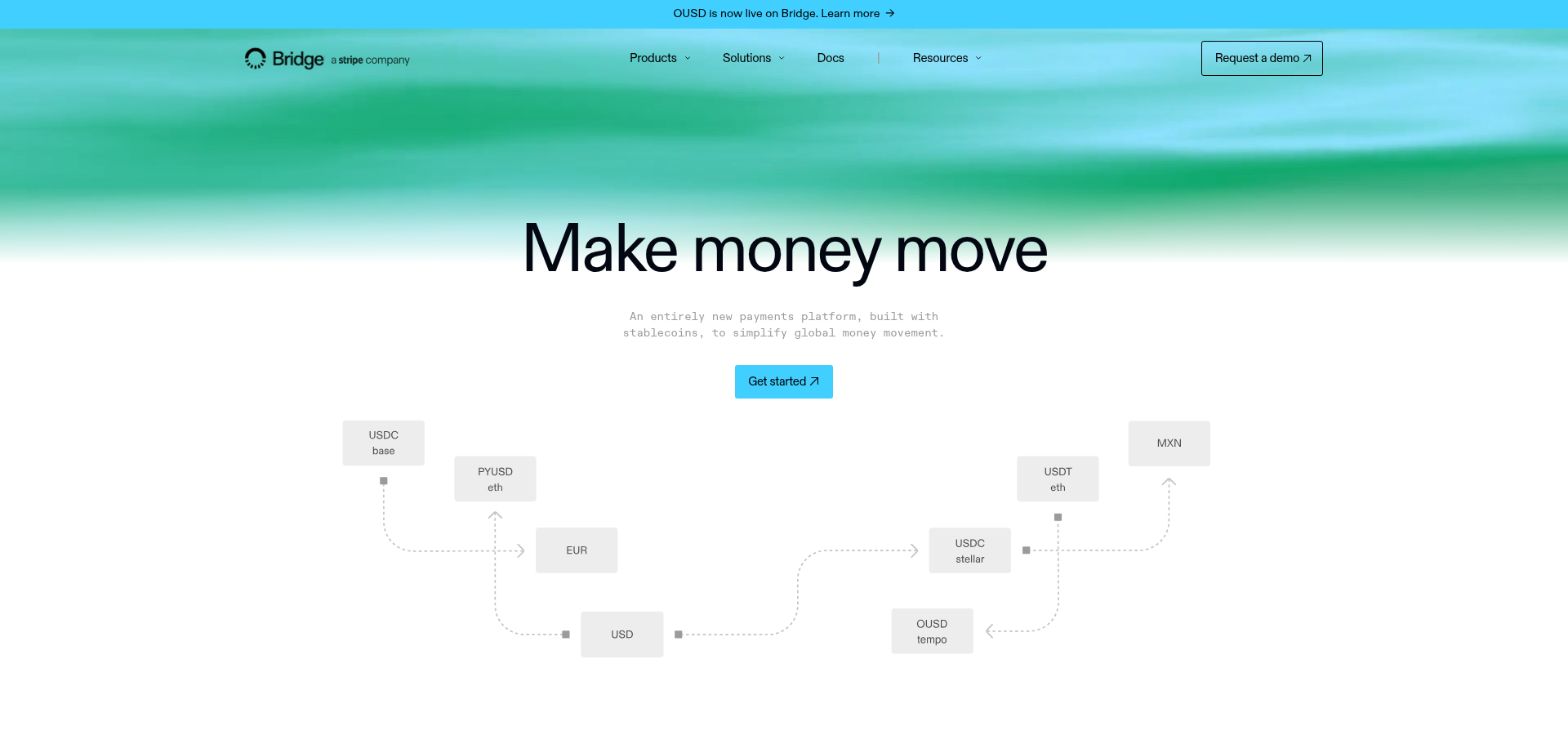
Bridge is Stripe’s stablecoin infrastructure platform, acquired in February 2025.
Role in the Card Stack
Bridge combines a stablecoin rail with a card issuing and program management API. A business can hold stablecoins in Bridge accounts and issue Visa cards that spend from those balances.
Network and Issuer Partnerships
Bridge’s card product is built with Visa. On October 15, 2026, Stripe announced multi-currency stablecoin cards with Plasma as design partner, covering USD, EUR, BRL, MXN, and COP; no launch date has been given. Clients using Bridge cards include Ramp and Kraken.
Geographic Coverage
Bridge cards were live in 18 countries in March 2026 and more than 30 countries by October 2026. Stripe has said it aims to reach 100-plus countries.
Pros
- Visa stablecoin cards already live in 30-plus countries
- Fits naturally for businesses already on Stripe
- Accounts, cards, and branded stablecoin issuance from one vendor
Cons
- Visa only, with no Mastercard option
- Multi-currency cards have no launch date yet
- Country coverage is still expanding toward the 100-plus target
3. Zero Hash
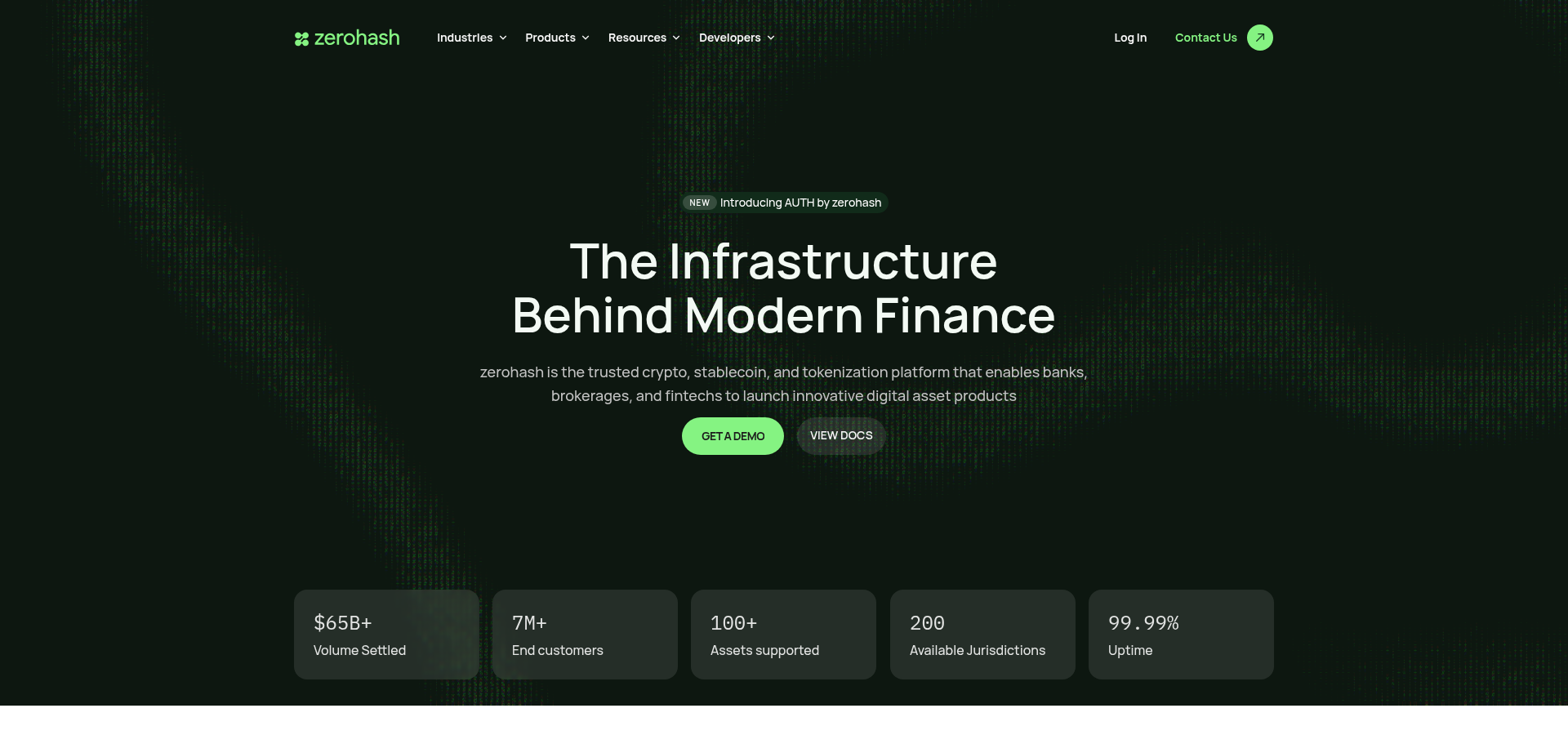
Zero Hash (styled zerohash) is a regulated crypto and stablecoin infrastructure provider for banks, brokerages, and fintechs.
Role in the Card Stack
Zero Hash is not a card issuer. It provides the stablecoin layer behind card programs: custody, liquidity, conversion, and settlement, while a processor handles issuing.
Network and Issuer Partnerships
In July 2026, Marqeta partnered with Zero Hash to expand stablecoin-backed card issuing, with Marqeta handling issuing, bank sponsorship, and network access and Zero Hash handling the stablecoin side. As covered in our Zero Hash competitors guide, this backend role is typical of how Zero Hash works with partners.
Geographic Coverage
Zero Hash is licensed in 51 US jurisdictions and holds MiCA CASP authorization and an EMI license in the Netherlands, plus permissions in Canada, Latin America, Australia, New Zealand, and Bermuda.
Pros
- Deep US licensing behind the stablecoin layer
- Partnership with Marqeta for card issuing
- MiCA CASP and Dutch EMI authorization in Europe
Cons
- Not a card issuer, so a separate processor is required
- No card product of its own
- Strongest in the US market
4. Rain
Rain is a stablecoin payments platform that helps companies launch stablecoin-powered cards through a single API.
Role in the Card Stack
Rain operates as card issuer, program manager, and stablecoin infrastructure. It offers consumer and corporate card products alongside digital dollar accounts and cross-border payments.
Network and Issuer Partnerships
Rain is a principal member of Visa and, since May 2026, of Mastercard, allowing it to issue stablecoin-powered cards on both networks. It raised a $250 million Series C led by ICONIQ in January 2026. Clients include Western Union, MoneyGram, Nuvei, and Kast.
Geographic Coverage
Rain says its card programs are used in more than 150 countries.
Pros
- Principal member of both Visa and Mastercard
- Offers a dedicated corporate card product
- Well funded, with large remittance and payments clients
Cons
- Its country coverage figure is company-reported
- More than a business needs if it only wants a stablecoin rail
- Pricing is not published
5. Baanx
Baanx is a UK-based card program manager specializing in self-custodial crypto and stablecoin cards.
Role in the Card Stack
Baanx is the program manager and card technology layer. Its smart contract approach lets cardholders spend directly from self-custodial wallets, with funds debited at the point of purchase rather than held by a custodian.
Network and Issuer Partnerships
Baanx works with both Visa and Mastercard. It powers the MetaMask Card, which launched nationwide in the US with Mastercard in February 2026, and launched Visa USDC cards spending from self-custodial wallets in 2025. Ledger and Exodus are also among its clients.
Geographic Coverage
Baanx is registered with the UK Financial Conduct Authority as a cryptoasset business and runs programs across the UK, the EU, and the US.
Pros
- Cardholders spend straight from self-custodial wallets
- Powers cards for major wallet brands such as MetaMask and Ledger
- Works on both Visa and Mastercard
Cons
- Built mainly for consumer programs rather than corporate cards
- Not a principal member, so it relies on issuing partners
- Limited to the UK, EU, and US
6. Marqeta
Marqeta is a modern card issuing and processing platform used by fintechs and enterprises worldwide.
Role in the Card Stack
Marqeta sits on the issuing and processing layer. It handles card creation, authorization, program management, and network connectivity, working with bank BIN sponsors on Visa and Mastercard.
Network and Issuer Partnerships
Marqeta has added stablecoin capabilities by partnering with stablecoin infrastructure providers rather than building that layer itself. In 2026 it announced partnerships with Zero Hash in July, BVNK in September, and Coinbase in October, each supplying the stablecoin side for Marqeta customers’ card programs.
Geographic Coverage
Marqeta operates in more than 40 countries.
Pros
- Proven issuing and processing at large scale
- Choice of stablecoin partners, including BVNK, Zero Hash, and Coinbase
- Works on both Visa and Mastercard
Cons
- Needs a separate stablecoin provider for the settlement layer
- Onboarding is geared toward larger programs
- Does not hold or convert stablecoins itself
7. Reap
Reap is a Hong Kong-based card issuing and stablecoin infrastructure company that began in corporate cards.
Role in the Card Stack
Reap acts as issuer and issuing infrastructure, covering authorization, processing, compliance, and operations. As a Visa principal issuer in Hong Kong and Mexico, it can issue without a third-party sponsor in those markets.
Network and Issuer Partnerships
In September 2026, Reap and Visa announced stablecoin-linked Visa credit card programs across 100-plus markets, and Reap participates as a settlement partner in Visa’s Asia-Pacific stablecoin settlement program. In May 2026, Payward, the parent company of Kraken, agreed to acquire Reap for $600 million.
Geographic Coverage
Reap’s stablecoin card programs span 100-plus markets, expanding from Asia and Latin America into Europe, the Middle East, and Africa.
Pros
- Visa principal issuer in Hong Kong and Mexico
- Stablecoin card programs across 100-plus markets
- Roots in corporate cards
Cons
- Visa only
- The pending Payward acquisition could shift its priorities
- Client names are not public
8. Immersve
Immersve is a card issuer focused on letting users spend digital currency anywhere Mastercard is accepted.
Role in the Card Stack
Immersve provides issuing as a service, including BIN sponsorship and non-custodial APIs and smart contracts that connect wallet balances to card spend.
Network and Issuer Partnerships
Immersve is a principal member of Mastercard. In April 2026 it began issuing KuCoin’s KuCard in Australia, letting users spend USDC in real time with Apple Pay and Google Pay. It also powers the Bitget Wallet card.
Geographic Coverage
Immersve operates across Australia, New Zealand, the UK, the US, and the UAE.
Pros
- Principal member of Mastercard
- Non-custodial APIs and smart contracts
- Real-time USDC spending with Apple Pay and Google Pay
Cons
- Operates in a limited number of markets
- Focused on crypto-native and consumer programs
- Smaller scale than larger issuers
How the Stack Fits Together: Issuer, Processor, and Stablecoin Rail
| Provider | Primary layer | Network | Card issuance coverage |
|---|---|---|---|
| BVNK | Stablecoin rail, accounts, and virtual card issuing | Mastercard | 130+ countries (acceptance wherever Mastercard is accepted) |
| Bridge | Stablecoin rail plus card issuing API | Visa | 30+ countries live, 100+ targeted |
| Zero Hash | Stablecoin backend for card programs | Via partners (e.g. Marqeta) | US plus EU and other licensed markets |
| Rain | Issuer, program manager, stablecoin infrastructure | Visa and Mastercard principal member | 150+ countries (company figure) |
| Baanx | Program manager, self-custodial card tech | Visa and Mastercard | UK, EU, US |
| Marqeta | Issuing processor and program manager | Visa and Mastercard | 40+ countries |
| Reap | Issuer and issuing infrastructure | Visa principal issuer | 100+ markets |
| Immersve | Issuer and BIN sponsor | Mastercard principal member | Australia, NZ, UK, US, UAE |
A Worked Example: From Stablecoin Balance to Card Swipe
A remote-first company holds its operating funds as dollar stablecoins in a multi-currency account. It issues virtual corporate cards to employees in Brazil, Germany, and the Philippines.
An employee in Berlin pays for a software subscription in euros. The card network sends an authorization request to the issuer, which checks the employee’s spend limit and the available stablecoin balance in real time. Once approved, the rail converts the required amount from stablecoins to fiat and settles with the network. The merchant receives euros as normal and never knows a stablecoin was involved.
The company’s finance team sees one balance, one reconciliation feed, and no pre-funded euro account.
As covered in our stablecoin-backed corporate cards guide, this is the core efficiency gain for B2B card programs.
Choosing the Right Combination for Your Card Program
If You’re a Crypto-Native Neobank
Self-custodial card technology from Baanx or Immersve fits users who want to spend directly from their own wallets. Rain fits teams that want one partner covering issuing and program management on both networks.
If You’re a Traditional Fintech Adding Stablecoin Rails
Keep your existing processor and add a stablecoin layer. Marqeta customers can choose between BVNK, Zero Hash, and Coinbase for the stablecoin side. Stripe-based businesses will find Bridge the shortest path.
If You Need Multi-Country Coverage on a Single Integration
Look at issuance coverage and acceptance coverage separately. BVNK combines global money accounts, payouts, and Mastercard card issuing across 130-plus countries in one API, with spending accepted wherever Mastercard is. Reap and Rain also offer broad multi-market issuance on their own principal memberships.
Conclusion
Stablecoin-backed cards are a stack, not a single vendor decision.
BVNK and Bridge combine the stablecoin rail with card issuing in one API, on Mastercard and Visa respectively. Rain, Reap, and Immersve operate as issuers with their own network memberships. Marqeta is the processing layer that partners with stablecoin providers such as BVNK and Zero Hash. Baanx specializes in self-custodial card programs.
The right combination depends on which layers a business already has, which network it prefers, and where its cardholders need to spend.
FAQs:
1. What infrastructure powers a stablecoin-backed card?
A stablecoin-backed card is powered by three layers working together: a stablecoin settlement rail such as BVNK, Bridge, or Zero Hash that holds balances and converts them at settlement; a card issuer or processor such as Marqeta, Rain, Reap, or Immersve; and a card network, either Visa or Mastercard.
2. What is the difference between a stablecoin rail provider and a card issuer?
The difference between a stablecoin rail provider and a card issuer is that the rail provider holds the stablecoin balance, manages liquidity, and converts stablecoins to fiat for settlement, while the card issuer creates the card, authorizes transactions, and maintains the regulated relationship with the card network.
3. How does the BVNK and Marqeta integration work?
The BVNK and Marqeta integration works by Marqeta, a BVNK customer, using BVNK’s stablecoin infrastructure and embedded accounts so that Marqeta’s own customers can offer stablecoin-backed cards as part of their card programs, with Marqeta handling issuing and processing; Marqeta is also among the first companies integrating the Mastercard Global Money Platform.
4. Are stablecoin-backed cards regulated the same as traditional debit cards?
Stablecoin-backed cards follow the same card network rules and issuer regulations as traditional prepaid or debit cards on the card side, but the stablecoin side adds separate requirements such as money transmission or e-money licensing, MiCA in the EU, and US stablecoin rules under the GENIUS Act framework, which is still being implemented.
5. Which stablecoin card infrastructure providers support the most countries?
Among the providers in this guide, BVNK supports stablecoin card issuance across 130-plus countries with acceptance wherever Mastercard is accepted, Rain reports card use in 150-plus countries, Reap’s Visa programs span 100-plus markets, and Bridge is live in 30-plus countries with a 100-plus country target.
Disclaimer:
This content is provided for informational and educational purposes only and does not constitute financial, investment, legal, or tax advice; no material herein should be interpreted as a recommendation, endorsement, or solicitation to buy or sell any financial instrument, and readers should conduct their own independent research or consult a qualified professional.