Table of Contents
Banks and regulated custodians entering stablecoins are told the same thing by auditors and regulators: keep signing keys in a certified hardware security module. Thales, for example, pitches its Luna HSMs as aligned with SFC, MAS, MiCA, BaFin and FINMA expectations.
The certificate that matters most in those conversations is FIPS 140 Level 3. What the vendor brochures rarely say is that several blockchain functions only work with FIPS mode switched off.
So this compares six HSM providers on the questions a custody team actually faces: which blockchain curves run natively, what needs an extra licence, and whether the FIPS badge covers the keys that sign transactions.
An HSM's FIPS certificate covers the algorithms it validated. Blockchain curves and key derivation often sit outside that list, so the badge on the box may not apply to the keys that move your funds.
Key Takeaways
- Thales runs BIP32 derivation only with FIPS mode switched off.
- AWS CloudHSM supports Ed25519 only on hsm2m.medium in non-FIPS mode.
- Securosys and Utimaco sell blockchain functions as licensed extensions.
- Fortanix lists secp256k1, Ed25519 and BIP32 in its documentation.
- Entrust's blockchain page names no curves at all.
What Actually Differs
Every HSM here protects keys in tamper-resistant hardware and carries a FIPS or Common Criteria certificate. The differences show up once you try to sign a blockchain transaction.
Bitcoin and Ethereum use the secp256k1 curve, while Solana and many newer chains use Ed25519. Wallets also derive many keys from one seed using BIP32 or SLIP-0010, which a general-purpose HSM may not support.
The third difference is how custody platforms connect to the HSM. Our explainer on institutional crypto custody covers why banks often buy the platform and the HSM from different vendors.
What to note: ask each vendor for the exact firmware version and mode needed for every curve you use.
Best HSM Providers for Digital Asset and Stablecoin Custody
1. Thales Luna
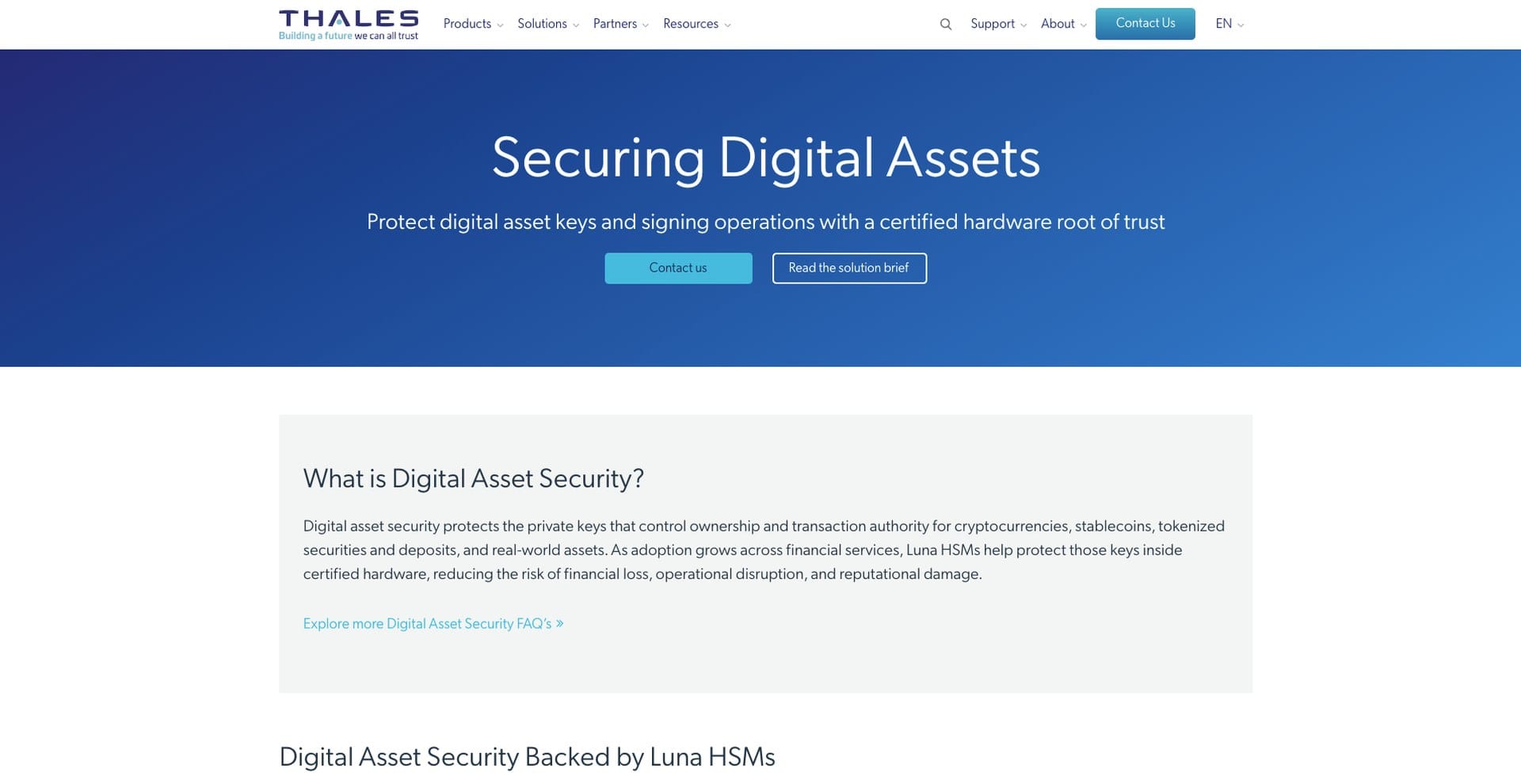
Does the job: the most widely integrated HSM in custody platforms, on premises or in the cloud.
Thales says Luna was the first HSM validated to FIPS 140-3 Level 3, and it names Fireblocks, Taurus and Dfns as digital asset partners.
The platform supports:
- On-HSM BIP32 master and child key derivation on secp256k1
- Luna Cloud HSM through the DPoD marketplace
- PKCS#11, Java, OpenSSL and Microsoft CNG interfaces
- NIST post-quantum algorithms
- A named exchange case study with HKVAX
Thales's own documentation says the BIP32 mechanisms need firmware 7.3 or later and only work when non-FIPS algorithms are allowed. The digital assets page names no supported curves and no pricing.
Best for banks that want an HSM their custody platform already supports.
2. Securosys Primus
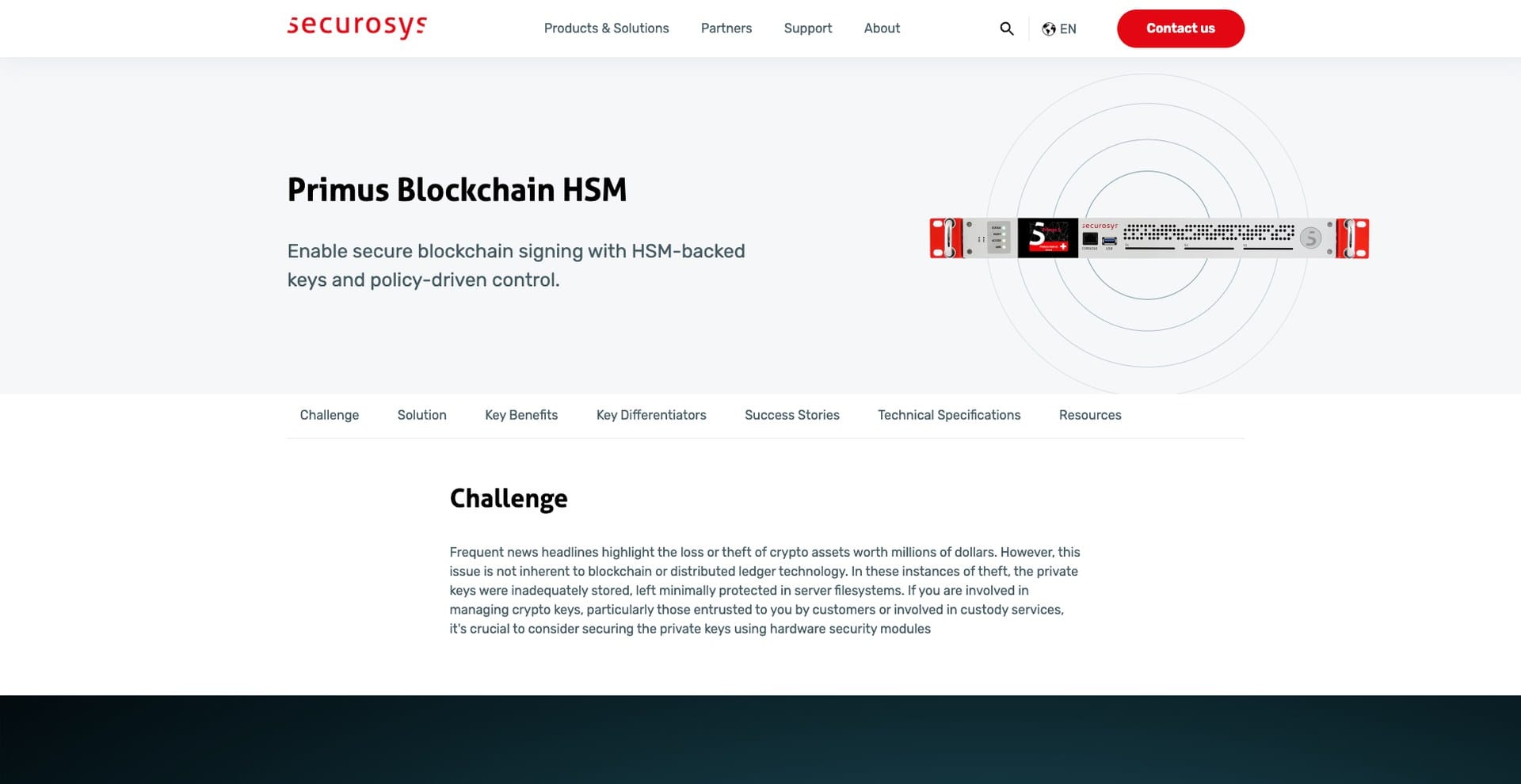
Does the job: a Swiss HSM with blockchain functions and an approval engine built in.
Securosys builds approval policies into the key itself, so a transaction can require several approvers before the HSM signs.
The platform supports:
- BIP32 derivation and seed phrase import
- Smart Key Attributes for per-key multi-authorisation
- A Transaction Security Broker workflow engine
- Ed25519 enabled by default on its CloudHSM
- Integration with Ripple Custody, on hardware or CloudHSM
SLIP-0010 derivation and BLS signing need a separate licence, according to Securosys's own documentation. Ripple lists its certifications as FIPS 140-2 Level 3 and CC EAL4+ with FIPS 140-3 still in progress, and no pricing is published.
Best for custodians that want approval policies enforced inside the HSM, not in software around it.
3. Utimaco Blockchain Protect
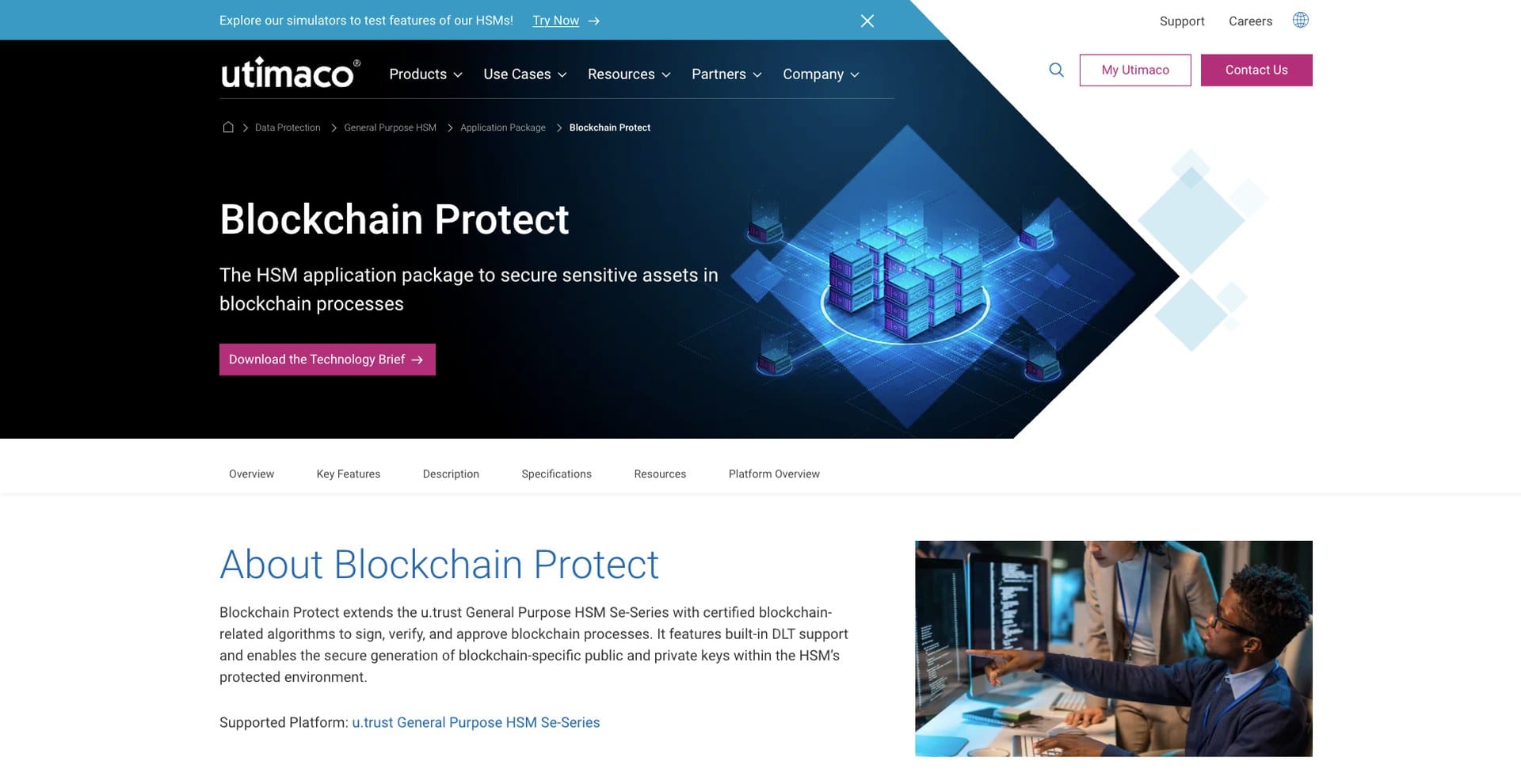
Does the job: a firmware extension that adds blockchain algorithms to a general-purpose HSM.
Utimaco sells blockchain support as Blockchain Protect, which runs on its u.trust General Purpose HSM Se-Series.
The platform supports:
- BIP-32, BIP-44 and SLIP-0010 key derivation
- MultiSig and BLS signing
- Generation of blockchain keys inside the HSM
- A FIPS 140-2 Level 3 HSM platform
- A free simulator for development
The page does not name the supported curves, list customers or say how the extension is licensed. Treat it as an add-on to budget for, not a default feature.
Best for teams that already run Utimaco HSMs for payments or PKI.
4. Entrust nShield
Does the job: a general-purpose HSM positioned as the root of trust for blockchain networks.
Entrust's nShield 5 range achieved FIPS 140-3 certification in 2024, and its blockchain page focuses on protecting root keys and network identities.
The platform supports:
- Generation and storage of root keys for ledger networks
- Protection of the keys that issue and revoke signing keys
- Strong authentication before users or devices join a network
- Clustering for performance and availability
- Entrust professional services for custom blockchain work
The blockchain page names no curves, partners or customers, and leans on professional services for implementation. That suits permissioned ledgers more than a stablecoin hot wallet.
Best for enterprises running permissioned blockchain networks.
5. Fortanix DSM
Does the job: a key management service with the broadest documented blockchain curve support.
Fortanix positions its Data Security Manager as an alternative to traditional HSMs, which its blockchain brief calls complex, expensive and hard to scale for blockchain.
The platform supports:
- secp256k1 for ECDSA, BIP32 and SLIP-0010
- BIP32 key generation, child derivation and signing on mainnet and testnet
- Ed25519 and Ed448 under EdDSA
- NIST P-curves and X25519 for other workloads
- Key management for private and hybrid enterprise blockchains
Fortanix's dedicated warm wallet page now returns a 404, so check what digital asset tooling is still sold before relying on it. Ask which certificate covers the service you buy, and compare it with the MPC providers many custodians now use instead of HSMs.
Best for teams that want Ed25519 and secp256k1 documented in one key manager.
6. AWS CloudHSM
Does the job: single-tenant cloud HSMs billed by the hour.
AWS CloudHSM is the easiest way to get a dedicated HSM without buying hardware, with hourly billing and no upfront fees.
The platform supports:
- secp256k1 key generation and ECDSA signing
- Ed25519 on the hsm2m.medium instance type
- OpenSSL, PKCS#11 and JCE integrations
- Clusters across availability zones
- Pay-as-you-go pricing per HSM hour
AWS's documentation says Ed25519 works only on hsm2m.medium in non-FIPS mode, and its OpenSSL engine does not support Ed25519 at all. There is no native BIP32 derivation listed, so wallet logic sits in your own code.
Best for cloud-native teams signing on secp256k1 chains.
HSM Providers Compared
| Provider | secp256k1 | Ed25519 | HD derivation | Catch |
|---|---|---|---|---|
| Thales Luna | Yes, for BIP32 | Not on page | BIP32 | BIP32 only in non-FIPS mode |
| Securosys Primus | Yes | Yes, default | BIP32, SLIP-0010 | SLIP-0010 and BLS licensed |
| Utimaco | Not named | Not named | BIP-32, BIP-44, SLIP-0010 | Firmware add-on |
| Entrust nShield | Not named | Not named | Not named | Relies on services |
| Fortanix | Yes | Yes | BIP32, SLIP-0010 | Warm wallet page removed |
| AWS CloudHSM | Yes | hsm2m.medium only | None listed | Ed25519 only in non-FIPS mode |
The last column is the one procurement teams miss. Two of the six vendors document blockchain functions that only run outside FIPS mode, and two more sell them as extras.
What to note: ask auditors whether they accept signing in non-FIPS mode before you choose a curve.
The FIPS Mode Problem
A FIPS 140 certificate validates specific algorithms. secp256k1 and Ed25519 key derivation are not always among them, so some HSMs only allow them once the module is switched into a non-FIPS mode.
That is a policy problem as much as a technical one. A regulator or partner that asks for "FIPS 140-3 Level 3" may assume every key in the HSM is covered, when the keys signing stablecoin transfers are not.
The fix is to document it honestly. Record which keys run in which mode, why, and what compensating controls apply, and agree that with your auditor before the first transaction.
What to note: keep FIPS and non-FIPS keys in separate partitions so the boundary is visible in audits.
How to Choose
1. List every chain you will sign on
Ethereum, Bitcoin and most EVM chains need secp256k1, while Solana needs Ed25519. Match that list against each vendor's documentation, not its brochure.
2. Check the mode for each curve
Ask whether each curve and derivation method runs in FIPS mode. Thales and AWS both document non-FIPS restrictions.
3. Confirm your custody platform supports the HSM
Custody platforms support specific HSM models and firmware, as Ripple Custody does for Securosys. Our guide to digital asset custody solutions covers the platforms that sit on top.
4. Price the extensions
Securosys licenses SLIP-0010 and BLS separately, and Utimaco sells Blockchain Protect as firmware. Get those costs in writing.
5. Decide where approvals live
Securosys enforces approvals inside the HSM, while most others rely on the custody platform. Pick the model your auditors can test.
What to note: run a full key ceremony on a test partition before buying production hardware.
How This List Was Built
Inclusion required three things, so that the comparison means something.
- A first-party page or documentation describing digital asset or blockchain use
- A FIPS 140 or Common Criteria certified product, or a clearly stated compliance claim
- A product available to buy or rent today
Several capable vendors are not here, including smaller HSM makers with little public blockchain documentation. Providers who believe they meet the three criteria above are welcome to send documentation for consideration in the next update.
What to note: last reviewed against vendor documentation in November 2026.
Risks and Limitations
- Curve and mode support changes with firmware, so verify against the current version.
- Keys signing in non-FIPS mode may not meet a partner's certification requirement.
- An HSM protects keys, not the approval process that decides what gets signed.
- Licensed extensions add cost that is rarely published.
- Single-tenant cloud HSMs still depend on the cloud provider's availability.
Conclusion
Every HSM here can protect a key. The real differences are whether it can derive and sign with blockchain keys natively, and whether it does so inside the certified mode your auditors expect.
Thales suits banks that want the most integrations, Securosys suits custodians that want approvals inside the HSM, Utimaco and Entrust suit existing customers, Fortanix suits buyers who need both curve families documented, and AWS CloudHSM suits cloud-native teams on secp256k1.
Read the documentation, not the certificate. The question is not whether the HSM is FIPS certified, but whether the keys moving your stablecoins are.
Read Next:
- Institutional Crypto Custody Explained
- Best Key Management and MPC Providers
- Digital Asset Custody Solutions
FAQs:
1. What is an HSM in crypto custody?
A hardware security module is tamper-resistant hardware that generates and stores private keys and signs transactions without the key ever leaving the device.
2. Do HSMs support Ethereum and Bitcoin keys?
Most can sign on secp256k1, the curve both use, but support for wallet-style key derivation such as BIP32 varies and sometimes needs an add-on or a non-FIPS mode.
3. Can an HSM sign Solana transactions?
Only if it supports Ed25519. Securosys and Fortanix document it, while AWS CloudHSM supports it only on hsm2m.medium in non-FIPS mode.
4. What does non-FIPS mode mean?
It allows algorithms outside the module's FIPS validation. Keys used in that mode are still in hardware, but they are not covered by the FIPS certificate.
5. Is MPC better than an HSM for stablecoin custody?
Neither is strictly better. MPC splits keys across parties, while an HSM keeps one key in certified hardware, and many custodians combine both.
Disclaimer:
This content is provided for informational and educational purposes only and does not constitute financial, investment, legal, or security advice; no material herein should be interpreted as a recommendation, endorsement, or solicitation, and readers should conduct their own independent research or consult a qualified professional. Algorithm support, certifications and features are drawn from each vendor's own website and documentation at the time of writing, are not independently verified here, and change with firmware releases. Confirm current capabilities, modes, certifications and pricing directly with each vendor before purchasing.