Table of Contents
A card that settles in seconds instead of days used to be a pitch-deck slide. Around the world, it is becoming the default, and stablecoins are the reason why. Latin America, where the pain of slow, fragmented rails runs deepest, is simply where the shift is arriving first.
Card issuing has always meant opening a bank account in every market you want to serve. It has meant waiting two or three days for settlement to clear and carrying foreign-exchange risk on every cross-border transaction. Stablecoins are quietly rewriting that model, one balance check at a time.
They do it not by changing what happens at the checkout, but by replacing the machinery that sits behind it.
Over the past two years, a full stack of stablecoin-native card infrastructure has taken shape, and the card networks themselves have moved it from experiment to core plumbing.
This piece breaks down how a stablecoin card transaction actually works end to end, the layers of infrastructure now behind it, what Visa, Mastercard, and new regulation changed, why Latin America became the proving ground where this infrastructure is built and battle-tested before scaling worldwide, and how global and local issuance combine, with Pomelo's Global Card as the working example.
Key Takeaways
- Stablecoin balances are replacing bank accounts as the value layer behind card authorization and settlement.
- On-chain USDC settlement compresses the multi-day bank clearing cycle into near-real-time movement, with seven-day availability across weekends and holidays.
- Visa and Mastercard have moved stablecoins from pilot to core settlement infrastructure. Visa's USDC settlement reached a roughly $7B annualized run-rate by April 2026.
- The GENIUS Act (July 2025) gave U.S. payment stablecoins a federal framework, de-risking them for regulated card issuers.
- Latin America is the fastest-concentrating market, with an estimated $1.5T in regional crypto volume, 50+ companies mapped, and Brazil alone at $318.8B.
Why Card Issuing Needed New Rails in the First Place
Traditional card programs depend on correspondent banking relationships in every country they touch. Each new market means new local accounts, new compliance work, new financial partners, and settlement windows measured in days rather than seconds.
For any issuer expanding internationally, that overhead compounds fast, and nowhere faster than in a region as fragmented as Latin America, where regulation, currencies, and payment habits differ market by market. It caps how quickly a program can move, whether the destination is São Paulo or Singapore.
Stablecoins remove the local bank account from the center of the transaction. A card program can hold and move value in a dollar-denominated token instead of routing every check and every settlement through a domestic banking partner.
That single shift, value living in a stablecoin rather than a demand-deposit account, is what makes the rest of the stack possible.
How Stablecoins Change What Sits Behind a Card
The important thing to understand is what does not change. At checkout, a stablecoin card behaves exactly like any other Visa or Mastercard product. It runs over the same networks, is accepted at the same terminals and online merchants, and looks identical to the cardholder. The stablecoin plumbing underneath stays invisible to both the buyer and the merchant.
What changes is the funding and settlement layer. Instead of a bank account per market holding program balances, an issuer can hold value in USDC and settle its network obligations on-chain.
The practical effects are concrete: Funds move faster, settlement is available seven days a week, including weekends and holidays that would normally stall a bank wire, treasury is dollar-denominated without a local account in every country, and the chain of intermediaries between authorization and final settlement gets shorter.
Authorization, Clearing, and Settlement: How a Stablecoin Card Transaction Works
A card swipe still moves through the same three stages it always has, authorization, clearing, and settlement. What changes on stablecoin rails is what sits behind each one.
- Authorization, Balance check: The available balance is verified against a stablecoin balance instead of a domestic bank account, in real time, at the moment of the swipe.
- Clearing, Obligations netted: The network computes what each party owes exactly as it always has. This layer is unchanged.
- Settlement, Settled in USDC: The issuer settles on-chain in USDC, while the merchant is still paid in local fiat through its acquirer.
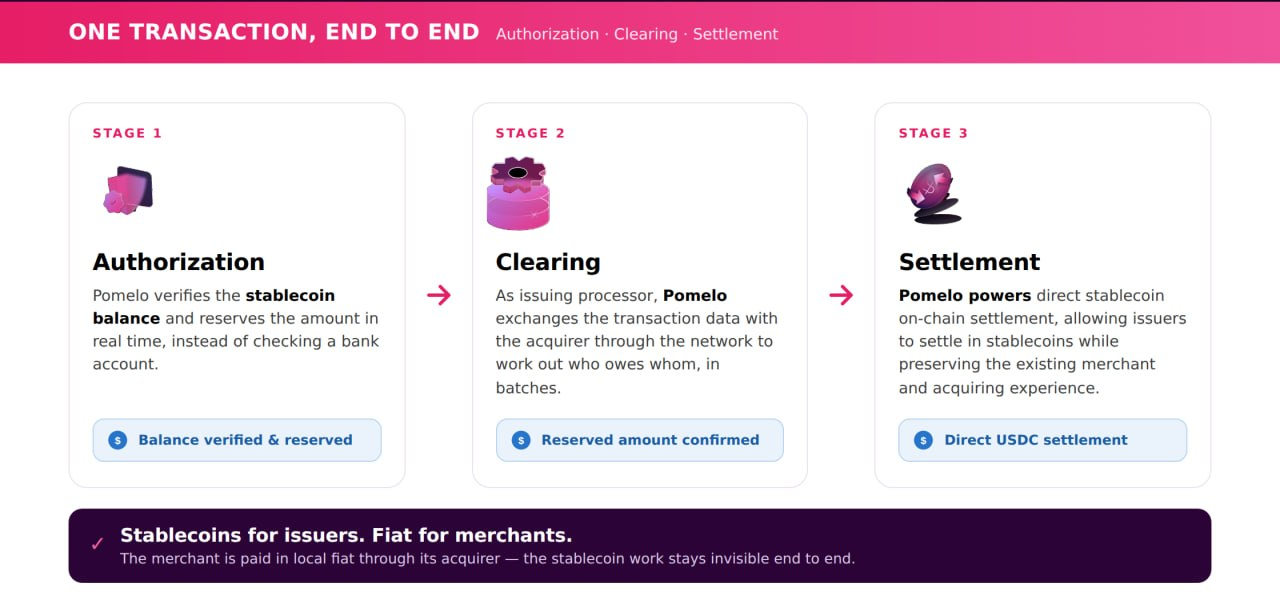
The result is a card that feels ordinary at the point of sale and modern underneath. The cardholder taps, the merchant is paid in their local currency, and the value that backs and settles the transaction moves as a dollar-denominated token in the background.
The Stablecoin Card Issuing Stack, Layer by Layer
"Stablecoin card" is shorthand for a stack of specialized infrastructure working together. Each layer solves a distinct problem, and a real program stitches several of them into a single flow:
- The program and front end is the neobank, fintech, or brand that owns the customer relationship and the app.
- The issuer-processor is the engine that authorizes transactions in real time, keeps the ledger, and applies the program's rules and controls.
- The BIN sponsor is the entity whose Visa or Mastercard bank identification numbers the cards are issued against.
- Custody and wallets are where the stablecoin balances are actually held.
- On- and off-ramps handle the conversion between fiat and stablecoins at the edges.
- Compliance is the KYC, AML, and sanctions-screening layer that keeps the whole thing inside the rules.
In the Latin American map further down, these functions resolve into roughly eight categories, each with its own set of specialist providers.
How Visa and Mastercard Turned Stablecoins Into Settlement Infrastructure
The clearest signal that stablecoin cards are no longer experimental is that the networks themselves have built stablecoins into their core settlement machinery, not as a crypto feature bolted on the side, but as an alternative rail for moving institutional value.
Visa began settling with issuers in USDC back in 2021, then expanded to additional blockchains and acquirers, and in December 2025 launched USDC settlement in the United States for issuer and acquirer partners, settling over Solana with early banking participants. By April 2026 that stablecoin settlement had scaled to a roughly $7B annualized run-rate.
The pitch to issuers is operational, not speculative: faster funds movement, seven-day availability, and resilience across weekends and holidays, with no change to the consumer card experience.
Mastercard has taken a parallel route. In April 2025, it unveiled end-to-end stablecoin capabilities spanning wallet enablement, card issuance, and merchant settlement, letting merchants opt into receiving settlement in USDC regardless of how the customer paid. Then, in June 2026, it expanded those settlement capabilities to include intraday, weekend, and holiday settlement in regulated stablecoins such as USDC, PYUSD, and RLUSD.
Underneath the pilots, the direction of travel is unmistakable. The spend flowing through stablecoin-linked cards climbed from around $100M a month in early 2023 to roughly $1.5B a month by late 2025, an annualized figure on the order of $18B, per industry tracking. The rails are being used.

What the GENIUS Act Means for Card Issuers
Regulation was the missing piece, and in 2025 the United States supplied it. The GENIUS Act, signed into law on July 18, 2025, is the first federal framework governing how U.S. payment stablecoins are issued, backed, and supervised.
It restricts issuance to permitted issuers, requires full reserves in cash and short-term Treasuries that cannot be lent out or rehypothecated, bans paying yield to holders, and brings issuers under anti-money-laundering obligations. Implementing rules are due through 2026, with enforcement following.
For a bank or fintech weighing a stablecoin card program, that clarity matters more than any single feature. It turns "is this even allowed?" into a known set of requirements, which is precisely the condition under which regulated institutions are willing to build.
The reserve and redemption standards also reinforce the thing a card program most needs from its settlement asset: that a dollar-denominated token reliably behaves like a dollar.
Why Latin America Is the Proving Ground for Stablecoin Cards
If stablecoins solve for slow settlement, cross-border friction, and dollar access, those problems exist in every market. Latin America is simply where they are felt most acutely, which is why the region has become the laboratory where stablecoin card infrastructure gets designed, stress-tested, and hardened before it travels anywhere else.
Inflation, currency volatility, and capital controls have made dollar-denominated savings a practical necessity in several markets, cash is steadily giving way to digital payments, and real-time rails like Brazil's Pix have primed users for money that moves instantly.
Cards remain the region's dominant digital payment method, which makes a stablecoin-backed card a natural bridge rather than a leap.
We put together an ecosystem map tracking more than 50 companies building this stack across Latin America, grouped into eight categories. Regional crypto volume reached an estimated $1.5 trillion between July 2022 and June 2025, and B2B stablecoin flows across the region are projected to reach $57 billion by 2030.
- $1.5T, Regional crypto volume, Jul 2022 to Jun 2025
- 50+, Companies mapped across 8 categories
- $318.8B, Brazil stablecoin volume
- $57B, Projected regional B2B flows by 2030
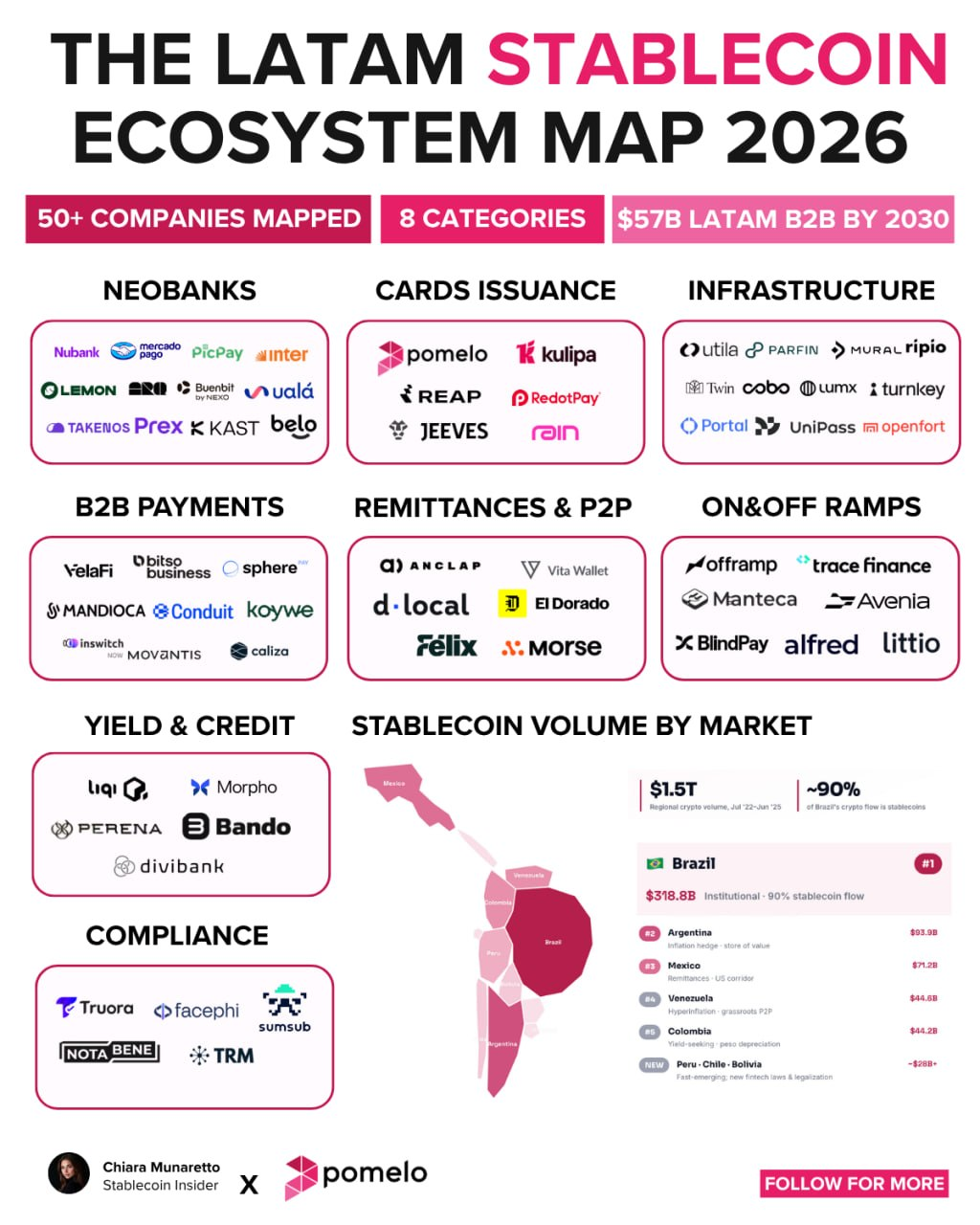
Brazil's share of that volume is striking: an estimated 90% of the country's crypto flow now runs through stablecoins, most of it institutional. Argentina and Venezuela tell a different story, where stablecoins work more as an inflation hedge and a grassroots savings tool than an institutional payments rail.
Same technology, very different demand, and that is precisely what makes the region such an effective launchpad. Infrastructure flexible enough to serve both Brazil's institutional flows and Argentina's grassroots dollar demand is, almost by definition, flexible enough to serve nearly any market in the world.
From Local to Global: The Card Issuance Model Shift
Historically, expanding a card program into a new country meant building local infrastructure, navigating local regulation, and setting up local banking relationships from scratch. That model still works, and remains the right call, for issuers going deep in a single market. It just does not scale well across a dozen countries at once.
Global card issuance flips that. Pomelo's Global Card, for example, makes it possible to issue Visa or Mastercard cards into more than 150 countries with no physical presence or local infrastructure at either the origin or the destination. Pre-assigned BINs mean programs can launch without waiting on a per-market bank sponsor.
Virtual cards can be issued instantly and used within seconds, in person through digital wallets or online, and the solution also covers international production and door-to-door delivery of physical cards across markets.
Because Pomelo controls its infrastructure end to end, programs can configure their own rules, controls, and features rather than bending to a standardized template.
The financial-operations side collapses too. Reconciliation with the card networks, collateral management, and settlement all run through a single structure, unified in USD and USDC, instead of a separate financial setup for every market. That is the part most directly reshaped by stablecoins: one dollar-and-USDC settlement layer standing in for a patchwork of local banking relationships.
"The interest we're seeing from companies in the Americas, Europe, and the Middle East confirms that the need for global issuing infrastructure transcends geographies, industries, and business models. More and more companies are looking to expand with greater speed and less complexity, and Global Card was created to support that transformation."
Alfonso Torreguitar, Head of Regional Accounts, Pomelo
That ambition is backed by scale. Pomelo, founded in Argentina in 2021, now serves more than 170 corporate clients, including banks such as BBVA and Santander and technology companies such as Binance and Western Union, and in early 2026 raised a $55 million Series C to expand its issuing stack and build toward a stablecoin-native global card.
It is a familiar arc for the region: infrastructure hardened in some of the world's most demanding payment conditions, now issuing cards into more than 150 countries.
In other words, the settlement rails described throughout this piece are moving from roadmap to product.
Why Local and Global Issuance Work Better Together
The more interesting shift is that issuers are not choosing one model over the other. There is no single right issuing model. Local issuance brings regulatory depth, adaptation to specific spending habits, and customization for each market, while global issuance brings international reach, speed of expansion, and centralized operations.
So the emerging playbook is hybrid. A global model is used to validate a market quickly and start acquiring users, while a local model is layered in once a market proves out, for the regulatory depth and payment habits only a local setup can match.
The real advantage is not picking local or global. It is having the flexibility to run the right model at each stage of growth, ideally on a single platform.
What This Means for the Next Chapter of Card Issuing
The infrastructure behind stablecoin cards is no longer experimental. It spans neobanks, issuer-processors, custody and wallets, on- and off-ramps, and compliance layers.
The card networks have wired stablecoins into core settlement, regulation has given issuers a framework to build against, and in Latin America, the proving ground where this stack was assembled first, more than 50 companies are now mapped across it.
As stablecoin settlement scales worldwide, with B2B flows in Latin America alone projected to reach $57 billion by 2030, the issuers best positioned to capture that growth are the ones that pair global reach with local depth.
Because the industry's next challenge is no longer issuing a card in one country. It is building financial experiences that can support users and businesses in any market in the world, on infrastructure that finally moves at the speed those users already expect.
FAQs:
1. What is a stablecoin card?
A payment card, usually Visa or Mastercard, where the underlying balance and settlement run on a stablecoin such as USDC instead of a traditional bank account. At checkout it works like any other card, and the stablecoin sits in the funding and settlement layer underneath.
2. How does settlement work on stablecoin rails?
The issuer settles its network obligations directly in USDC on-chain, while the merchant is still paid in local fiat through their acquirer. That replaces a multi-day bank clearing cycle with near-real-time movement that's available seven days a week.
3. Does a stablecoin card change the experience for the cardholder or merchant?
No. Authorization, acceptance, and the checkout experience are identical to any Visa or Mastercard transaction. The stablecoin infrastructure stays invisible to both the buyer and the seller.
4. Which Latin American market processes the most stablecoin volume
Brazil, with an estimated $318.8 billion and roughly 90% of its crypto flow running through stablecoins, most of it institutional. Argentina and Venezuela lean more toward stablecoins as an inflation hedge and grassroots savings tool.
5. Are stablecoin cards regulated?
Increasingly, yes. In the U.S., the GENIUS Act (July 2025) created a federal framework for payment stablecoins covering permitted issuers, full reserves, redemption, and anti-money-laundering obligations, with implementing rules rolling out through 2026. Card programs also operate within existing card-network and local financial regulations.
Disclaimer:
This content is provided for informational and educational purposes only and does not constitute financial, investment, legal, or tax advice; no material herein should be interpreted as a recommendation, endorsement, or solicitation to buy or sell any financial instrument, and readers should conduct their own independent research or consult a qualified professional.