Table of Contents
When U.S. exchanges began reporting fractional trades in their true decimal form this year, the data revealed how small the average retail order has become, since the median fractional trade in the first two weeks of the new regime was for less than 4/100ths of a share and just $4.86 in notional terms.
An entire class of platforms now serves orders that size, from Stash and Acorns to SoFi and Robinhood, most of them offering fractional shares from $1 to $5 with no account minimum.
At the same time, stablecoin market capitalisation reached $308.0 billion as of 13 August 2026, up 14.3% year over year, giving small savers a dollar-denominated alternative that pays a rate.
This article compares fractional shares, automatic deposits, and stablecoin yield on return, risk, cost, and liquidity, then shows which platforms execute each one best.
Key Takeaways
- Fractional shares let $5 buy diversified equity exposure; Stash trades from one cent.
- The GENIUS Act bans issuer-paid stablecoin yield, pushing returns into third-party wrappers.
- USDC yields ranged roughly 3.3% to 5.7% across major venues in August 2026.
- Automatic deposits beat timing: consistency drives small-balance growth more than asset selection.
- Flat subscription fees hit small balances hardest, so match them against platform benefits.
What Small-Balance Investing Means in 2026
Small-balance investing is the practice of building a portfolio with amounts too small to buy whole shares of major stocks or to meet traditional brokerage minimums, and two structural changes have turned it from a novelty into a legitimate strategy.
The first is market infrastructure, because on February 23, 2026, the industry began reporting fractional share trading through the Trade Reporting Facilities and Security Information Processors, establishing an industry-wide standard for market data, and the SIPs that aggregate and disseminate consolidated market data are now required to publish fractional trade quantities up to six decimal places.
Until that change took effect, sub-share trades were rounded or truncated, which meant the consolidated tape systematically misrepresented what retail investors were actually doing. Small orders are finally visible, measurable, and priced accordingly.
The second is the arrival of a competing home for idle dollars, since stablecoins gave savers a dollar-denominated instrument that settles instantly and can be deployed into yield venues without a traditional bank relationship. That created an allocation decision that simply did not exist five years ago.
What matters most in framing all of this is that the three tools are not substitutes for one another, because one is an asset class, one is a delivery mechanism, and one is a cash-management product. Treating them as interchangeable is the most common and most expensive small-balance mistake.
How Fractional Shares, Automatic Deposits, and Stablecoin Yield Actually Work
How Fractional Shares Work for Small Balances
A fractional share is ownership of less than one full share, so instead of specifying a share count, you specify a dollar amount and the broker allocates the matching fraction, with dividends, stock splits, and economic rights all accruing proportionally.
The practical effect on a small balance is that diversification stops being a function of capital, because a $50 deposit can hold six positions rather than sitting in cash while it waits to accumulate enough for one share of a $400 stock. That distinction matters more than it sounds, since concentration risk rather than market risk is what usually damages a beginner portfolio.
It is worth being clear that fractional shares solve an access problem rather than a volatility problem, because a 20% drawdown on $500 is proportionally identical to a 20% drawdown on $500,000. This makes them the right vehicle for money with a five-year-plus horizon and the wrong one for an emergency fund.
How Automatic Deposits Drive Small-Balance Growth
Automatic deposits are not an asset class but the scheduling layer that determines whether a small balance ever becomes a large one, and below roughly $10,000 they matter considerably more than security selection.
The arithmetic settles the argument quickly, because a 10% return on a $500 balance produces $50 while a $100 monthly contribution adds $1,200 across the same year. Contribution rate keeps dominating return rate until compounding takes over somewhere in the low five figures, which is why optimising asset selection before deposit consistency means solving the wrong problem entirely.
Automation also removes the two behaviours that quietly destroy small portfolios, namely waiting for a better entry price and skipping contributions during down months.
In practice, three mechanisms convert intent into deposits reliably:
- Scheduled recurring transfers set weekly, biweekly, or monthly, which remain the only method that scales cleanly as income grows.
- Direct deposit splitting, which routes part of a paycheck into the account before it ever reaches checking and can be spent.
- Spend-linked accumulation, including round-ups and card rewards paid in fractional shares rather than cash.
That third category is best understood as a habit device with modest economics, since it reinforces engagement without ever funding a portfolio on its own.
How Stablecoin Yield Works After the GENIUS Act
Stablecoin yield in 2026 does not come from the stablecoin itself, because the GENIUS Act, signed into law in July 2025, requires stablecoin issuers to maintain reserves on at least a one-to-one basis and prohibits issuers from offering any form of interest or yield to stablecoin holders, though it does not explicitly prohibit affiliate or third-party arrangements that might offer interest-bearing products.
As USDC by itself pays nothing and Circle does not pass through the T-bill interest its reserves earn, that revenue stays with the issuer rather than the holder.
The gap between the two created an entire product category, and yield-bearing stablecoins went on to drive more than half of net stablecoin supply growth in Q1 2026, expanding 22% during the quarter and adding around $4.3 billion in market cap.
It also created regulatory tail risk, given that the OCC's February proposal would extend the yield ban to affiliates that replicate yield economics.
The rates themselves have compressed considerably, and as of August 17, 2026, the strongest USDC yields sat at Fluid at roughly 5.0% base on Ethereum, Morpho Blue curated vaults on Base at 4.0% to 5.7%, and Maple syrupUSDC at roughly 4.8%, while custodial Coinbase Rewards paid around 4.1%, Aave v3 sat near 3.3% on Ethereum and 3.52% on Base, and Compound v3 paid 3.33% on Ethereum.
Set that against insured cash, where the FDIC-reported average APY across all U.S. savings accounts as of July 20, 2026 was 0.38% but the top nationally available high-yield savings rate reached 4.21% at Axos Bank, subject to balance and direct-deposit conditions.
The best insured savings account in August 2026 therefore paid roughly what a mid-tier on-chain lending venue paid, without smart contract exposure or issuer credit risk, which means the premium for taking on-chain risk has largely disappeared.
Three risks never appear in a posted APY, and history illustrates all of them. Anchor's 20% UST yield, Celsius's 8% to 17% custodial yield, and BlockFi's 8% all went to zero, while overcollateralized lending on Aave and Compound paid out continuously through Terra, 3AC, FTX, and USDC's March 2023 depeg.
Rates are variable rather than promised, as shown by the fact that Ethena's sUSDe funding engine averaged roughly 11% APY over 2023 to 2025 but ranged from -6% to +75%. On top of both, no stablecoin balance carries federal deposit insurance.
Fractional Shares vs Automatic Deposits vs Stablecoin Yield: Side-by-Side Comparison
| Fractional Shares | Automatic Deposits | Stablecoin Yield | |
|---|---|---|---|
| What it is | Equity and ETF ownership in slices | Contribution mechanism | Dollar cash management |
| Minimum to start | 1¢ on Stash, 5¢ above $1,000 per share Stash | Any recurring amount | Typically $1 to $100 plus gas |
| Typical 2026 return | Market dependent, high variance | Not a return, an input multiplier | Roughly 3.3% to 5.7% on major USDC venues Eco |
| Principal risk | High, full market drawdowns | None, mechanism only | Low nominal, real issuer and contract risk |
| Insured | SIPC on the brokerage account | Not applicable | No |
| Liquidity | Same day to T+1 | Not applicable | Instant to T+1 |
| Time horizon | Five years or more | Indefinite | Zero to 24 months |
| Best suited for | Long-term wealth building | Every investor, always | Emergency reserves and dry powder |
Laid out side by side, the conclusion becomes hard to miss, because automatic deposits are the engine, fractional shares are the long-horizon destination, and stablecoin yield is a short-horizon holding pen. The failure mode is using a 4% yield as a substitute for equity exposure across a ten-year window, where inflation-adjusted equity returns win comfortably.
Best Apps for Small-Balance Investing in 2026
Execution matters more than theory here, because platform design determines whether the automation ever actually happens, and these five cover the realistic options for anyone starting with under $1,000.
1. Stash: Best Overall for Fractional Investing With Built-In Automation
Stash was built fractional-first rather than as a full-service broker that bolted fractional trading on later, and the defaults reflect that, since purchases start at 1¢, or 5¢ for investments priced over $1,000 per share, with unlimited trades and no add-on trading commissions.
The catalogue covers roughly 4,000 stocks and ETFs, with Auto-Stash scheduling and dividend reinvestment built in, and there is no account minimum, alongside the option to round up purchases and invest the change.
Two features do disproportionate work at small balances, because Stash includes a 3% retirement match worth up to $225 per year plus Stock-Back® rewards worth up to $120 per year, while direct deposit setup takes about five minutes and can route all or part of a paycheck straight into the account, with pay available up to two days early.
A guaranteed 3% match is a return no yield venue can promise, and paycheck routing quietly eliminates the discretionary decision behind most missed contributions.
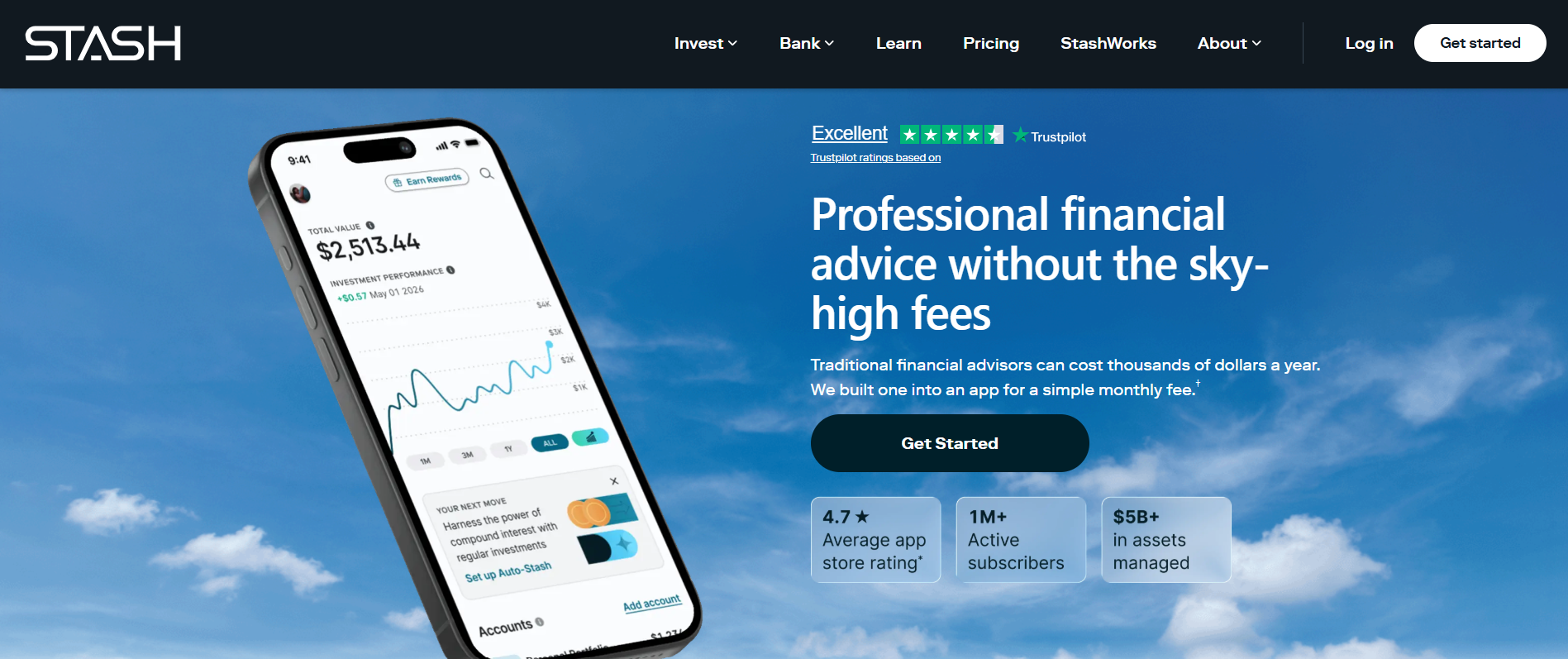
Pricing runs on a single flat subscription, as the Stash Plan costs $12 per month or $108 billed annually, with an additional 0.25% annual advisory fee on Smart Portfolios holding $1,000 or more and on Managed Retirement Accounts.
The platform suits investors who want guided, automated long-term investing and will genuinely use the retirement account and card, though it is worth knowing that Stash does not support cryptocurrency trading, options, or advanced order types, because it is built for long-term buy-and-hold investing rather than active trading.
If you are opening your first account, you can Invest $5 and earn $25, subject to terms and conditions.
2. Acorns: Best for Pure Round-Up Automation
Acorns is the most hands-off option in the category, built around round-ups that feed managed ETF portfolios, and the trade-off is asset choice, since with Acorns you invest in ETF portfolios rather than individual stocks, which limits how you diversify.
The monthly subscription runs high relative to meaningful balances, although the habit-formation value is real for people who struggle to save anything at all.
Acorns also matches up to 1% or 3% of new IRA contributions in the first year depending on tier, with contributions required to stay in the account for four years to earn the match.
3. SoFi Invest: Best for Zero Subscription Fees
SoFi carries no account minimum for active or automated investing, a $5 minimum to own a fractional share, zero commissions on stocks and ETFs, and no management fee on automated investing.
That zero management fee model is exceptionally cost-effective for small balances and pairs with SoFi's wider ecosystem of savings, credit, and lending products, though the trade-off is noticeably less structured guidance than a subscription platform provides.
4. Robinhood: Best for Self-Directed Stock Picking
Robinhood offers no account minimum, fractional shares from $1, commission-free options and crypto trading, and a 1% match on IRA contributions, with Robinhood Gold at $5 per month adding a robo-advisor option and Morningstar-powered research.
Since its educational content is thinner than Fidelity's or Schwab's, it fits investors who already know what they want to buy rather than those still learning.
5. Public: Best for Themed Diversification and In-App Learning
Public offers fractional shares called slices with a $5 entry point, organises holdings into themes rather than automated portfolios, charges no monthly or annual fees, and offers commission-free trading.
It also teaches as you go, with tappable definitions of key terms and safety labels on riskier holdings, but because there is no automated portfolio, the deposit discipline has to come entirely from you.
How Subscription Fees Affect Small Investment Balances
Flat-fee platforms present the sharpest trade-off in small-balance investing, and it deserves an honest accounting rather than a footnote buried at the bottom of a review.
On a $300 balance, a $108 annual subscription is a heavy percentage drag, and this remains the most consistent criticism levelled at subscription brokerages, since one flat fee costs the same at every balance and therefore weighs most on the smallest accounts.
The counter-argument is that a subscription is not priced against a bare brokerage account, so running the offsets on the Stash Plan gives a far clearer picture:
| Component | Annual value |
|---|---|
| Subscription cost | $108 billed annually |
| 3% retirement match | Up to $225 |
| Stock-Back® rewards | Up to $120 |
| $10,000 life insurance policy | Included |
| New-account bonus | $25 on a $5 deposit |
Read that way, the subscription turns net negative if you treat it as a plain brokerage account and net positive if you use the retirement match, the card, and the guidance layer, which makes it a usage question rather than a balance question. It is also the single calculation most people skip before choosing a platform.
The same logic holds across the whole category, because flat-fee platforms get cheaper in percentage terms as balances grow while percentage-fee platforms get more expensive over time. The right answer at $500 is rarely the right answer at $50,000, which is why this decision deserves an annual review rather than a one-time choice.
How to Build a Small-Balance Portfolio in Six Steps
Step 1: Fund the insured cash layer first
Hold one to three months of expenses in an FDIC-insured account, because at top rates near 4.21% that layer earns comparable yield to mid-tier on-chain venues without any of the counterparty exposure.
Step 2: Automate before you allocate
Set a recurring transfer or split your direct deposit, keeping in mind that the schedule matters more than the amount, since the amount is easy to raise later and the habit is not.
Step 3: Capture any available match
Contribute to the retirement account up to the full match before adding to a taxable brokerage account, because a guaranteed 3% arrives before any market risk is taken at all.
Step 4: Deploy into diversified fractional positions
Start with broad-market ETFs and add individual names second, using only money you will not need for five years.
Step 5: Treat stablecoin yield as a satellite rather than a core
Size the position to the risk instead of the APY, and assume the third-party yield channel could be narrowed by follow-on regulation.
Step 6: Reassess annually
Compare your total platform cost against your balance every twelve months and switch as soon as the arithmetic stops working in your favour.
Regulatory and Market Changes to Watch Through 2027
- Final GENIUS Act rulemaking: Agency comment periods closed in mid-2026, and the precise scope of the yield ban is still unresolved.
- The affiliate-yield question: The OCC's February proposal would extend the yield ban to affiliates that replicate yield economics, making it the largest single repricing risk to yield-bearing wrappers.
- Odd-lot quote transparency: The best odd lot bid and offer, known as BOLO, went live in May 2026, improving execution visibility for exactly the small retail orders that dominate fractional trading.
- Rate direction: High-yield savings rates were trending slightly downward as of August 2026, which compresses the safe-cash alternative and shifts the relative case back toward equities.
Conclusion
Stash remains the most complete option for the investor this article describes, someone starting with an amount most brokerages were never designed to serve and who needs automation and fractional access far more than an options chain.
Across the three approaches the comparison resolves cleanly, since automatic deposits determine outcomes at small balances, fractional shares are where long-horizon money belongs, and stablecoin yield works best as a short-duration cash tool whose premium over insured savings has largely vanished in 2026.
The digital-dollar era did not replace equity investing for small balances so much as add a competitive parking spot for the cash layer sitting underneath it, and the investors who keep those three jobs separate will compound faster than those who mistake a 4% APY for a portfolio.
Read Next:
- Circle Expands in South Korea
- AllUnity Launches EURAU Stablecoin on Stellar Network
- USDi: Inflation-Linked Stablecoin
FAQs:
1. What is the best way to start investing with a small balance in 2026?
The best way to start investing with a small balance in 2026 is to automate a recurring deposit into diversified fractional shares instead of waiting to accumulate enough for whole shares, since platforms such as Stash allow purchases from one cent, or five cents for securities priced above $1,000 per share, with no add-on trading commissions. Contribution consistency drives results far more than security selection until a balance reaches roughly five figures.
2. Do stablecoins pay yield to holders under the GENIUS Act?
Stablecoins do not pay yield to holders under the GENIUS Act, because the law prohibits issuers from offering any form of interest or yield to stablecoin holders, although it does not explicitly prohibit affiliate or third-party arrangements that might offer interest-bearing products. Any yield therefore has to come from lending the token, supplying it to a vault, or swapping it for a regulated yield-bearing wrapper.
3. What is the minimum amount needed to buy fractional shares on Stash?
The minimum amount needed to buy fractional shares on Stash is one cent, since the platform allows purchases of stocks and funds starting at 1¢, or 5¢ for investments priced over $1,000 per share. There is no account minimum, and a $5 deposit into a new personal brokerage account also qualifies for a $25 bonus, subject to terms and conditions.
4. Is stablecoin yield safer than investing in fractional shares?
Stablecoin yield is safer than fractional shares on nominal price volatility but not on absolute principal safety, because custodial yield programmes including Celsius at 8% to 17% and BlockFi at 8% went to zero, while overcollateralised lending on Aave and Compound kept paying through the same stress events. Since no stablecoin balance carries federal deposit insurance, the fair comparison is against an insured savings account rather than against equities.
5. Why do automatic deposits matter more than stock picking for small balances?
Automatic deposits matter more than stock picking for small balances because contribution size outweighs return percentage at low account values, with a 10% gain on $500 producing $50 against the $1,200 added by a $100 monthly deposit. Automating the transfer also removes the discretionary decision behind most missed contributions, which is why it outperforms optimisation until compounding takes over.
Disclaimer:
This content is provided for informational and educational purposes only and does not constitute financial, investment, legal, or tax advice; no material herein should be interpreted as a recommendation, endorsement, or solicitation to buy or sell any financial instrument, and readers should conduct their own independent research or consult a qualified professional.