Table of Contents
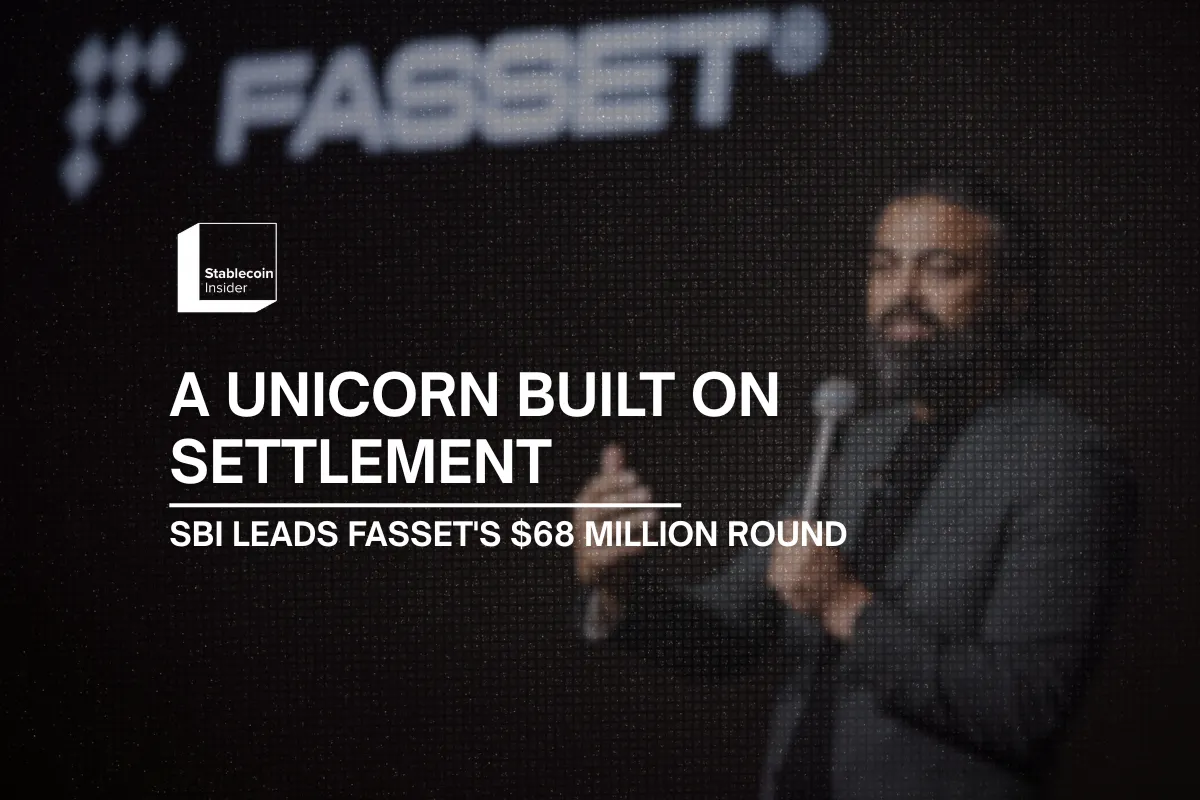
Fasset raised $68 million in a Series C led by SBI Group at a $1 billion valuation, the stablecoin neobanking platform announced on August 24, 2026. The round arrives roughly three months after a $51 million Series B, bringing total funding this year to $119 million.
The company processes more than $40 billion in annualised transaction volume across 3 million wallets and over 1,000 enterprises in 125 countries. Chief executive Mohammad Raafi Hossain said revenue has grown roughly sixfold over the past year and that the business has been profitable for twelve consecutive months.
The design choice underneath is what distinguishes it. Stablecoins operate as the settlement layer beneath ordinary banking products rather than as assets customers hold and manage directly.
"The next phase is about any-to-any banking. Any person to any person. Any asset to any asset. Any rail to any rail, anywhere." - Mohammad Raafi Hossain, CEO of Fasset
Key Takeaways
- Fasset raised $68 million at a $1 billion valuation, led by SBI Group and announced August 24.
- Annualised volume reached $40 billion, up from $32 billion reported at the May Series B.
- The company reports twelve straight profitable months and roughly sixfold revenue growth year over year.
- Own Network connects 16 blockchains and 100-plus banking corridors as an Arbitrum-based Layer 2.
- Stablecoins sit beneath the product, handling settlement while customers use accounts and cards.
What Fasset Built
The platform gives individuals, businesses, and institutions accounts that hold, move, spend, and invest across currencies and asset classes. Customers interact with banking products while stablecoins handle settlement underneath, which is a different proposition from a crypto exchange or wallet.
Own Network is the infrastructure layer. Fasset describes it as a proprietary AI-enabled Ethereum Layer 2 built on Arbitrum, connecting banks, telecom operators, payment firms, and liquidity providers across 16 blockchain networks and more than 100 banking corridors.
Routing is where the AI component operates. The system directs transactions across payment rails, currencies, and liquidity providers based on cost, speed, and availability rather than following a fixed path.
The target market is specific. Fasset focuses on emerging markets across Asia, the Middle East, and Africa, where cross-border transfers typically pass through several correspondent banks, and it offers a Shariah-compliant model that has gained traction in the Gulf and South Asia.
Why SBI Keeps Buying
SBI Group first invested in Fasset in May and has now led the round that made it a unicorn. The Japanese financial conglomerate holds positions across the digital asset stack including Ripple, Circle, Morpho, and liquidity provider B2C2.
The strategic logic runs through distribution. SBI Remit, the group's international transfer arm, signed a memorandum with Fasset in June to build stablecoin remittance infrastructure, bringing a payout network spanning roughly 470,000 locations and bank transfers to around 200 countries.
SBI framed the investment around its own ambitions rather than financial return alone, saying Fasset's vision of money moving across borders as easily as information points in the same direction as the on-chain economic zone the group is building through digital finance.
The pattern is consistent with SBI's broader stablecoin work. The group launched the JPYSC yen stablecoin and partnered on tokenised equity settlement, covered in our Ondo and SBI tokenisation analysis, so backing emerging-market stablecoin rails extends the same strategy outward.
Why This Matters for Stablecoins
The profitability claim is the most unusual detail in the announcement. Twelve consecutive profitable months is rare in stablecoin infrastructure, where most companies are still funding growth ahead of revenue, and it suggests corridor banking generates margin rather than only volume.
The invisibility of the stablecoin is the second. Customers move between bank accounts, cards, and other assets while tokens settle underneath, which matches the pattern emerging across the sector where the winning products hide the mechanics entirely.
The geographic focus is where the demand actually is. Emerging market corridors carry the highest correspondent banking costs and the longest settlement delays, which is why local stablecoin adoption has consistently outpaced developed markets, a distribution pattern we mapped in our stablecoin infrastructure landscape.
The valuation also says something about how the category is being priced. Reaching $1 billion through payments rather than trading volume places Fasset among a small group of crypto-adjacent companies valued on settlement infrastructure rather than speculation.
What the Money Funds
Own Network expansion is the primary use. Fasset intends to grow the regulated network connecting banks, telcos, payment providers, and liquidity sources to enable settlement across more international markets.
Agentic AI systems are the second focus. The company plans increased investment in AI-enabled infrastructure supporting corridor banking, stablecoin settlement, and tokenised asset services.
Lending and trade finance were flagged at the Series B and remain on the roadmap. Working capital products for the small and medium businesses already using the platform would extend it from payments into credit.
Regional expansion follows the SBI relationship. The two companies plan to connect additional payment corridors across Japan, Asia, and other emerging markets, though no specific new corridors or products have been named, and the Japanese corporate adoption we covered in our AZ-COM Maruwa JPYC analysis shows how quickly that market has moved.
Conclusion
Fasset's raise is a funding announcement with unusually concrete numbers behind it. Forty billion dollars in annualised volume, sixfold revenue growth, and a year of profitability are operating results rather than projections.
The strategic reading is that stablecoin infrastructure is consolidating around companies that make the technology invisible. Fasset sells accounts, cards, and corridors, and the stablecoin is an implementation detail its customers largely do not see.
What the valuation has to justify is durability. Emerging market corridor banking is competitive and margin-sensitive, and turning a growing transaction network and institutional backing into a lasting payments business is the work the next phase actually requires.
FAQ:
1. How much did Fasset raise?
Fasset raised $68 million in a Series C led by Japan's SBI Group at a $1 billion valuation, announced August 24, 2026. The round follows a $51 million Series B in May, bringing total funding raised in 2026 to $119 million and making Fasset a fintech unicorn.
2. What does Fasset do?
Fasset is a stablecoin neobanking platform giving individuals, businesses, and institutions accounts to hold, move, spend, and invest across currencies and asset classes. Stablecoins act as the settlement layer underneath ordinary banking products rather than as assets customers manage directly, with a focus on emerging markets across Asia, the Middle East, and Africa.
3. What is Own Network?
Own Network is Fasset's proprietary AI-enabled Ethereum Layer 2 built on Arbitrum, connecting banks, telecom operators, payment firms, and liquidity providers. It spans 16 blockchain networks and more than 100 banking corridors, and the Series C funding is primarily directed at expanding it.
4. How large is Fasset's business?
The company processes more than $40 billion in annualised transaction volume, up from $32 billion at its May Series B, serving over 3 million wallets and more than 1,000 enterprises across 125 countries. CEO Mohammad Raafi Hossain said revenue has grown roughly sixfold over the past year and the company has been profitable for twelve consecutive months.
5. Why is SBI Group investing?
SBI Group has positioned global expansion of digital-asset financial services as a core growth strategy and holds stakes across the sector including Ripple, Circle, Morpho, and B2C2. Its subsidiary SBI Remit signed a partnership with Fasset in June to build stablecoin remittance infrastructure, bringing a payout network of roughly 470,000 locations and transfers to about 200 countries.
Disclaimer:
This content is provided for informational and educational purposes only and does not constitute financial, investment, legal, or tax advice; no material herein should be interpreted as a recommendation, endorsement, or solicitation to buy or sell any financial instrument, and readers should conduct their own independent research or consult a qualified professional.