Table of Contents
The Middle East Stablecoin Association (MESA) used its inaugural annual conference on September 17, 2026 to explain why it exists and what it plans to do next.
Chairman Dr. Bhaskar Dasgupta built the keynote around one problem: Seven regulatory frameworks now govern digital money across the UAE, Bahrain, and Qatar, and the region had no neutral place to compare them.
Alongside the keynote, MESA has set out a Memorandum of Understanding (MoU) with Terminal 3, a Hong Kong-incorporated digital identity and credential verification company. The agreement, dated July 2026, covers joint research, public education, and a policy paper for GCC regulators on standardizing digital identity and credential verification in financial services.
Neither the keynote nor the MoU announces a product, a license, or a commercial deal. MESA is a non-profit that cannot advise firms, endorse providers, or lobby for members, and the Terminal 3 agreement repeats those limits clause by clause. What MESA presented instead was a map of where Gulf rules already diverge, starting with yield, and a plan to work on the identity layer that every stablecoin payment depends on.
The Gulf did not lack stablecoin rules. It lacked a room where anyone could read them side by side, and a shared answer to who is on the other end of a payment.
Key Takeaways
- MESA says seven Gulf frameworks regulate stablecoins on different terms.
- Bahrain expressly permits stablecoin yield, and ADGM does not prohibit it.
- MESA finds no Middle Eastern regulator operates a depeg regime.
- MESA has scoped 15 payment corridors, 13 of them anchored on the UAE.
- A Terminal 3 MoU targets a GCC policy paper on digital identity standards.
What Is the Middle East Stablecoin Association?
The Middle East Stablecoin Association is a non-profit industry body in the Dubai International Financial Centre (DIFC). It is registered as a Non-Profit Incorporated Organisation (NPIO) under DIFC Law No. 6 of 2012, with registration number 13658 and operating licence OL13658. According to its MoU documentation, MESA was incorporated on June 19, 2026, and is based at Burj Daman in the DIFC.
MESA's authorized purposes are set out in its Charter of Organisation, approved by the DIFC Registrar:
- Education and public awareness
- Research and publications
- Policy dialogue and regulatory engagement
- Standards development
- International knowledge exchange
The limits matter as much as the mandate. MESA gives no institution-specific guidance, endorses no product, lobbies for no member's commercial interest, and puts nothing behind a paywall. The keynote stressed that these are statutory limits under DIFC law, not house preferences. Under Article 9(1) of the NPIO Law, the association is prohibited from commercial or financial gain.
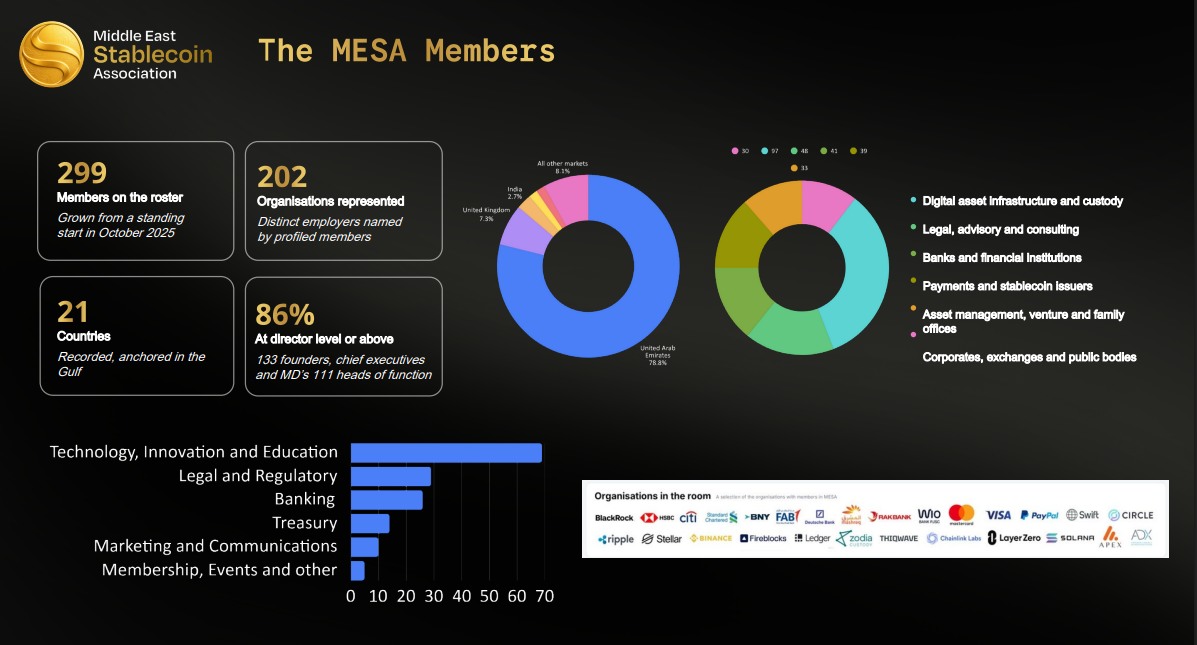
The membership roster started in October 2025 and has grown to 299 members from 202 organizations across 21 countries. About 79% of members are based in the UAE, followed by the United Kingdom at 7.3% and India at 2.7%. MESA says 86% of members are at director level or above.
Why the Gulf Needed a Neutral Stablecoin Forum
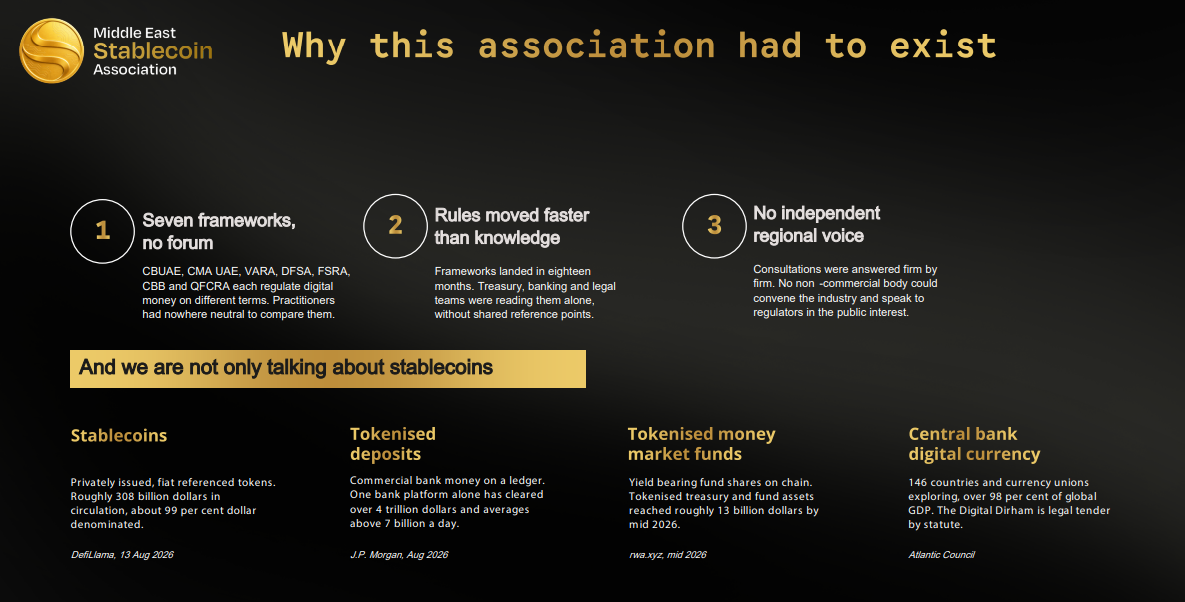
Dasgupta gave three reasons for founding the association.
- Fragmentation: Seven regulators each set their own terms for digital money, and practitioners had nowhere neutral to compare them.
- Speed: The frameworks landed within about eighteen months. Treasury, banking, and legal teams were reading them alone, without shared reference points.
- No regional voice: Consultations were answered firm by firm, and no non-commercial body could convene the industry and speak to regulators in the public interest.
The scope is wider than stablecoins. MESA covers four forms of digital money:
- Stablecoins: Privately issued, fiat-referenced tokens. Supply is roughly $308 billion, according to DefiLlama data from August 13, 2026.
- Tokenized deposits: Commercial bank money on a ledger. One bank platform alone has cleared over $4 trillion and averages more than $7 billion a day, according to J.P. Morgan.
- Tokenized money market funds: Yield-bearing fund shares on chain. Tokenized treasury and fund assets reached about $13 billion by mid-2026, per rwa.xyz.
- Central bank digital currencies (CBDCs): 146 countries and currency unions are exploring one, covering over 98% of global GDP, per the Atlantic Council. The UAE's Digital Dirham is legal tender by statute.
The Seven Gulf Stablecoin Frameworks, Compared
Five of the seven frameworks sit inside the UAE, spread across federal regulators, Dubai, and two financial free zones. None of the seven is in Saudi Arabia.
| Regulator | Jurisdiction | Framework |
|---|---|---|
| CBUAE | UAE (federal) | Payment Token Services Regulation |
| CMA UAE | UAE (federal) | Virtual Assets Framework, February 13, 2026 |
| VARA | Dubai, outside the DIFC | Fiat-referenced virtual assets |
| DFSA | Dubai, inside the DIFC | Crypto token regime |
| FSRA | Abu Dhabi Global Market (ADGM) | Fiat-referenced token regime, January 1, 2026 |
| CBB | Bahrain | Stablecoin Issuance and Offering Module, July 2025 |
| QFCRA | Qatar Financial Centre | Digital Assets Framework, stablecoins as Excluded Tokens |
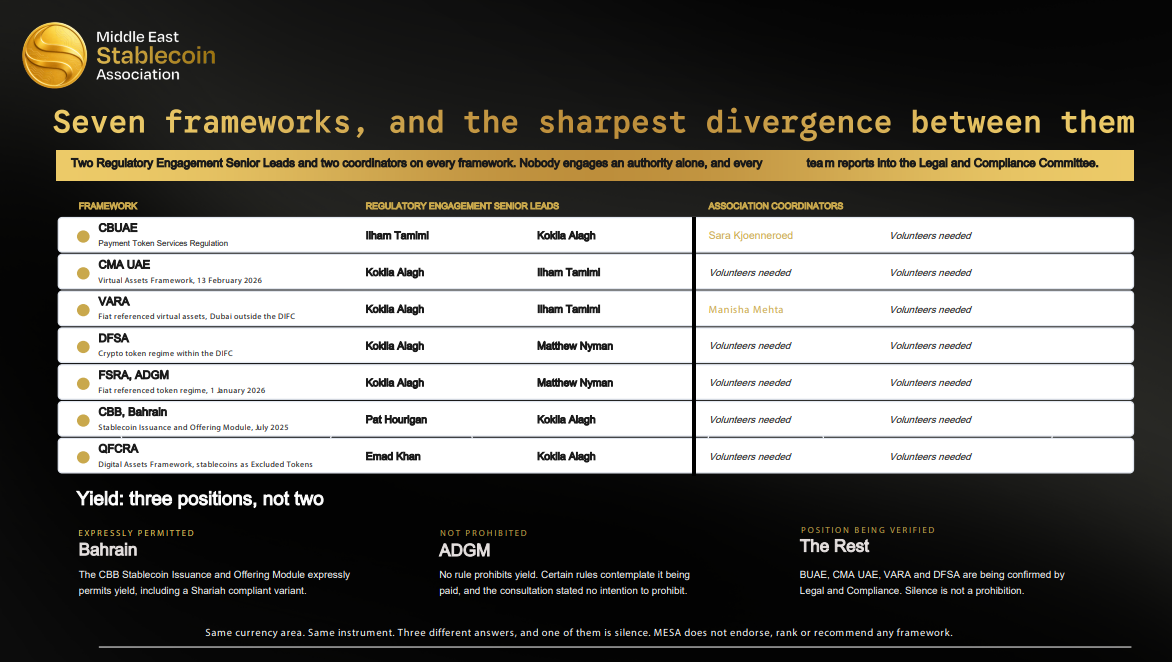
MESA has assigned two Regulatory Engagement Senior Leads to every framework, with two coordinators under them. No member engages an authority alone, and every team reports into the Legal and Compliance Committee. Most coordinator seats are still open for volunteers.
Where Gulf Regulators Stand on Stablecoin Yield
Yield is where the frameworks diverge most. MESA sorted them into three positions, not the two most observers would expect.
- Expressly permitted (Bahrain): The CBB's Stablecoin Issuance and Offering Module expressly permits yield, including a Shariah-compliant variant.
- Not prohibited (ADGM): No FSRA rule prohibits yield. Some rules contemplate yield being paid, and the consultation stated no intention to ban it.
- Position being verified (CBUAE, CMA UAE, VARA, DFSA): MESA's Legal and Compliance Committee is still confirming where these regulators stand. The keynote was explicit that silence is not a prohibition.
The result is one currency area and one instrument with three different answers, one of which is silence. MESA stressed that it does not endorse, rank, or recommend any framework. A paper on reserve-derived yields on regulated stablecoins is in production.
The yield question is live outside the Gulf too. In the United States, the stablecoin yield loophole was central to the fight over the CLARITY Act cloture vote.
No Middle Eastern Regulator Has a Depeg Regime
The keynote's sharpest finding came from MESA's Depeg Analysis Paper. According to MESA, no Middle Eastern regulator operates a depeg regime, only peg prevention regimes.
In practice, Gulf rules focus on keeping a stablecoin at par through reserves, redemption rights, and disclosure. They do not set out what happens after a token breaks its peg, such as who absorbs losses or how redemptions are prioritized. For issuers and banks building on these frameworks, that gap falls on the most important day in a stablecoin's life.
For a look at how losses land when payments fail, see our explainer on who bears the loss when a stablecoin payment goes wrong.
The paper sits alongside MESA's Stablecoin Discussion Paper, now in its third revised edition, which the association positions as the reference document for the regional framework landscape. MESA has also published a concept note on agentic AI and digital money.
The Money Flows Behind the Gulf Stablecoin Push
MESA presented stablecoin supply growing roughly two and a half times, from $124 billion to $308 billion. It pointed to three flows that anchor demand in the region.
- Retail remittances: The UAE's $38.5 billion in outward remittances ranks second in the world, and Saudi Arabia ranks third, based on 2023 World Bank data.
- Business-to-business payments: Global cross-border B2B payment value is forecast to rise from $39 trillion in 2023 to $56 trillion by 2030, citing Convera and FXC Intelligence.
- Investment flows: Fund subscriptions and redemptions, capital calls, and startup funding now settle on stablecoin rails, which MESA called "the third leg."
On usage, MESA cited $10.9 trillion in adjusted stablecoin transaction volume during 2025, up 91%. Only $350 billion to $550 billion of that is estimated to be real-economy payments. That gap between on-chain volume and actual commerce is what the corridor program is designed to measure.
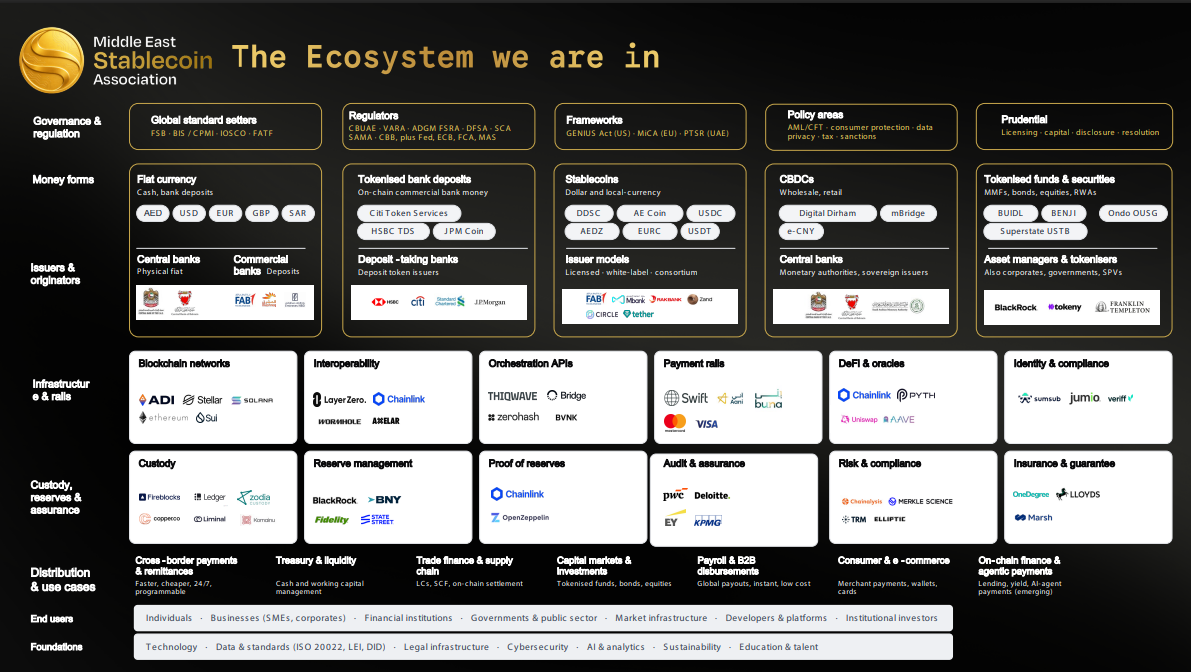
The Ecosystem MESA Is Mapping
The keynote set out the full digital money stack MESA works across, from global standard setters down to end users.
- Global standard setters: FSB, BIS/CPMI, IOSCO, and FATF.
- Regulators: Gulf regulators including SAMA and SCA, alongside the Fed, ECB, FCA, and MAS.
- Reference frameworks: the GENIUS Act in the US, MiCA in the EU, and the UAE's Payment Token Services Regulation.
- Local-currency stablecoins: examples such as DDSC, AE Coin, and AEDZ, alongside dollar and euro tokens such as USDC, USDT, and EURC.
- Tokenized bank money: Citi Token Services, HSBC's tokenized deposit service, and JPM Coin.
- Tokenized funds: BlackRock's BUIDL, Franklin Templeton's BENJI, Ondo OUSG, and Superstate USTB.
- CBDCs: the Digital Dirham, mBridge, and China's e-CNY.
One infrastructure layer on the map is identity and compliance, covering KYC, KYB, and the travel rule. That is the layer MESA's first bilateral MoU addresses.
MESA and Terminal 3: A Digital Identity MoU, Not a Commercial Deal
MESA's Memorandum of Understanding with Terminal 3 HK Limited focuses on digital identity, credential verification, and knowledge exchange. Terminal 3 is incorporated in Hong Kong (registration number 74472019). It is described in the MoU as a digital identity and verifiable credential infrastructure company with operations in financial services and regulatory compliance in the UAE and internationally.
The signatories named in the document are Dasgupta for MESA and Joey Liu, Chief Operating Officer, for Terminal 3.
What the two parties will produce
The MoU sets three workstreams.
- Public education: Freely available materials on digital identity verification, KYC frameworks, verifiable credential issuance, and cross-jurisdiction verification standards for financial services. Terminal 3 contributes technical knowledge, industry data, and subject matter expertise.
- Joint research: A jointly authored, publicly available research paper on digital identity and credential verification in financial services. It will cover principles, current regulatory frameworks, implementation challenges, and proposals for regulatory improvement.
- GCC policy paper: A policy paper for submission to GCC and regional regulators proposing the standardization of digital identity and credential verification frameworks. Each party's position must be its own, evidence-based view. The paper cannot be structured to serve either party's commercial interests over the broader public benefit.
Why digital identity matters for stablecoins
Every regulated stablecoin transfer depends on knowing who sits at each end. The seven Gulf frameworks each impose their own KYC and AML/CFT expectations. MESA's 15 corridors also cross into jurisdictions with different verification standards. A credential verified once and accepted across jurisdictions would remove one of the operational blockers the corridor program is designed to find.
The agreement also points east. It allows both parties to take part in policy and industry dialogues in Hong Kong and the wider Asia-Pacific region. That lines up with MESA's Hong Kong and Greater China corridor briefings and its new Bahrain-to-Hong Kong route.
The guardrails written into the MoU
Most of the document sets limits rather than obligations, reflecting MESA's NPIO status.
- No endorsement: Nothing in the MoU endorses, recommends, or validates Terminal 3's products. Terminal 3 may describe the relationship only with a pre-approved statement:
"Terminal 3 collaborates with the Middle East Stablecoin Association under a Memorandum of Understanding covering research, knowledge exchange, and regulatory policy engagement on digital identity and credential verification."
- Editorial control: MESA keeps full and unconditional editorial control over anything published under its name. Terminal 3 has no right to approve, amend, delay, or condition MESA publications.
- Open access: All jointly developed outputs must be published free, with no paywall. Neither party may fold them into a paid product without the other's consent.
- Shared IP: Intellectual property in joint outputs is owned equally by both parties. Each keeps its pre-existing IP.
- Separate voices: Each party speaks for itself at CBUAE-hosted events and GCC regulatory forums. Neither can act for the other before any regulator.
- Members stay independent: MESA members who choose to use Terminal 3's commercial services do so on their own account. MESA does not facilitate these engagements and takes no responsibility for them.
- Money is a donation, not a fee: Neither side charges the other. Any financial contribution from Terminal 3 must be structured as a donation under Article 18(b) of the NPIO Law. It earns name and logo recognition only, with no commercial benefit, preferential access, or editorial rights.
- Data protection: Both parties must comply with DIFC Data Protection Law No. 5 of 2020 and UAE Federal Decree-Law No. 45 of 2021. No personal data of members or attendees can be shared without a lawful basis, safeguards, and a completed Data Protection Impact Assessment on MESA's side.
The MoU at a glance
| Term | Detail |
|---|---|
| Parties | MESA NPIO (DIFC) and Terminal 3 HK Limited (Hong Kong) |
| Document date | July 2026 |
| Initial term | 12 months from execution, auto-renewing for 12-month periods |
| Exit | 30 days' notice for convenience; 14-day cure period for breach |
| MESA-only exit | Immediate termination if the MoU would breach the NPIO Law |
| Confidentiality | Survives termination for three years |
| Oversight | MESA Board approval; relationship managers meet at least quarterly |
| Governing law | DIFC law, non-exclusive jurisdiction of the DIFC Courts |
The MoU is also a template. Its legal note describes it as a bespoke agreement under MESA's Board-approved MoU framework. That suggests future partnerships with technology firms will follow the same non-commercial structure.
Fifteen Payment Corridors, Thirteen Anchored on the UAE
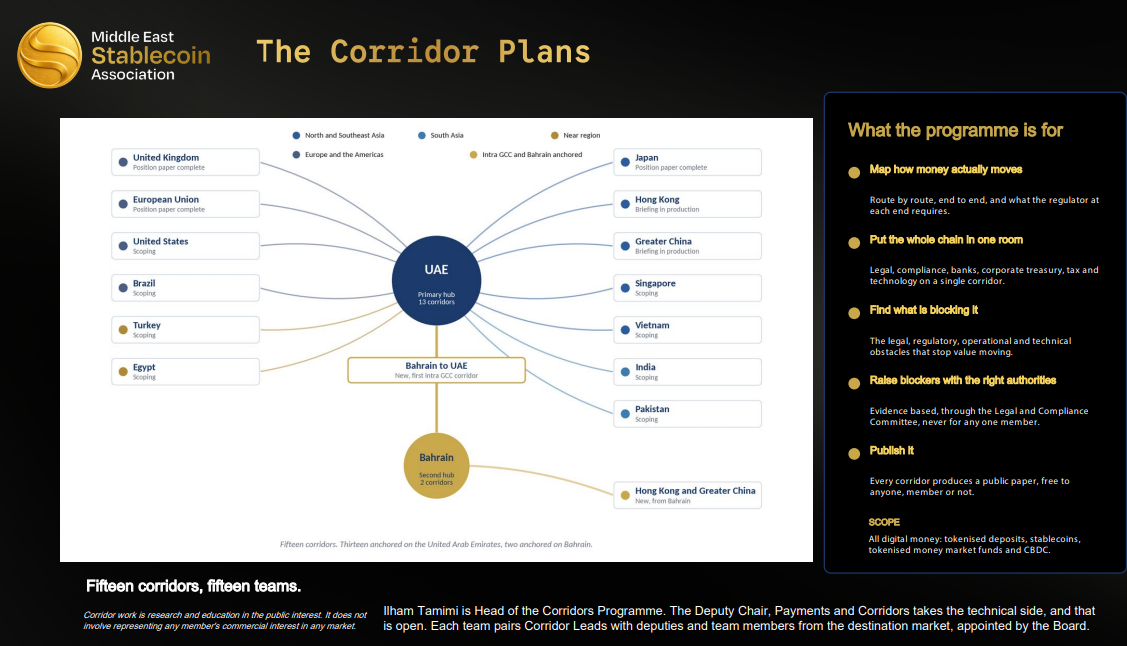
MESA's largest workstream is a payments and corridors program covering 15 routes. Thirteen are anchored on the UAE as the primary hub, and two are anchored on Bahrain.
| Status | Corridors |
|---|---|
| Position paper complete | UAE–United Kingdom, UAE–European Union, UAE–Japan |
| Briefing in production | UAE–Hong Kong, UAE–Greater China |
| Scoping | UAE–United States, Brazil, Turkey, Egypt, Singapore, Vietnam, India, Pakistan |
| New, Bahrain-anchored | Bahrain–UAE (first intra-GCC corridor), Bahrain–Hong Kong and Greater China |
The method is the same on every route:
- Map how money moves end to end, including what the regulator at each end requires.
- Put legal, compliance, banking, treasury, tax, and technology teams on the same corridor.
- Identify the legal, regulatory, operational, and technical blockers.
- Raise those blockers with the relevant authorities through the Legal and Compliance Committee.
- Publish a free paper for each corridor.
The scope covers all four forms of digital money. Ilham Tamimi leads the program. MESA says the work is public-interest research and never represents a member's commercial interest in any market.
- The Asian routes overlap with trends we tracked in our report Money Moves East: The Stablecoin Corridors in Asia in 2026.
- The Hong Kong briefings also land shortly after the city's Policy Address opened stablecoin trading and fund settlement.
- The UAE–Brazil route adds to the regulatory picture in our guide to stablecoin regulation in Latin America.
Twelve Papers and Six Commitments for the Next Year
MESA has 12 papers in production, all to be published free and open access:
- Dynamic Ratings
- Shariah Compliant Stablecoin Framework
- Tax and Accounting Treatment in the UAE and Free Zones
- VAT Implications of Stablecoins
- Understanding the Stablecoin Issuer Landscape
- Digital Custody for Banks
- Proof of Reserves
- The India and UAE Digital Finance Corridor
- Marketing Stablecoins in the UAE
- Reserve Derived Yields on Regulated Stablecoins
- Institutional Stablecoin Settlement in the UAE
- Tokenisation and Digital Money in UAE Asset Management
The joint research paper and GCC policy paper with Terminal 3 would sit on top of this list.
Dasgupta also set six commitments for the next twelve months:
- Payments and corridors: Run all 15 corridors to publication.
- Full United States engagement: Cover regulatory treatment, the foreign issuer pathway, payments practice, technology, education, and tax.
- Digital money sub-sectors: Seek clearer legal, tax, and technology treatment for tokenized deposits, stablecoins, tokenized money market funds, and CBDCs.
- Standards and guidance: Publish voluntary good-practice guidance, free to any market participant.
- Regulatory engagement: Hold structured, evidence-based dialogue with regulators across the Middle East.
- GCC ecosystem development: Build across the Gulf, not one financial center.
The US commitment is notable. The GENIUS Act's foreign issuer pathway is the route any Gulf-issued dollar stablecoin would need to reach US markets. It also sits against a wider trend, including the 21 banks planning a shared USD stablecoin company.
What MESA Did Not Announce
MESA did not announce a regional office. Dasgupta said the association is in early conversations about a local presence in Qatar, Bahrain, and Saudi Arabia, but nothing is settled.
Several other items remain open:
- Yield positions: The positions of four UAE regulators are still unconfirmed.
- Paper authorship: Author lines on the 12 papers are working attributions, subject to Board approval and conflict screening.
- Terminal 3 deliverables: The MoU sets no delivery dates for the joint research or GCC policy paper.
- Execution: The copy of the MoU reviewed by Stablecoin Insider leaves the effective date to be inserted on execution.
The association has so far run on unpaid work. It is now recruiting for its first three salaried roles, Executive Director, Head of Memberships, and Marketing Director, funded from its operating budget. Volunteer seats remain open across committees, including Deputy Chair for Payments and Corridors, Company Secretary, and Internal Compliance Officer.
Who Runs MESA
Founding Board:
- Dr. Bhaskar Dasgupta, Chairman
- Ramana Kumar, Vice Chairman
- Ramy Soliman, Kokila Alagh, Matthew Nyman, Ilham Tamimi, and Andre Olivier, Board Members
MESA says conflict of interest declarations for Board members are being completed.
Advisory Board:
Seven members, each of whom co-chairs a committee, with no management authority and no vote on Board resolutions.
- Kristiina Lumeste
- Finali Fernando
- Dishang Patel
- Joseph Cleetus
- Emmanuel Ofosu-Appiah
- Dipti Sudhir
- Lukasz Dec
Six committees:
- Legal and Compliance
- Banking
- Technology, Innovation and Education (with Shariah, Asset Management, and Insurance and Risk subcommittees)
- Treasury
- Strategic Marketing
- Market Infrastructure
The conference drew over 600 registrations and 306 approved delegates from 250 organizations and 48 nationalities. Sixty-five percent of approved delegates are at C-level, director, or vice president level. Banks (46) and fintechs (45) were the largest groups.
The conference was supported by sponsors and exhibitors ADI, Apex, Sherlocq, Universal, and KARM. MESA stated that the acknowledgement is not an endorsement.
What Comes Next
MESA listed three upcoming events:
- DIFC Future of Finance Week: November 2026
- ADGM Abu Dhabi Finance Week: December 2026
- MESC 2027: the second edition of the conference, in the first half of 2027
The keynote closed with three asks for delegates: join a committee, contribute evidence to the next regulatory consultation, and send MESA the hard questions nobody can currently answer.
FAQs:
1. What is the Middle East Stablecoin Association?
The Middle East Stablecoin Association (MESA) is a non-profit incorporated in the DIFC under DIFC Law No. 6 of 2012, registration number 13658. It works as an educator, standards convenor, and dialogue partner with Gulf regulators. It does not advise firms, endorse products, or lobby for members.
2. Which regulators oversee stablecoins in the Gulf?
MESA tracks seven frameworks:
- CBUAE
- CMA UAE
- VARA
- DFSA
- FSRA in ADGM
- CBB in Bahrain
- QFCRA in Qatar
Five of the seven are in the UAE.
3. Can stablecoins pay yield in the UAE and Bahrain?
Bahrain's CBB expressly permits stablecoin yield, including a Shariah-compliant variant. ADGM's FSRA does not prohibit it. The positions of CBUAE, CMA UAE, VARA, and DFSA are still being verified by MESA's Legal and Compliance Committee.
4. Do Gulf regulators have rules for a stablecoin depeg?
According to MESA's Depeg Analysis Paper, no Middle Eastern regulator operates a depeg regime. Existing frameworks focus on preventing a stablecoin from losing its peg, not on what happens after it does.
5. What is the MESA and Terminal 3 MoU?
It is a non-commercial Memorandum of Understanding, dated July 2026, between MESA and Terminal 3 HK Limited. It covers digital identity, credential verification, and knowledge exchange. The parties plan free educational materials, a joint research paper, and a GCC policy paper on standardizing digital identity frameworks. MESA keeps full editorial control and does not endorse Terminal 3's products.
6. What is MESA's stablecoin corridors program?
It is a research program covering 15 payment corridors, 13 anchored on the UAE and two on Bahrain. Each corridor team maps how money moves, identifies blockers, raises them with regulators, and publishes a free paper. Position papers for the UK, EU, and Japan corridors are complete.
Disclaimer:
This content is provided for informational and educational purposes only and does not constitute financial, investment, legal, or tax advice; no material herein should be interpreted as a recommendation, endorsement, or solicitation to buy or sell any financial instrument, and readers should conduct their own independent research or consult a qualified professional.