
Table of Contents
Two years ago, an enterprise shortlisting stablecoin APIs mostly asked about chain coverage and fees.
But now, that checklist has grown. Buyers now want to know how predictable settlement is, whether compliance screening comes built in, who holds the funds along the way, and how much operational work the vendor takes off the team's plate.
Hard to blame them, given how much money is moving. Stablecoin transfers reached a record $4.5 trillion in the first quarter of 2026, and more of that flow runs through fintech and payment integrations every quarter.
No single API wins every use case. A neobank taking deposits from any chain has different needs from a marketplace paying suppliers or a treasury desk parking USDC.
The list below ranks the leading stablecoin APIs for enterprises in 2026 and breaks down what each one does well, where it falls short, and who it fits best.
Key takeaways
- Chain coverage and settlement speed no longer separate stablecoin APIs. What does is predictable settlement, compliance that runs by default, a clear custody model, and how much operational work the vendor takes on.
- Match the API to where stablecoins enter your business. Full-stack platforms make sense when you need fiat rails and cards from one vendor, but they add custody and onboarding weight a deposit-focused team doesn't need.
- For neobanks, exchanges and payment companies where the first deposit has to work, Rhino.fi gives each user one address for 30+ networks and settles at the quoted amount, without requiring teams to manage routing themselves.
What to look for in a stablecoin API in 2026
Every vendor here will tell you they cover 20+ chains and settle in seconds, and they're right.
You'll only see the differences once real customer money is moving and your compliance, ops, and risk teams get involved. Here's what to ask about before you sign.
- Can users deposit from any chain without choosing one? Every time a user has to pick a chain, some of them pick wrong, and the deposit either fails or ends up somewhere you can't get it back. A good API gives each user one address that works no matter which chain they send from, then routes the money wherever you want it.
- Do you know what will land before it lands? Your finance team should know how much will arrive, on which chain, and at what rate before the deposit hits. If the vendor can't tell you that up front, someone has to reconcile every single deposit by hand.
- Is compliance built in or bolted on? Every deposit should be screened for suspicious activity automatically, with rules you can adjust to your own risk appetite. Ideally you do one KYB with the vendor and that covers everything. They should also be able to explain how they handle MiCA and the updated FATF Recommendation 16, which now requires payment messages to carry the beneficiary's location.
- Will you find out about problems before your customers do? That means webhooks for every status change, a dashboard your ops team can read, alerts when a settlement gets stuck, and logs your auditors will accept. Ask about SOC 2 and how they've handled past incidents.
Top 5 Best Stablecoin API's for Enterprises in 2026
1. Rhino.fi
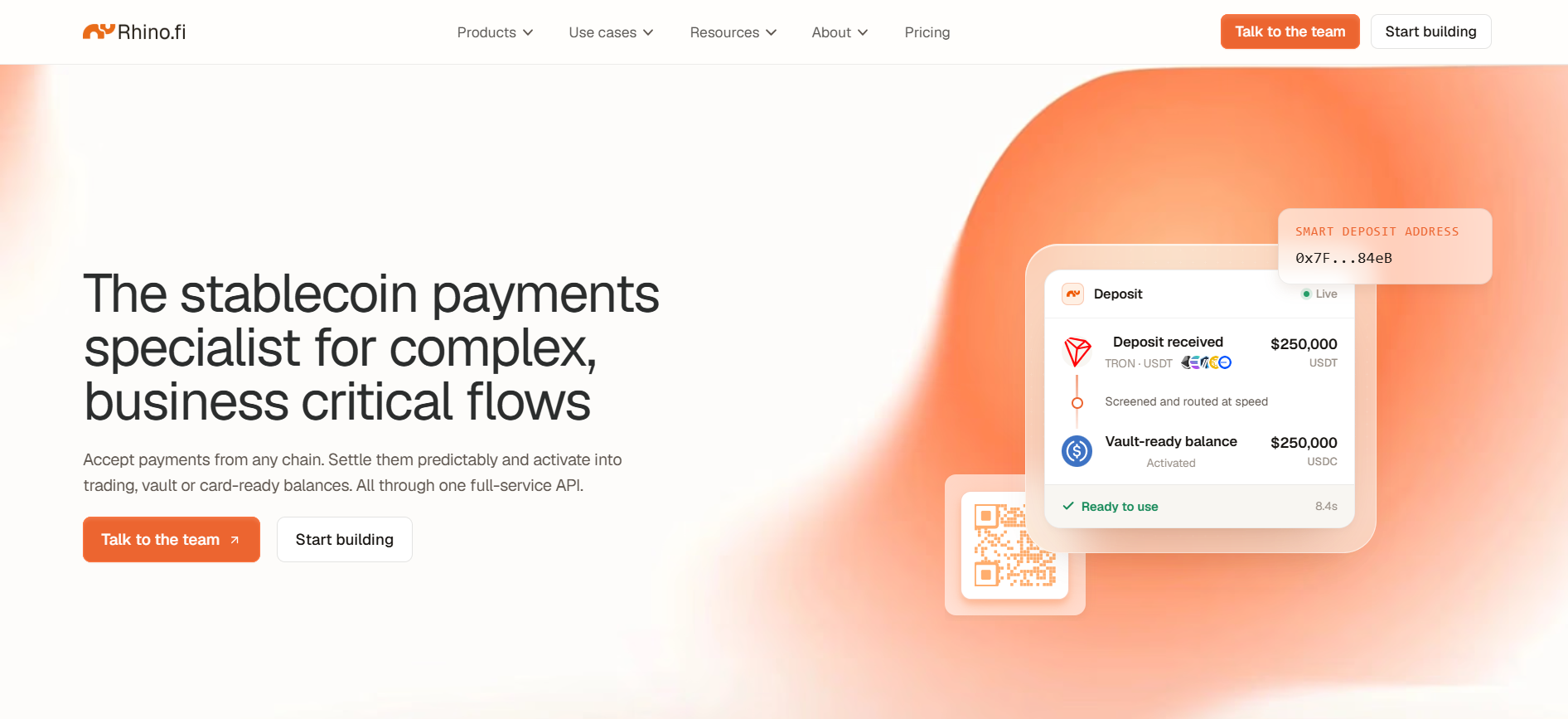
Rhino.fi is API-first infrastructure for stablecoin acceptance and settlement. Your user sends whichever stablecoin they hold, in dollars or euros, and your platform gets a clean balance in the single asset you chose, screened, settled, and ready to spend.
Rhino's Smart Deposit Addresses give each user one address that now accepts all major USD stablecoins, including USDT, USDC, USDG, USDe, EUR stablecoins and native tokens such as BTC, ETH, BNB, with SOL planned for the future; with chain and asset detection, KYT screening, and settlement handled automatically. The business sets its settlement policy once. Rhino.fi absorbs whatever a counterparty decides to send, whether that's USDT on Tron or EURC on Base.
That keeps the chain and asset complexity out of the product experience and gives teams the kind of predictability they expect from conventional payments infrastructure.
Co-founder and CEO Will Harborne describes the goal as building a "stablecoin clearing house": builders no longer need to worry about which stablecoin or chain a counterparty uses, because Rhino.fi absorbs the conversion instantly.
For neobanks, exchanges, and payment companies that need stablecoin acceptance and settlement to work predictably across a growing list of assets, without building the routing, conversion, and compliance stack themselves, Rhino.fi is one of the strongest options on this list.
Key features
- Smart Deposit Addresses: One address per user for a broad range of dollar- and euro-denominated stablecoins, plus BTC, ETH, BNB and SOL, on 30+ networks. Rhino.fi can also add local-currency stablecoins on request, with detection, screening and routing built in.
- 1:1 and Cross-Currency Settlement: Same-currency stablecoins settle 1:1 with no slippage. Cross-currency pairs (a dollar stablecoin settling to a euro balance, for example) convert at prevailing market rates, built into the deposit rather than handled as a separate step.
- Automated Onchain Actions: A contract call that fires as soon as settled funds arrive, sending deposits straight into a vault, trading balance, or card account.
Advantages of using Rhino.fi
- Deposit and activation in one step: Every step between "deposit received" and "balance usable" is a place users drop off. Rhino.fi removes those steps by landing funds from any chain directly in the trading account, vault or card, with no follow-up transfer to build.
- No OTC desk needed for seven-figure transactions: Where other APIs cap out and hand you off to a market maker, Rhino.fi's own liquidity settles single transfers of up to $10M in seconds, at the price you saw when you hit send.
- Rhino.fi handles the ongoing maintenance: Wrong-token refunds, liquidity rebalancing, gas spikes, MEV, token migrations, and chain upgrades usually end up on your on-call rota. Rhino.fi takes all of that, with 24/7 monitoring, and builds custom pieces where the standard flow doesn't fit.
- Large-scale execution, backed by first-party liquidity: For large transactions, the only real alternative used to be a market maker or an OTC desk. Rhino.fi packages that execution into an API: deep, first-party liquidity for large-scale conversion and settlement, with single transactions up to $10M settled in seconds.
- Activation, not just settlement: Funds don’t just arrive, they arrive ready to use. One flow takes a payment from any chain to a usable balance, yield position, stake, or card, which is what makes Rhino.fi more than a bridge and what makes deposits stick.
- Compliance built into every flow: Every transaction is screened, with KYT on every deposit, TRM integrated, and MiCA licensing in progress.
- A partner, not an endpoint: Rhino.fi handles the hard operational edge, including refunds, rebalancing, gas and MEV protection, migrations, chain upgrades, and 24/7 monitoring, and builds genuinely custom solutions through a modular, customisable product suite.
What real users are saying about Rhino.fi
- Extended, a perpetuals DEX on Starknet, had a five-step deposit flow that took around 15 minutes and two gas payments. After moving to Rhino.fi, deposits became a single click that lands in the trading vault in under a minute, with over $1B processed in the first year.

- Wirex, a crypto card issuer with 150K+ users, needed customers to fund accounts from any chain without building the infrastructure in-house. Rhino handled it, and Wirex saw an 8x increase in deposits with activation under 10 seconds.
"Rhino.fi turned multi-chain deposits into instantly spendable balances across 20+ networks." Daniel Rowlands, General Manager, Wirex
- KettlePay, a stablecoin payments app, waited up to 15 minutes for settlement and topped up liquidity by hand. On Rhino, settlement dropped to under 60 seconds, costs fell 70%, and manual top-ups went to zero.
"It lets us focus on customer use cases instead of stablecoin settlement." Sean Parsons, Founder and CEO, KettlePay
2. Bridge (Stripe)
Bridge is the stablecoin arm of Stripe, acquired in early 2025 for $1.1B, and it now powers Stripe's stablecoin financial accounts, USDC payouts and stablecoin-linked Visa cards while still running as a standalone API for teams that aren't Stripe merchants.
Where Rhino.fi focuses on getting deposits from any chain into a usable balance, Bridge is built to run the whole money lifecycle.
Fiat comes in through virtual accounts, converts to USDC or USDB, sits in Bridge custodial wallets, and goes back out through ACH, SEPA, or SWIFT, with KYC, KYB, and Travel Rule handled inside the same integration.
For payroll platforms and remittance products that want fiat rails, stablecoin rails and card issuance from a single vendor, and don't mind Bridge holding custody along the way, it's a strong fit.
Key features
- Orchestration API: Transfers, virtual accounts, liquidation addresses and prefunded accounts for moving money between fiat and stablecoins, with FX and settlement logic included.
- Custodial Wallets: Bridge holds the keys, you hold an account abstraction. Provision wallets for users or treasury without running custody yourself.
- Issuance and Cards: Launch a branded stablecoin or use USDB, then issue Visa cards that spend straight from stablecoin balances.
Pros
- Fiat and stablecoin rails in one contract: Bank account numbers, custody, conversion and payouts without stitching together separate vendors.
- Regulatory weight: Stripe's MSB registration and US money transmitter licenses come with the platform.
- Broad product surface: Start with payouts, add cards or issuance later on the same integration.
Cons
- Custody-only model: Teams that want funds in their own contracts or a non-custodial setup won't find a fit.
- Heavy onboarding: Every end user must clear Bridge's KYC or KYB before any money moves on their behalf.
- No public rate card: Pricing, FX spreads and Stripe bundling all require a sales conversation.
3. Circle
Circle issues USDC and EURC and runs the developer platform around them. Wallets, CCTP for native cross-chain transfers, Gateway for a unified USDC balance, Paymaster for gas in USDC, and the Circle Payments Network for institutional settlement all come from the same company that mints the token.
For treasury teams and institutions that want issuer-native rails, direct minting and redemption, and a NYSE-listed counterparty, Circle is worth a close look.
Key features
- CCTP: Burn-and-mint transfers of native USDC between 20+ chains, with no wrapped assets and no custodial bridge. Fast Transfer settles in seconds, Standard settles at chain finality.
- Circle Wallets: Developer-controlled or user-controlled MPC wallets, with transaction screening and Travel Rule support built in.
- Circle Payments Network: Managed stablecoin settlement for PSPs, banks and fintechs that want to use USDC rails without holding digital assets themselves.
Pros
- Issuer-grade trust: Regulated issuer, public company, direct minting through Circle Mint with 1:1 redemption.
- Published pricing: CCTP Standard is free, Fast Transfer runs 1 to 14 bps, and wallet pricing is listed per monthly active wallet.
- Non-custodial cross-chain: CCTP never holds user funds, which simplifies the custody conversation.
Cons
- USDC-centric by design: USDT support is limited, and Tron isn't a CCTP chain, so a large share of retail stablecoin flow can't use the native route.
- You assemble the stack yourself: Wallets, CCTP, Gateway and Paymaster are separate products with separate integrations, and no single deposit address ties them together.
- CCTP V1 sunset: Legacy integrations face a forced migration during 2026.
4. Crossmint
Crossmint is a stablecoin infrastructure platform that bundles wallets, onramps, offramps, orchestration and compliance into one API. It began as NFT checkout tooling in 2022 and later shifted its focus to stablecoin rails.
On the regulatory side, Crossmint holds VASP status, a MiCA CASP authorisation in the EU, and money transmission coverage in every US state. It also works only with regulated issuers such as Circle and Paxos, which matters if your compliance team screens counterparties.
Its fiat coverage runs to 160+ countries through local bank rails, mobile money and a cash pickup network. That makes it more relevant for remittance and cash-out use cases than for platforms that only need crypto-to-crypto settlement.
Key features
- Stablecoin Orchestration: Routing for USDC and USDT between networks and currencies, with webhooks, a dashboard and SDKs on top of the REST API.
- Embedded and Treasury Wallets: Smart contract wallets for users, AI agents or company treasury, with MPC key management, so end users never touch keys, seed phrases or gas.
- Onramp and Offramp: Fiat conversion in 160+ countries via bank rails, mobile money and agent cash pickup, with KYC, AML and sanctions screening built in.
Pros
- Single vendor for the full stack: Wallets, ramps, orchestration and compliance under one contract.
- Licensing in place: VASP, MiCA CASP, and all US states covered.
- Non-technical tooling: Dashboard and widgets for ops teams alongside the developer API.
Cons
- Broad product surface: NFTs, agent cards and tokenisation share the same roadmap as the stablecoin products.
- No single any-chain deposit address: Orchestration routes funds, but users still need to be pointed at the right wallet and chain up front.
5. Fireblocks
Fireblocks is an institutional digital asset platform built around MPC custody, transaction policy enforcement and a network of 2,400+ institutional counterparties. Stablecoin payments came later, through the Network for Payments in 2025 and Fireblocks Flow in June 2026, and both sit on top of that custody core.
That origin shapes how it fits. Custody, policy rules, treasury operations and audit trails are the mature pieces, and the API surface reflects a platform designed for banks and large exchanges holding thousands of assets on 100+ chains.
Key features
- MPC Wallets and Vaults: Key management where no single party holds a complete private key, with hardware isolation, governance rules and approval workflows on every transaction.
- Fireblocks Flow: Stablecoin acceptance for PSPs and fintechs that accepts any digital asset at checkout and settles in the stablecoin of your choice.
Pros
- Institutional security posture: MPC custody, policy engine and audit trails that regulated institutions already accept.
- Asset and chain breadth: 100+ chains and over a thousand tokens under one workspace.
Cons
- Custody-first design: Payment products are recent additions to a platform built for holding assets, so deposit orchestration is less mature than the vault layer.
- Setup effort: Policy configuration, workspace design and integration typically need dedicated engineering and a longer onboarding than API-first vendors.
Turn Stablecoin Deposits into Usable Balances with Rhino.fi
It's easy to spend a vendor comparison scoring chain counts, licences and fiat coverage. All fair questions, but they describe what happens around a deposit, not what happens to it.
Your users don't care which chain they're on or how the money gets to you. They send stablecoins from wherever they hold them and expect a balance they can use, fast, without opening a support ticket.
Most vendors on this list handle one or two steps of that journey and leave the rest to you.
Rhino.fi was built to handle all of it.
You hand each user one address, Rhino handles the chain detection, screening, routing, and settlement, and your platform receives a single asset on the chain you chose, at the amount you were quoted. Your team doesn’t have to manage the routing or reconcile an unexpected settlement.
Here's what you get with Rhino.fi:
- Smart Deposit Addresses accept USDT, USDC or EURC from 30+ networks through one address per user, so a wrong-chain deposit stops being a thing that happens.
- 1:1 Stablecoin Settlement treats USDT and USDC as the same dollar, converted at a guaranteed rate with no slippage and no spread hiding in the conversion.
- Deterministic routing locks the amount, fee and destination before the transfer starts and holds that quote until it expires, so finance knows what's landing.
- KYT and AML screening on every deposit, with rules you can tune and one KYB that covers the whole integration.
Talk to the Rhino.fi team to see what the deposit flow looks like on your chains, at your volume.
FAQs:
1. What is the difference between a stablecoin API and a crypto payment gateway?
A gateway is a checkout product. A customer pays in crypto, the gateway converts and settles the merchant, and the merchant moves on.
A stablecoin API is infrastructure for your own product. You control the deposit experience, the settlement chain and what happens to funds once they land, which is what neobanks, exchanges and fintechs need when stablecoin balances are part of the product itself.
2. Does an enterprise need a custodian as well as a stablecoin API?
Depends on the vendor's custody model.
- Custodial platforms like Bridge and Fireblocks hold the keys, so custody and money movement come from one vendor.
- Non-custodial infrastructure like CCTP or Rhino.fi routes funds between addresses you or your users control, so you pair it with your own wallets or an existing custodian.
- Hybrid platforms like Crossmint offer MPC wallets alongside orchestration, so custody is optional.
Each changes your regulatory exposure and what happens if the vendor goes down mid-transfer.
3. Which stablecoin API is best for neobanks and fintechs accepting customer deposits?
If customers show up with stablecoins on different chains, Rhino.fi is the most direct fit. One address per user accepts USDT, USDC or EURC from 30+ networks and settles a single asset on the chain you choose.
If the product also needs fiat onramps, cards or issuance, Bridge and Crossmint cover more of that surface.