Table of Contents
Venture capital is flooding into stablecoin infrastructure with incredible speed.
In 2025, VC investment in stablecoin-related companies surpassed $1.5 billion (a 30x increase from 2019) and 2026 has kicked off with $1.4 billion committed across crypto venture rounds and IPOs in January alone.
The sector's breakout deal: Rain's $250M Series C at a $1.95 billion valuation, led by ICONIQ and announced January 9, 2026, just 10 months after its Series A (Rain via PR Newswire).
The thesis is converging across every tier of investor: stablecoins are becoming the default settlement layer for global commerce.
With the GENIUS Act now law, Y Combinator offering USDC payouts, and total stablecoin transaction volume hitting $33 trillion in 2025, the institutional floodgates are open.
This report breaks down the key deals, the most active VCs, and the trends shaping where capital flows next in the stablecoin ecosystem.
By the Numbers

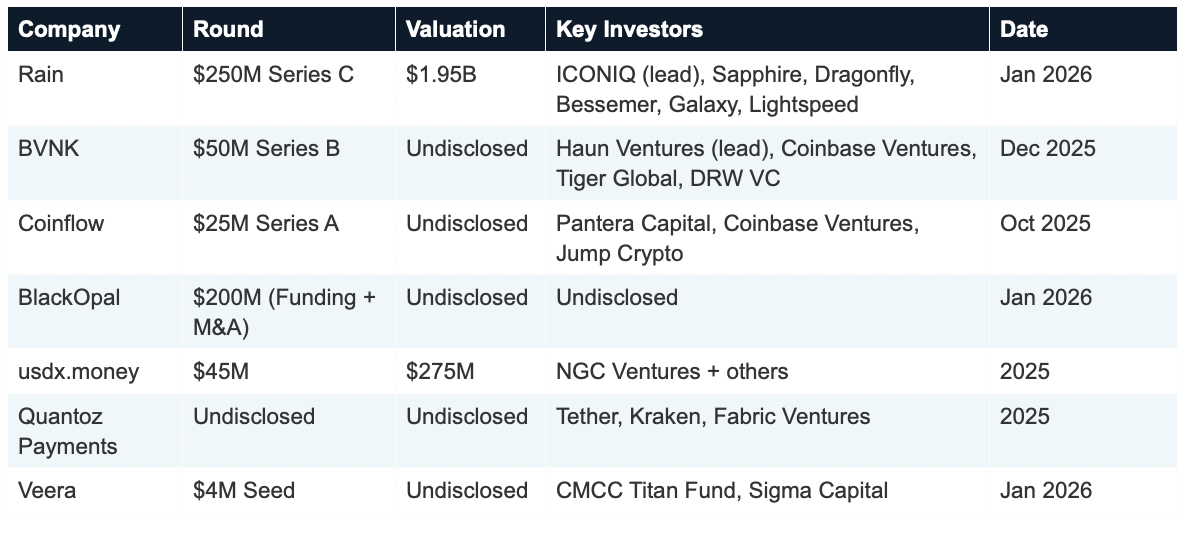
Major Stablecoin Funding Rounds (Late 2025 – Early 2026)
The concentration of capital into stablecoin infrastructure companies has been one of the defining features of the current funding cycle.
Here are the most significant rounds:
Deep Dives on Big Deals
Rain - The Stablecoin Infrastructure Unicorn
Rain's trajectory is the clearest signal of where VC conviction lies.
The company closed its Series A, Series B and $250M Series C within 10 months, bringing total funding to over $338M, with its valuation up more than 17x over that period (Rain).
Led by ICONIQ, with Dragonfly, Bessemer, Lightspeed, and Galaxy Ventures also participating, Rain builds enterprise payment tools that let businesses issue stablecoin-backed cards and wallets that work anywhere Visa is accepted.
Active cards grew 30x and payment volume grew 38x over the past year.
ICONIQ partner Kamran Zaki called it a race to define the default enterprise platform for tokenized money.
BVNK - Enterprise Stablecoin Payments Goes Global
London-based BVNK raised $50M in Series B funding led by Haun Ventures, with participation from Coinbase Ventures, Scribble Ventures, DRW Venture Capital, and existing investors Avenir and Tiger Global (BVNK).
The company processes $10 billion in annualized stablecoin payment volumes for enterprise clients and is now expanding into the US market with offices in San Francisco and New York.
BVNK's positioning as the infrastructure layer that abstracts blockchain complexity for businesses aligns with the dominant VC thesis.
Coinflow - Taking on Stripe with Stablecoin PSP
Coinflow raised a $25M Series A led by Pantera Capital, with participation from CMT Digital, Coinbase Ventures, The Fintech Fund, Jump Capital, and Reciprocal Ventures (CoinDesk).
The company functions as a stablecoin-native payment service provider (PSP), competing directly with Stripe and Worldpay by enabling merchants to process payments through blockchain rails without ever touching crypto themselves.
The company mints and burns stablecoins directly and settles payments instantly across Solana and Ethereum.
Y Combinator - USDC Funding for All Startups
In a landmark move announced February 3, 2026, Y Combinator began offering its standard $500,000 seed investment in USDC stablecoins across Ethereum, Base, and Solana.
This isn't limited to crypto startups, any YC company can opt in. YC cited the GENIUS Act as a regulatory inflection point and noted that stablecoin transfers cost less than one cent and settle in under one second.
YC partner Nemil Dalal explicitly called stablecoins one of the firm's key investment pillars and is actively seeking more stablecoin founders.
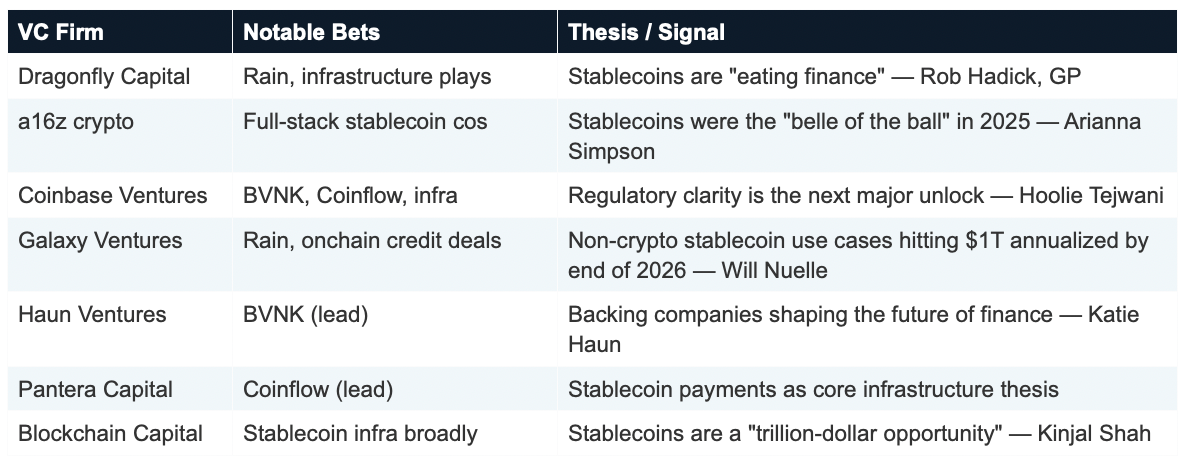
Most Active VCs in the Stablecoin Sector
The following firms have emerged as the most vocal and active investors in stablecoin infrastructure.
Their thesis statements reveal a remarkable degree of convergence: stablecoins represent a generational opportunity to replace legacy payment rails.
5 Key Themes Driving Stablecoin VC in 2026
1. Enterprise Payments Infrastructure Is the #1 Thesis
The clearest pattern across all major stablecoin deals is the focus on B2B payments and enterprise infrastructure.
Rain, BVNK, and Coinflow are all building the plumbing that allows businesses to move money via stablecoins without requiring end users to interact with crypto.
Galaxy Ventures' Will Nuelle expects stablecoin transaction volume for non-crypto use cases such as trade finance and payment processing to reach $1 trillion by the end of 2026 (The Block via ChainCatcher).
2. The GENIUS Act Changed Everything
The passage of the GENIUS Act in 2025 created the first federal framework for stablecoins in the US, mirroring traditional banking safety and soundness standards.
This single regulatory milestone has unlocked a wave of institutional confidence. Y Combinator cited it directly when announcing USDC payouts.
VCs across the board point to it as the catalyst for mainstream enterprise adoption, and the US remains the epicenter of crypto investment: companies headquartered in the US took 55% of crypto VC capital invested in Q4 2025 (Galaxy Research).
3. Stablecoins + Traditional Finance Convergence
The line between stablecoin companies and fintech is dissolving.
- Stripe acquired Bridge for $1.1 billion, closing the deal in February 2025 (CNBC).
- Fiserv launched FIUSD.
- PayPal is expanding PYUSD.
Mastercard enabled multiple stablecoins across its network. Cloudflare announced plans for its own stablecoin.
SoFi launched an enterprise stablecoin. Coinbase rolled out white-label stablecoin issuance for banks. VCs expect more acquisitions of crypto startups by banks and payment giants, creating exit opportunities for early investors.
4. Stablecoin Cards Are the Bridge to Mass Adoption
Stablecoin-linked payment cards have become the primary bridge between digital assets and everyday commerce.
Rain's Visa-linked cards are the flagship example, but the category is expanding rapidly. Dragonfly's Rob Hadick describes stablecoins as "eating finance" with the growth in B2B card-based transactions as a leading indicator.
The ability to spend stablecoins at any merchant that accepts Visa or Mastercard without the merchant knowing or caring about the underlying asset is the UX breakthrough the sector needed.
5. Early-Stage Remains Tough, But the Bar Is Higher
While headline deals are massive, early-stage stablecoin founders face one of the toughest funding environments in years.
Median crypto seed valuations reached $34M, up 70% from 2023 levels, and the median check size climbed 1.5x to $5M (SVB). VCs are prioritizing proven teams with clear product-market fit.
a16z's Arianna Simpson noted that crypto VC overlaps heavily with fintech now, bringing more traditional business model scrutiny (transaction fees, take rates, volume) rather than token economics.
What to Watch in Q1 2026
- Bank-issued stablecoins: With FDIC rules for bank stablecoin issuance pending, expect the first wave of bank-issued stablecoins to launch. JPMorgan's Kinexys platform is already piloting tokenized deposit and stablecoin-based settlement tools.
- Circle's post-IPO expansion: Circle has 100+ financial institutions in its payments network pipeline and launched Arc, a blockchain designed for enterprise stablecoin payments, FX, and capital markets.
- World Liberty Financial's stablecoin bank: The Trump family-affiliated DeFi company has submitted an OCC application to establish a national trust bank purpose-built for stablecoin operations.
- Wyoming's FRNT token: The state of Wyoming has officially launched the Frontier Stable Token ($FRNT), the first state-issued stablecoin, a category that didn't exist 12 months ago.
- Fiserv + PayPal interoperability: FIUSD and PYUSD are going interoperable, opening stablecoins to thousands of financial institutions and PayPal's 430M+ consumers and 36M merchants.
The Bottom Line
VCs are placing massive, concentrated bets on the companies building enterprise-grade plumbing: payment processing, card issuance, settlement, compliance, and treasury management.
For founders: the bar has never been higher, but neither has the opportunity.
For investors: stablecoin infrastructure is the consensus trade of 2026, and the M&A exit environment has never been more favorable.
FAQ
What was the largest stablecoin VC round in early 2026?
Rain's $250M Series C, led by ICONIQ and announced on January 9, 2026, valued the company at $1.95 billion (PR Newswire).
Who led BVNK's Series B?
Haun Ventures led BVNK's $50M Series B, with Coinbase Ventures, Scribble Ventures, DRW Venture Capital, Avenir and Tiger Global participating (BVNK).
Who invested in Coinflow's Series A?
Pantera Capital led Coinflow's $25M Series A, joined by CMT Digital, Coinbase Ventures, The Fintech Fund, Jump Capital and Reciprocal Ventures (CoinDesk).
How much did Stripe pay for Bridge?
Stripe paid $1.1 billion for Bridge and closed the acquisition in February 2025, its largest deal to date (CNBC).
Where is most crypto venture capital going geographically?
To the US: companies headquartered there received 55% of crypto VC capital invested in Q4 2025, followed by the UK at 33% (Galaxy Research).
Related Reports
- 50 Stablecoin Statistics That Matter in 2026
- Tokenized Money Market Funds: Everything you Need to Know for 2026
Partner/Advertise with Stablecoin Insider
Fill out this form to partner and advertise on the only publication, dedicated entirely to the Stablecoin ecosystem.
See you next week,
- The Stablecoin Insider team