
Table of Contents
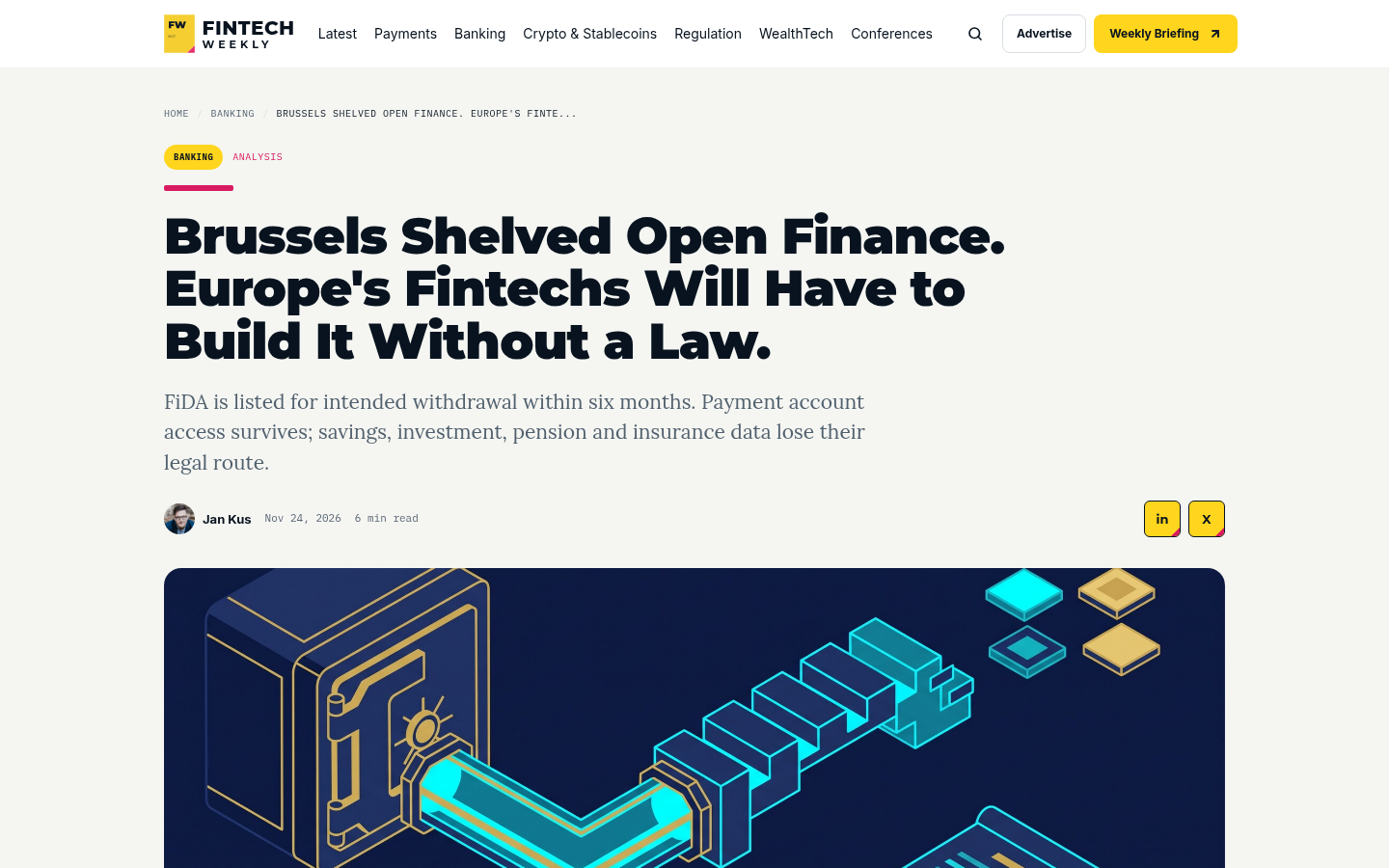
On 4 November 2026 the European Commission listed the Financial Data Access Regulation (FIDA) among 18 pending proposals it intends to withdraw within six months, saying the file had been stuck with lawmakers for more than three years with no trilogue talks since June 2025 (Source: FinTech Weekly).
Stablecoin Insider follows the rules that decide how fintech, crypto and stablecoin firms reach customer data in Europe, and the planned withdrawal of FIDA is the biggest change to that picture this year.
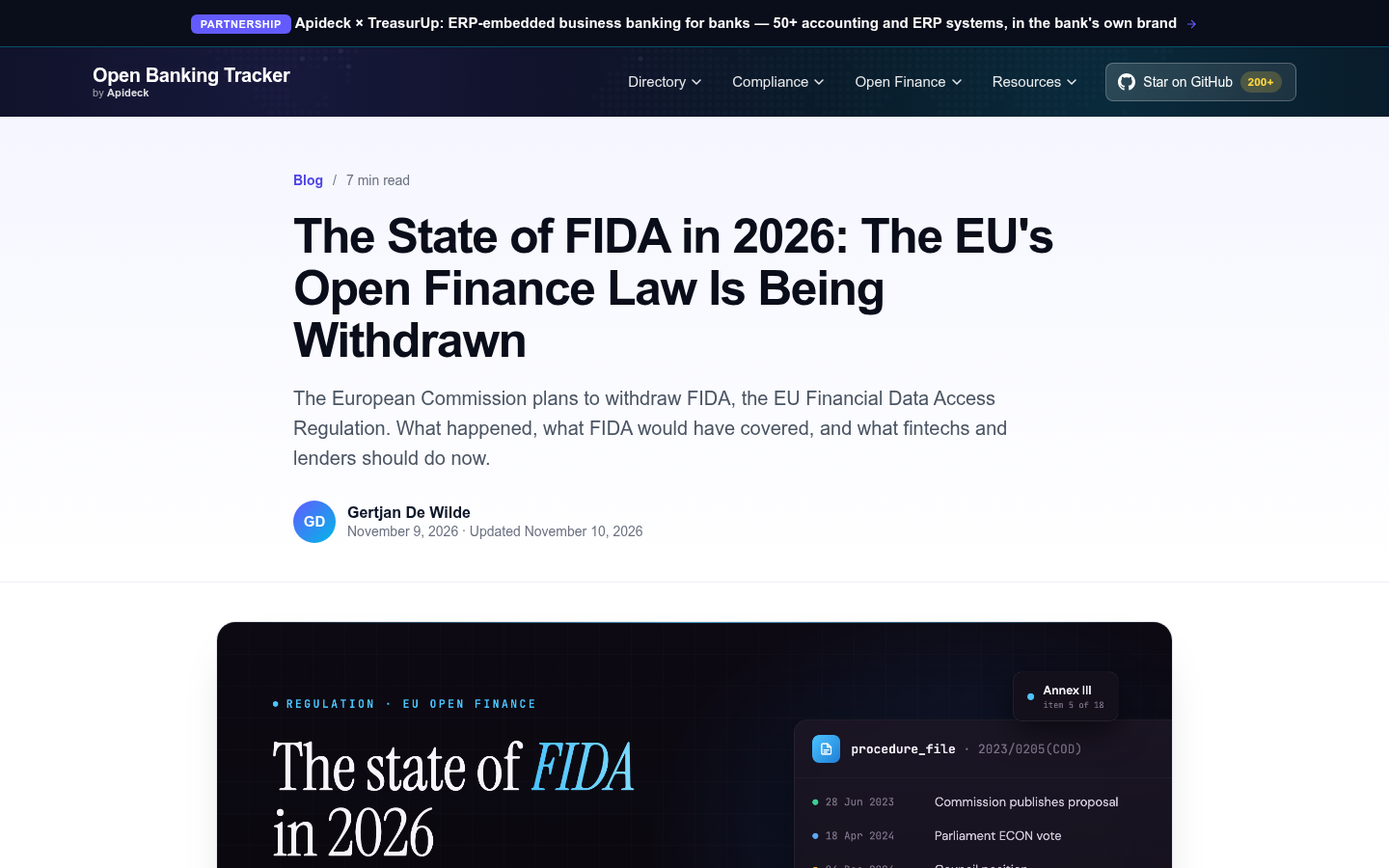
FIDA was meant to extend open banking beyond payment accounts to savings, investments, pensions, insurance and crypto-assets.
Without it, access to that data will depend on commercial deals rather than a legal right.
This guide explains what FIDA was, why the Commission is dropping it, what stays in place, how the UK is going the other way, and what fintechs should do now.
Key Takeaways
- The Commission plans to withdraw FIDA by about May 2027.
- FIDA would have opened savings, pension, insurance and crypto data.
- Open banking for payment accounts continues under PSD2 and the PSR.
- Other financial data now depends on voluntary schemes and contracts.
- The UK is building an open finance framework by 2027.
What FIDA Was
FIDA is the European Commission's proposal for a framework for Financial Data Access, published on 28 June 2023 together with PSD3 and the Payment Services Regulation (PSR). PSD2 had opened payment account data to licensed third parties in 2018. FIDA would have applied the same idea to most other financial products (Source: Open Banking Tracker).
- Data holders: Banks, insurers, investment firms and other financial institutions would have had to share customer data on request.
- Data users: Licensed financial firms or a new type of firm, the financial information service provider (FISP).
- Schemes: Holders and users would have joined data sharing schemes that set technical standards and the fees holders could charge.
- Customer control: A permissions dashboard would have let customers see and revoke every data permission.
| Data type | Under FIDA | Now |
|---|---|---|
| Payment accounts | PSD2 already | PSD2, then PSR |
| Savings and loans | Covered | No legal right |
| Investments | Covered | No legal right |
| Crypto-assets | Covered | No legal right |
| Pensions | Covered | No legal right |
| Non-life insurance | Covered | No legal right |
Life, sickness and health insurance and individual credit scores were left out of the original proposal, and the Council's December 2024 position also excluded occupational pension data, with an option for member states to opt it back in.
Why the Commission Is Dropping It
The Commission's reason in the annex to its 2027 work programme is short: the file has been pending with lawmakers for more than three years, no trilogues have taken place since June 2025, and it is unlikely to win Council support within a reasonable time.
- Cost concerns: Insurers and much of the wider financial industry objected to the scope and the cost of building the required APIs.
- Big Tech dispute: Parliament and Council disagreed on how far large platforms designated as gatekeepers should be allowed to use the data.
- Simplification agenda: A new data-sharing obligation sat badly with the Commission's focus on cutting rules.
- A failed rescue: In April 2026 the Commission floated phasing access in over 24, 36 and 48 months, but member states stayed split.
The withdrawal is not final yet. It needs a separate Commission decision, and Parliament and Council can give their views but have no formal veto. A leaked draft in February 2025 also listed FIDA for withdrawal before it was saved, but this time the listing is in the adopted work programme.
What Stays in Place
Open banking for payment accounts is not affected. PSD2 still gives licensed account information and payment initiation providers access to payment accounts, and the PSR will tighten that access by banning obstacles banks may put in front of third-party providers. Parliament's final vote on PSD3 and the PSR is indicatively set for 14 December 2026. Our explainer on PSD3 and the PSR covers those changes in detail.
- GDPR portability: People can still ask for their personal data, but there is no standard API and it does not cover business customers.
- The Data Act: In application since 12 September 2025, it covers data from connected products such as cars and machines, not financial accounts.
- Voluntary schemes: The EPC's SEPA Payment Account Access scheme and Germany's giroAPI offer paid premium APIs, but both focus on payment accounts.
- Bilateral deals: Beyond that, data users must negotiate access with each bank, insurer or asset manager, who sets the price and scope.
Account-to-account payments, which rely on open banking, keep growing regardless. Our guide to Pay by Bank in Europe shows how that market works today.
Winners and Losers
Incumbent banks and insurers welcomed the decision. Data users, such as aggregators, robo-advisers, pension dashboards and comparison sites, lose the legal route they were planning around.
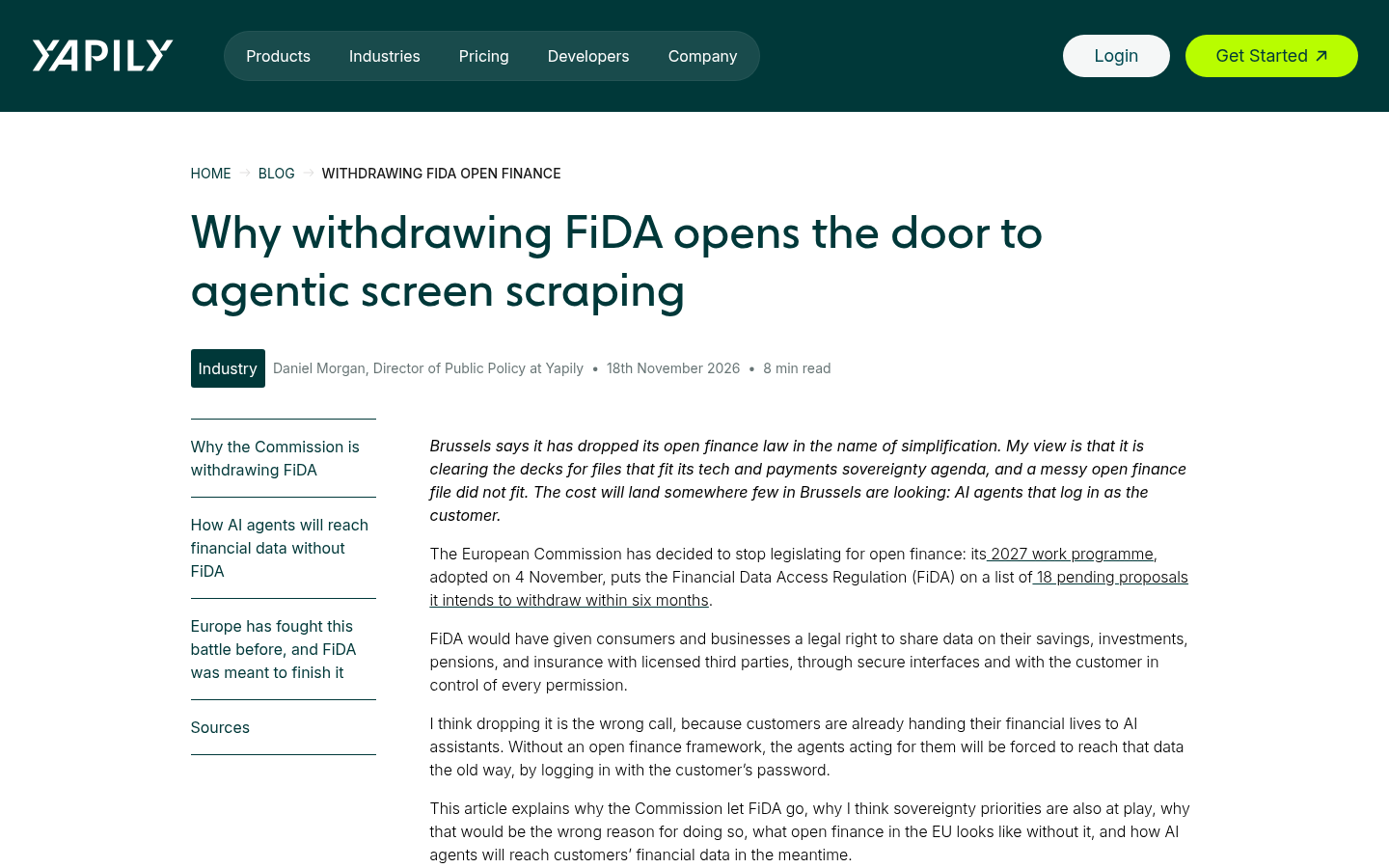
Some in the industry warn of a side effect. Yapily's director of public policy, Daniel Morgan, argues that without FIDA, AI agents acting for customers will reach savings and pension data by logging in with the customer's password, a new form of screen scraping that Europe spent a decade removing from open banking (Source: Yapily).
- Winners: Data holders keep control over who gets access and at what price.
- Losers: Fintechs that planned products on a legal right to savings, investment or pension data.
- Mixed: Banks and insurers also lose the chance to pull customer data from competitors.
- Unresolved: The limits on Big Tech gatekeepers that both Parliament and Council wanted will not become law either.
The agent question is already live in the US, where large banks have moved to block AI agents that log in with customer credentials. Our analysis of agentic banking covers how agents are getting their own accounts and wallets instead.
The UK Is Going the Other Way
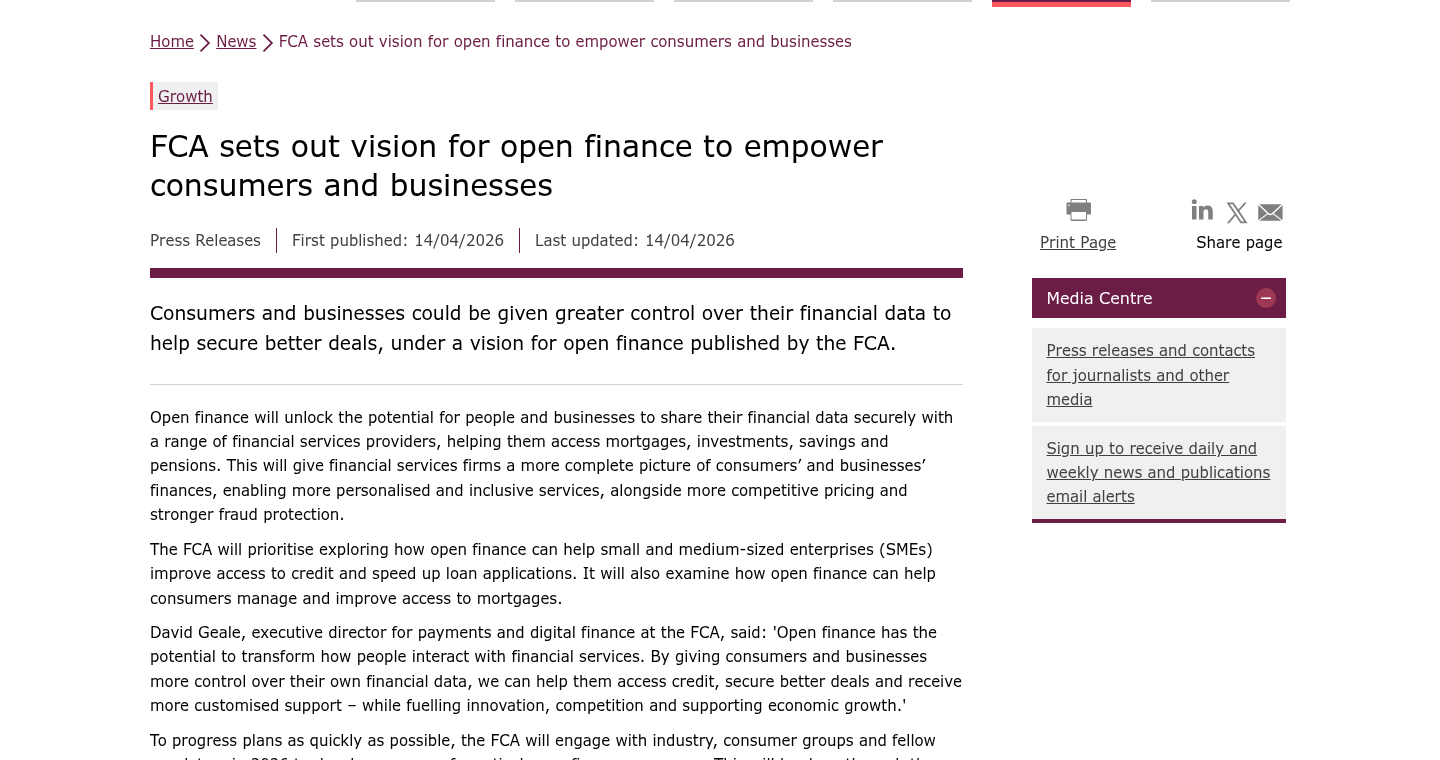
While Brussels steps back, London is moving forward. The FCA published an open finance roadmap on 14 April 2026, prioritising use cases for small business lending and mortgages, and said it will work with HM Treasury on options for a regulatory framework for open finance by the end of 2027. UK open banking already has about 17 million users, nearly one in three adults (Source: FCA).
| Area | EU | UK |
|---|---|---|
| Open banking | PSD2, then PSR | Regulated |
| Open finance law | Being withdrawn | Planned by 2027 |
| Main route now | Contracts | FCA pilots |
For firms active in both markets, the gap will widen. Our explainer on the UK payments regulation overhaul covers the wider UK reforms.
What It Means for Crypto and Stablecoin Firms
Crypto-assets were in FIDA's scope, so the withdrawal matters directly to the digital asset sector.
- No portability right for crypto holdings: Customers will not get a legal right to share exchange or custody data with third-party apps through a standard API.
- Portfolio tools lose out: Apps that combine bank, investment and crypto holdings in one view must sign deals with each provider.
- Payment accounts still open: On-ramps and stablecoin apps can keep using PSD2 open banking to verify bank accounts and initiate payments.
- Identity routes remain: The EU Digital Identity Wallet offers a separate route for verified customer data, as covered in our guide to EU Digital Identity Wallets for payments.
What Fintechs Should Do Now
- Update roadmaps: Remove any assumption of a legal right to savings, investment or pension data by 2028 or 2029.
- Use PSD2 fully: Build on payment account access, which stays regulated and will get stronger under the PSR.
- Negotiate direct access: Approach data holders for commercial API deals where a product depends on their data.
- Join schemes: Follow the EPC's SPAA scheme and national schemes such as giroAPI as they expand.
- Avoid credential sharing: Design AI features around consented API access rather than customer passwords.
- Watch the UK: Consider piloting open finance products there first.
What to Watch
- 14 December 2026: Parliament's indicative final vote on PSD3 and the PSR.
- By about May 2027: The formal Commission decision to withdraw FIDA.
- End of 2026: The FCA consultation on a long-term UK open banking framework.
- SPAA rulebook: Whether the EPC's updated scheme attracts asset holders, not just brokers.
- A new proposal: Whether the Commission returns to open finance later, which would restart the process from scratch.
Conclusion
Stablecoin Insider tracks how Europe's financial data rules shape fintech and crypto, and the end of FIDA means open finance in the EU will be built by the market, not by law.
Payment account access stays protected and will get stronger under the PSR.
Everything else, from savings and pensions to crypto holdings, now depends on voluntary schemes and bilateral contracts priced by the institutions that hold the data.
For fintechs, the practical answer is to build on what is regulated, negotiate for the rest and keep a close eye on the UK, where open finance is still moving ahead.
Read Next
- OakNorth's US Bank Charter: What the CUB Deal Means for Foreign Fintechs
- Best Apps to Buy Nvidia Stock in Singapore (2026): 5 Brokers Compared on Fees and FX
- Private Health Insurance Rebate Changes: What Over-65s Lose From April 2027
FAQs
1. What is FIDA?
FIDA is the EU's proposed Financial Data Access Regulation, published in June 2023. It would have required banks, insurers and investment firms to share customer data on savings, investments, pensions, insurance and crypto-assets with licensed third parties at the customer's request.
2. Has FIDA been withdrawn?
FIDA has not been formally withdrawn yet, but the Commission listed it for withdrawal on 4 November 2026. It intends to complete the withdrawal within six months, which points to a decision by about May 2027.
3. Why is the EU withdrawing FIDA?
The EU is withdrawing FIDA because the file stalled for more than three years with no trilogue talks since June 2025. The Commission said it was unlikely to win Council support, amid disputes over cost, scope and Big Tech access.
4. Does the FIDA withdrawal affect open banking?
The FIDA withdrawal does not affect open banking for payment accounts. PSD2 still applies, and the Payment Services Regulation will replace it with stronger rules on third-party access.
5. Does FIDA apply in the UK?
FIDA does not apply in the UK, which left the EU before it was proposed. The UK is building its own open finance framework, with the FCA and HM Treasury working on options by the end of 2027.
Disclaimer: This content is provided for informational purposes only and does not constitute legal, financial, or investment advice. The status of FIDA, PSD3 and the PSR reflects publicly available information as of November 2026 and may change as the Commission completes the withdrawal process. Check official European Commission and FCA sources before making decisions.