
Table of Contents
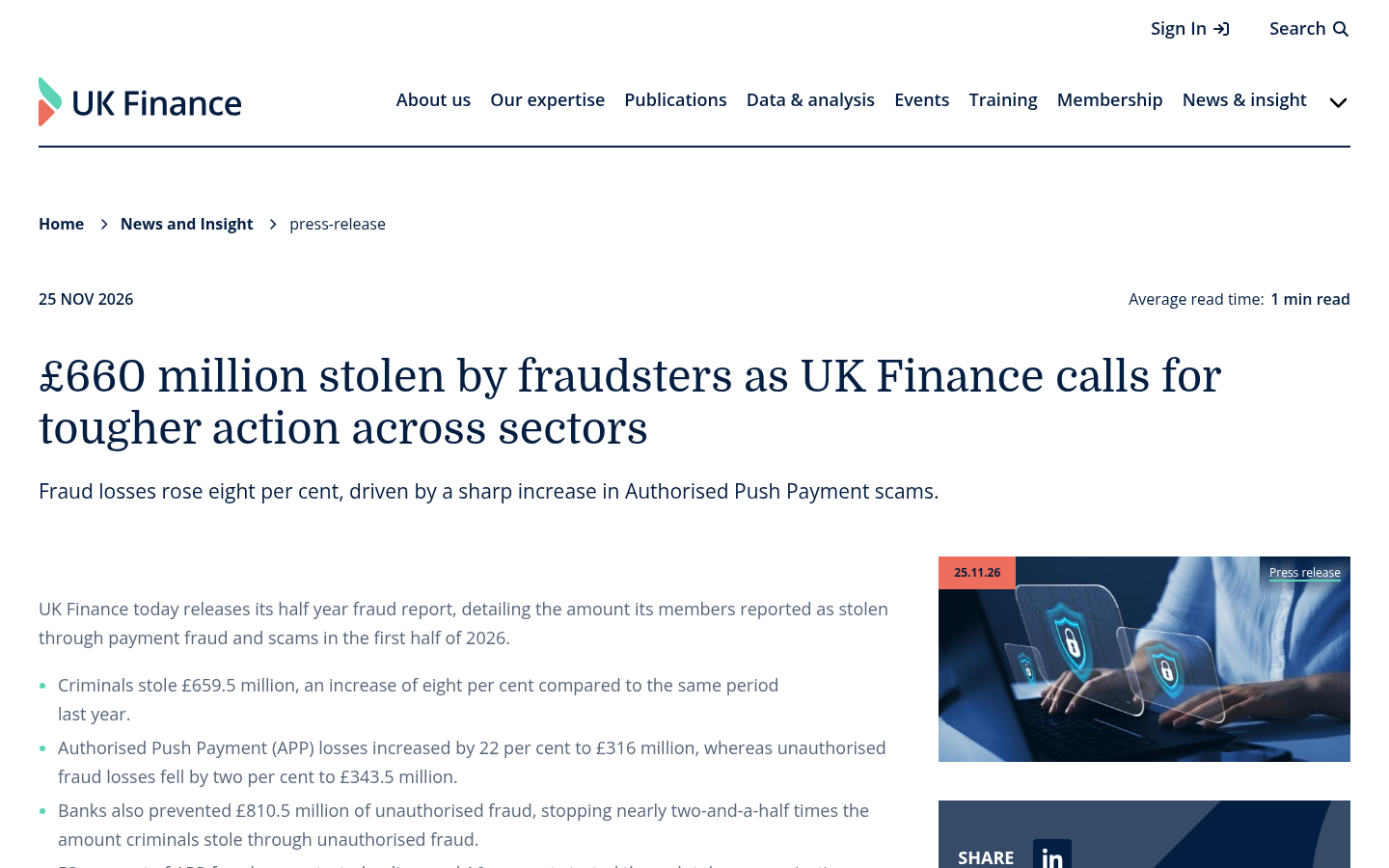
Criminals stole £659.5 million through payment fraud and scams in the UK in the first half of 2026, up 8% on a year earlier, with authorised push payment scam losses up 22% to £316 million (Source: UK Finance).
Stablecoin Insider tracks how payment rules are changing for banks, fintechs and stablecoin issuers, and the UK is preparing its biggest payments overhaul since 2017.
HM Treasury wants to replace detailed payment laws with more flexible FCA rules, bring UK stablecoins and tokenised deposits into the payments regime, and rebuild open banking on a new legal footing.
The consultation closed on 6 October 2026, and the government is now analysing the responses.
This guide explains what the overhaul covers, how it treats stablecoins, open banking and AI agents, the key dates, and what payment firms should do next.
Key Takeaways
- HM Treasury plans to rewrite the PSRs 2017 and EMRs 2011.
- Detailed payment rules would move from law into the FCA Handbook.
- UK-issued stablecoins could be treated as money-like payment instruments.
- Variable recurring payments would get a new statutory access right.
- The UK crypto regime starts on 25 October 2027.
What the UK Is Changing
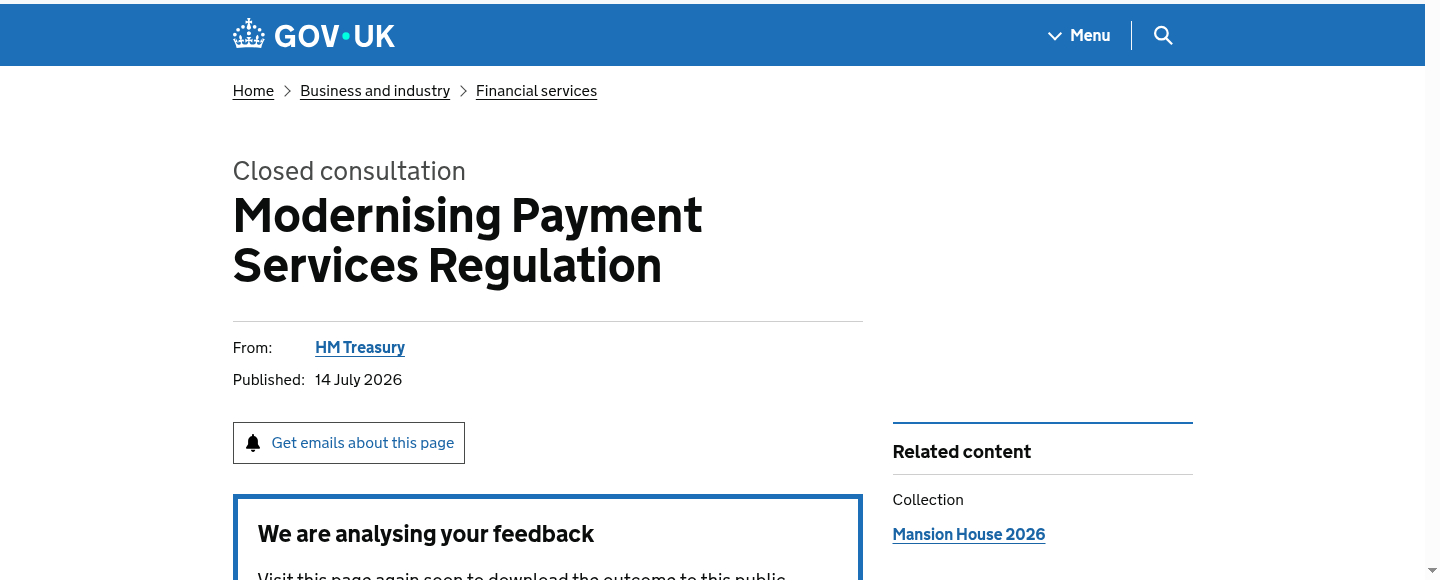
HM Treasury published its consultation on modernising payment services regulation on 14 July 2026. It ran until 6 October 2026, and the government says it is now analysing the feedback before publishing its response (Source: GOV.UK).
The aim is a framework that can keep up with tokenised payments, open banking and agentic payments while keeping strong consumer protection. The two main laws in scope are the Payment Services Regulations 2017 (PSRs) and the Electronic Money Regulations 2011 (EMRs).
- Stays in law: The payments perimeter, key definitions and core consumer protections.
- Moves to the FCA: Technical and firm-facing rules, potentially including authentication, safeguarding, prudential and conduct requirements.
- Already decided: The government will revoke the PSRs' Strong Customer Authentication rules so the FCA can set more outcomes-focused rules.
A&O Shearman notes the reforms build on recent changes that let firms delay suspected fraudulent payments by up to 72 hours and require 90 days' notice before closing a customer's account. The government is also asking which parts of the EU's new PSD3 and PSR the UK should reflect (Source: A&O Shearman).
For the EU side of the story, see our explainer on PSD3 and the PSR.
Stablecoins and Tokenised Payments
The government wants one set of payment permissions that works whether a payment is made in fiat money, tokenised deposits or certain stablecoins. Skadden describes this as a "multimoney" payments ecosystem, with regulated activities made technology-neutral rather than creating a separate blockchain regime (Source: Skadden).
| Instrument | Proposed treatment | Regime |
|---|---|---|
| Tokenised deposits | Same as deposits | Banking rules |
| UK stablecoins | Money-like | Payments regime |
| Recognised overseas | Possibly money-like | Payments regime |
| Other overseas | Cryptoasset | Crypto regime |
- Issuer status matters: A UK-issued qualifying stablecoin could be used in regulated payment services. A similar coin issued abroad may stay under the crypto regime unless its home country is recognised by HM Treasury.
- Fewer duplicate permissions: The government wants to avoid firms needing both payments and crypto custody permissions for the same stablecoin payment activity.
- Variation of permission: Existing payment firms would still need FCA approval before offering tokenised payment services.
- Programmable payments: The consultation asks how rules should handle smart contracts, such as paying a supplier automatically when goods arrive.
Systemic stablecoins will also face Bank of England rules, which we covered in our report on the Bank of England's draft rules for systemic stablecoins.
The New Crypto Regime Timeline
The payments overhaul sits next to the UK's new cryptoasset regime. The FCA finalised its crypto rules in June 2026. Firms can apply for authorisation between 30 September 2026 and 28 February 2027, and the mandatory regime comes into force on 25 October 2027. Stablecoin issuers, trading platforms, custodians and intermediaries will all need FCA authorisation (Source: FCA).
| Milestone | Date | Status |
|---|---|---|
| Crypto rules final | June 2026 | Done |
| Payments consultation | Jul to Oct 2026 | Closed |
| FCA crypto gateway | Sep 2026 to Feb 2027 | Open |
| Crypto regime live | 25 Oct 2027 | Scheduled |
| Payments law changes | Not yet set | Pending |
UK Finance said it looks forward to working with the FCA on how stablecoin payments will connect with the wider payments modernisation programme, according to the same FCA release.
Open Banking and Variable Recurring Payments
Open banking in the UK currently rests on the PSRs and a 2017 Competition and Markets Authority order. The government wants to replace this with a long-term framework overseen by the FCA, using powers under the Data (Use and Access) Act 2025, as Skadden sets out.
- VRP access right: A new statutory right for variable recurring payments, so payment providers can collect a series of payments within limits the customer sets.
- Charging for access: Banks could charge a fair fee for some enhanced or commercial open banking services, while core access may stay free.
- Commercial schemes: Industry-led schemes would set common service, liability and pricing terms, under FCA oversight.
- Future Entity: A new central standards body would replace the current Open Banking implementation arrangements.
VRPs could make account-to-account payments work for subscriptions, bills and retail checkout. For how Pay by Bank is already spreading across Europe, see our guide to Pay by Bank in Europe, and for the US equivalent, our explainer on the CFPB Section 1033 rule.
AI Agents and Agentic Payments
The consultation asks whether rules on authentication, consent and liability need to change so AI agents can make payments safely. The FCA has since raised the pressure. In a statement on 24 November 2026, it warned firms that AI agents can blur the line between regulated and unregulated activity and that senior managers are responsible for AI systems in their area (Source: PaymentExpert).
- Consent: How far a customer's mandate to an agent extends, and how it can be limited or revoked.
- Authentication: How Strong Customer Authentication applies when an agent, not a person, starts the payment.
- Liability: Who pays when an agent acts outside its mandate or relies on faulty data.
- Consumer Duty: Firms must avoid foreseeable harm and explain what an agent can and cannot do.
Our analysis of agentic banking covers how AI agents are already getting their own accounts, cards and wallets.
Financial Crime and Senior Manager Accountability
The government says its latest National Risk Assessment found higher financial crime risk in the payments and e-money sector, linked to fast growth and more complex services. It is asking whether senior managers at payment and e-money institutions should carry clearer personal responsibility for financial crime controls, as A&O Shearman explains.
The consultation stops short of proposing a full Senior Managers and Certification Regime. Even so, payment firms should check that responsibility for anti-money laundering, sanctions, fraud, safeguarding and agent oversight is clearly assigned.
What Payment Firms Should Do Now
- Map your products: List which services touch tokenised deposits, UK stablecoins or overseas stablecoins.
- Check permissions: Plan for a possible variation of permission to offer tokenised payments.
- Prepare for crypto authorisation: If you issue, hold or trade stablecoins, the FCA gateway closes on 28 February 2027.
- Review open banking costs: Model how access charges and commercial schemes could change your business.
- Tighten governance: Assign clear senior owners for financial crime, safeguarding and AI agents.
What to Watch
- Government response: HM Treasury's response to the consultation and draft secondary legislation.
- FCA consultations: New FCA rules on authentication, safeguarding and conduct once powers are delegated.
- Stablecoin recognition: Which overseas jurisdictions the UK recognises for stablecoin payments.
- VRP rollout: When the statutory VRP access right and pricing rules take effect.
- Agentic rules: Whether the FCA moves from guidance to specific rules for AI agents.
Conclusion
Stablecoin Insider follows payment rules across major markets, and the UK's overhaul is one of the most ambitious attempts to fit stablecoins, open banking and AI agents into one framework.
The core idea is simple: keep the basics in law and let the FCA write and update the detail as payments change.
For stablecoin issuers, the big question is whether their coin counts as UK-issued or recognised, because that decides which regime applies.
Firms should not wait for the final text. The crypto authorisation window is already open, and the payments changes will follow once the government responds.
Read Next
- Tax Brackets 2027: New IRS Bands, $16,600 Standard Deduction and What You'll Pay
- Poundland Administration: More Than 10,000 Jobs at Risk and a New Returns Rule
- Coinbase Wallet Direct Deposit: Paychecks as USDC on Base
FAQs
1. What is the UK payments regulation overhaul?
The UK payments regulation overhaul is HM Treasury's plan to modernise the Payment Services Regulations 2017 and Electronic Money Regulations 2011. It would move detailed rules to the FCA, bring UK stablecoins into the payments regime and create a new open banking framework.
2. When did the HM Treasury payments consultation close?
The HM Treasury payments consultation closed on 6 October 2026, after opening on 14 July 2026. The government is now analysing responses and has not yet published its final decisions.
3. Will stablecoins be regulated as payments in the UK?
Stablecoins will be regulated as payments in the UK if they are UK-issued qualifying stablecoins, and possibly if issued in a recognised overseas jurisdiction. Other overseas stablecoins would stay under the new cryptoasset regime.
4. When does the UK crypto regime start?
The UK crypto regime starts on 25 October 2027. Firms can apply for FCA authorisation between 30 September 2026 and 28 February 2027 to be ready for the start date.
5. What are variable recurring payments?
Variable recurring payments are payments a customer authorises in advance within set limits, so a provider can collect varying amounts from their bank account over time. HM Treasury plans to create a statutory access right for them.
Disclaimer: This content is provided for informational purposes only and does not constitute legal, financial, or investment advice. Proposals, dates and figures cited here reflect publicly available information as of November 2026 and may change once the government publishes its response. Check official HM Treasury and FCA sources before making decisions.