
Table of Contents
US spot Bitcoin ETFs lost a net $185.4 million on Friday, 13 November 2026, their seventh straight trading day of outflows, according to Farside Investors. The seven sessions since 5 November add up to $1.91 billion, and BlackRock's iShares Bitcoin Trust (IBIT) accounts for almost three-quarters of it.
Bitcoin kept falling into the weekend. It dropped below $68,000 on Saturday and touched an intraday low of $66,511.8 in Asian trading, its weakest level since August, Investing.com reported (Investing.com). CoinGecko showed about $66,760 at 14:15 CET on 14 November, roughly 21% below its 21 October peak of about $84,780 in CoinGecko's hourly data.
Key Takeaways
- Seven sessions, 5 to 13 November: $1,907.4 million of net outflows from US spot Bitcoin ETFs (Farside). SoSoValue data put the streak at $1.91 billion.
- IBIT supplied $1,416.4 million (74%) of the streak and has now had 11 straight outflow days since 30 October, totalling about $2.35 billion.
- Last week's $1.28 billion outflow was the largest weekly figure since the week of 22 June; this week added $1.07 billion.
- Morgan Stanley's MSBT was the only fund with net inflows over the seven sessions, at $54.4 million.
- The streak is long but not this year's longest: outflows ran for 13 sessions from 15 May to 3 June and 10 sessions from 17 June to 1 July.
- US spot Ether ETFs broke their own six-day outflow run with a $2.3 million inflow on Friday.
How much have Bitcoin ETFs lost in the outflow streak?
Bitcoin ETFs have lost a net $1,907.4 million over the seven trading sessions from 5 to 13 November, by our sum of Farside's daily data. The worst days were 5 November ($430.2 million) and 6 November ($411.9 million). Friday's $185.4 million was the smallest daily outflow since Tuesday, when $95.0 million left.
Investing.com, citing SoSoValue, reported the same streak at $1.91 billion and Friday's outflow at $185.45 million (Investing.com). The small gap is rounding: Farside publishes to one decimal place in millions.
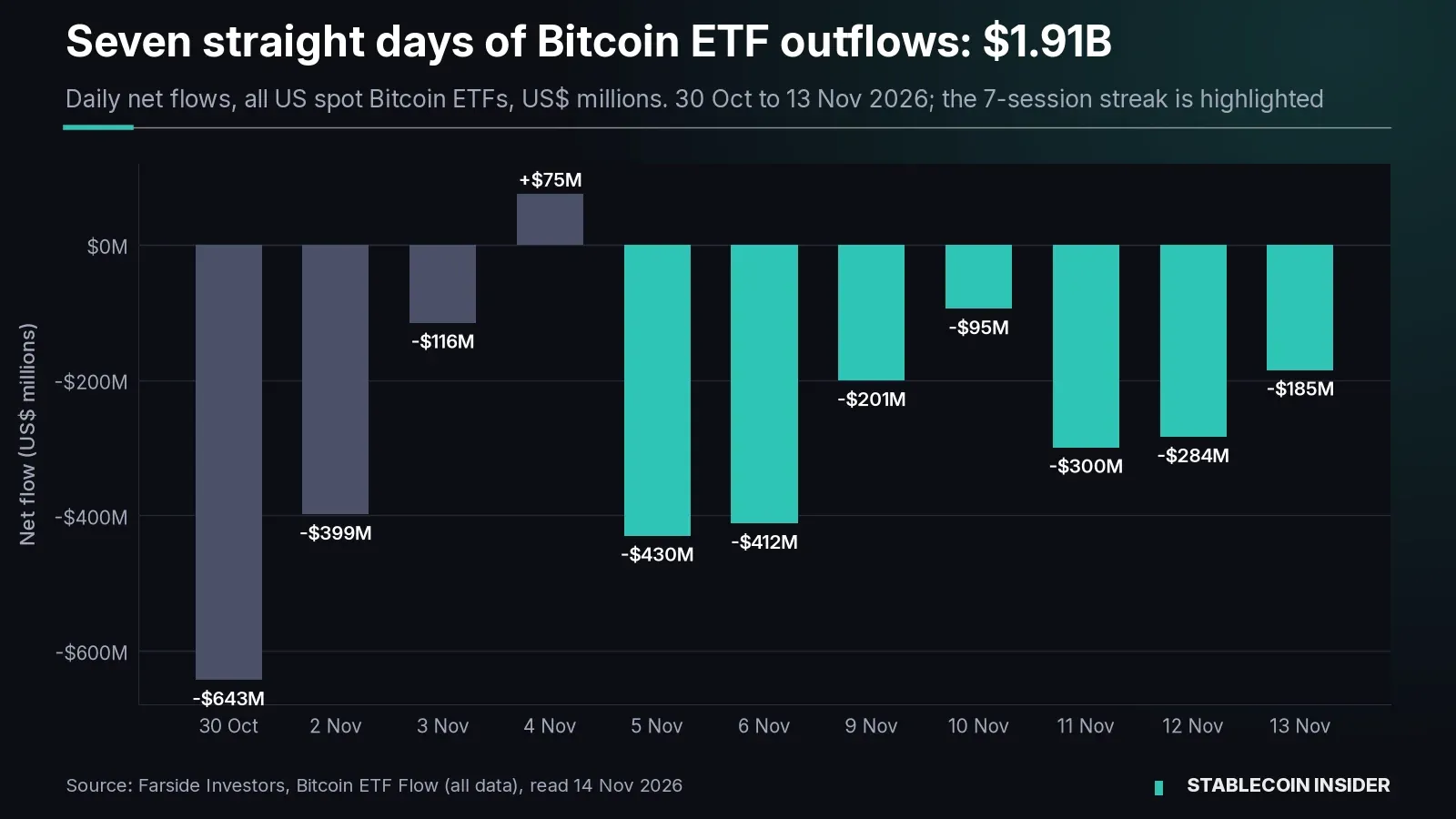
The chart shows why the streak started on 5 November and not earlier. Outflows began on 30 October, but a $74.6 million inflow on 4 November broke the run. Counting from 30 October, the 11 sessions still add up to $2.99 billion of net outflows.
Which Bitcoin ETFs saw the biggest outflows?
BlackRock's IBIT saw the biggest outflows, followed by Fidelity's FBTC and Grayscale's GBTC. The table sums Farside's daily figures by fund for the seven sessions and lists each fund's cumulative net flow since launch from the same Farside table.
| Fund (issuer) | Net flow, 5 to 13 Nov | Share of streak | Cumulative net flow since launch |
|---|---|---|---|
| IBIT (BlackRock) | -$1,416.4M | 74% | +$64,193M |
| FBTC (Fidelity) | -$268.4M | 14% | +$10,164M |
| GBTC (Grayscale) | -$100.1M | 5% | -$28,149M |
| ARKB (ARK 21Shares) | -$67.4M | 4% | +$922M |
| BITB (Bitwise) | -$46.9M | 2% | +$2,001M |
| EZBC and HODL (Franklin, VanEck) | -$62.6M | 3% | +$1,282M |
| MSBT (Morgan Stanley) | +$54.4M | inflow | +$868M |
| All US spot Bitcoin ETFs | -$1,907.4M | 100% | +$54,701M |
Two patterns stand out. First, the selling is concentrated: IBIT alone had outflows on all seven days, including $143.5 million of Friday's $185.4 million, with FBTC supplying the other $41.9 million (Cointelegraph reported the same split). Second, the streak barely dents what the funds have gathered. The $1.91 billion is about 3.5% of the $54.7 billion of cumulative net inflows since January 2024. Remaining funds not listed had zero net flow over the period.
IBIT's own run is longer than the market's. It has had net outflows on 11 straight sessions since 30 October, about $2.35 billion in total, and its November outflows of about $2.12 billion are roughly 90% of the whole market's net November withdrawals (our sum of Farside data; Cointelegraph reported the same figures).
How does this streak compare with earlier 2026 outflows?
This streak is the longest since summer but shorter than two earlier runs in 2026. In Farside's data, outflows ran for 13 sessions from 15 May to 3 June ($4.36 billion) and for 10 sessions from 17 June to 1 July ($2.71 billion). No run between July and October lasted more than six sessions.
| Outflow streak | Sessions | Net outflow | Largest weekly outflow in the run |
|---|---|---|---|
| 15 May to 3 Jun 2026 | 13 | -$4,361.8M | -$1,722.0M (week of 1 Jun) |
| 17 Jun to 1 Jul 2026 | 10 | -$2,709.8M | -$1,787.3M (week of 22 Jun) |
| 5 to 13 Nov 2026 | 7 (and counting) | -$1,907.4M | -$1,281.7M (week of 2 Nov) |
Weekly totals are summed Monday to Friday from the same daily data. On that basis, the week to 6 November ($1.28 billion) was the largest weekly outflow since the week of 22 June, which matches what Cointelegraph reported.
Ether funds are not following the same path this week. US spot Ether ETFs had six straight outflow days from 5 to 12 November, totalling $594.4 million, then took in a net $2.3 million on Friday (Farside, Ethereum ETF Flow).
Why is Bitcoin falling?
Bitcoin is falling as ETF outflows, forced liquidations and wider risk aversion hit at the same time, according to coverage on 13 and 14 November. None of the sources below can show how much each factor contributed, so treat them as context rather than a proven cause.
- Liquidations. Exchanges liquidated $1.47 billion of positions over 24 hours, $1.31 billion of them bullish bets, according to CoinGlass data cited by Investing.com.
- The Anthropic IPO. CoinDesk reported that Anthropic aims to raise up to $64.4 billion with orders about six times the shares available, and called investors freeing up capital for the listing "one possible explanation" for the sell-off (CoinDesk).
- Tech and rates. CoinDesk also listed Jensen Huang's resignation as Nvidia CEO and growing expectations of a 25-basis-point Federal Reserve rate increase at the 9 December meeting as headwinds. We covered how tokenized Nvidia traded around the Huang resignation.
CoinDesk said Bitcoin was on course for a sixth straight weekly loss, echoing its first-quarter losing streak; the record is nine weeks, set in 2022. It put Bitcoin down 11% in November and 21% so far in 2026 (CoinDesk).
Are stablecoins also seeing outflows?
Yes, stablecoins are also shrinking. Total stablecoin supply in DefiLlama's daily series fell from $293.33 billion on 5 November to $287.76 billion on 13 November, a $5.57 billion drop over the same dates as the ETF streak. Tether's USDT fell by $2.23 billion and Circle's USDC by $1.67 billion.
Supply falls when issuers redeem more tokens for dollars than they mint, so this is a separate channel from ETF redemptions. The data do not show whether the same investors are behind both, and we have not assumed it. Our earlier report on the 30-day stablecoin supply drop explains the longer trend.
Stablecoin Insider's take
New to how stablecoin supply affects crypto markets? See our guide to stablecoin liquidity.
For the full picture, see our Stablecoin regulation hub.
FAQ
What does a net outflow from a spot Bitcoin ETF mean?
Why do Farside and SoSoValue show slightly different numbers?
When will the next Bitcoin ETF flow data come out?
Do falling stablecoin supplies mean money is leaving crypto?
What happens next?
Next, the market gets three tests. Monday's ETF data will show whether the streak reaches eight sessions or breaks, and whether IBIT's run extends past 11 days (Farside). The weekly close on Sunday decides whether Bitcoin books its sixth straight weekly loss (CoinDesk). Beyond that, CoinDesk flagged Anthropic's IPO as one of next week's biggest market events, and the Federal Reserve meets on 9 December. Watch DefiLlama's stablecoin supply too: a return to growth would be the first sign of fresh onchain dollars coming back (DefiLlama).
Sources: Farside Investors, Bitcoin ETF Flow (all data); Farside Investors, Ethereum ETF Flow (all data); Investing.com (14 Nov 2026); CoinDesk (13 Nov 2026); Cointelegraph (14 Nov 2026); CoinGecko, Bitcoin price data; DefiLlama, stablecoins dashboard. All read on 14 November 2026. Sums, shares and streak comparisons are Stablecoin Insider calculations from Farside's daily data.
This content is provided for informational and educational purposes only and doesn't constitute financial, investment, legal or tax advice. ETF flows, prices and stablecoin supply figures were read on 14 November 2026 and can be revised. It isn't a recommendation to buy, sell or hold Bitcoin, Ether, USDT, USDC or any ETF, including those issued by BlackRock, Fidelity, Grayscale, ARK 21Shares, Bitwise, Franklin Templeton, VanEck or Morgan Stanley.