Table of Contents
OpenAI launched ChatGPT Wallet on 13 November 2026, a payment feature that lets its "dots" AI agents buy things for users without ever seeing their card number. It was built with American Express, Mastercard and Visa, and is rolling out first to ChatGPT Pro subscribers in the US who are 18 or older and hold an eligible US-issued card (OpenAI announcement).
Every purchase still needs the user's approval with a biometric check such as Face ID or a fingerprint. After approval, the card network issues a payment token with its own card number, security code and expiry date, and the charge lands on the user's chosen card (same source). OpenAI is not taking a cut of transactions to start, CNBC reported (CNBC).
Key Takeaways
- ChatGPT Wallet launched on 13 November 2026 for US ChatGPT Pro users aged 18+, inside dots only, not in Chat, Work or standalone Codex threads.
- Agents pay with a network token instead of the real card number; OpenAI says it receives only limited card details such as the last four digits.
- At launch it accepts eligible US-issued credit cards only. OpenAI's help article rules out debit cards and virtual cards and also names Chase as a supported issuer.
- Merchants need no Wallet-specific integration. OpenAI asks them to let its signed cloud browser through firewalls and to tune fraud systems so agent purchases are not declined.
- The merchant stays the seller of record. OpenAI says it is not a bank, card issuer, payment network, lender or merchant and does not hold purchase funds.
- The launch runs entirely on card rails. None of the OpenAI documents we read mentions stablecoins or crypto.
What did OpenAI launch on 13 November 2026?
On 13 November 2026 OpenAI launched ChatGPT Wallet, a stored-card wallet that lets a dot agent complete checkout on a merchant's website after the user approves the order. OpenAI calls it "the first wallet that lets agents pay without access to users' actual card details and that requires a security check for every purchase" (OpenAI). That is OpenAI's own claim; we have not seen an independent review of it.
OpenAI also published a Commerce Partner Playbook for businesses and named the partners it is working with: fraud firms Forter, Riskified, Sardine and Signifyd, and payment providers Adyen, Checkout.com and Stripe (OpenAI). Quotes in the announcement come from Luke Gebb, EVP and Head of Global Innovation at American Express, Sherri Haymond, EVP, Global Head of Digital Commercialization at Mastercard, and Rubail Birwadker, Head of Global Growth at Visa. Gebb called it "our first American Express Agentic Commerce Experiences integration."
How does a ChatGPT Wallet purchase work?
A ChatGPT Wallet purchase works in five steps: add a card once, review the order, approve it with biometrics, receive a network token, and let the merchant's checkout charge it. The diagram follows OpenAI's launch post, help article and Wallet terms.
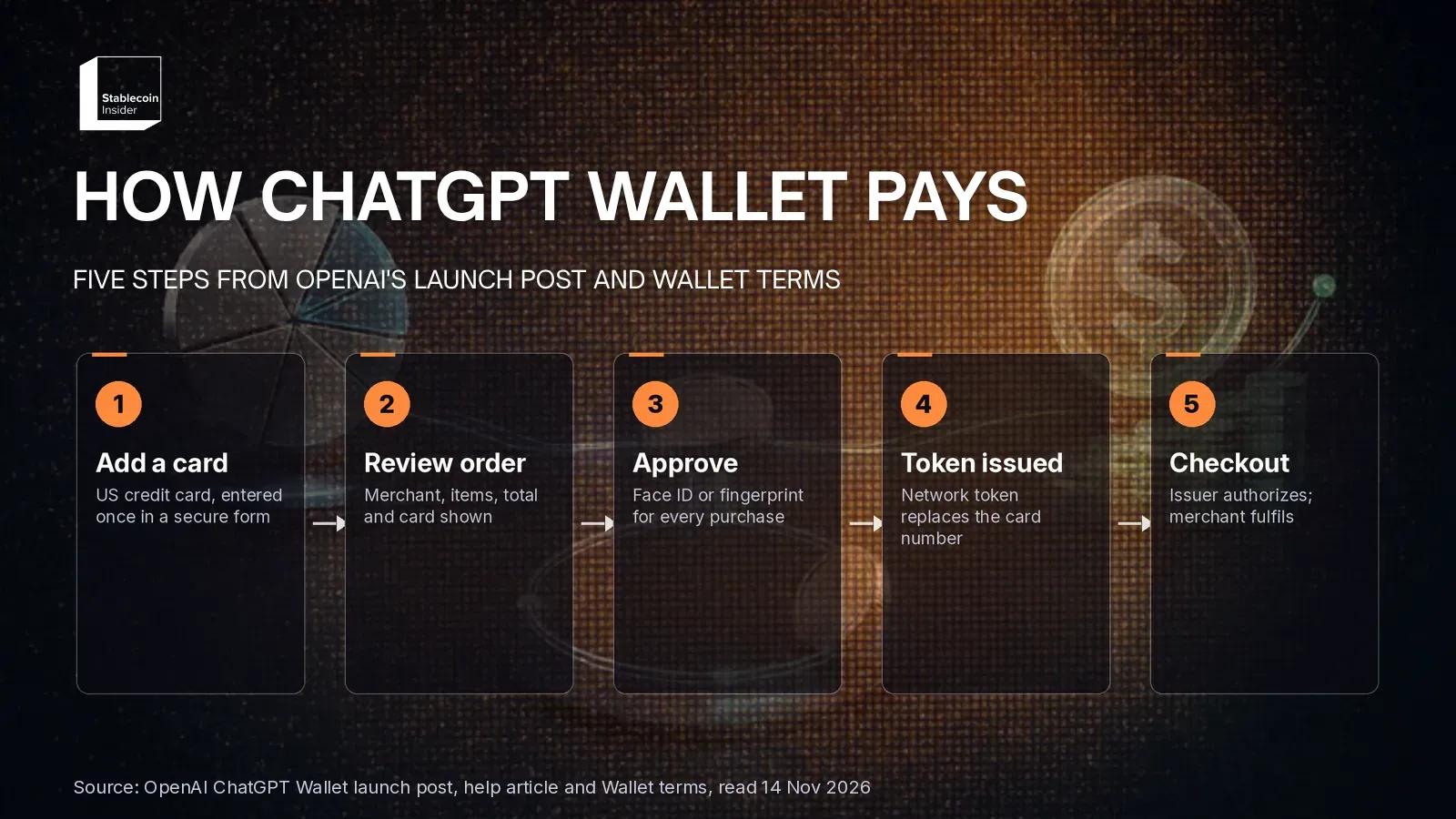
Card details go into a secure form run by OpenAI's payment service provider, not into the chat. OpenAI says it receives a tokenized credential plus limited data such as network, issuer, card type and last four digits, and "does not receive the full credit card number or security code" (Wallet Privacy Notice).
The approval screen shows the merchant, items, total, card and any recurring-charge terms. The terms say approval is limited to what was shown, and that a material change before submission triggers a new approval (Wallet terms). The help article warns that "Ready to check out" only means approval is done, not that the merchant has placed the order (OpenAI Help Center).
Who can use ChatGPT Wallet?
ChatGPT Wallet can be used only by ChatGPT Pro subscribers in the US who are 18 or older, live in the US, have a US billing address and hold an eligible US-issued credit card. It is rolling out gradually, so not every eligible Pro user has it yet (OpenAI Help Center).
The help article adds details the launch post leaves out. It names American Express, Chase, Mastercard and Visa cards; it says debit cards and virtual cards are not supported at launch; Chase cards need the primary cardholder; and approval needs Face ID, Touch ID or similar on a supported device (OpenAI Help Center). Business cards are allowed if the employer permits it (Wallet terms).
Who is responsible when an agent purchase goes wrong?
Responsibility for an agent purchase that goes wrong depends on the problem. The merchant handles orders, the card issuer handles charges, and OpenAI handles only the Wallet itself. The table maps each problem to the party OpenAI's documents name; rows link to the source.
| Problem | Who handles it | Source |
|---|---|---|
| Order status, returns, refunds, cancelling a recurring charge | Merchant (seller and merchant of record) | Help Center |
| Declined, pending, disputed or unrecognized charge | Card issuer | Help Center |
| Wallet error, account takeover, purchase differs from what was approved | OpenAI Support | Help Center |
| Interest, fees, rewards, chargeback rights | Cardholder agreement and network rules still apply | Wallet terms |
| Whether the card is authorized | Issuer decides; OpenAI gives no acceptance guarantee | Wallet terms |
Two points stand out. OpenAI keeps itself out of the money flow: the terms say it "is not a bank, card issuer, payment network, lender, or merchant" for Wallet purchases and does not hold purchase funds. It also "does not decide or fund merchant refunds or card chargebacks unless required by law" (Wallet terms). Rewards and dispute rights stay governed by the cardholder agreement and network rules (same source).
What do merchants need to do to accept ChatGPT Wallet?
To accept ChatGPT Wallet, merchants do not need to build anything, because it "works out of the box with existing checkout pages and payment forms" (OpenAI developer docs). The practical work is on bot and fraud controls.
- Let the agent in. ChatGPT's cloud browser signs requests with Web Bot Auth (RFC 9421). Akamai, Cloudflare, HUMAN and Vercel verify the signature automatically; other firewalls can check it against keys OpenAI publishes (agent access guide).
- Stop false declines. OpenAI is rolling out user signals such as country, locale, time zone and a masked IP prefix in the HTTP
Forwardedheader for risk systems to read (accept payments guide). - Treat the token as one-time. Merchants get a network token, not the card number, and may not reuse it for a separate purchase. Subscriptions are allowed if checkout already supports recurring billing, and the Payment Account Reference links the token to the underlying account (accept payments guide).
Not every merchant will allow it. CNBC reported that United Airlines said on Wednesday it will block agents from booking tickets, and that Amazon prevents agents from buying on its platform (CNBC; TechCrunch).
How is ChatGPT Wallet different from Instant Checkout?
ChatGPT Wallet differs from Instant Checkout mainly in where the purchase happens. Instant Checkout, launched on 29 September 2025, needed merchants to integrate the Agentic Commerce Protocol built with Stripe. Wallet uses an agent browsing the merchant's existing site. The table compares what OpenAI said at each launch.
| Instant Checkout (Sep 2025) | ChatGPT Wallet (Nov 2026) | |
|---|---|---|
| Who could use it | US Free, Plus and Pro users | US Pro users, 18+, rolling out (Help) |
| Merchant setup | Agentic Commerce Protocol integration; Etsy first, Shopify merchants "coming soon" | None required; works on existing checkout (docs) |
| Payment credential | Encrypted token scoped to amount and merchant | Network token from Amex, Mastercard or Visa (OpenAI) |
| Fee to OpenAI | Merchants paid "a small fee" on completed purchases | No cut of transactions to start (CNBC) |
Sources: OpenAI, 29 Sep 2025 for the Instant Checkout column. CNBC reported that OpenAI "quickly pivoted away" from Instant Checkout and rolled out a revamped shopping experience by March (CNBC). The protocol itself is compared with Google's rival in our ACP vs UCP explainer.
Does ChatGPT Wallet use stablecoins or crypto?
No, ChatGPT Wallet does not use stablecoins or crypto. It is a card product: the terms say it "does not create a bank account or stored balance, extend credit, transfer funds," and it charges an existing credit card through a network token (Wallet terms). The terms also bar using Wallet for "cash-equivalent transactions." None of the launch post, help article, terms, privacy notice or developer guides we read mentions stablecoins, x402 or blockchain settlement.
So OpenAI's first agent wallet for ChatGPT, which it says has 1.2 billion weekly users, runs on card rails (OpenAI). Stablecoin-native agent standards take a different route: our x402 vs AP2 vs ACK-Pay guide covers them, and our cost comparison of agent payments and card payments shows how card fees compare with stablecoin rails on small payments.
What is still unknown about ChatGPT Wallet?
Several things about ChatGPT Wallet are still unknown, because OpenAI's documents do not address them:
- Which network programs issue the tokens. OpenAI does not say whether purchases run through Visa Intelligent Commerce, Mastercard Agent Pay or another tokenization service (compare the two in our network comparison).
- Any purchase limits. The terms say OpenAI "may set transaction, merchant, category" and other limits, but no amounts are published.
- When pre-approved purchases arrive. The launch post describes delegation with spending limits as something users will get "over time," though the terms already mention granting ChatGPT authority to approve purchases in advance. No date is given.
- Whether OpenAI will start charging merchants or users. CNBC reported only that there is no cut "to start."
- Adoption. OpenAI has published no user, merchant or transaction counts for Wallet.
Stablecoin Insider's take
Building agent checkout yourself? See how the Agentic Commerce Protocol compares with UCP.
For the full picture, see our AI agent payments hub.
FAQ
Does ChatGPT Wallet cost anything to use?
Can ChatGPT buy things without asking me?
Is ChatGPT Wallet available outside the US?
Does the merchant see my card number?
Can I pay with crypto or a stablecoin in ChatGPT Wallet?
What happens next?
Next, OpenAI says it will learn from the limited Pro rollout and then widen access with businesses, banks and networks (OpenAI). Things to watch: whether Wallet reaches Plus or Free users, the first published spending-limit and pre-approval controls, more issuers joining after Chase, and whether large merchants that block agents, such as United Airlines and Amazon per CNBC, change course. For payment providers, the near-term signal is how quickly fraud vendors start reading OpenAI's Forwarded header signals (OpenAI developer docs).
Sources: OpenAI, Introducing ChatGPT Wallet (13 Nov 2026); OpenAI Help Center, Making purchases with ChatGPT Wallet; ChatGPT Wallet terms (effective 12 Nov 2026); ChatGPT Wallet Privacy Notice (effective 12 Nov 2026); OpenAI Commerce Partner Playbook; OpenAI, Accept payments; OpenAI, cloud browser access guide; OpenAI, Buy it in ChatGPT (29 Sep 2025); CNBC (13 Nov 2026); TechCrunch (13 Nov 2026). All read on 14 November 2026.
This content is provided for informational and educational purposes only and doesn't constitute financial, investment, legal or tax advice. Details were read from OpenAI's documents and press coverage on 14 November 2026 and may change as the rollout continues; Stablecoin Insider has not used ChatGPT Wallet. It isn't a recommendation to use or avoid ChatGPT Wallet, OpenAI, American Express, Mastercard, Visa, Chase, Stripe, Adyen, Checkout.com or any other company named.