Table of Contents
The best multisig wallet for a stablecoin treasury on Ethereum and other EVM chains is Safe{Wallet}: it charges no software fee on USDC transfers, and on Ethereum, Base, BNB Chain and Arbitrum it can pay gas from the Safe balance in USDC or USDT (Safe; Safe gas FAQ). Squads is the pick for USDC on Solana. Ledger Enterprise Multisig suits high-value treasuries that want every approval signed on a Ledger device. Den suits companies that want policy rules and sponsored gas under an enterprise contract.
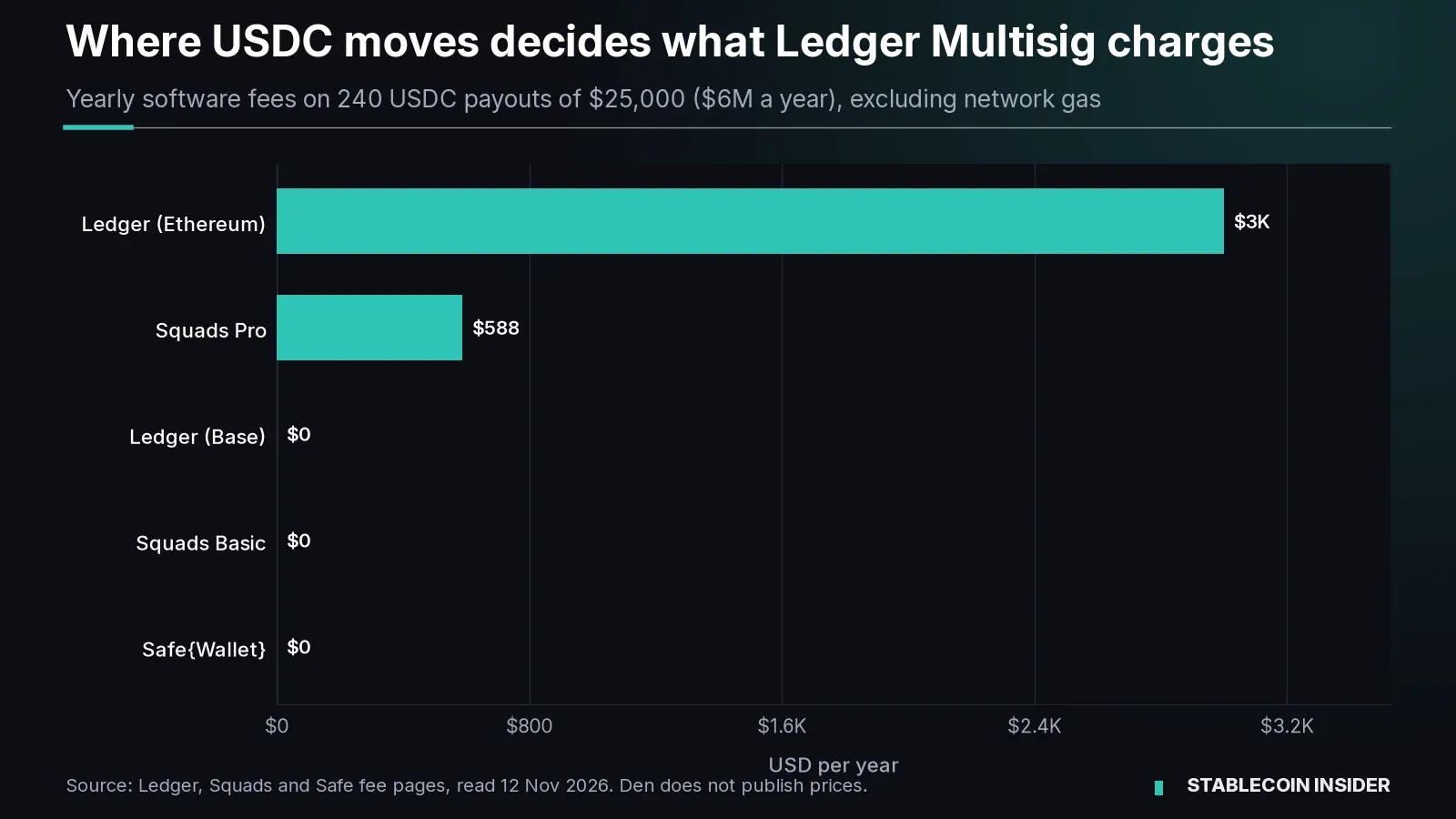
Fees decide more than most teams expect. Ledger charges 0.05% on Ethereum token transfers, capped at $5,000 per transaction, but nothing extra on Base, Arbitrum, Optimism, Polygon or BNB (Ledger). On $6 million a year of USDC payouts that is $3,000 on Ethereum and $0 on Base.
Last updated: 12 November 2026. Fees and terms re-checked against provider pages on this date.
Key Takeaways
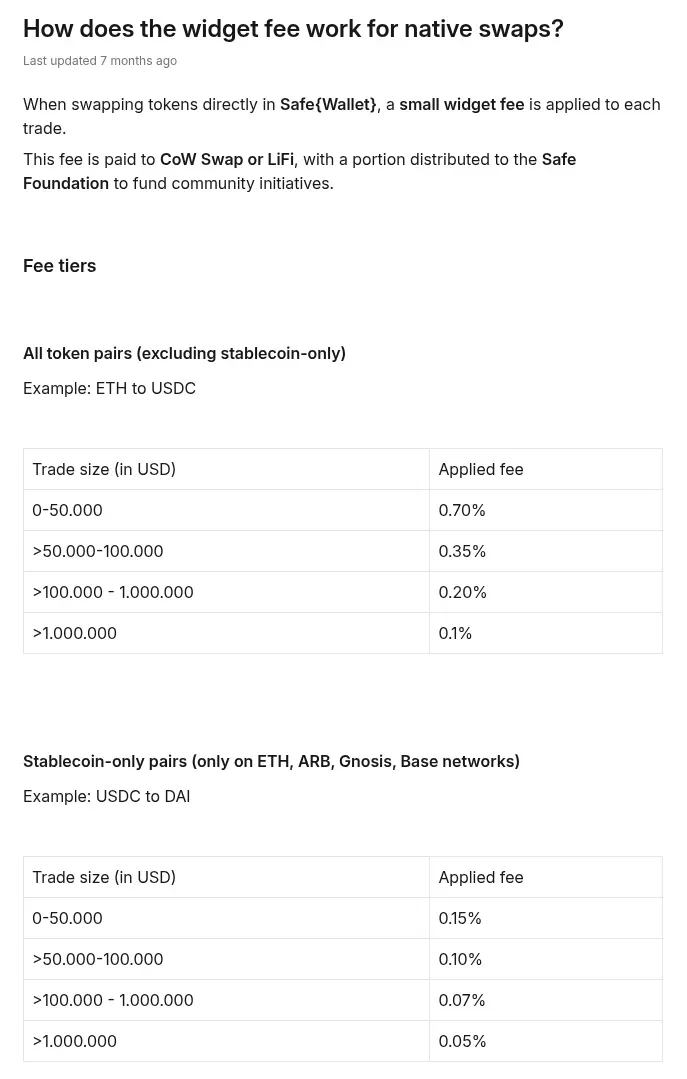
- Safe{Wallet} takes no fee on transfers or settings changes; gas goes to the network. Its in-app swaps carry a widget fee of 0.05%–0.15% on stablecoin-only pairs (Safe; Safe swap fees).
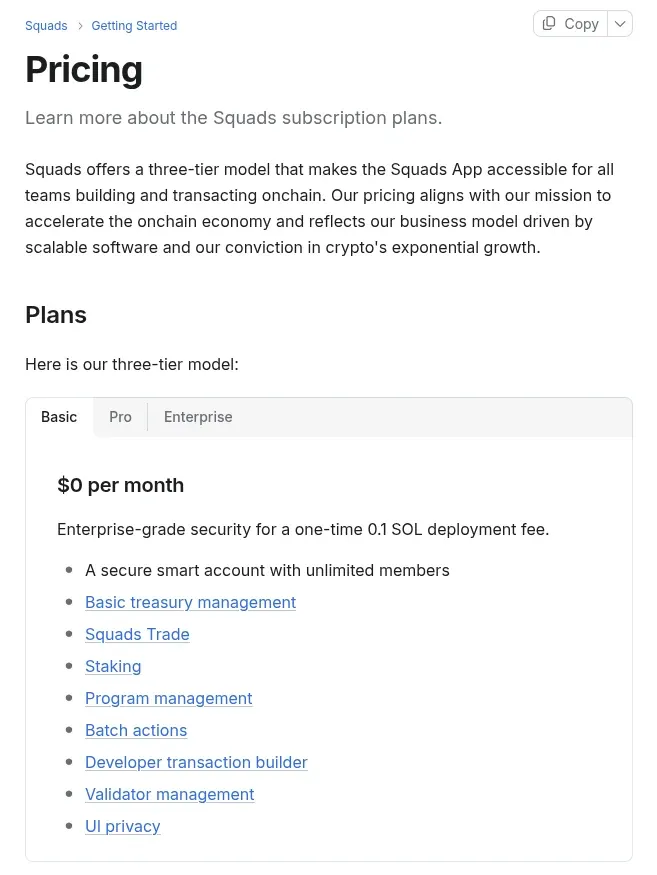
- Squads Basic costs $0 a month plus a one-time SOL deployment fee; Squads Pro costs $49 a month and adds payments, spending limits and sub-accounts (Squads; Squads docs).
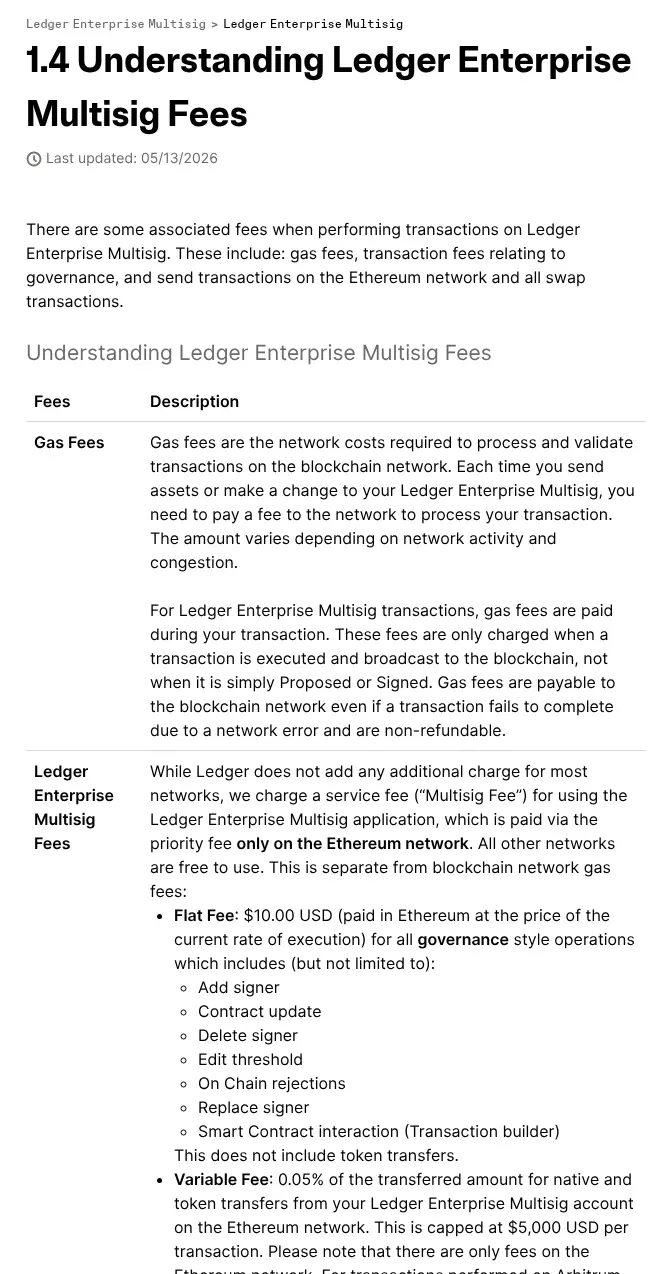
- Ledger Enterprise Multisig is built on the Safe protocol and charges only on Ethereum: $10 per governance action or 0.05% per transfer (Ledger).
- Den does not publish prices. Its plans include a gas allowance with overages billed, and enterprise use runs under an order form (Den; Den terms).
- The 2025 Bybit theft started with a compromised Safe{Wallet} developer machine, not a flaw in Safe's contracts. What signers see on screen matters as much as the threshold (Safe Ecosystem Foundation; FBI).
Which multisig wallets are best for stablecoin treasuries?
The best multisig wallets for stablecoin treasuries are the four below. Each holds USDC or USDT in a smart account that needs several approvals before funds move. Every row links to the page we read.
| Wallet | Best for | Chains | Software fees (read 12 Nov 2026) |
|---|---|---|---|
| Our pick: Safe{Wallet} | Most EVM teams holding USDC or USDT | EVM networks; gas in stablecoins on Ethereum, Base, BNB Chain, Arbitrum | None on transfers; swaps 0.05%–0.70% |
| Squads | USDC treasuries on Solana | Solana | Basic $0; Pro $49/month; one-time SOL deployment fee |
| Ledger Enterprise Multisig | High-value treasuries signing on Ledger devices | Ethereum, Base, Optimism, Arbitrum, Polygon | Ethereum only: $10 governance; 0.05% transfers, $5,000 cap |
| Den | Policy-driven enterprise treasury and customer wallets | Ethereum, Arbitrum, Base, Optimism, Ronin | Not published; gas allowance, then overages |
| Wallet | How approvals work | Who pays gas | Biggest limitation |
|---|---|---|---|
| Safe{Wallet} | Owner threshold, for example 2 of 3; confirmations are free, the executor pays (Safe) | Safe balance in ETH, USDC, USDT, DAI and more on four networks (Safe) | Signers must verify what the web interface shows them |
| Squads | Threshold plus, on Pro, permissions and spending limits (Squads) | Solana network fees, e.g. 0.0051 SOL per SPL-token withdrawal (Squads) | Solana only |
| Ledger Enterprise Multisig | Safe threshold, signed with Clear Signing on Ledger Stax or Flex (Ledger) | Executing signer pays gas and the Ledger fee in ETH (Ledger) | Nano X and Nano S Plus cannot sign |
| Den | Policies checked by the signing app, Den's Guardian co-signer and onchain contracts (Den) | Den sponsors gas within a plan allowance (Den) | EVM only; price only through sales |
Two patterns stand out. Three of the four rest on Safe's contracts: Ledger builds on the Safe protocol, and Den also offers a Safe deployment called Den Multisig alongside its own Multi-Layer Security Wallet (Den terms). So the choice is mostly about the signing experience, chain and fee model on top, not the vault underneath. And only Squads serves Solana.
How much does a multisig cost to run on $6 million of USDC payouts?
A multisig costs between $0 and $3,000 a year in software fees on $6 million of USDC payouts, depending on the wallet and the chain. We assumed 240 payouts a year of $25,000 each, the published rates read on 12 November 2026, and no negotiated discounts. Network gas is left out because it changes by the block.
| Action | Safe{Wallet} | Squads (Solana) | Ledger Multisig |
|---|---|---|---|
| Send 100,000 USDC on Ethereum | $0 + gas | n/a (on Solana: $0 + about 0.0051 SOL) | $50 + gas |
| Send 100,000 USDC on Base | $0 + gas | n/a | $0 + gas |
| Change the signing threshold | $0 + gas | $0 + about 0.0042 SOL | $10 + gas on Ethereum; $0 elsewhere |
| 240 payouts of $25,000 a year | $0 | $0 on Basic; $588 on Pro | $3,000 on Ethereum; $0 on Base |
| Swap 100,000 USDC to USDT in the app | 0.10% widget fee tier, about $100 | No Squads fee on market swaps; 0.25% on limit orders | Third-party fee plus a Ledger transaction fee |
Rates: Safe transaction fees, Safe swap tiers, Squads costs, Squads plans, Ledger fees. Ledger's 0.05% hits its $5,000 cap on a single $10 million transfer. Squads Pro is only needed for payments, spending limits or sub-accounts. Den is left out of the table because it publishes no rates.
The practical lesson: a Ledger Multisig team that pays vendors in USDC can move routine payouts to Base or Arbitrum and keep Ethereum for large settlements, where the cap limits the fee.
Safe{Wallet}: best for most EVM stablecoin treasuries
Best for: startups, DAOs and finance teams holding USDC or USDT on Ethereum and its layer-2 networks who want free software and wide app support.
Safe{Wallet} is the default EVM multisig because it adds no fee of its own: transaction fees "do not go to Safe" but to the network (Safe). Gas abstraction is rolling out on Ethereum, Base, BNB Chain and Arbitrum, so signers no longer need ETH; gas comes from the Safe in ETH, USDC, USDT, DAI or, on Ethereum and Arbitrum, PYUSD (Safe gas FAQ). The native swap widget charges 0.70% on small mixed-token trades, falling to 0.1% above $1 million, and 0.15% to 0.05% on stablecoin-only pairs on Ethereum, Arbitrum, Gnosis and Base (Safe).
- Pros: no software fee on holdings or transfers; stablecoins can pay gas on four networks; Ledger and Den both build on the same contracts, so a Safe can later move under either interface.
- Cons: the swap widget is expensive for small mixed trades; the Bybit theft of about $1.5 billion in February 2025 came through a compromised Safe{Wallet} developer machine that served a disguised transaction, so signers must check what they sign (Safe Ecosystem Foundation; FBI).
Squads: best for USDC on Solana
Best for: Solana teams, protocols and validators that hold USDC and want payouts, spending limits and bank rails in the same account.
Squads calls itself "the multisig platform to secure and manage Solana assets" and lists third-party stablecoin payouts, ACH, wire and SEPA virtual accounts and off-ramps among its features (Squads). Basic is $0 a month with unlimited members. Pro is $49 a month, with a 30-day free trial, and adds permissions, payments, sub-accounts, spending limits and a paymaster; it is pulled in USDC from the vault each month (Squads docs). Squads says it charges no transaction fees except 0.25% on limit orders (Squads costs).
- Pros: free Basic tier; flat monthly price instead of a percentage of assets; payouts and fiat rails built in.
- Cons: Solana only; smart-account network fees run higher than ordinary wallets, e.g. 0.0051 SOL per SPL-token withdrawal; the deployment fee is listed as 0.05 SOL on the product page but 0.1 SOL in the docs, so check the figure at setup; Ledger devices must connect through Phantom or Solflare with blind signing enabled (Squads; Squads docs; Create a Squad).
Ledger Enterprise Multisig: best for hardware-signed approvals
Best for: funds, exchanges and corporates moving large USDC amounts who want each signer to confirm details on a hardware screen.
Ledger Enterprise Multisig runs on the Safe protocol and syncs with existing Safe accounts, so there is nothing to migrate. Signers approve with Clear Signing on Ledger Stax or Flex; Nano X and Nano S Plus can view balances but cannot sign. Supported networks are Ethereum, Base, Optimism, Arbitrum and Polygon (Ledger). On Ethereum only, Ledger charges $10 for governance actions such as adding a signer, or 0.05% of a token transfer capped at $5,000, paid in ETH by the executing signer (Ledger; Ledger support).
- Pros: transaction details shown on the device screen, which targets the kind of display tampering seen at Bybit; no fee off Ethereum; works with existing Safes.
- Cons: every signer needs a Stax or Flex; the 0.05% Ethereum fee adds up on frequent payouts; swaps carry a Ledger transaction fee on top of third-party fees.
Den: best for policy-driven enterprise treasury
Best for: larger companies and fintechs that need spending policies, audit logs, sponsored gas and wallets for their own customers.
Den's Multi-Layer Security Wallet checks each transaction against policy three times: in the mobile or SDK signer, in Den's Guardian co-signer and in onchain contracts. Policies can set approvals, allowlists and spending limits. Den sponsors network fees within a plan allowance, holds SOC 2 Type II, and deploys in Den Cloud, the customer's cloud or on-premise (Den). Its contracts run on Ethereum, Arbitrum One, Base, Optimism and Ronin (Den docs). Fees are set in an order form and payable in digital assets (Den terms).
- Pros: rules enforced in three places; no gas balances to manage; Wallet-as-a-Service for customer accounts; audited open-source contracts (Certora and yAudit, per Den).
- Cons: no public price, so cost can only be compared after a sales call; EVM only; the standard flow depends on Den's Guardian service.
Is a multisig or an MPC wallet better for stablecoins?
A multisig is better for stablecoins when you want approvals enforced onchain and visible to anyone; an MPC wallet is better when you need one address across many chains and a provider-run policy engine. For the MPC side, see Best Key Management and MPC Providers and BitGo vs Fireblocks.
How we chose
How we chose rests on four tests applied on 12 November 2026: the product must hold stablecoins in a multi-approval smart account; the provider must publish its fees or state plainly that it does not; it must be usable by a business without custody by the provider; and its chain support must be documented. We left out MPC custodians, which we cover separately, and gave no scores. Den is included despite no public pricing because its policy model is a real alternative for enterprises; we say so where the price would go.
Paying contractors from the treasury? See the best stablecoin payroll platforms.
For the full picture, see our Stablecoin payments and cards hub.
FAQ
How many signers should a stablecoin treasury multisig have?
Who pays gas when a multisig sends USDC?
Can I move an existing Safe to Ledger Enterprise Multisig?
Does a multisig protect against a hacked interface?
Stablecoin Insider's verdict
Safe{Wallet} is our pick for most stablecoin treasuries on EVM chains: no software fee on transfers, gas payable in USDC and the widest base of tools. Choose Squads if your USDC lives on Solana. Choose Ledger Enterprise Multisig when approvals are large enough to justify hardware signing for everyone, and keep routine payouts off Ethereum to avoid the 0.05% fee. Choose Den when you need enforced spending policies, sponsored gas and customer wallets, and are ready to negotiate a contract.
Sources: Safe transaction fees; Safe{Wallet} gas fees FAQ; Safe native swap widget fee; Safe Ecosystem Foundation statement, 28 Feb 2025; FBI PSA I-022625-PSA; Squads Multisig; Squads pricing docs; Costs of using Squads; Create a Squad; Ledger Enterprise Multisig; Ledger Enterprise Multisig fees; Den; Den MLS deployments; Den terms of use. All read on 12 November 2026.
This content is provided for informational and educational purposes only and doesn't constitute financial, investment, legal or tax advice. Fees, plans and supported networks were read on 12 November 2026 and can change without notice; the worked example uses stated assumptions and excludes network gas. Companies and assets mentioned: Safe, Squads Labs, Ledger, Den, Bybit, USDC, USDT, DAI and PYUSD. Stablecoin Insider has no commercial relationship with any provider named here.