
Table of Contents
Circle, MoonPay and other stablecoin businesses publish their SOC 2 Type 2 reports because banks, payment partners and enterprise buyers ask for them first. For a startup, that report is often what stands between a pilot and a signed contract.
Compliance automation platforms promise to get you there in weeks. What none of them advertises is how little of a crypto company's real risk their default templates touch.
So this compares six SOC 2 platforms on the questions that matter for a stablecoin startup: who does the audit, what it costs, and how you add the key controls SOC 2 leaves to you.
SOC 2 certifies how a company runs its systems. It says nothing specific about how private keys are generated, stored or used, so a stablecoin startup has to build those controls itself.
Key Takeaways
- None of the six platforms names crypto key controls in its SOC 2 template.
- Vanta and Drata lead on scale, tests and custom frameworks.
- Thoropass bundles the audit itself through an in-house CPA firm.
- Sprinto is the only one publishing example first-year costs.
- CCSS covers key generation, storage and usage that SOC 2 omits.
What Actually Differs
All six platforms connect to your cloud, identity and code tools, collect evidence and map it to SOC 2 controls. The differences sit around that core.
The first is the audit model, meaning whether the platform sends you to an outside CPA firm or performs the audit itself. The second is pricing, which only one vendor puts in writing.
The third is how easily you can add crypto-specific controls as a custom framework. Partners and underwriters increasingly ask for evidence of both, as our guide to stablecoin business insurance shows when it covers what insurers check before quoting.
What to note: ask each vendor to show a live customer with a custom key-management framework, not a slide.
Best SOC 2 Compliance Automation Platforms for Stablecoin Startups
1. Vanta
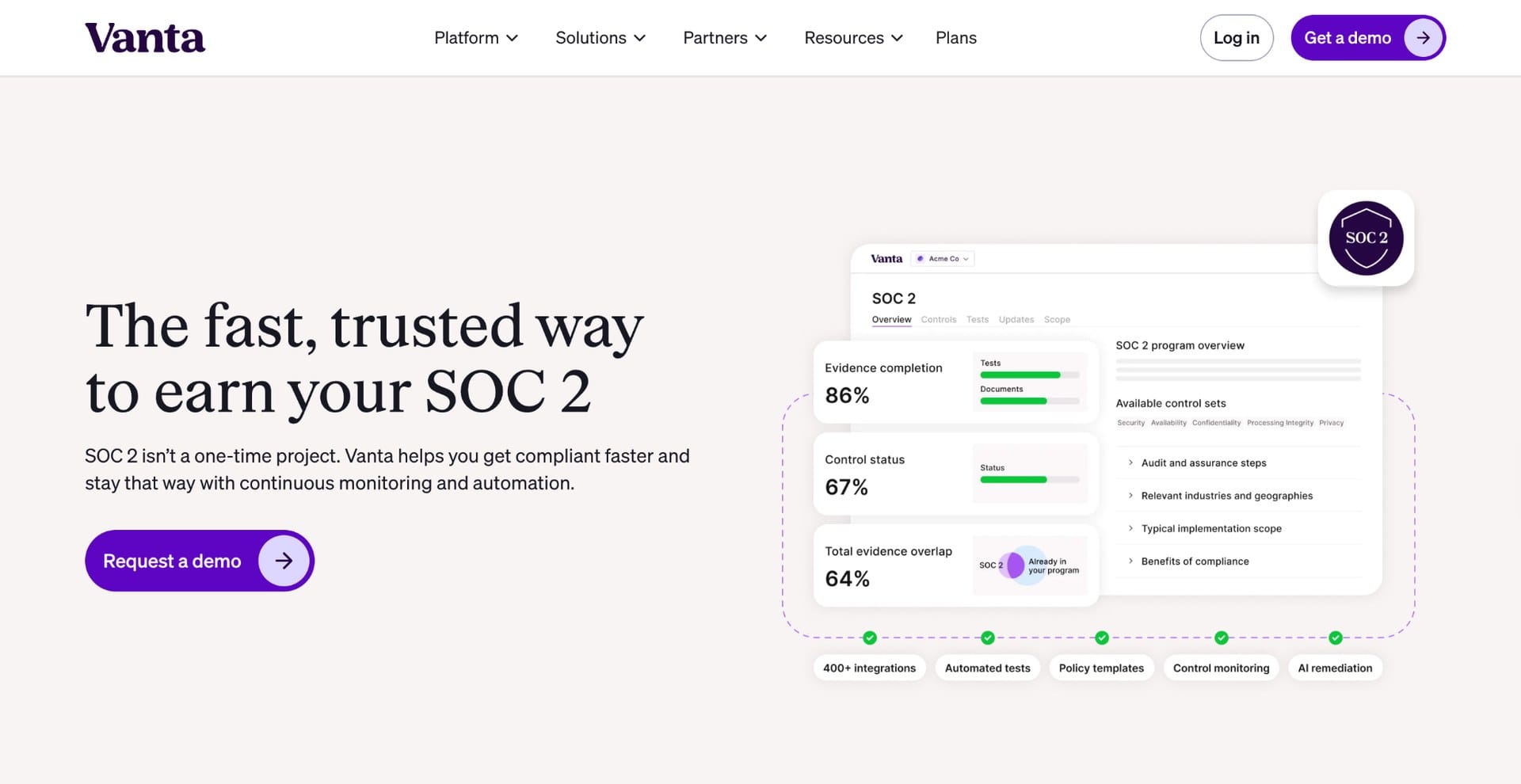
Does the job: the largest automation platform, with hourly control tests and a deep integration list.
Vanta says it serves over 16,000 customers, and its fintech page carries a testimonial from MoonPay's compliance team.
The platform supports:
- 1,400+ automated tests that monitor controls hourly
- 400+ integrations across cloud, code, identity and device tools
- Vanta AI to review evidence, flag gaps and suggest fixes
- Custom frameworks alongside SOC 2, ISO 27001 and others
- An auditor directory for choosing a CPA firm
Vanta's pricing page shows plans but no prices. Its SOC 2 page says nothing about crypto key controls, so those would sit in a custom framework you write.
Best for startups that expect to add ISO 27001 and other frameworks as they sell into banks.
2. Drata
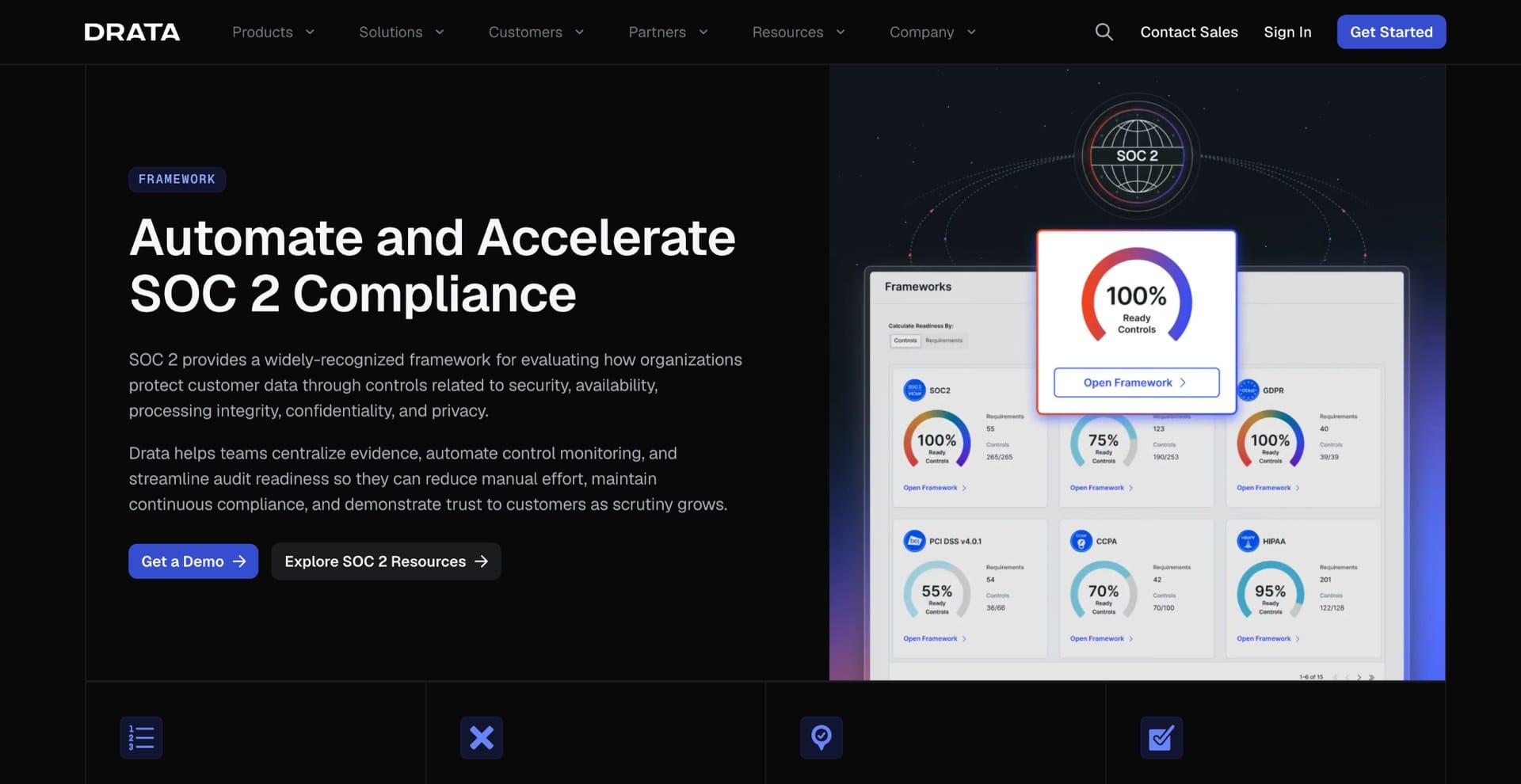
Does the job: continuous control testing with strong multi-framework and custom framework support.
Drata states 8,500+ customers and 30+ pre-built frameworks, including DORA for teams with European exposure.
The platform supports:
- Continuous testing across all five trust service categories
- Integrations with cloud, identity, HR, code and ticketing systems
- DORA, ISO 27001, PCI DSS and other frameworks in one place
- Custom frameworks for controls outside the standard templates
- The Audit Alliance directory for finding an auditor
The SOC 2 page gives no test or integration counts and no prices. It does not mention crypto or blockchain, and nothing in it covers a key management setup.
Best for teams that need DORA alongside SOC 2 and want custom frameworks built in.
3. Secureframe
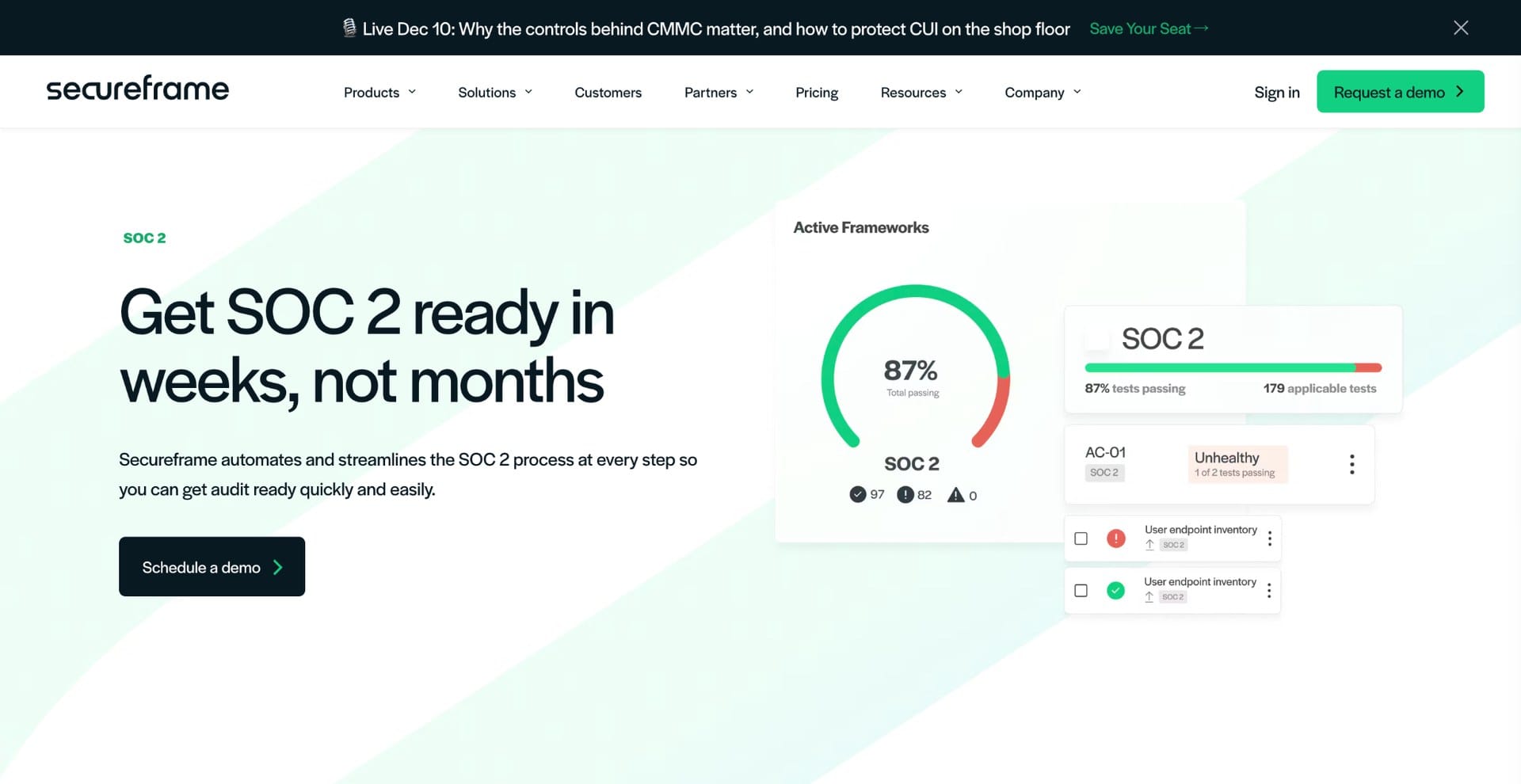
Does the job: SOC 2 automation with hands-on audit support from former auditors.
Secureframe leans on its people as much as its software, with policies vetted by former auditors and dedicated audit support.
The platform supports:
- 150+ integrations with continuous configuration monitoring
- A policy library vetted by in-house experts and former auditors
- Onboarding, offboarding and security training workflows
- Vendor risk assessments and storage of vendor reports
- Common controls that carry over to ISO 27001, NIST and HIPAA
The page notes a typical SOC 2 involves more than 200 controls and recommends a 12-month Type II window. No pricing, auditor partners or crypto controls are named.
Best for small teams without a compliance hire that want guidance as well as software.
4. Sprinto
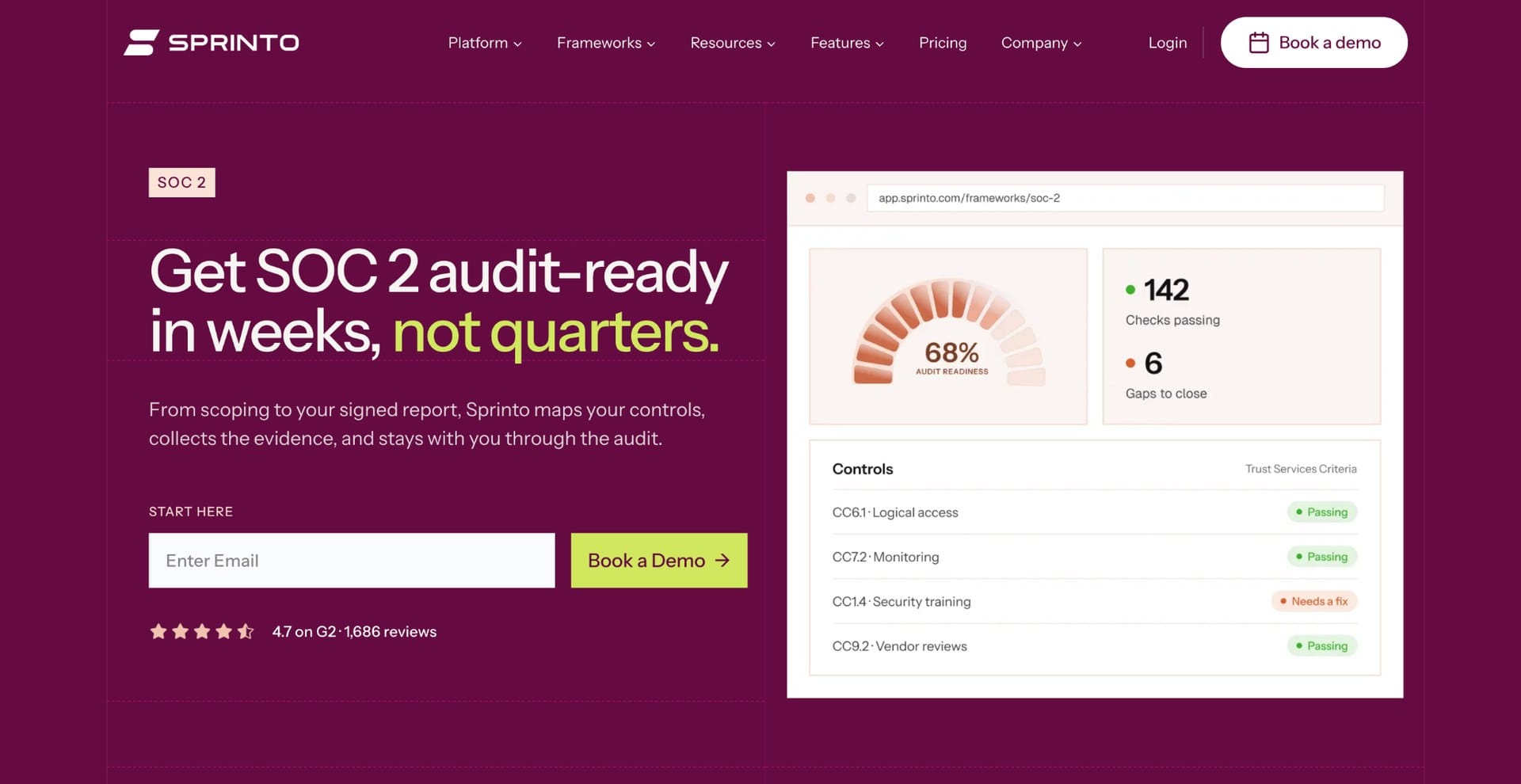
Does the job: the only platform here that puts example costs in writing.
Sprinto states over 4,000 customers in 75+ countries and gives a year-one example of about 9,000 to 13,000 dollars for a 40-person company, including platform, audit and a low-cost pen test.
The platform supports:
- 200+ frameworks, including SOC 2, ISO 27001, DORA and PCI DSS
- Your own auditor or a vetted list of independent CPA firms
- No referral fee taken from any auditor, by its own statement
- Pen tests arranged through partners
- Continuous monitoring after the audit
The page contradicts itself on timing, quoting an 8-week median to audit preparation and a stage guide of two to four weeks. With an established pen-test firm, its own estimate rises to 13,000 to 25,500 dollars.
Best for cost-conscious startups that want a budget figure before the first call.
5. Thoropass
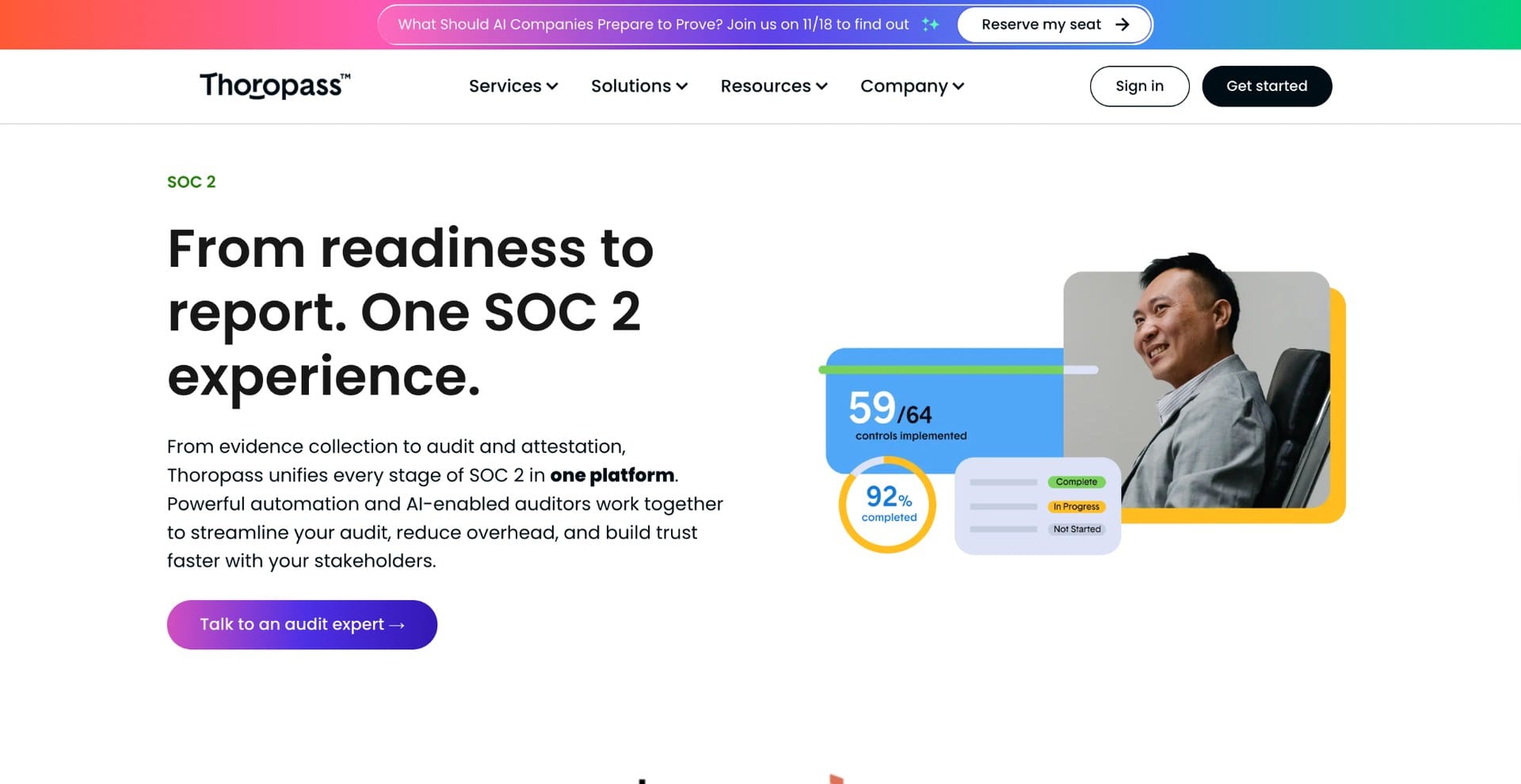
Does the job: automation and the audit itself from one company.
Thoropass performs the audit through Laika Compliance, LLC, dba Thoropass Assurance, a licensed CPA firm registered with the AICPA.
The platform supports:
- Audits completed by in-house auditors assigned before fieldwork
- Smart Sort AI to map evidence from Thoropass, other GRC tools or spreadsheets
- API and MCP server evidence linking
- SOC 1, SOC 2, ISO 27001, PCI DSS, HITRUST and NYCRR Part 500
- A multi-framework option for overlapping controls
One vendor preparing and auditing the same controls is convenient, but some partners prefer an auditor independent of the readiness tool. Prices depend on scope and are not published.
Best for startups that want one contract and one point of contact from readiness to report.
6. Scrut
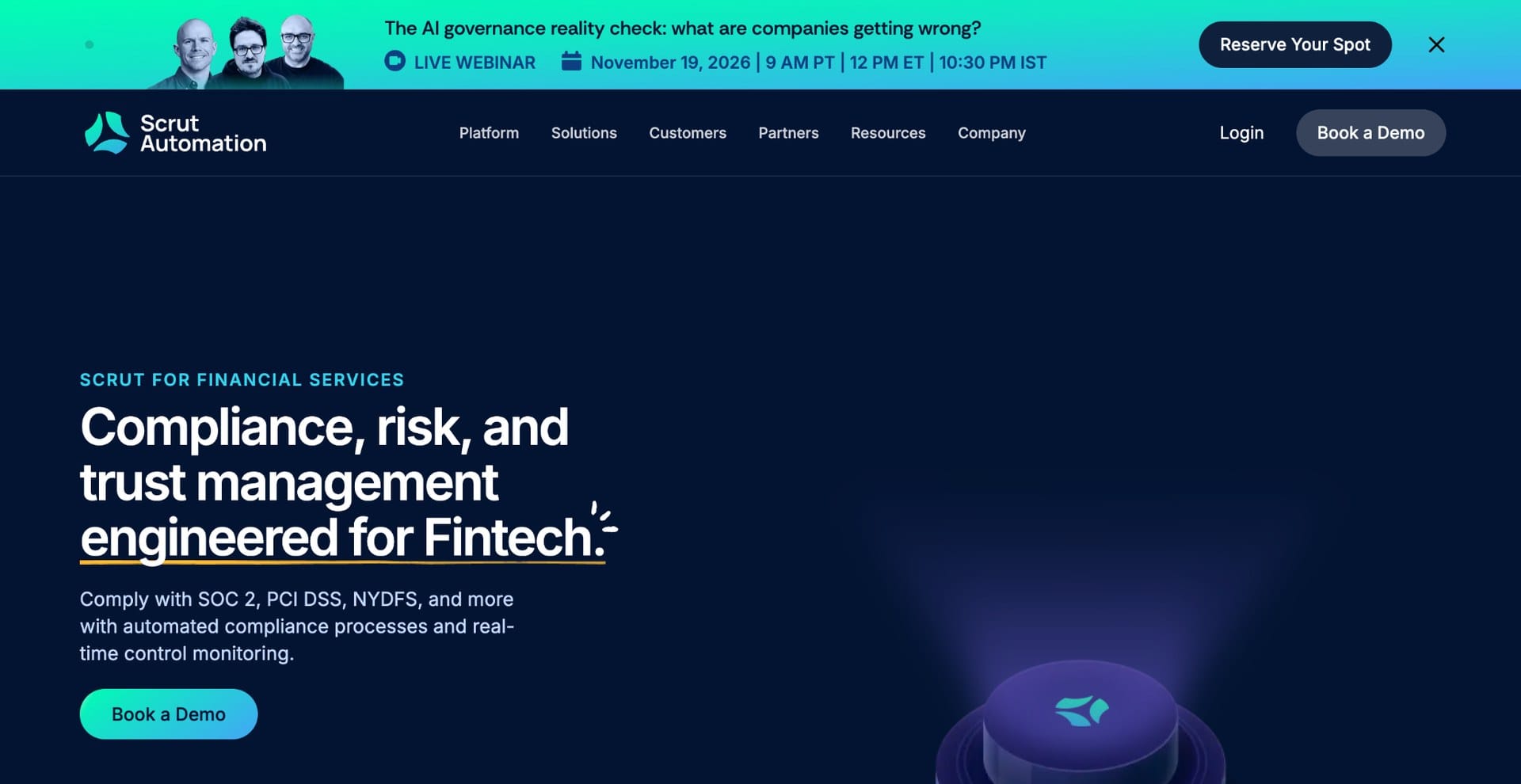
Does the job: a financial services package built around SOC 2, PCI DSS and NYDFS.
Scrut targets financial firms directly and says it supports 70+ frameworks out of the box for over 2,500 customers.
The platform supports:
- SOC 2, PCI DSS and NYDFS positioned for financial services
- ISO 27001 and related ISO standards
- GDPR and CCPA privacy frameworks
- Integrations with cloud and IT systems
- Demos and a product tour before purchase
The financial services page gives no integration count and no prices. DORA appears only as an ebook title, not as a supported framework.
Best for US-focused startups that expect NYDFS questions from banking partners.
SOC 2 Platforms Compared
| Platform | Audit model | Published scale | Pricing | Crypto key controls |
|---|---|---|---|---|
| Vanta | Outside CPA, directory | 16,000+ customers, 1,400+ tests | Not published | Custom framework |
| Drata | Outside CPA, Audit Alliance | 8,500+ customers, 30+ frameworks | Not published | Custom framework |
| Secureframe | Outside CPA, audit support | 150+ integrations | Not published | Not stated |
| Sprinto | Own or vetted CPA, no referral fee | 4,000+ customers, 200+ frameworks | Example ranges published | Not stated |
| Thoropass | In-house CPA firm | Not stated | Not published | Not stated |
| Scrut | Not stated | 2,500+ customers, 70+ frameworks | Not published | Not stated |
The last column is the same story everywhere. Every platform can hold your crypto controls, but none of them ships those controls for you.
What to note: budget time to write your own key-management control set before the observation window starts.
What SOC 2 Leaves Out
The CryptoCurrency Security Standard, CCSS, was written for exactly this gap. Version 9.0 sets 47 control objectives across ten aspects, from key generation and storage to key usage, proof of reserve and a key compromise protocol.
Generic security frameworks only partly reach that ground. Open Security Architecture's mapping finds that NIST SP 800-53 controls cover CCSS objectives by 54.3 percent on average, which leaves almost half of the crypto-specific work uncovered.
The practical answer is to add CCSS-style controls as a custom framework inside whichever platform you choose. The compromise protocol matters most, because, as our guide to the first hour after a theft shows, a rehearsed plan decides how much is lost.
What to note: tell your auditor early that you will include key-management controls, so they scope the testing.
How to Choose
1. Start from who is asking
A US bank partner may ask for NYDFS alignment, and a European one for DORA. Pick the platform that covers the second framework you will need, not only SOC 2.
2. Decide on audit independence
Thoropass audits what it prepares, while the others send you to an outside firm. Ask your largest prospective partner which it prefers.
3. Get a written price
Only Sprinto publishes example ranges. Ask every vendor for year-one and year-two totals, including the audit and pen test.
4. Map your key controls first
Write down how keys are generated, stored, approved and revoked before you buy. Then load it as a custom framework in the platform you choose.
5. Plan for Type II, not Type I
Partners usually want a Type II report, which needs an observation window of at least three months. Start the window as soon as controls are live.
What to note: confirm whether the platform keeps monitoring after the report is issued, because the next audit starts the day after.
How This List Was Built
Inclusion required three things, so that the comparison means something.
- A first-party page describing SOC 2 automation in detail
- Support for frameworks beyond SOC 2, since stablecoin startups rarely stop at one
- A product available to buy today without a long sales qualification
Several capable platforms are not here, including newer AI-first tools that do not yet publish enough detail. Providers who believe they meet the three criteria above are welcome to send documentation for consideration in the next update.
What to note: last reviewed against vendor websites in November 2026.
Risks and Limitations
- A SOC 2 report is an auditor's opinion on controls, not a guarantee of security.
- Customer counts, test counts and timelines are vendor claims and not independently verified.
- Default templates do not cover crypto key management, so gaps remain unless you add controls.
- Prices are mostly unpublished and can rise sharply with scope and headcount.
- An audit performed by the same company that prepared you may not satisfy every partner.
Conclusion
Every platform here can get a stablecoin startup to a SOC 2 report. None of them will, by default, test the controls that protect its keys and reserves.
Vanta and Drata suit startups planning several frameworks, Secureframe suits teams that want guidance, Sprinto suits tight budgets, Thoropass suits buyers who want one vendor for the audit, and Scrut suits US financial-services positioning.
Whichever you pick, write the crypto controls yourself. A clean SOC 2 opinion with no key-management controls answers the questionnaire but not the real risk.
Read Next:
- Best Insurance for Stablecoin Businesses
- What to Do in the First Hour After a Theft
- Best Key Management and MPC Providers
FAQs:
1. Do stablecoin startups need SOC 2?
Not by law in most places, but banks, payment partners and enterprise customers often require a SOC 2 Type II report before signing.
2. How long does SOC 2 take with an automation platform?
Readiness can take weeks, but a Type II report needs an observation window of at least three months, so most first reports take several months.
3. Does SOC 2 cover private key security?
Only in general terms. SOC 2 does not specify how keys are generated, stored or used, which is why standards such as CCSS exist.
4. What is CCSS?
The CryptoCurrency Security Standard, published by the CryptoCurrency Certification Consortium, sets controls for key management, wallets, proof of reserve and audit logs at three levels.
5. How much does SOC 2 automation cost?
Most vendors do not publish prices. Sprinto gives an example of about 9,000 to 13,000 dollars in year one for a 40-person company, including the audit.
Disclaimer:
This content is provided for informational and educational purposes only and does not constitute financial, investment, legal, or compliance advice; no material herein should be interpreted as a recommendation, endorsement, or solicitation, and readers should conduct their own independent research or consult a qualified professional. Features, customer counts, timelines and prices are drawn from each vendor's own website or news reports at the time of writing, are not independently verified here, and change frequently. A SOC 2 report does not guarantee security. Confirm current scope, terms and pricing directly with each vendor before purchasing.