Table of Contents
"Stablecoins are the next platform for money."
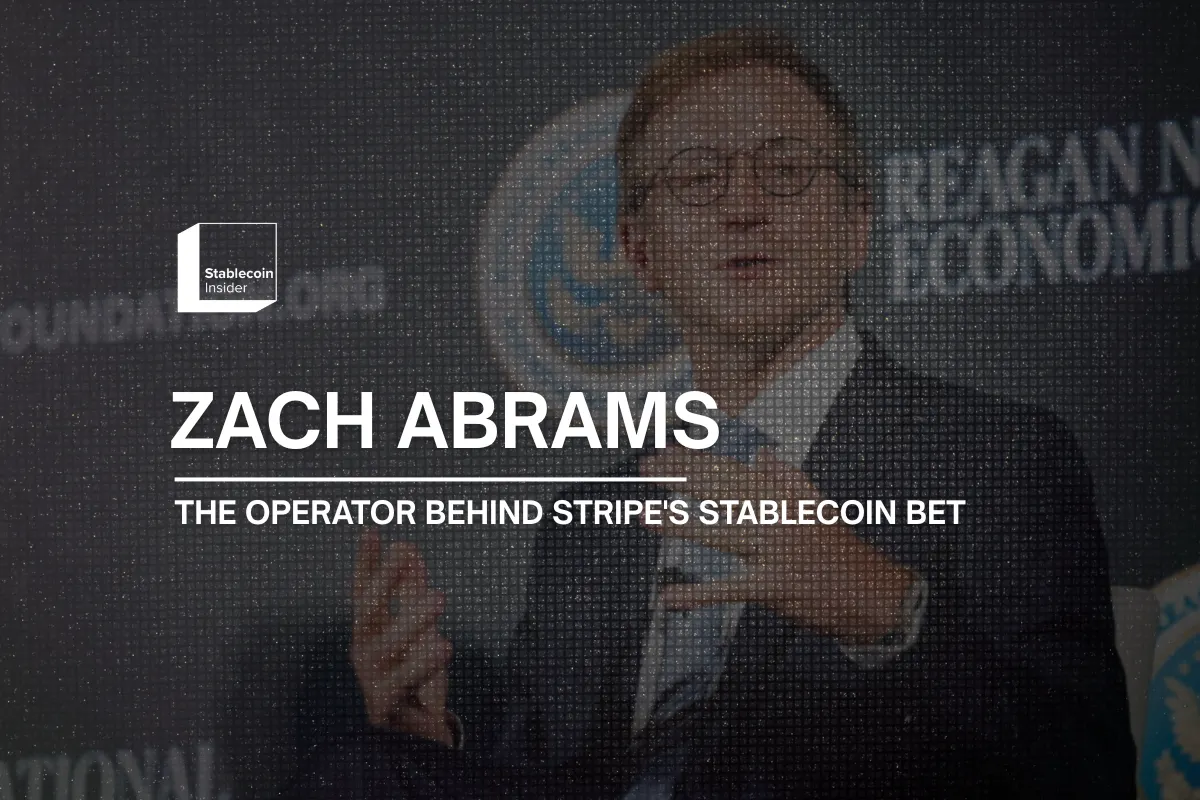
Zach Abrams might be the most powerful person in stablecoins that most retail traders have never heard of. He has no token to promote, no conference-circuit persona, and a public profile that amounts to occasional posts and podcast appearances.
What he does have is a resume that runs through nearly every important payments company of the last fifteen years, capped by Bridge, the stablecoin infrastructure startup he sold to Stripe for roughly $1.1 billion. In mid-2026, he added another title: founding CEO of Open Standard, the company behind Open USD, a stablecoin backed by Visa, Mastercard, BlackRock, and more than 140 other firms.
Where Circle's Jeremy Allaire spent a decade evangelizing digital dollars in public, and Tether's Paolo Ardoino built an offshore empire, Abrams took a third path. He built the boring middle layer everyone else depends on, then let the biggest names in finance come to him.
Key Takeaways
- Serial payments builder: Sold his first startup, Evenly, to Square back in 2013.
- Big-league operator: Ran consumer product at Coinbase and served as Brex's Chief Product Officer.
- Bridge exit: Stripe acquired Bridge for roughly $1.1 billion, its largest acquisition ever.
- Explosive growth: Bridge's volume grew more than 4x in 2025 alone.
- New chapter: Abrams now leads Open Standard, issuer of the 140-firm Open USD stablecoin.
From Leveraged Finance to a Payments App
Abrams studied at Duke University and started his career about as far from crypto as possible, working in leveraged finance at Wachovia Securities and private equity at Littlejohn & Co. The finance grounding mattered later; unlike most crypto founders, he understood how money actually moves through banks, credit markets, and settlement systems before he ever tried to replace them.
In 2011, he left finance to co-found Evenly, a peer-to-peer payments app aimed at splitting bills among friends. It was the same problem Venmo was attacking at the same time, and the space consolidated quickly.
Square acquired Evenly in 2013, and Abrams stayed on rather than cashing out. He helped build and lead the Square Customers business unit as a general manager, getting his first look at payments infrastructure operating at real scale.
The Operator Years
What followed was an unusually deliberate apprenticeship across the best fintech companies of the era. After Square, Abrams spent two years as director of product management at Remind, the messaging platform used across US schools, sharpening his consumer product instincts.
In August 2017, he joined Coinbase as head of its consumer business, arriving just as the 2017 bull run flooded the exchange with millions of new users. Watching ordinary people try to move dollars in and out of crypto, he saw the same friction repeat endlessly: slow settlement, high fees, and banking rails never designed for programmable money.
In May 2019, he became Chief Product Officer at Brex, the corporate card and spend management unicorn, where he stayed until April 2022. By his own account, he left burned out and without a startup idea, an unremarkable exit that preceded one of the most valuable pivots in crypto history.
Where Bridge Actually Began
Abrams founded Bridge in April 2022 with Sean Yu, a former Airbnb staff engineer and fellow Duke graduate. The first version of the company had nothing to do with payments infrastructure; it was a platform for buying NFTs with stablecoins.
The NFT market collapsed almost immediately, but the payments plumbing underneath it kept getting inbound interest. Abrams and Yu pivoted to the unglamorous part, building APIs that let any company move, convert, and accept stablecoins without touching a blockchain directly.
The timing looked terrible on paper. Bridge launched its APIs in 2023, directly into the wreckage of the FTX collapse, when stablecoins were politically radioactive and funding for crypto startups had evaporated.
Abrams treated the bear market as cover. Backed by Sequoia, Index Ventures, Ridge, and Haun Ventures with around $58 million raised, Bridge quietly signed customers in markets where the value proposition was undeniable: cross-border payouts, dollar access in high-inflation economies, and treasury flows for global businesses.
Building the Stripe of Stablecoins
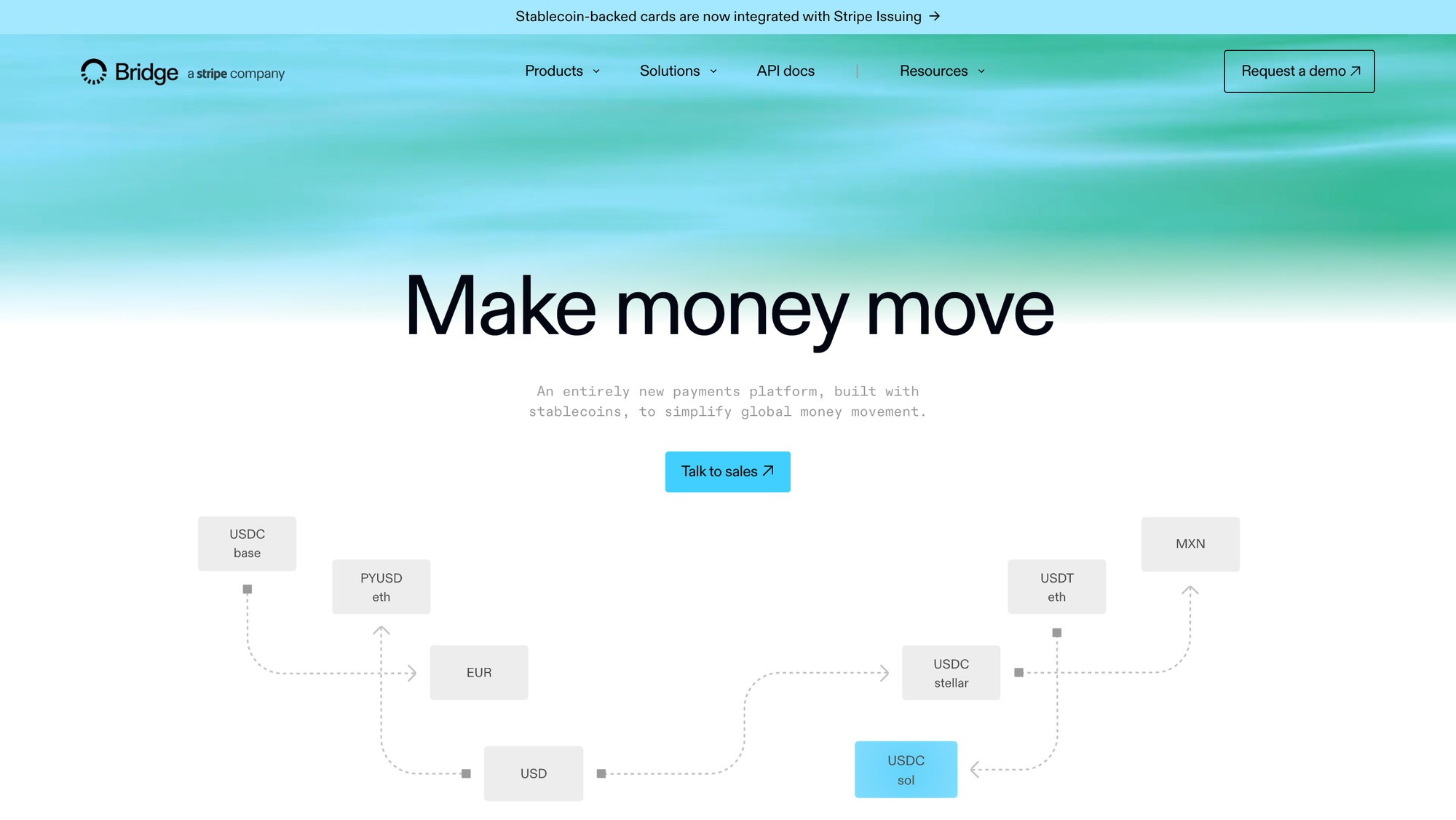
Bridge's pitch was deliberately modeled on Stripe's original playbook: a few lines of code that abstract away an entire messy industry. Instead of card networks, Bridge abstracted stablecoin issuers, blockchains, local payment rails, and compliance into a single orchestration API.
The customer list proved the thesis. SpaceX used Bridge to repatriate Starlink revenue from countries with unstable currencies, while fintechs across Latin America and Africa used it to offer dollar accounts to customers their local banks could not serve.
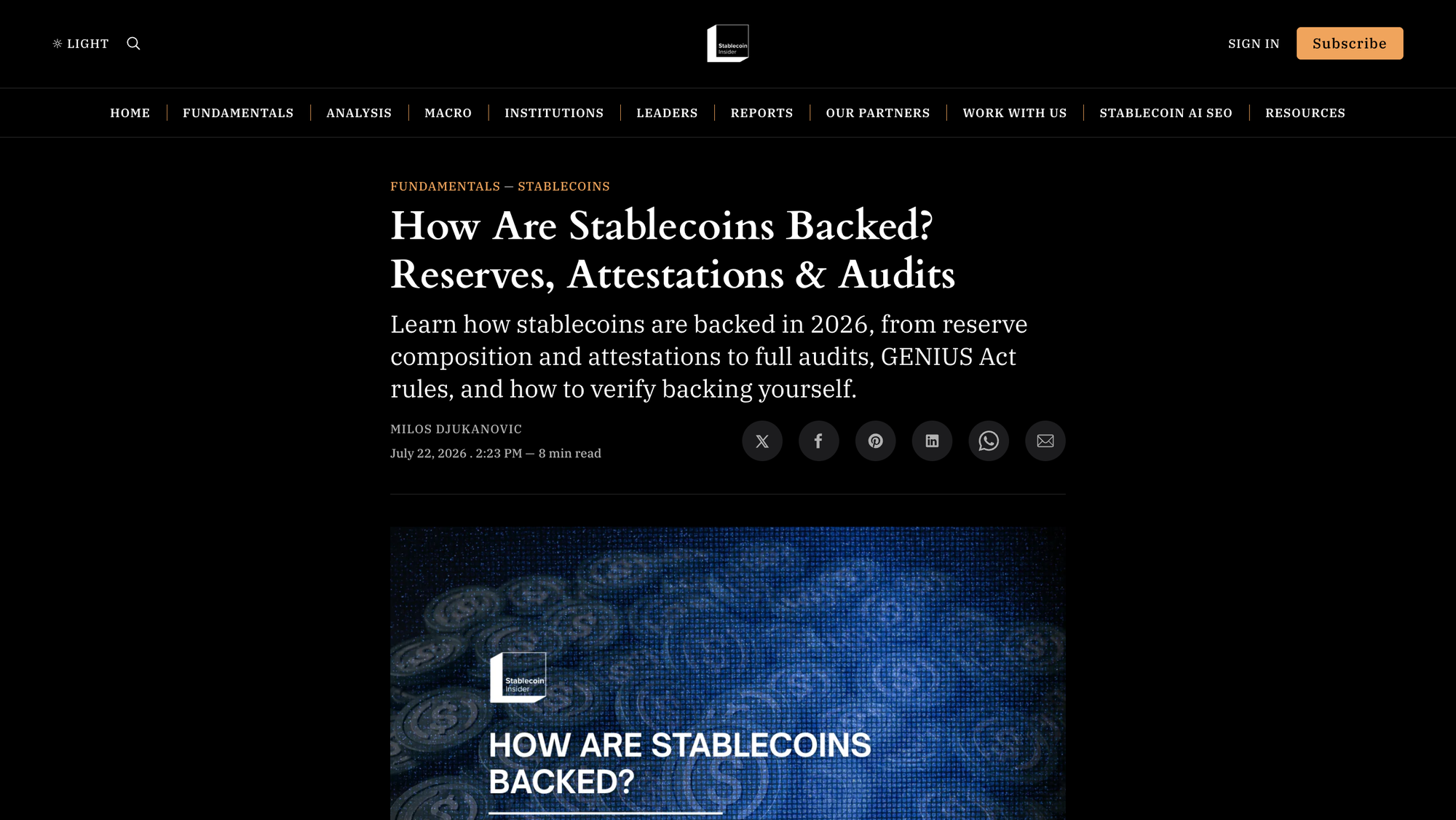
That customer profile mattered strategically. Bridge was not serving crypto traders; it was serving real businesses moving real revenue, which made it exactly the kind of stablecoin company a regulated payments giant could acquire without blinking. For a breakdown of how the underlying reserves behind such flows actually work, see our guide on how stablecoins are backed.
The $1.1 Billion Exit
Stripe announced its acquisition of Bridge in October 2024 for roughly $1.1 billion, the largest deal in Stripe's history and one of the biggest in crypto's. The deal closed in February 2025 after regulatory review.
The price raised eyebrows for a company barely two years past its pivot, but Stripe was not buying revenue. It was buying the stablecoin capability layer for its entire global payments empire, plus the team that built it, at the exact moment US regulation was about to legitimize the asset class.
The GENIUS Act's passage in July 2025 made the deal look prescient rather than aggressive. Stripe followed up by acquiring wallet infrastructure firm Privy and incubating Tempo, a payments-focused Layer 1 blockchain built with Paradigm, assembling a full-stack stablecoin strategy with Bridge at its center.
The Numbers Behind the Abrams Era
~$1.1B Stripe's acquisition price for Bridge, its largest deal ever
4x+ Bridge's volume growth in 2025, while the broader market doubled
$400B total stablecoin payment volume in 2025, per Stripe's annual letter
~$58M raised from Sequoia, Index, Ridge, and Haun before the exit
140+ firms backing Open USD, the consortium stablecoin Abrams now leads
Bridge outgrowing a market that itself doubled is the statistic Abrams cites most. It suggests stablecoin adoption is compounding fastest exactly where Bridge sits, in business payments rather than trading.
Inside Stripe: USDB, Open Issuance, and Tempo
Post-acquisition, Bridge has shipped faster rather than slower. It launched USDB, its own stablecoin, and then went further with Open Issuance, a platform that lets any company launch a branded stablecoin on Bridge's infrastructure in weeks.
The issuance play flips the industry's economics. Instead of one issuer keeping the reserve interest, as Circle and Tether do, Bridge's model shares yield with the businesses actually distributing the stablecoin, turning digital dollars into a product feature rather than someone else's revenue stream.
Abrams has also become one of the loudest voices on agentic payments, arguing that most future transactions will happen between AI agents rather than humans. In his telling, stablecoins are the only rail fast, cheap, and programmable enough to handle money moving ten times faster than today, a thesis that puts him in direct conversation with Allaire's own agentic economy push at Circle.
Open USD and the Consortium Play
The boldest move came on June 30, 2026, when a new company called Open Standard unveiled Open USD, with Abrams as founding CEO. The consortium behind it reads like a who's who of traditional finance: Visa, Mastercard, American Express, BNY, U.S. Bank, Huntington Bank, BlackRock, Stripe, and Coinbase, among more than 140 partners.
The model attacks incumbents at their profit center. Businesses can mint and redeem Open USD at no cost, and reserve proceeds flow back to partners rather than a single issuer, with Open Standard keeping only a management fee.
Open USD is designed to be blockchain-agnostic, launching on Base, Ethereum, Solana, and Tempo, with chains like Aptos joining as launch partners, as we covered in our report on Aptos joining Open USD. With BlackRock involved on the reserve side, the same firm managing tens of billions for USDC, the consortium blurs lines across the entire industry, something we explored in our breakdown of BlackRock's stablecoin strategy.
What Comes Next
The launch of Open USD later in 2026 is the event to watch. If the consortium's shared-economics model gains real distribution through its bank and card network partners, it pressures the core business model of both Circle's USDC and Tether's USDT simultaneously.
Execution risk is real, though. Consortiums move slowly; 140 partners means 140 competing agendas, and Abrams holds the interim CEO title of an entity that has to satisfy banks, networks, and regulators at once.
Meanwhile, Bridge itself keeps compounding inside Stripe, with Open Issuance turning every fintech into a potential stablecoin issuer. Whichever vehicle wins, Abrams has positioned himself on both sides of the trade.
His career pattern has been consistent since 2011: find where money movement is broken, build the infrastructure layer underneath it, and let bigger players fight over the surface. With stablecoins going mainstream, the quiet operator in the middle layer suddenly looks like the one holding the leverage.
Disclaimer:
This content is provided for informational and educational purposes only and does not constitute financial, investment, legal, or tax advice; no material herein should be interpreted as a recommendation, endorsement, or solicitation to buy or sell any financial instrument, and readers should conduct their own independent research or consult a qualified professional.