Table of Contents
Stablecoin infrastructure firm Brale introduced ION Protocol on July 29, 2026, an interoperability system that lets custom stablecoins move across blockchains by burning tokens on one chain and minting an equivalent amount on another. The protocol targets what Brale calls the single biggest barrier to scaling bespoke stablecoins: fragmented liquidity spread across dozens of networks.
Unlike traditional bridges that depend on pre-funded liquidity pools, ION uses an attested burn-attest-mint model, where assets are burned on the source chain before an equivalent amount is minted on the destination chain with the issuer's authorization. That design removes the capital requirement of duplicating deep liquidity on every chain.
Launch partners include Solana, Monad, Rain, Coinflow, Turnkey, Spark, and Canton, with more to come. Brale is targeting testnet availability in the third quarter, allowing partners to begin evaluating and integrating the protocol.
"Liquidity between stablecoin programs is the #1 barrier to scaling bespoke stablecoins. We have to fix it to realize the potential of protocols and stablecoins." - Ben Milne, founder and CEO of Brale
Key Takeaways
- Brale introduced ION Protocol on July 29, 2026, a cross-chain interoperability layer for custom stablecoins.
- ION uses an attested burn-attest-mint model, removing the need for pre-funded liquidity pools on each chain.
- Launch partners span seven networks and firms, including Solana, Monad, Rain, Coinflow, Turnkey, Spark, and Canton.
- Testnet is targeted for Q3 2026, with broader availability planned in a future release.
- The market has over 350 stablecoins worth more than $300 billion, making fragmentation an escalating problem.
What Brale Announced
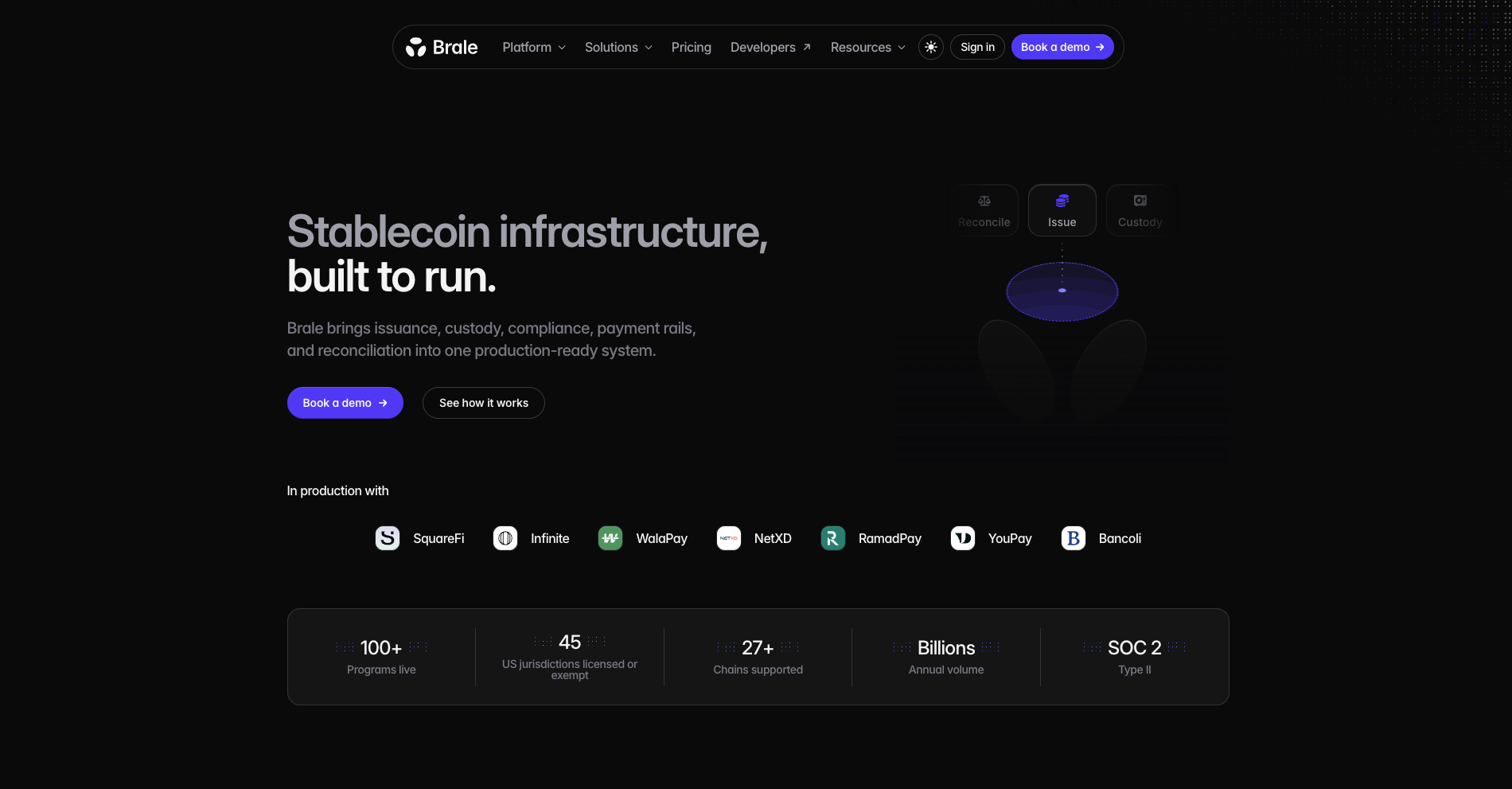
ION Protocol extends Brale's platform from regulated stablecoin issuance into cross-chain infrastructure. The system lets participating stablecoins move between blockchains without routing through a conventional bridge, addressing a bottleneck that grows worse as more companies launch their own tokens.
The mechanism is a controlled burn-and-mint sequence. Assets are destroyed on the origin chain, an attestation confirms the burn, and an equivalent amount is minted on the destination chain under the issuer's authorization, so total supply stays constant across networks. Brale says the underlying technology has already enabled more than $10 billion in mint and burn activity across its platform.
The rollout is early. The protocol is not yet live for general use, with Brale targeting testnet availability in the third quarter and technical documentation published on its blog for partners to begin integration. Broader availability is planned for a later release.
The framing is ambitious. Milne said ION saves the ecosystem tens of billions of dollars in liquidity obligations today and potentially trillions in the years ahead, positioning the protocol as foundational plumbing rather than an incremental feature.
The Liquidity Fragmentation Problem
The problem ION targets is structural. Moving assets across blockchains today typically depends on liquidity pools, which fragment capital, introduce slippage, and carry bridge risk, and as ecosystems multiply, duplicating deep liquidity on every chain becomes impossible.
That constraint creates a ceiling on stablecoin adoption. A company issuing a branded dollar has to fund liquidity pools on each network it wants to support, and with insufficient capital to build deep pools everywhere, the current model becomes unsustainable as issuance accelerates.
The scale of issuance makes this urgent. The market now holds more than 350 stablecoins worth over $300 billion, and each new custom or enterprise token adds another set of liquidity islands that need connecting.
Brale's bet is that burn-and-mint interoperability, not deeper pools, is the way through. By eliminating the pre-funding requirement, ION aims to let issuers deploy across many chains without the capital drag that has kept most bespoke stablecoins effectively single-chain.
Why This Matters for Stablecoins
ION generalizes a model that has so far belonged mostly to the largest issuers. The approach resembles Circle's Cross-Chain Transfer Protocol, but where CCTP serves USDC, ION extends burn-and-mint interoperability to any participating stablecoin issuer, which is the meaningful shift.
That matters because the future Brale is building for is one of many stablecoins, not a few. Custom and enterprise-issued tokens have proliferated as companies choose branded dollars over integrating USDC or USDT, a trend we detailed in our Brale platform review, and every one of those tokens faces the same cross-chain liquidity wall.
It also fits the broader theme of stablecoin infrastructure consolidating around issuer-controlled rails rather than third-party bridges. The same logic that has issuers minting directly, as seen in our Ripple Mint coverage, now extends to moving those tokens across chains without surrendering control to a bridge operator.
For the market, the significance is that interoperability is becoming a competitive layer of its own. If ION works as described, the ability to move frictionlessly across chains could become as important to a custom stablecoin's viability as its reserves or its distribution, joining a wave of protocol-level stablecoin design we tracked in our DigiDollar UTXO stablecoin coverage.
Conclusion
Brale's ION Protocol is an attempt to solve a problem that only gets bigger as the stablecoin market fragments: how to move hundreds of custom tokens across dozens of chains without drowning issuers in liquidity obligations. Extending burn-and-mint interoperability beyond a single issuer is a genuinely useful generalization.
The caveats are timing and proof. ION is pre-testnet, with general availability still ahead, so its real-world performance and security remain unproven, and an attestation layer is itself a trust surface that will draw scrutiny.
But the direction is telling. As issuance accelerates and the market passes 350 stablecoins, the infrastructure race is moving from who can issue a token to who can make it move, and Brale is betting the answer is burn-and-mint, not bigger pools.
FAQ:
1. What is Brale's ION Protocol?
ION Protocol is a cross-chain interoperability system introduced by Brale on July 29, 2026 that lets custom stablecoins move between blockchains by burning tokens on one chain and minting an equivalent amount on another. It is designed to remove the liquidity pool funding requirements that make moving bespoke stablecoins across networks expensive and capital-intensive.
2. How does ION Protocol work?
ION uses an attested burn-attest-mint model. Assets are burned on the source chain, an attestation confirms the burn, and an equivalent amount is minted on the destination chain with the issuer's authorization, keeping total supply constant. This avoids the pre-funded liquidity pools, slippage, and bridge risk associated with traditional cross-chain transfers.
3. When will ION Protocol be available?
Brale is targeting testnet availability in the third quarter of 2026, allowing launch partners to begin evaluating and integrating the protocol. It is not yet live for general use, and Brale has said broader availability is planned for a future release, with technical documentation already published on its blog.
4. Who are Brale's ION launch partners?
Launch partners include Solana, Monad, Rain, Coinflow, Turnkey, Spark, and Canton, with Brale saying more will follow. The mix spans blockchains and payment and infrastructure firms, reflecting the protocol's goal of connecting custom stablecoins across a wide range of networks.
5. How is ION different from Circle's CCTP?
Both use a burn-and-mint approach to cross-chain transfers, but Circle's Cross-Chain Transfer Protocol serves USDC specifically, while ION extends the model to any participating stablecoin issuer. That generalization is the key distinction, aiming to give custom and enterprise stablecoins the same cross-chain mobility that large issuers have built for their own tokens.
Disclaimer:
This content is provided for informational and educational purposes only and does not constitute financial, investment, legal, or tax advice; no material herein should be interpreted as a recommendation, endorsement, or solicitation to buy or sell any financial instrument, and readers should conduct their own independent research or consult a qualified professional.