Table of Contents
"We are a company that was born with Bitcoin."
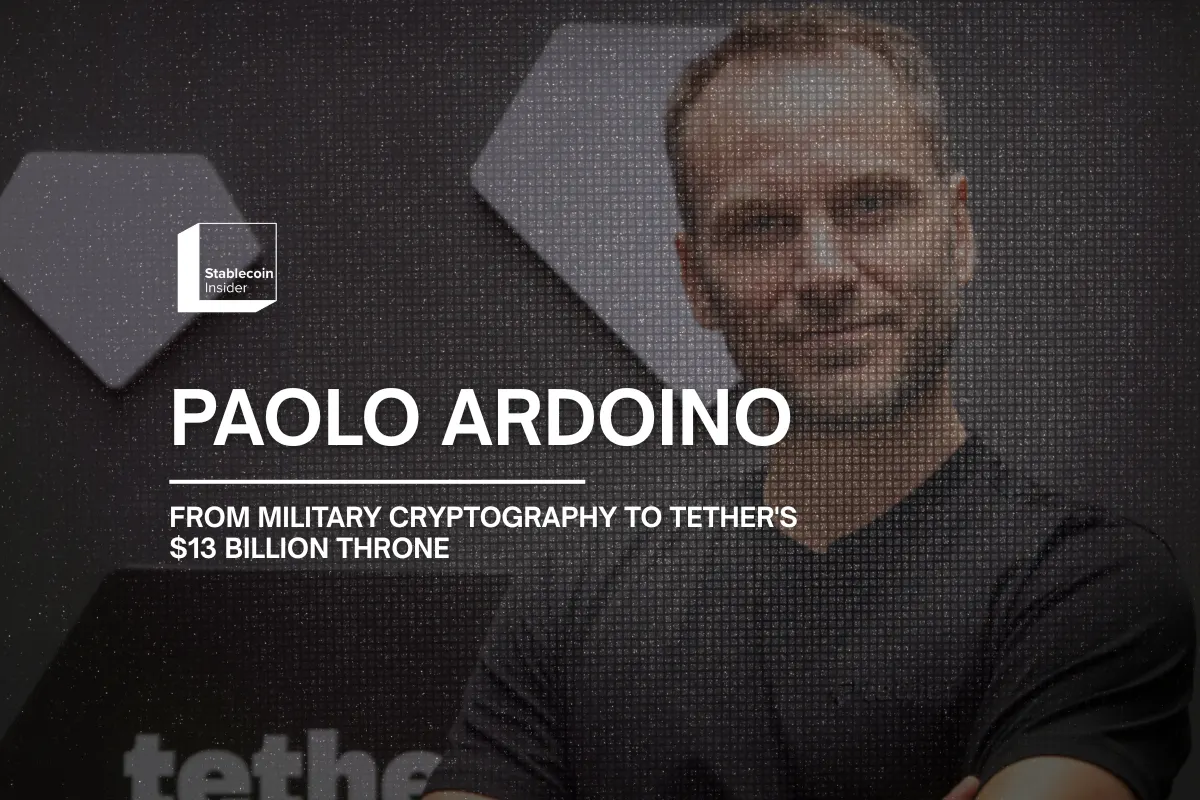
Paolo Ardoino did not grow up planning to run the world's largest stablecoin issuer. He grew up writing code.
Today he is CEO of Tether, the company behind USDT, and one of the most recognizable executives in crypto. He built that reputation over more than a decade inside Bitfinex, not on a stage, but wiring together the systems that keep billions of dollars moving every day.
His path from developer to boardroom says a lot about how Tether actually runs. It is a company that promotes engineers into leadership rather than the other way around, and Ardoino is the clearest proof that the model has worked, for better or worse.
Key Takeaways
- Engineer first: Ardoino joined Bitfinex in 2014 as a senior developer, not an executive.
- CEO since 2023: He took over from founding CEO Jean-Louis van der Velde in December 2023.
- Profit machine: Tether posted more than $13 billion in net income for 2024.
- Prolific investor: Tether holds stakes in over 120 companies, from Rumble to Bitdeer.
- Beyond stablecoins: Bitcoin mining, gold tokens, and AI now sit under Tether's roof.
The Coder Who Started Before Crypto Existed
Ardoino grew up in Italy with an early fascination for computers, reportedly writing his first programs as a child. He studied Computer Science at the University of Genoa, graduating in 2008.
Long before that degree was finished, he was already working. Starting in 2003, he took on freelance consulting work in security, software development, and distributed systems architecture, the kind of unglamorous groundwork that rarely makes headlines but builds real skill.
His most formative early project was military research into high-availability, self-recovering networks and applied cryptography. That work on systems designed to survive failure would later shape how he approaches financial infrastructure that cannot afford downtime.
From Senior Developer to CEO
Ardoino joined Bitfinex in October 2014 as a senior software developer, brought in to rebuild the exchange's trading engine so it could handle far heavier volume. Two years later, he was named Bitfinex's Chief Technology Officer.
In 2017, he added the CTO title at Tether as well, Bitfinex's sister company. In that role he oversaw Tether's expansion from a single-chain token into a stablecoin issued across more than a dozen blockchains, a technical undertaking most CEOs never touch directly.
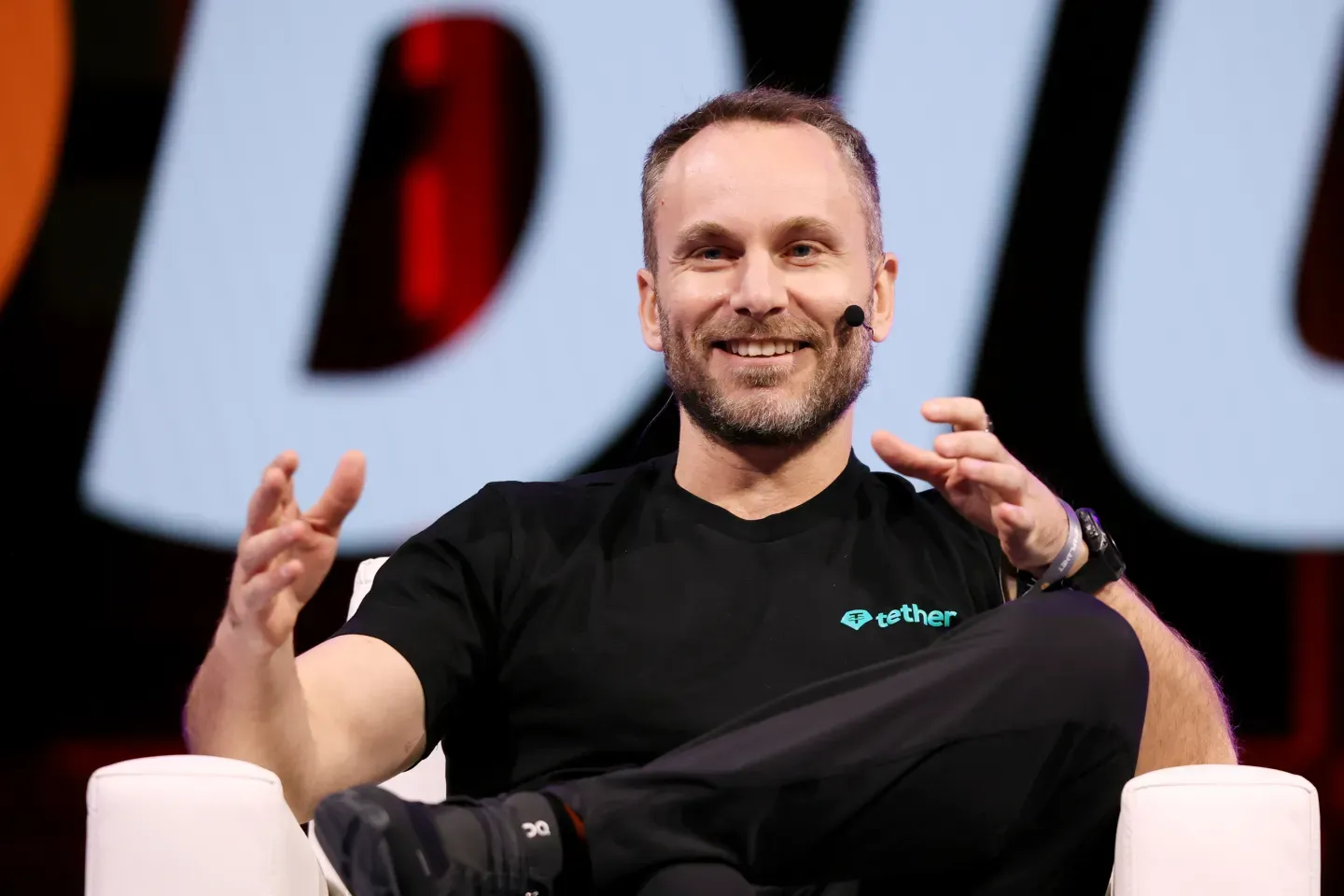
In October 2023, Tether announced Ardoino as its new CEO. Founding CEO Jean-Louis van der Velde moved into an advisory role while staying on as CEO of Bitfinex, and Ardoino formally took the reins in December 2023, while keeping his CTO title at Bitfinex and a Chief Strategy Officer role at the peer-to-peer platform Holepunch.
Where Tether Actually Began
Tether's story starts before Ardoino ever touched it. It launched in mid-2014 out of Santa Monica as Realcoin, founded by Brock Pierce, Reeve Collins, and Craig Sellars, built on the Omni Layer protocol on top of the Bitcoin blockchain.
The idea was simple: a token backed one-to-one by dollar reserves, letting traders move value without routing everything through a bank wire. The project rebranded to Tether that November and struck its defining partnership with Bitfinex.
For years, the relationship between the two companies stayed murky to outsiders. It only became fully clear in 2017, when Bitfinex's banking troubles pulled both firms into the same lawsuits and headlines, a link that has followed Tether ever since.
When Ardoino joined Bitfinex in late 2014, Tether was still a small experiment. It would take years, and a lot of his engineering work, before it became the liquidity backbone of crypto trading.
The Numbers Behind the Ardoino Era
$13B+ net income reported for 2024
$1.04B net profit in Q1 2026 alone
$8.23B excess reserves above USDT liabilities, Q1 2026
30M+ new USDT wallets added per quarter, per Ardoino
~200 employees running this entire operation
Tether's scale under Ardoino is hard to overstate, especially given the size of the team behind it. USDT's circulating supply has kept climbing alongside that profit, and Ardoino said in July 2026 that the token is still adding tens of millions of new wallets every quarter.
Tether also keeps its proprietary investments, in Bitcoin, gold, equities, and other assets, walled off from the reserves that back USDT itself. Ardoino has repeatedly pointed to that separation as central to the stablecoin's reliability, arguing the reserves should never depend on how well the side bets perform.
Tether's Investment Empire
Under Ardoino, Tether has become one of the more active private investors in tech, media, and mining. By his own account, the company holds stakes in more than 120 companies, though only a fraction have ever been named publicly.
The biggest and most public bet came in December 2024, when Tether paid $775 million for a stake in Rumble, the video platform that positions itself as a free-speech alternative to YouTube. That stake has since grown toward roughly 48 percent of the company.
Tether has also built and rebuilt a position in Bitdeer, the Nasdaq-listed Bitcoin miner spun out of Bitmain, trading its holding between roughly 18 and 20 percent as the miner's stock price has swung. Other disclosed bets span an unusually wide range: Italian football club Juventus, agriculture firm Adecoagro, payments company XREX, German compute firm Northern Data, and, in late 2025, talks over a stake worth more than $1 billion in the humanoid robotics firm Neura Robotics.
Ardoino has framed the strategy around backing companies that promote what he calls economic freedom and resilience, language that shows up across Tether's statements on Rumble, the Italian media firm Be Water, and similar deals.
Betting Beyond the Stablecoin
Ardoino has pushed Tether well past its stablecoin roots on the operational side too. The company has invested directly in renewable energy and Bitcoin mining infrastructure in Uruguay, and Ardoino has said Tether wants to become the largest Bitcoin miner in the world.
Tether's own gold-backed token, XAUT, has grown quickly alongside a rising gold price, and the company has been building a wallet development kit called WDK for outside developers to build on. On the software side, Tether Data has been developing QVAC, a platform for on-device AI and synthetic datasets.
In March 2026, Ardoino teased a "true breakthrough" coming from Tether's AI division. None of this replaces USDT as the core business; it simply shows where he wants Tether's profits, and its engineering talent, to go next.
The Transparency Question
Tether's growth has never fully escaped a shadow: years of questions over whether its reserves are exactly what the company says they are. In 2021, Tether paid $41 million to settle CFTC charges that it made misleading statements about its reserves between 2016 and 2019.
Watchdog groups like Consumers' Research have repeatedly accused Tether of relying on quarterly attestations instead of a full independent audit. Ardoino has pushed back on the criticism, arguing that major accounting firms avoided the job for reputational reasons rather than financial ones, and in November 2025 S&P Global Ratings downgraded Tether's stability rating over disclosure gaps.
That pressure finally moved the needle in March 2026, when Tether hired KPMG, one of the Big Four accounting firms, to conduct its first full independent audit, with PwC brought in to prepare Tether's internal systems beforehand. It is the clearest signal yet that Ardoino sees the audit question as unfinished business worth closing.
The Push Into US-Regulated Stablecoins
The biggest structural move of the past year was regulatory. After the GENIUS Act became law in mid-2025, creating the first federal framework for stablecoins in the US, Ardoino attended its White House signing.
In January 2026, Tether launched USAT, a separate dollar-backed stablecoin issued through Anchorage Digital Bank and custodied by Cantor Fitzgerald. Unlike USDT, it was built specifically to operate inside that federal framework rather than offshore.
Former White House Crypto Council director Bo Hines now leads the USAT business, and Ardoino has said the goal is 100 million American users and eventually a $1 trillion market cap. USDT itself continues operating globally while working toward its own GENIUS Act compliance path ahead of a 2028 deadline.
What Comes Next
Ardoino is set to headline Bitcoin 2026 in Las Vegas at the end of April, framing Tether's story as inseparable from Bitcoin's own. The KPMG audit is the item worth watching most closely; a clean result would answer nearly a decade of questions about Tether's reserves, while any gaps would hand ammunition to rivals like Circle.
Expect more from the AI side through QVAC, more wallet infrastructure through WDK, and continued pressure on USAT to compete directly with Circle's USDC in the US market.
Whatever comes next, Ardoino has built his career shipping infrastructure that scales quietly under enormous pressure. Tether's next chapter looks like more of the same, just with a lot more zeros and a lot more scrutiny attached.