
Table of Contents
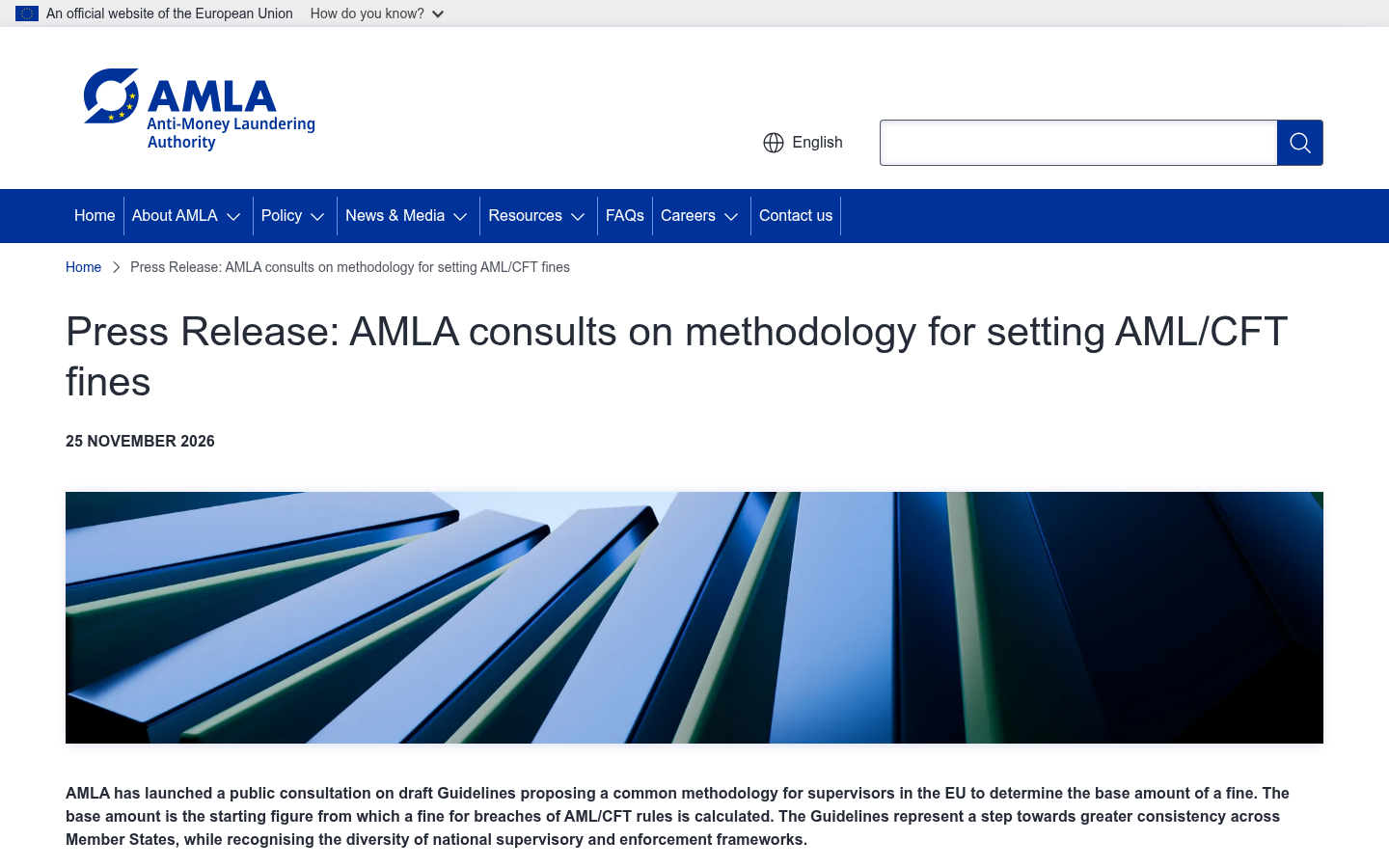
Average fines for anti-money laundering breaches range from €15,000 in one EU country to €10 million in another, according to the EU's new Anti-Money Laundering Authority, which launched a consultation on 25 November 2026 to set a common method for calculating them (Source: AMLA).
Stablecoin Insider tracks the rules that shape fintech and crypto businesses in Europe, and the EU's new anti-money laundering regime is one of the biggest compliance changes coming.
From 10 July 2027, a single EU regulation will replace 27 sets of national AML rules, and a new EU authority based in Frankfurt will start supervising the riskiest firms directly from 2028.
Payment firms, e-money institutions and crypto-asset service providers will all feel the change.
This guide explains what AMLA is, what the single AML rulebook requires, the key dates, what it means for crypto and stablecoin firms, and what fintechs should do now.
Key Takeaways
- The EU AML Regulation applies directly from 10 July 2027.
- AMLA will directly supervise about 40 high-risk entities from 2028.
- Cash payments above €10,000 will be banned across the EU.
- Crypto-asset service providers face bank-level AML standards.
- AMLA is now setting common rules for fines and supervision.
What AMLA Is
The Authority for Anti-Money Laundering and Countering the Financing of Terrorism (AMLA) is a new EU agency based in Frankfurt. It was legally established on 26 June 2024 and started operations in summer 2025. Its job is to make sure EU anti-money laundering rules are applied the same way in every member state.
- Direct supervision: AMLA will directly supervise selected high-risk financial firms that operate across borders.
- Indirect supervision: It will coordinate national supervisors for all other firms, in both financial and non-financial sectors.
- FIU support: It will help national financial intelligence units run joint cross-border analyses and manage the FIU.net system.
- Rule-making: It drafts technical standards and guidelines that complete the EU rulebook.
AMLA does not replace national supervisors. It works alongside them and takes over direct oversight only for the largest cross-border risks.
The AMLA Timeline
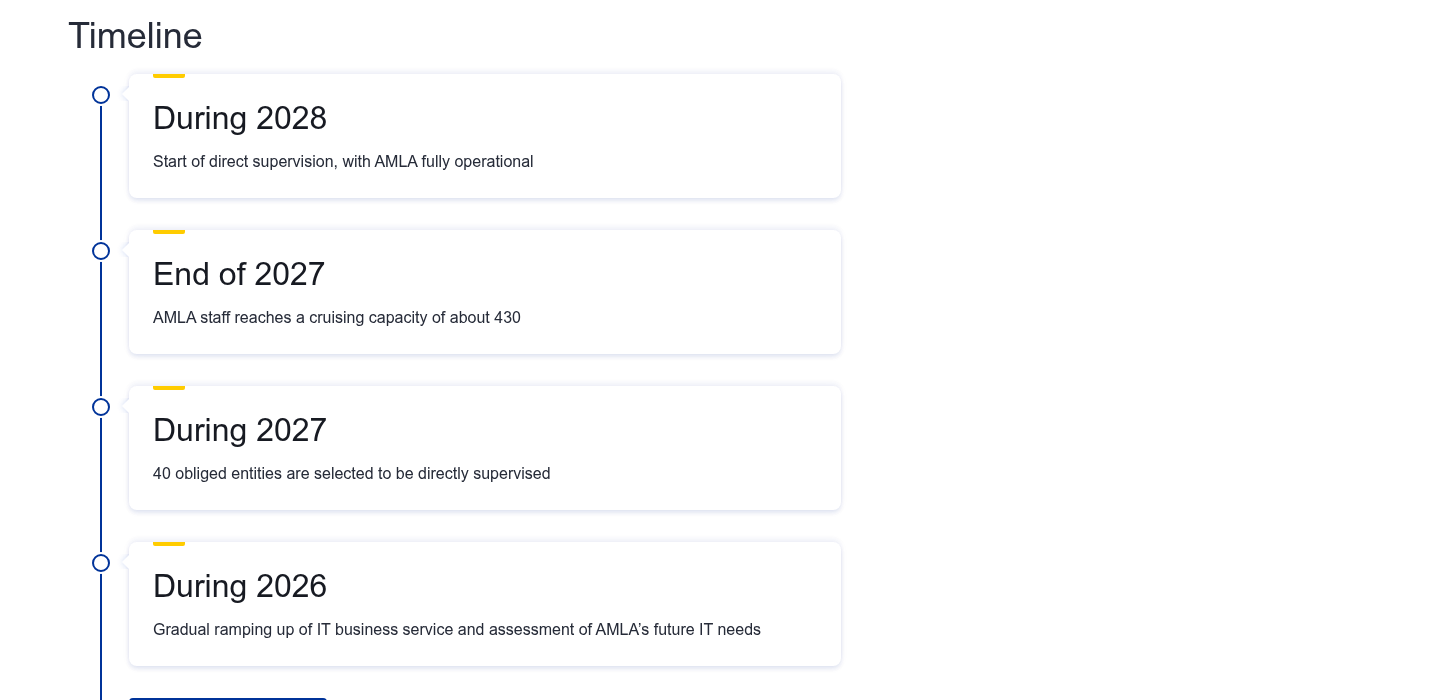
AMLA's own timeline shows a steady build-up. During 2027, it will select 40 obliged entities for direct supervision. By the end of 2027 its staff should reach about 430, and direct supervision starts during 2028, when AMLA becomes fully operational (Source: AMLA).
| Milestone | Date | Status |
|---|---|---|
| AMLA set up | June 2024 | Done |
| Operations start | Summer 2025 | Done |
| AMLR applies | 10 July 2027 | Upcoming |
| 40 entities picked | During 2027 | Upcoming |
| Direct supervision | During 2028 | Upcoming |
AMLA is already busy. In November 2026 alone it consulted on rules for AML supervisory colleges, published its first report on how those colleges work after attending 17 meetings, signed a cooperation deal with the European Public Prosecutor's Office, and opened the consultation on fines.
What the Single AML Rulebook Requires
The AML package has four parts: the AMLA Regulation, the AML Regulation (AMLR), the sixth AML Directive (AMLD6) and the recast Transfer of Funds Regulation. The AMLR is the core. It applies directly in all member states from July 2027, with some parts from July 2029, so firms no longer follow 27 different national versions of the rules (Source: Deloitte).
| Rule | What changes | Who is hit |
|---|---|---|
| Cash limit | €10,000 cap | Merchants |
| Beneficial owners | 25% or more | All entities |
| PEPs | Wider definition | All entities |
| New sectors | Crypto, football | New obliged firms |
| Travel rule | Crypto included | CASPs |
- Harmonised due diligence: One standard for identifying and verifying customers across the EU, with AMLA standards filling in the detail.
- Beneficial ownership: Anyone holding 25% or more of shares, voting rights or control counts as a beneficial owner.
- Politically exposed persons: The definition widens to include heads of regional and local authorities and siblings.
- Cash payments: Commercial cash payments above €10,000 are banned, and member states can set lower limits.
- Governance: A board member must be named as responsible for AML compliance.
What It Means for Crypto and Stablecoin Firms
Deloitte sums up the shift for crypto as "CASPs ≈ banks". Crypto-asset service providers become obliged entities under the same single rulebook as banks, with no special treatment.
- Travel rule: Since 30 December 2024, the recast Transfer of Funds Regulation requires sender and receiver information to travel with crypto transfers between providers.
- Self-hosted wallets: CASPs must apply extra checks on transfers to and from self-hosted wallets, especially above €1,000.
- Same checks as banks: Customer due diligence, ongoing monitoring and suspicious activity reporting follow bank-level standards.
- Direct supervision risk: Large cross-border CASPs could be among the 40 entities AMLA supervises directly.
AML rules sit alongside MiCA. Our guide on how to check if a stablecoin is MiCA-compliant covers the licensing side, and our list of stablecoin compliance tools covers the screening and monitoring side.
Fines, Fees and Enforcement
AMLA's draft guidelines set out how supervisors should work out the base amount of a fine, using the gravity of the breach, the type of firm, its legal form and a financial measure such as turnover. Aggravating and mitigating factors then set the final figure. A public hearing is planned for 12 January 2027, according to the same AMLA press release.
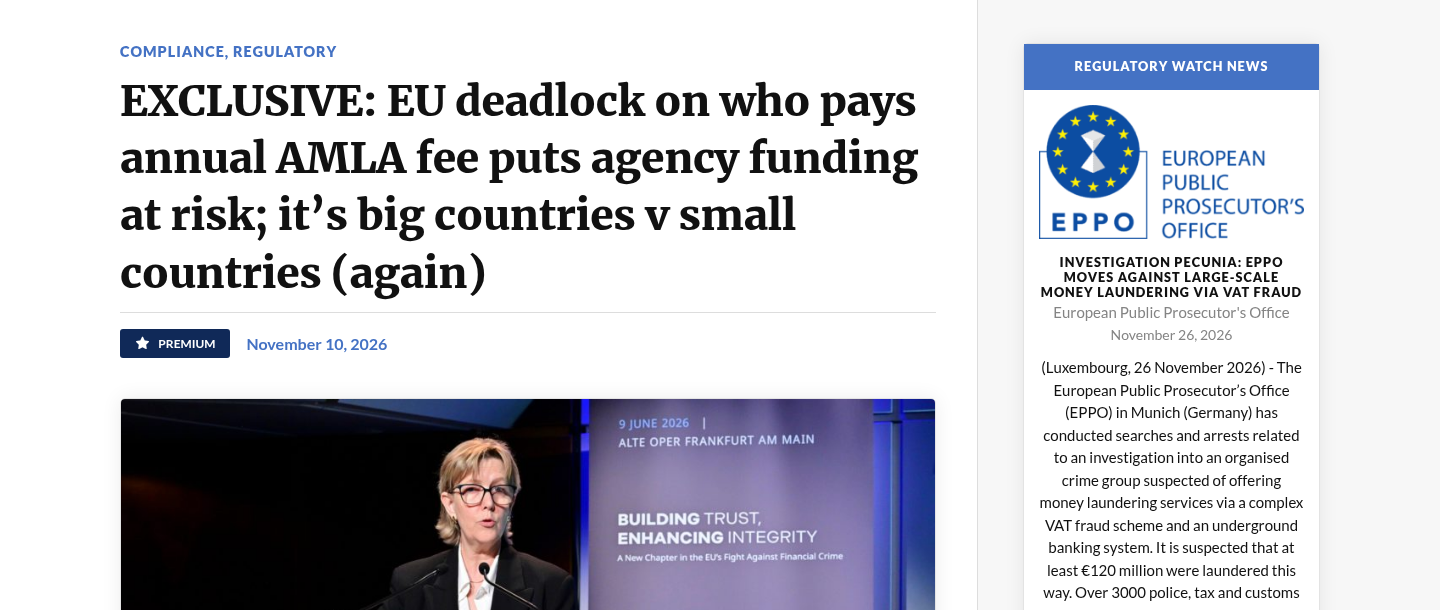
Who pays for AMLA is still being argued over. EU countries have failed to agree on how to calculate the annual supervisory fees that firms must pay from 2028, raising the risk of a funding gap, according to AML Intelligence (Source: AML Intelligence).
For firms, the message is that enforcement will become more consistent across countries. A breach that once drew a small fine in one member state may face a much larger one under a common method.
What Fintechs Should Do Now
- Run a gap analysis: Compare current KYC, monitoring and reporting against the AMLR before July 2027.
- Update beneficial ownership checks: Apply the 25% threshold and the wider PEP definition.
- Name an accountable board member: Make AML compliance a clear senior responsibility.
- Check your crypto flows: Confirm travel rule data and self-hosted wallet checks are in place.
- Prepare for supervisory data requests: AMLA's risk assessments rely on large sets of standard data points.
- Follow AMLA consultations: Standards and guidelines are being written now and will shape day-to-day rules.
The AML rules arrive alongside other EU payment reforms. Our explainer on PSD3 and the PSR covers the parallel overhaul of payment rules, and our guide to embedding stablecoin accounts shows where KYC fits in a product build.
What to Watch
- Fines hearing: AMLA's public hearing on the fines methodology on 12 January 2027.
- Fee deal: Whether EU countries agree on how supervisory fees are calculated.
- The list of 40: Which banks, payment firms and CASPs AMLA selects for direct supervision in 2027.
- Final standards: Technical standards on due diligence, supervision and colleges before July 2027.
- National transposition: How member states implement AMLD6 by July 2027.
Conclusion
Stablecoin Insider follows how EU rules reshape fintech and crypto, and the single AML rulebook is one of the largest changes the sector will face in 2027.
For the first time, the same AML rules will apply directly across the EU, backed by a new authority with its own supervisors and fining powers.
Crypto and stablecoin firms lose any special treatment and will be held to the same standards as banks.
With less than eight months to go, firms that start preparing now will find the July 2027 deadline far easier to meet.
Read Next
- UK Payments Regulation Overhaul Explained: Stablecoins, Open Banking and AI Agents
- Tax Brackets 2027: New IRS Bands, $16,600 Standard Deduction and What You'll Pay
- Poundland Administration: More Than 10,000 Jobs at Risk and a New Returns Rule
FAQs
1. What is AMLA?
AMLA is the EU's Authority for Anti-Money Laundering and Countering the Financing of Terrorism, a new agency based in Frankfurt. It coordinates national AML supervisors, supports financial intelligence units and will directly supervise selected high-risk financial firms from 2028.
2. When does the EU AML Regulation apply?
The EU AML Regulation applies from 10 July 2027, with some provisions from July 2029. It is directly applicable in every member state, replacing national AML laws based on earlier directives.
3. Which firms will AMLA supervise directly?
AMLA will supervise directly about 40 high-risk financial firms that operate across several EU countries. It will select them during 2027 using a common risk assessment, and direct supervision starts in 2028.
4. Does the EU AML package apply to crypto firms?
The EU AML package applies to crypto firms, including most crypto-asset service providers. They become obliged entities with bank-level due diligence duties, and the travel rule already requires sender and receiver details on crypto transfers.
5. What is the EU cash payment limit?
The EU cash payment limit is €10,000 for payments for goods or services, applying from July 2027 under the AML Regulation. Member states can set lower limits based on their own risk assessments.
Disclaimer: This content is provided for informational purposes only and does not constitute legal, financial, or investment advice. Dates, requirements and figures cited here reflect publicly available information as of November 2026 and may change as AMLA finalises its standards. Check official AMLA and EU sources before making decisions.