Table of Contents
Thailand wants to cap how much stablecoin a customer can move in and out of a licensed crypto platform. On 12 November 2026 the Securities and Exchange Commission of Thailand (SEC) opened comments on draft rules that would limit stablecoin deposits and withdrawals to 5 million baht each, per customer, per day, at each licensed digital asset operator, and ban transfers to or from anyone else's wallet (SEC release text via ThaiPR.net; SEC consultation page).
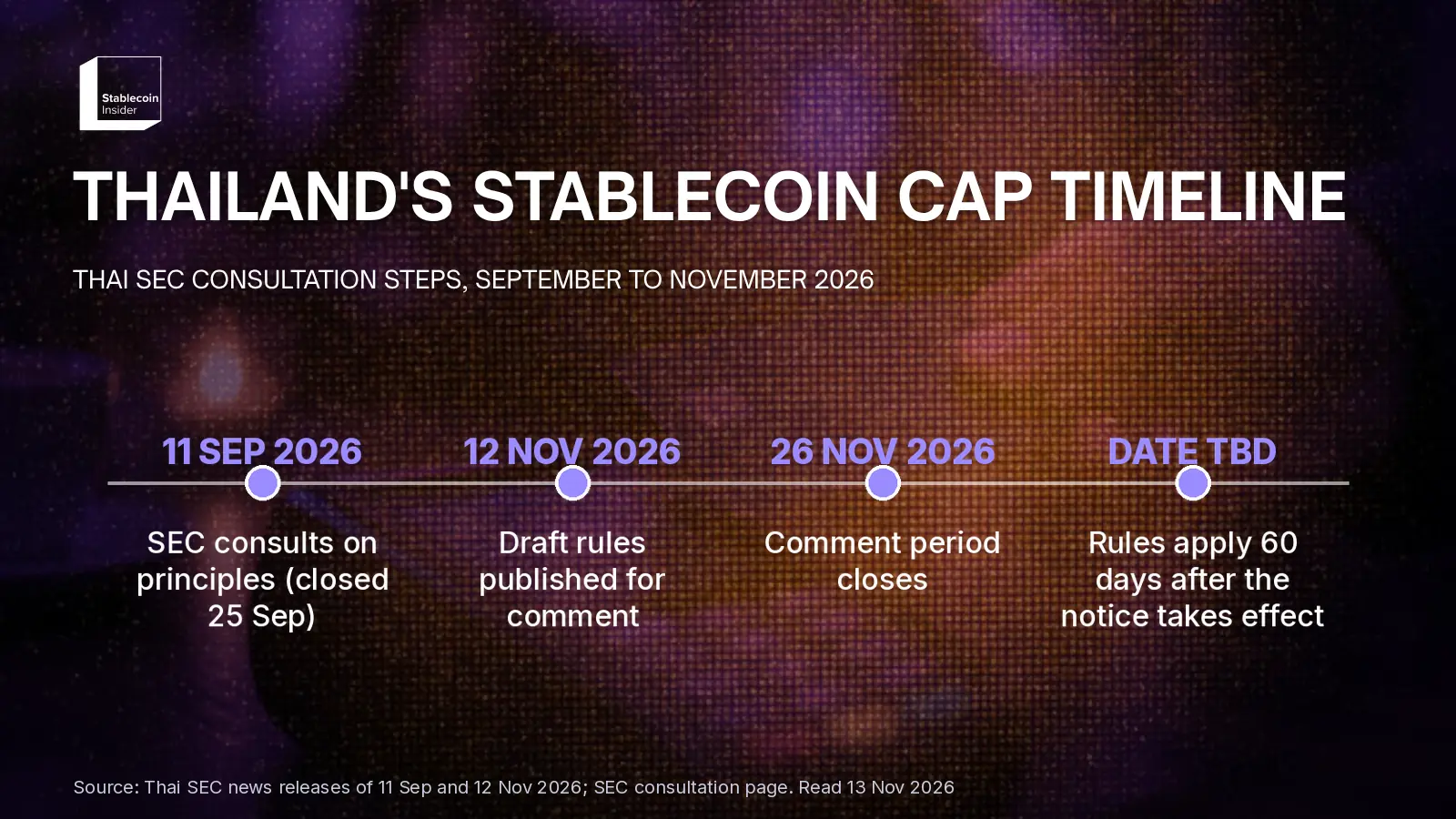
Comments close on 26 November 2026. At the European Central Bank's 12 November reference rates, 5 million baht is about $147,900, in line with the roughly $148,000 that Cointelegraph reported. The draft turns principles the SEC first floated on 11 September 2026 into notification text, with one new exemption.
Key Takeaways
- Stablecoin deposits and withdrawals would each be capped at 5 million baht (about $147,900) per customer, per day, at each licensed operator.
- Customers could only move stablecoins to and from accounts or wallets verified as their own; third-party transfers would be banned.
- Moves between a customer's own accounts at two SEC-licensed Thai operators are exempt from the cap if both firms apply the Travel Rule.
- New since September: token-offering subscriptions and refunds through SEC-approved ICO portals are exempt too.
- Exchanges would have to name their market makers; brokers could not use liquidity providers for stablecoin/baht pairs; off-platform trades would need a 3 million baht minimum.
What did Thailand's SEC propose on 12 November 2026?
Thailand's SEC proposed draft notifications that tighten how stablecoins move through licensed digital asset (DA) operators such as exchanges, brokers and dealers. The stated aim is to stop stablecoins being used for money laundering, cybercrime or to get around international money-transfer rules (SEC release).
The transfer rules have three parts:
- Own wallets only. The sending account or wallet for a deposit, and the receiving one for a withdrawal, must be verified as belonging to the customer making the transfer.
- Screening. Those wallets must meet Travel Rule requirements, customer profiling and screening (no mule accounts or high-risk parties), and blockchain-analytics checks for links to risky or watchlisted wallets.
- A value test plus a hard cap. Transfer values must fit the customer's income and financial position, and inbound and outbound transfers are each capped at 5 million baht per day per operator.
The SEC's comment form splits the transfer rules into three cases: transfers to or from other people's accounts, transfers to the customer's own account at a foreign operator or a private wallet, and transfers between the customer's own accounts at Thai operators (consultation page). That split shows where the cap bites. It covers money moving between Thai platforms and offshore exchanges or self-custody, not between two Thai platforms.
How much is 5 million baht in US dollars?
5 million baht is about $147,900 at the ECB euro reference rates for 12 November 2026 (1 EUR = 37.470 THB and 1 EUR = 1.1081 USD, giving 33.81 baht per dollar). The table converts each baht threshold in the draft at that rate. Exchange rates move daily, so treat the dollar figures as approximate.
| Draft threshold | Baht | US$ (approx.) |
|---|---|---|
| Daily stablecoin deposits, per customer, per operator | 5,000,000 | $147,900 |
| Daily stablecoin withdrawals, per customer, per operator | 5,000,000 | $147,900 |
| Both directions combined at one operator | 10,000,000 | $295,700 |
| Minimum off-platform (OTC) trade at a broker or dealer | 3,000,000 | $88,700 |
Two points follow from the wording. Because the cap applies at each operator, a customer with accounts at several licensed platforms would have a separate allowance at each one. And because own-account moves between Thai operators are exempt, the cap mainly limits money crossing the border of the Thai licensed system.
Who is exempt from the 5 million baht cap?
Five groups are exempt from the 5 million baht cap under the 12 November draft (SEC release):
- Transfers between a customer's own accounts at SEC-licensed Thai operators, if both operators apply the Travel Rule.
- DA operators themselves, moving stablecoins in or out of accounts in their own name for business purposes.
- Businesses supervised by the Bank of Thailand that have case-by-case approval from the central bank to use stablecoins under a specified model.
- Market makers for stablecoin/baht pairs, including transfers they need to make through licensed operators to provide liquidity.
- Subscriptions and refunds for SEC-approved digital token offerings where the counterparties are an ICO portal, the issuer and/or investors, plus repayments of principal or returns to investors. ICO portals must be able to refund failed subscriptions to the customer's account at a Thai operator.
The exemptions don't lift the ban on third-party transfers. They only take some flows outside the daily limit.
What changed from the September proposal?
The core rules are the same as the principles the SEC put out for comment on 11 September 2026, but the November draft adds detail. We compared the September English release with the 12 November release text. Rows link to each source.
| Rule | 11 Sep principles | 12 Nov draft |
|---|---|---|
| Own-wallet only, Travel Rule, analytics | Proposed | Kept |
| 5M baht daily cap, each direction | Proposed | Kept |
| ICO portal subscriptions and refunds | Not listed | Exempt (new) |
| Broker routing of off-platform orders | Via DA exchanges | Via Thai or foreign DA exchanges |
| When rules apply | Not stated | 60 days after the notice takes effect |
The new ICO-portal exemption matters for Thailand's token-offering market. Without it, investors paying for an approved token offering in stablecoins could hit the same daily cap as an ordinary withdrawal.
What else does the draft change for Thai exchanges and brokers?
The draft also tightens rules for exchanges, brokers and dealers, with market makers, liquidity providers and off-platform trades all under closer watch (SEC release):
- Exchanges must publish the names of their market makers and the assets each one supports, and screen and monitor market makers' sources of funds and trading purposes.
- Brokers may not use liquidity providers for stablecoin/baht pairs. Other LPs must not be in jurisdictions that fail to apply FATF recommendations, must be regulated, and must be disclosed to customers along with any conflicts of interest.
- Source exchanges that brokers route orders to must be supervised by a regulator and screened like LPs.
- Off-platform trades by brokers and dealers need a minimum of 3 million baht, with prices published on the operator's website or platform. Brokers can't match customers directly off-platform.
- Enforcement: the SEC could order operators that fail to collect or disclose required information to fix it within a set period.
How does Thailand's approach compare with Brazil's?
Thailand's plan is stricter on volume than Brazil's proposal. As we reported, Brazil's central bank in June 2026 floated a 24-hour hold on stablecoin transfers of $10,000 or more sent abroad or to self-custody wallets (our Brazil report). Brazil delays large transfers. Thailand would cap the daily amount, ban third-party transfers outright and exempt moves inside its own licensed system. Both treat stablecoins leaving the regulated perimeter as a capital-flow question as much as an AML one.
What is still unclear?
Three things are still unclear. Neither the release nor the consultation page gives a date when the notification will take effect, only that the stablecoin rules apply 60 days after it does. The release does not say how operators must prove that a private wallet belongs to the customer. And it does not say how the income-and-financial-position test will be applied to transfers under the 5 million baht cap.
Stablecoin Insider's take
For operators, the work is compliance plumbing: wallet-ownership checks, Travel Rule coverage on both legs, and per-customer daily counters on each side. Firms comparing screening vendors can start with our stablecoin compliance tools guide.
Comparing Asian regimes? See how Singapore, Hong Kong, Japan and Taiwan license stablecoins in our APAC stablecoin regulation guide.
For the full picture, see our Stablecoin regulation hub.
FAQ
Can I send USDT from a Thai exchange to a friend's wallet under the draft?
Can I still withdraw stablecoins to my own hardware wallet?
Does the cap apply to bitcoin or other crypto?
How can I comment on the draft?
What happens next?
Next, the comment window closes on 26 November. The SEC will then decide the final text and publish the notification. The stablecoin, market-maker, LP, source-exchange and off-platform rules apply 60 days after the notification takes effect, so Thai operators would have about two months to build wallet-ownership checks and daily counters once a date is set. Watch for changes to the exemptions, especially for payment firms approved by the Bank of Thailand.
Sources: Thai SEC release on the stablecoin draft notification (12 Nov 2026, Thai text via ThaiPR.net); Thai SEC consultation page and comment form; Thai SEC release No. 191/2026 on the proposed principles (11 Sep 2026); ECB euro foreign exchange reference rates (12 Nov 2026); Cointelegraph (12 Nov 2026); crypto.news (12 Nov 2026). All read on 13 November 2026.
This content is provided for informational and educational purposes only and doesn't constitute financial, investment, legal or tax advice. The Thai SEC rules described are a draft open for comment and may change. Dollar conversions use ECB reference rates for 12 November 2026 and are approximate. Figures and rule text were read on 13 November 2026. It isn't a recommendation to buy, sell, hold or transfer USDT or any other stablecoin or digital asset, or to use any exchange, broker or ICO portal. Operators should take Thai legal advice.