

Table of Contents
Mercury is the default startup bank for a reason. It costs nothing, opens in minutes, imposes no revenue minimum or personal guarantee, and serves more than 300,000 businesses. Most founders who leave it are not leaving because it failed.
They leave because they hit one of its edges. A balance that outgrows a $5 million sweep. A treasury minimum they cannot reach. A retail business that needs to deposit cash. Revenue arriving in five currencies. Or stablecoin flows Mercury will not hold.
The useful question is not which platform is better than Mercury. It is which specific limitation you hit, because each one is filled by a different alternative and none of them fills all of them.
This guide sets out where Mercury falls short, compares the seven alternatives that address those gaps, and maps each to the constraint it actually solves.
Key Takeaways
- Most founders leave Mercury over one specific limitation, not general dissatisfaction.
- Mercury's $5 million sweep sits at the low end of the category.
- Treasury requires $250,000, which excludes most seed-stage balances.
- Mercury takes no cash deposits and does not serve sole proprietorships.
- Only Grasshopper is a chartered bank insuring deposits directly.
- Brex and Ramp hold stablecoins natively; Mercury does not.
What Mercury Does Well
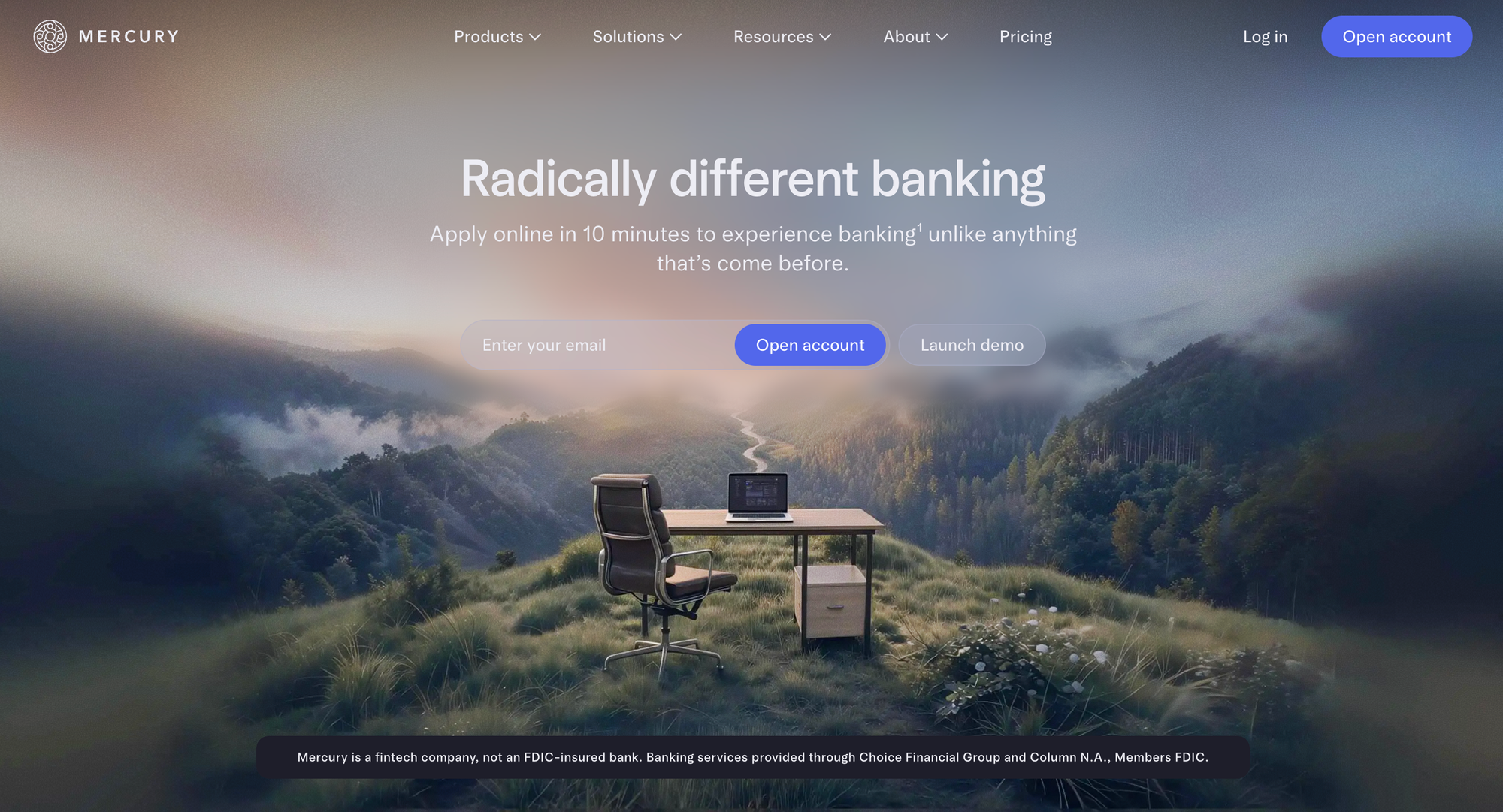
Any honest alternatives guide has to start here, because the reasons Mercury became the default have not changed.
It publishes no minimum revenue requirement, no personal guarantees, and no minimum employee count, which makes it openable at pre-seed and still usable at Series B. Onboarding is self-serve. The free tier has no monthly fee and no minimum balance.
It received conditional approval from the Office of the Comptroller of the Currency in April 2026 to establish Mercury Bank as a chartered national lender, which would remove the partner-bank layer if completed.
There is also a signalling value that no comparison captures. Investors and accountants recognise it immediately, which removes friction from diligence and bookkeeping alike.
Where Mercury Falls Short
Six gaps account for most departures, and they affect entirely different types of company.
Sweep coverage. Mercury's FDIC sweep reaches approximately $5 million, which sits at the low end of the category and becomes binding once a Series B balance sheet arrives.
Treasury minimum. Mercury Treasury yields around 4% but requires $250,000 across accounts, putting it out of reach for most seed-stage companies holding runway they would like to earn on.
Cash deposits. Mercury accepts none. For retail, hospitality, or services businesses handling physical cash, that is disqualifying rather than inconvenient.
Entity types. Mercury does not support sole proprietorships, which excludes freelancers, consultants, and unincorporated operators entirely.
Currency coverage. Mercury is built around USD. Companies collecting revenue from several countries or paying contractors abroad lose more to FX markups than to any fee schedule.
Stablecoin capability. Mercury serves crypto startups for fiat banking and does not hold digital assets. For companies with on-chain revenue, that means converting through an exchange and wiring the proceeds, as our guide to off-ramping USDC to ACH or wire describes.
What to Look For in a Mercury Alternative
Start with the constraint that pushed you to look, not with feature lists.
1. Match the gap, not the brand
Each alternative below solves a different Mercury limitation. Choosing on general impressions produces a platform that fixes something you did not need fixed.
2. Check eligibility before features
Mercury's openness is unusual. Brex applies reported thresholds around $400,000 in monthly revenue or venture backing, and Grasshopper does not serve non-US-incorporated entities, which means some Mercury users cannot qualify for either.
3. Decide whether you want a bank or a platform
Most alternatives here are fintechs routing deposits to partner banks. One is a chartered bank insuring deposits directly, which is a different counterparty structure rather than a better rate.
4. Read the yield mechanics
Advertised rates cluster within roughly a percentage point across the category. Minimums, balance tiers, and whether uninvested cash earns anything differ far more than the rates do.
5. Decide whether you are replacing or adding
Several of these are designed to run alongside a primary account rather than instead of one, which changes the comparison entirely.
Top Mercury Alternatives in 2026
1. Rho
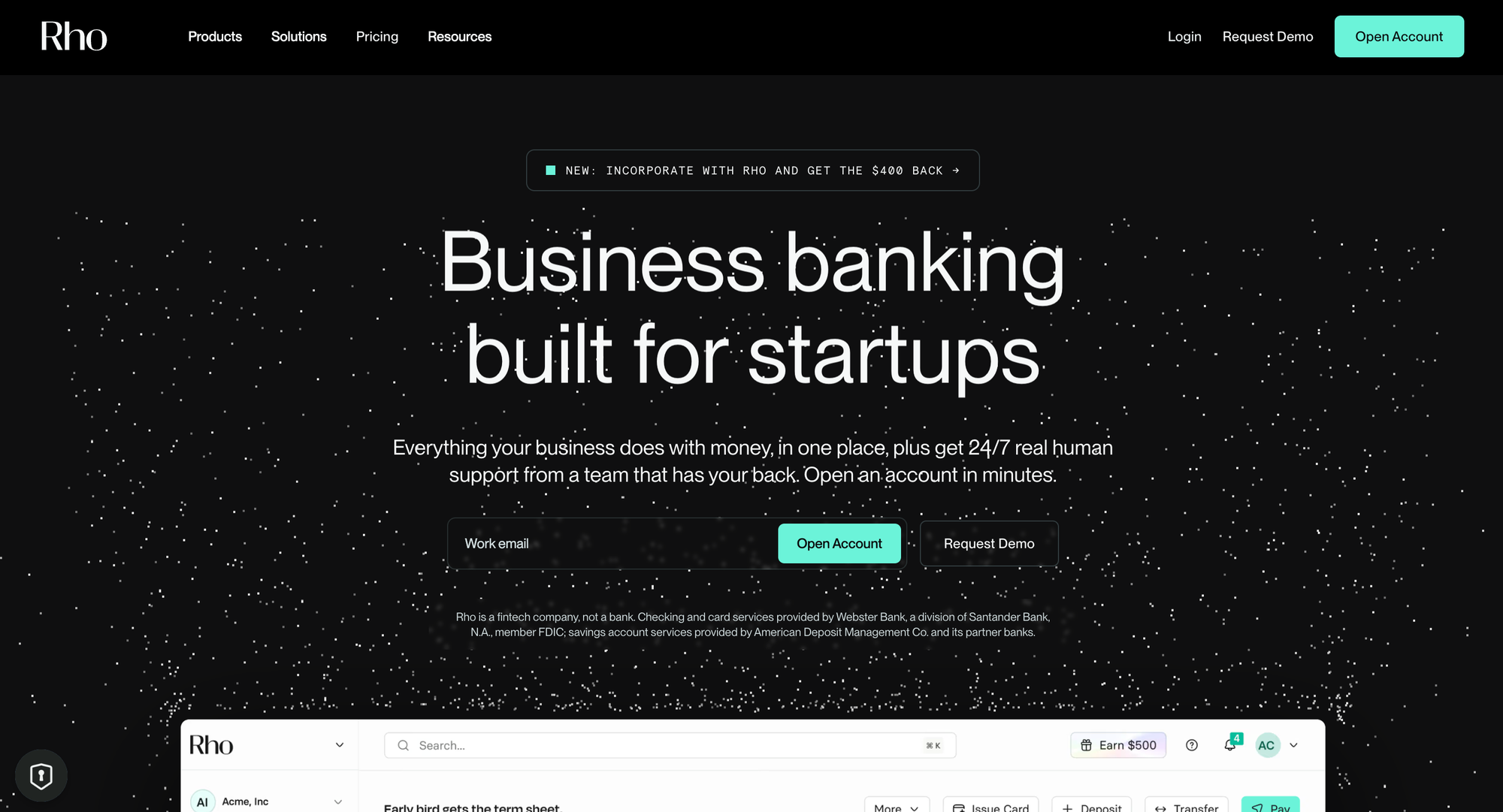
Fills the gap: finance operations depth and sweep coverage.
Rho is the closest thing to a direct upgrade path for companies that outgrew Mercury's product scope rather than its coverage. It bundles business checking, corporate cards, accounts payable automation, expense management, and treasury on one platform with no subscription or per-user fees.
The platform supports:
- Zero-fee checking with no paid tier required for savings
- Savings coverage up to $75 million through a network of more than 400 banks
- Treasury yields advertised up to 4.57% as of August 2026
- Up to 2% cashback on Rho Platinum, 1.5% standard
- A dedicated banking specialist and 24-hour support for every customer regardless of size
Rho is crypto-tolerant rather than stablecoin-capable, and it does not accept cash deposits.
Rho is best for funded startups that outgrew Mercury's product scope and want banking, cards, AP, and treasury consolidated without a platform fee.
2. Brex
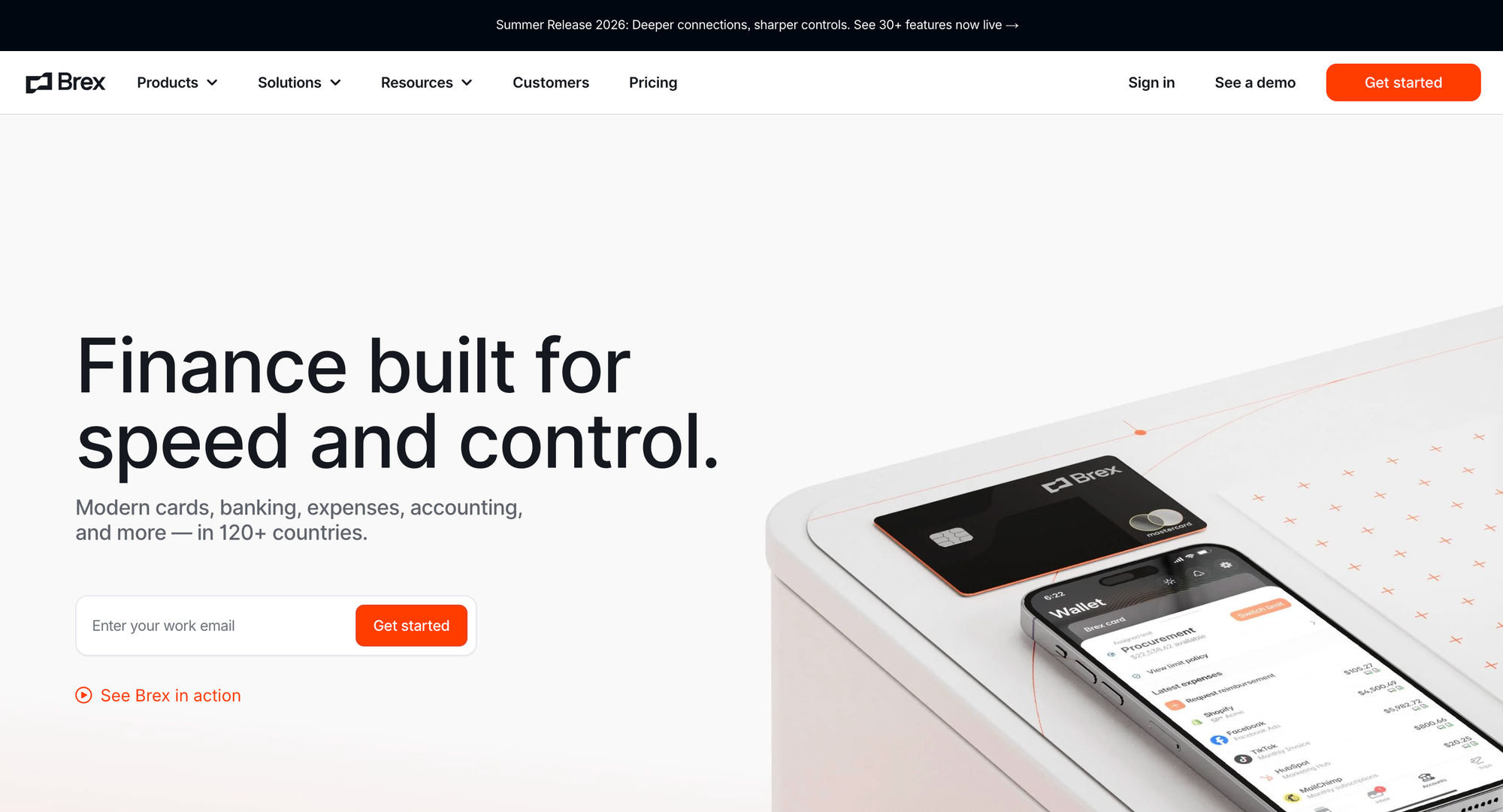
Fills the gap: global spend management and stablecoin settlement.
Brex is the strongest fit for funded companies with multi-entity structures, international card issuance needs, or meaningful card spend. Capital One completed its $5.15 billion acquisition on 7 April 2026, placing a traditional bank behind the product.
The platform supports:
- Coverage up to $6 million through an insured cash sweep network
- Yields reported in the 3.4% to 3.7% range on invested cash, with none on uninvested balances
- Category-based card rewards with acceptance across 210 or more countries
- Bill pay, expense management, travel booking, and multi-entity card issuance
- Native USDC payments launched September 2025, powered by Column, with automatic USD conversion
Eligibility is the constraint. Reported requirements around $400,000 in monthly revenue or venture backing exclude many companies that qualify for Mercury without difficulty.
Brex is best for Series A and later companies with global spend and on-chain settlement needs in the same platform.
3. Ramp
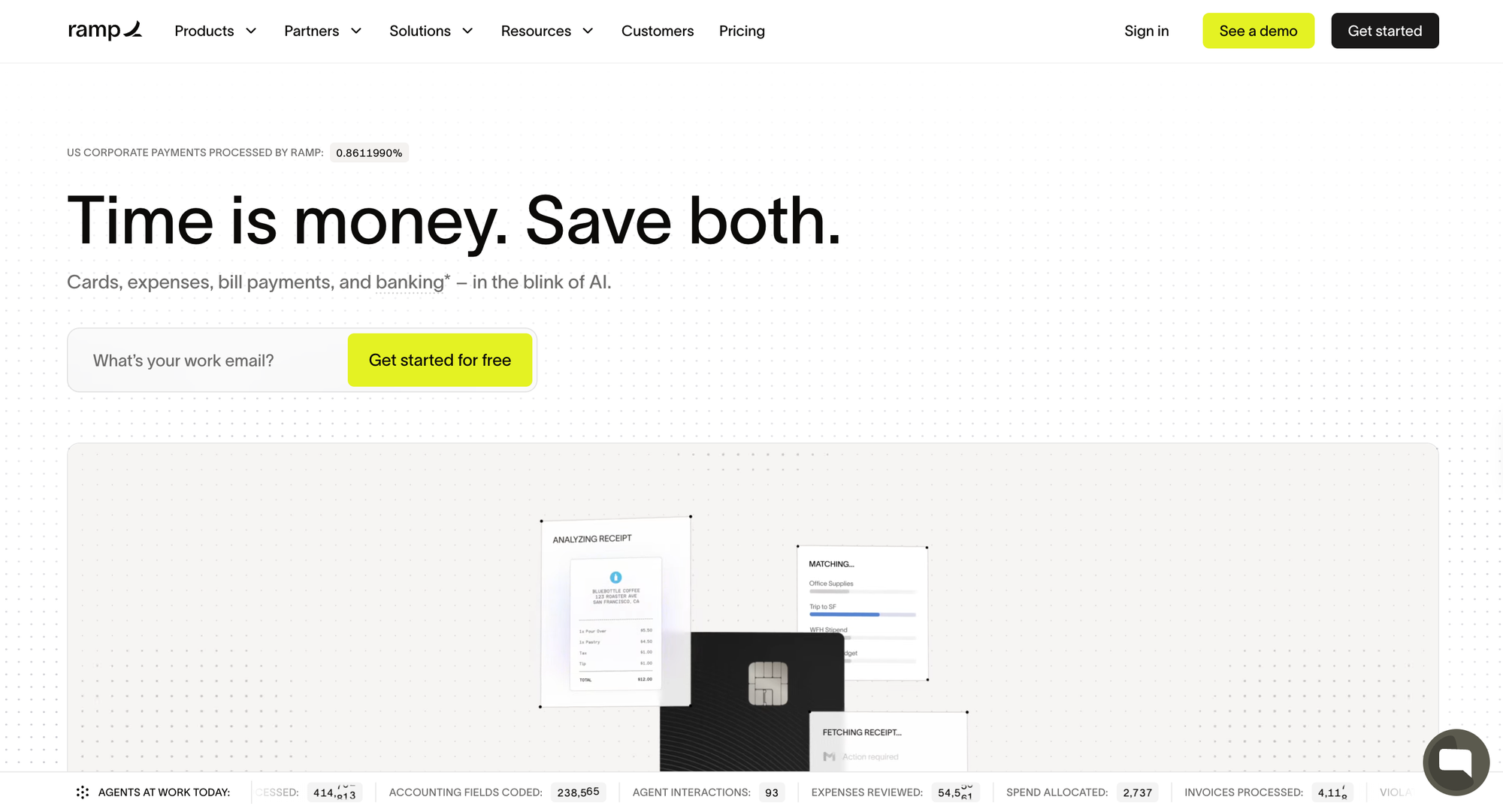
Fills the gap: spend management depth and stablecoin operations.
Ramp is the alternative for companies that do not want to move their banking at all. It layers procurement, expense management, bill pay, and travel on top of an existing account, and in 2026 it added stablecoin accounts to that stack.
It raised $750 million at a $44 billion valuation in June 2026, reporting more than $1 billion in annualised revenue and total payment volume up roughly 170% year over year.
The platform supports:
- Checking provided by First Internet Bank of Indiana
- Transactions across 40 currencies in 200-plus countries
- Stablecoin accounts generally available since 21 July 2026, holding USDC and USDT
- Vendor, bill, and card statement payments across seven networks including Base, Ethereum, and Solana
- The same approval flows and accounting sync used for fiat
One caveat deserves weight. Stablecoin custody is provided by Bridge Building Inc. and its affiliates, and Ramp's own disclosures state that stablecoin balances are not FDIC-insured bank deposits.
Ramp is best for companies keeping Mercury for banking and adding spend management and stablecoin operations on top. It is not available to businesses in New York.
4. Grasshopper
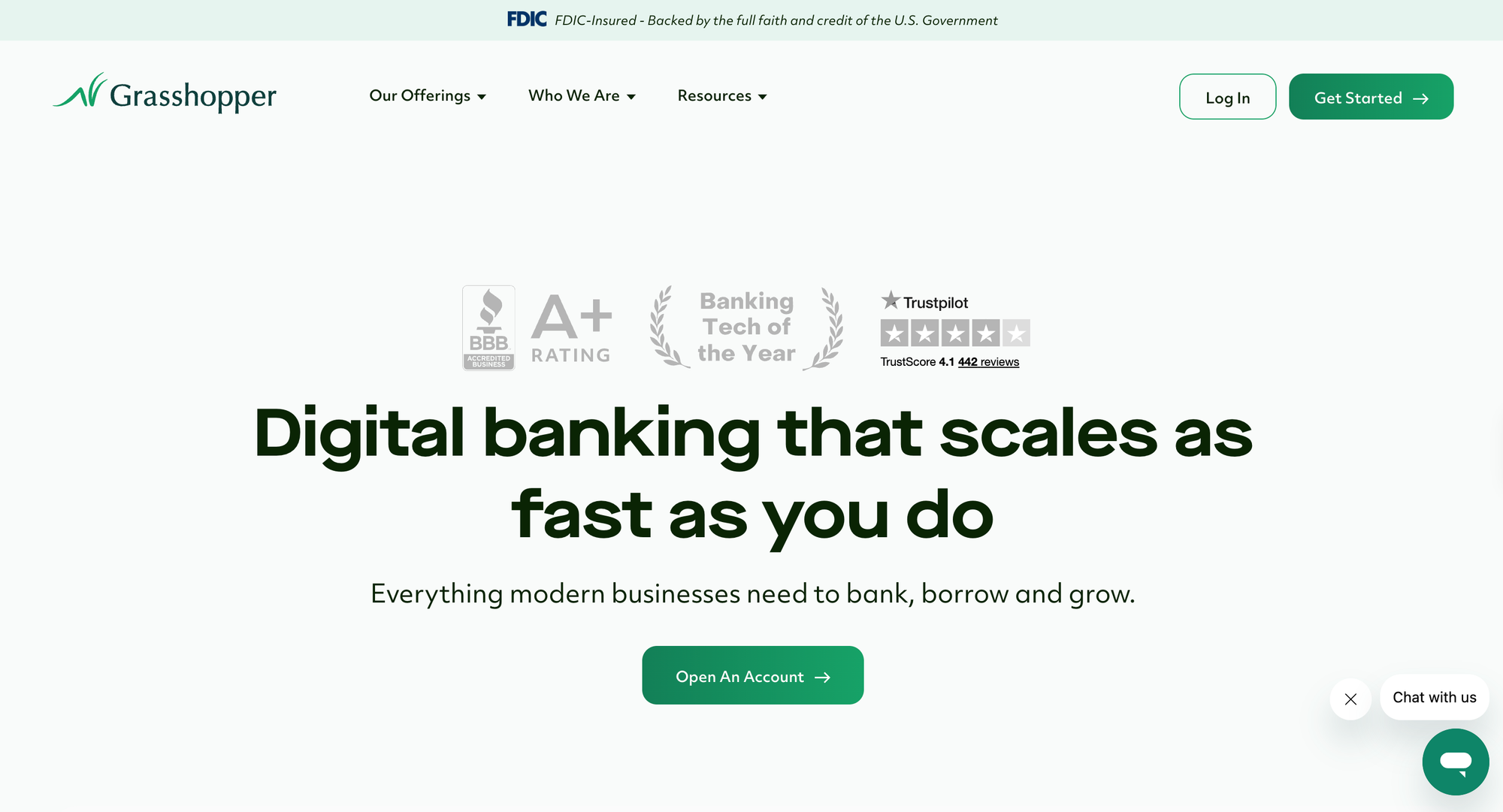
Fills the gap: direct chartered-bank insurance.
Grasshopper is the only alternative here that is a bank rather than a platform sitting on one. It is an OCC-chartered, FDIC-member national bank, which means deposits are insured directly rather than passed through a partner.
The platform supports:
- Direct FDIC insurance at the bank itself, with extended coverage available through an insured cash sweep programme
- Accelerator Money Market Savings paying 3.00% APY above $25,000 and 1.55% below
- Accelerator Checking tiered between 1.00% and 1.35% by balance
- Free outgoing domestic wires for accounts maintaining a $25,000 average monthly balance
- Integrations with QuickBooks, Xero, Plaid, Autobooks, and Ramp corporate cards
The structural simplicity is the point. With a chartered bank there is one counterparty rather than a platform, a partner bank, and a sweep network layered on top of each other.
The limitations are real. Grasshopper is USD-only, does not support Zelle, does not serve non-US-incorporated entities, and offers no procurement workflows. Published sweep ceilings also vary considerably across sources, so confirm the current figure directly.
Grasshopper is best for US-incorporated startups that want direct chartered-bank insurance and are content pairing it with Ramp for spend management.
5. Bluevine
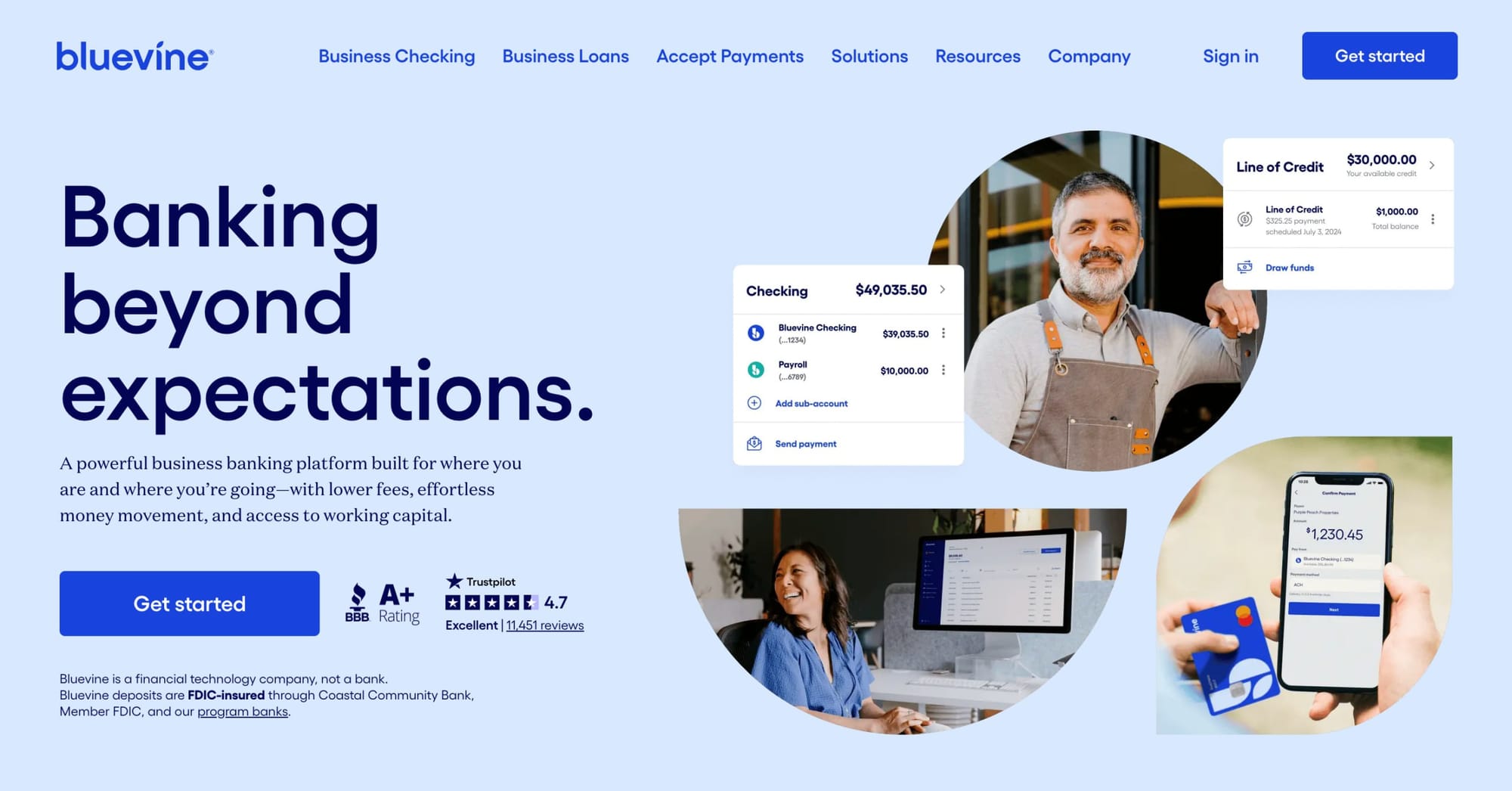
Fills the gap: entity eligibility and cash deposits.
Bluevine serves the businesses Mercury turns away. It supports sole proprietorships and unincorporated businesses, which removes the single hardest eligibility barrier on this list.
The platform supports:
- Cash deposits at more than 90,000 locations
- Up to 3.0% APY on checking balances without a venture-funding requirement
- Support for sole proprietorships and unincorporated entities
- Business lines of credit alongside the banking relationship
- Standard integrations for small business accounting
Bluevine is crypto-tolerant rather than stablecoin-capable.
Bluevine is best for freelancers, consultants, and small operating businesses that cannot open a Mercury account at all, or that handle physical cash.
6. Airwallex
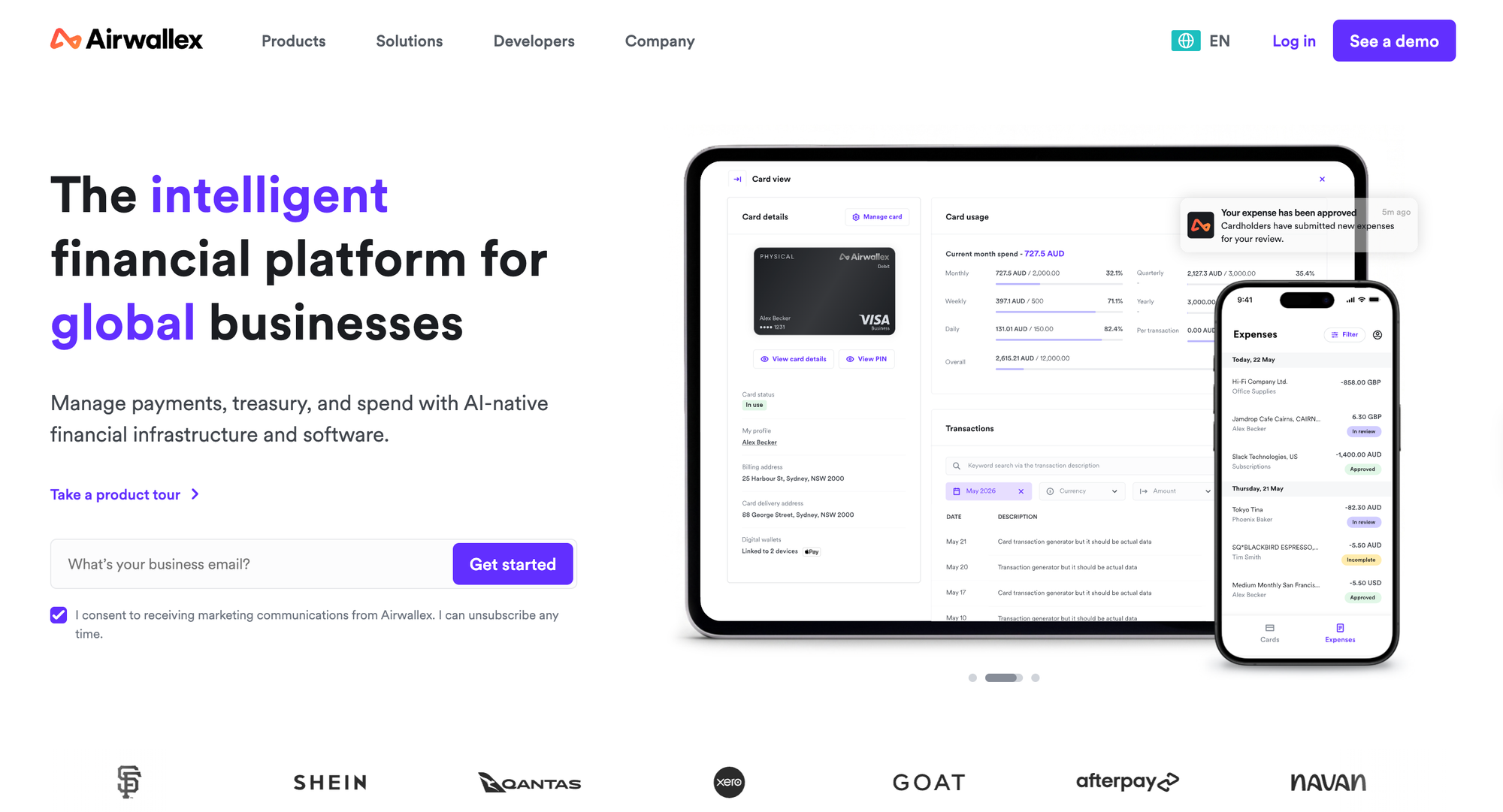
Fills the gap: multi-currency revenue and international payouts.
Airwallex addresses a constraint most US startup platforms do not attempt. Founded in Melbourne in 2015 and valued around $8 billion, it is a licensed payment services provider rather than a bank, holding 60-plus financial licences across 11 or more jurisdictions, with US deposits held at partner banks including Evolve Bank and Trust.
The platform supports:
- Balances in 20-plus currencies with local receiving details in more than 70 countries
- Free local transfers across 110-plus markets, routing most payments off SWIFT
- FX from around 0.5% above interbank for major currencies
- Airwallex Yield, launched March 2026, paying up to 3.44% APY on idle USD balances
- Unlimited virtual cards with QuickBooks, Xero, Stripe, and Shopify integrations
Its own guidance is unusually direct about fit. If all revenue and expenses sit in one currency and all counterparties are domestic, the platform's value is minimal.
Airwallex is best for e-commerce, SaaS, and services companies collecting revenue from several countries, typically run alongside a domestic account rather than replacing one.
7. Novo
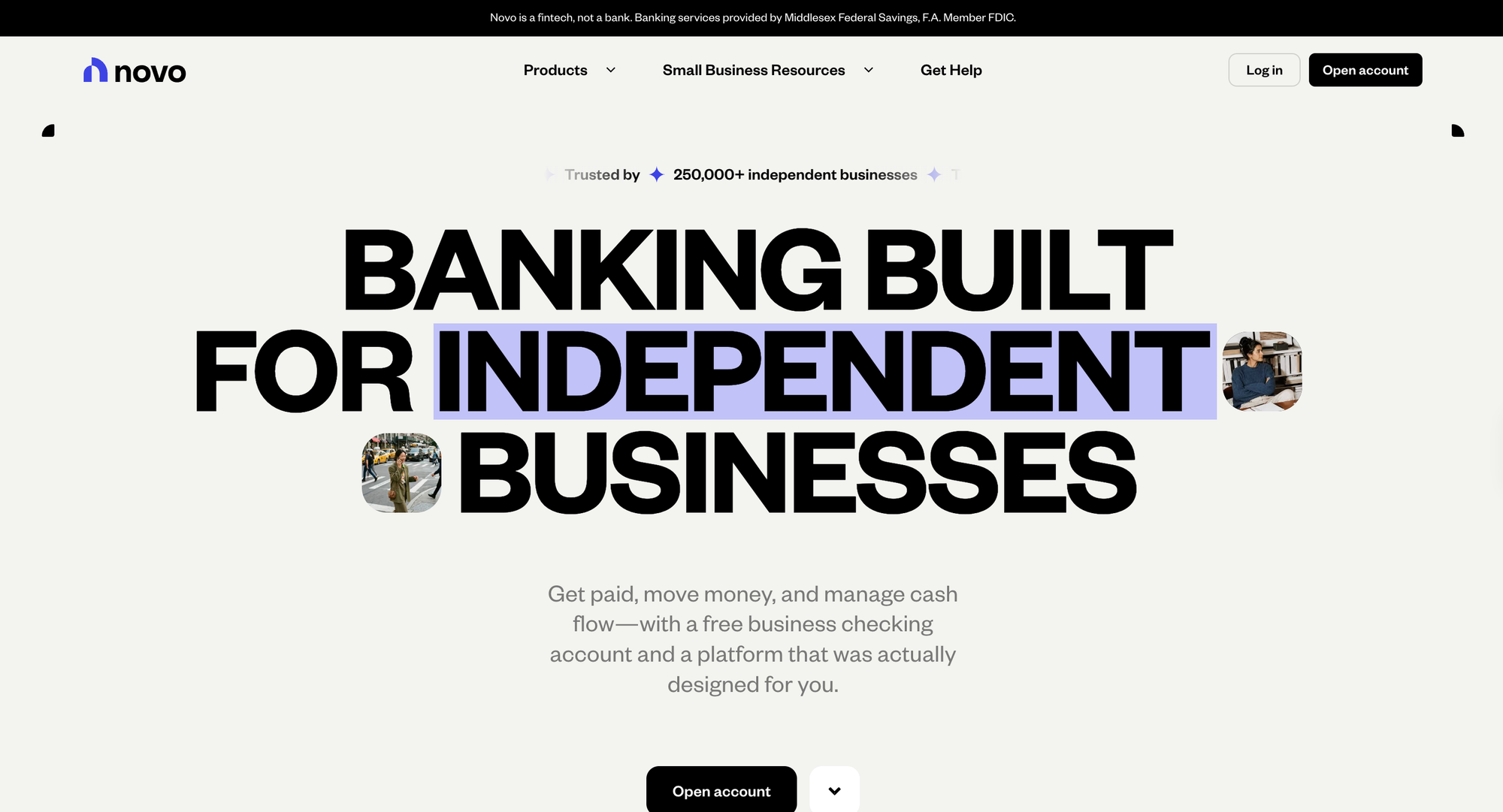
Fills the gap: simplicity for solo operators.
Novo is built for freelancers, solopreneurs, and very small businesses, and its value proposition is the absence of complexity rather than the presence of features.
The platform supports:
- Free business checking with no monthly fees or minimum balance
- Unlimited transactions
- ATM fee refunds
- A mobile-first interface built for single-operator businesses
- Standard integrations for invoicing and accounting
Novo offers no treasury product, no meaningful sweep coverage, and no stablecoin capability, which is consistent with who it serves.
Novo is best for solo founders and freelancers whose complaint about Mercury is that it is more platform than they need.
Best Mercury Alternative by Constraint
Map the reason you are looking to the platform that addresses it.
- If the constraint is sweep coverage, Rho at up to $75 million and Grasshopper with direct chartered-bank insurance are the two meaningful structural upgrades.
- If the constraint is the $250,000 treasury minimum, Grasshopper's tiered rates and Rho's treasury both start lower.
- If the constraint is cash deposits, Bluevine across 90,000-plus locations is the only option here.
- If the constraint is entity type, Bluevine and Novo both serve sole proprietorships and unincorporated businesses.
- If the constraint is finance operations depth, Rho bundles it into banking while Ramp layers it on top of whatever you already have.
- If the constraint is multi-currency revenue, Airwallex holds 20-plus currencies with local receiving details in 70-plus countries.
- If the constraint is stablecoin flows, Brex and Ramp both hold and move tokens natively.
- If the constraint is too much platform, Novo strips the category back to checking and a card.
Risks and Limitations Before Switching
Four cautions apply to any move away from Mercury.
The first is structure. With the exception of Grasshopper, none of these is a chartered bank. Deposits sit at partner institutions, and coverage depends on those relationships continuing. What deposit protection does and does not guarantee is set out in our guide to whether stablecoins are FDIC insured, and the same distinction applies to sweep networks.
The second is stablecoin balances are not deposits. Ramp's disclosures state plainly that stablecoin balances are not FDIC-insured bank deposits and that custody sits with a third party. The same logic applies anywhere tokens are held rather than dollars.
The third is data reliability. Yields, coverage ceilings, and eligibility thresholds are restated inconsistently across sources, and many of the most detailed Mercury comparisons available are published by companies competing with Mercury. Independent rankings and vendor materials disagree often enough that the discrepancy is itself informative.
The fourth is switching cost. Moving payroll, vendor ACH details, accounting integrations, and card programmes takes weeks, which is why most companies add a second platform before removing the first.
How to Choose a Mercury Alternative
1. Name the constraint in one sentence
If you cannot state which specific Mercury limitation prompted the search, the honest answer is usually to stay.
2. Confirm you qualify
Mercury's eligibility is more open than most alternatives here. Brex applies revenue or funding thresholds, and Grasshopper does not serve non-US-incorporated entities.
3. Size coverage against your real balance
Below $250,000, sweep networks are irrelevant and standard coverage applies. At $10 million of runway, both the ceiling and how it is constructed become the most consequential lines in any comparison.
4. Count your currencies
If revenue arrives in one currency and vendors are domestic, multi-currency capability is dead weight. If it does not, FX markups will cost more than every fee on the comparison combined.
5. Decide whether stablecoin capability is a requirement
Occasional on-chain receipts work fine through conversion. Recurring flows are where native support collapses a multi-account reconciliation into one ledger, as our guide to paying suppliers in USDC describes.
6. Plan to run two accounts
Multi-bank redundancy became a standard investor expectation after 2023. Most setups keep operating capital at a primary platform and several months of payroll somewhere structurally separate, which often means keeping Mercury rather than replacing it.
Conclusion
Mercury remains the strongest default for early-stage companies, and most alternatives to it are additions rather than replacements.
The platforms above each solve a different limitation. Rho and Grasshopper solve coverage and structure. Bluevine and Novo solve entity eligibility and cash. Rho and Ramp solve finance operations depth. Airwallex solves multi-currency. Brex and Ramp solve stablecoin operations.
Which one is right depends entirely on which edge you hit, and the companies that switch well are the ones that can name it before they start comparing.
Read Next:
- Best Neobanks for Startups in 2026-2027
- How to Set Up a Stablecoin Treasury: Wallet Policy, Access Controls, and Reconciliation
- Stablecoin-Backed Corporate Cards: The B2B Card Issuance Model Explained
FAQs:
1. What is the best alternative to Mercury?
It depends on which Mercury limitation prompted the search. Rho addresses sweep coverage and finance operations depth, Grasshopper offers direct chartered-bank insurance, Bluevine supports sole proprietorships and cash deposits, Airwallex handles multi-currency revenue, and Brex and Ramp hold stablecoins natively.
2. Why do startups leave Mercury?
Usually over one specific edge rather than general dissatisfaction. The most common are a balance exceeding the approximately $5 million sweep, the $250,000 treasury minimum, the absence of cash deposits, no support for sole proprietorships, limited multi-currency capability, and no native stablecoin support.
3. Which Mercury alternative is an actual bank?
Grasshopper, which is an OCC-chartered FDIC-member national bank insuring deposits directly rather than through a partner. Rho, Brex, Ramp, Bluevine, Airwallex, and Novo are financial technology companies routing deposits to partner institutions, as is Mercury itself pending its own charter.
4. Can I use Mercury alongside another platform?
Yes, and most companies do. Multi-bank redundancy became a standard investor expectation after the 2023 bank failures, with typical setups keeping operating capital at a primary platform and several months of payroll somewhere structurally separate. Ramp in particular is designed to layer on top of existing banking rather than replace it.
5. Which Mercury alternatives support stablecoins?
Brex and Ramp. Brex launched native USDC payments in September 2025 powered by Column with automatic USD conversion, and Ramp opened stablecoin accounts to eligible US customers on 21 July 2026, supporting USDC and USDT across seven networks. Ramp's disclosures note that stablecoin balances are not FDIC-insured deposits.
Disclaimer:
This content is provided for informational and educational purposes only and does not constitute financial, investment, legal, or tax advice; no material herein should be interpreted as a recommendation, endorsement, or solicitation to buy or sell any financial instrument, and readers should conduct their own independent research or consult a qualified professional. Coverage limits, yields, pricing, and eligibility criteria change frequently and are reported inconsistently across sources; verify all figures directly with each provider before acting. Treasury and money market products are investments rather than deposits and are not FDIC insured.