
Table of Contents
Startup banking consolidated fast between 2025 and 2026. Capital One acquired Brex, Mercury secured conditional approval to become a chartered bank, Slash raised at a $1.4 billion valuation, and sweep networks pushed insured coverage from single-digit millions into nine figures.
Most comparisons still rank these platforms on monthly fees, insured coverage, treasury yield, and card rewards. On three of those four, the leading options are close enough that the choice barely matters.
The measure that actually separates them appears in almost no comparison. Of the platforms venture-backed startups use, only three can hold and move stablecoins natively. The rest will let you wire money to an exchange.
This guide compares the best neobanks for startups in 2026-2027, sets out what each does well, and shows how to choose based on eligibility, coverage, and whether any part of your treasury settles on-chain.
Key Takeaways
- The right neobank depends on eligibility and payment flows, not headline features.
- None is a chartered bank; deposits sit at partner institutions.
- Insured coverage ranges from roughly $5 million to $125 million.
- Treasury yields cluster tightly, so coverage is the wider differentiator.
- Only Brex, Slash, and Meow hold stablecoins natively.
- Verification for foreign-owned entities tightened sharply across the category during 2026.
What Is a Startup Neobank in 2026
A startup neobank is a financial technology platform providing business checking, cards, and treasury through partnerships with chartered banks rather than holding a banking licence itself.
That structure matters more than the branding suggests. When you open an account with Mercury, Brex, Rho, Meow, Relay, Arc, or Slash, deposits are held at partner institutions, and FDIC protection reaches you through those banks rather than from the platform.
Sweep networks are how the headline coverage numbers get built. A platform distributes balances across many member banks, multiplying the standard $250,000 per-institution limit into the millions or tens of millions.
The category is shifting. Mercury received conditional approval from the Office of the Comptroller of the Currency in April 2026 to establish its own chartered national bank, part of a wider movement tracked in American Banker's running list of 2026 charter applications.
Why Startups Use Neobanks Instead of Traditional Banks
The practical case has less to do with technology than with access and speed.
Account opening takes minutes rather than a branch appointment. Monthly fees are typically zero. APIs connect to accounting, payroll, and cap table software without an integration project. And underwriting is built around venture-backed companies with no revenue history rather than around businesses with three years of financials.
After 2023, where runway sits stopped being an operations detail. Multi-bank redundancy moved from a nice-to-have into a term-sheet ask, and sweep coverage became the number founders actually compare.
A second driver arrived more recently. Startups with international customers, offshore contractors, or on-chain revenue increasingly need banking that touches stablecoin rails, and the traditional banking system has been slow to serve that need directly.
What Startups Should Look For in a Neobank
Choosing well in 2026 requires more than comparing APY.
1. Eligibility
This filters before anything else matters. Mercury publishes no minimum revenue, no personal guarantees, and no minimum employee count. Brex restricts access to incorporated entities with reported thresholds around $400,000 in monthly revenue or venture backing. Meow is built for large balances and typically runs alongside a primary operating account.
Verification also hardened during 2026. Mercury, Relay, Wise, and Brex all tightened requirements for foreign-owned LLCs, and Mercury and Relay stopped accepting registered-agent addresses as a business address.
2. Insured Coverage
This is the widest-varying number in the category, ranging from roughly $5 million to $125 million depending on how many partner banks a sweep network reaches. It matters exactly once, and the 2023 bank failures established why founders now ask about it first.
3. Treasury Yield and Minimums
Rates cluster tightly, but the mechanics differ. Mercury Treasury applies a $250,000 minimum. Brex distinguishes between invested and uninvested cash, paying nothing on the latter. Meow offers direct T-bill purchases at low basis-point pricing.
4. Card Programme Structure
All the major platforms issue charge cards rather than revolving credit. Reward structures differ in shape: flat-rate cashback at Slash and Rho Platinum, a lower flat rate at Mercury, and category multipliers at Brex. Which produces more depends entirely on spending composition, which our analysis of stablecoin-backed corporate cards examines from the issuance side.
5. Stablecoin Capability
The phrase crypto-friendly gets stretched across three different things. Crypto-tolerant platforms permit transfers to and from licensed exchanges under normal AML checks and will not hold digital assets. Stablecoin-native platforms let you send and receive tokens directly from the business balance. Payment infrastructure providers are neither, operating as regulated payments platforms rather than banking substitutes.
6. Software Depth
Some platforms are banking with cards attached. Others bundle bill pay, expense management, accounts payable automation, and multi-entity controls. The right answer depends on whether you have a finance team and what it already runs.
Best Neobanks for Startups in 2026-2027
1. Mercury
Mercury is the default choice for most venture-backed startups, and the reason is accessibility rather than any single standout feature.
It publishes no minimum revenue requirement, no personal guarantees, and no minimum employee count, which makes it openable at pre-seed and still usable at Series B. Deposits are held through partner banks including Column N.A. and Choice Financial, with coverage advertised up to $5 million through its sweep network.
Its structural position is changing. Mercury received conditional OCC approval in April 2026 to establish Mercury Bank as a chartered national lender, which would remove the partner-bank layer if completed.
The platform supports:
- Free business checking with no minimum balance
- Mercury Treasury at around 4%, subject to a $250,000 minimum
- The IO charge card with up to 1.5% cashback
- Read-write API access for accounting and payroll integration
- Mercury Raise, an investor introduction programme
On stablecoins, Mercury is crypto-tolerant rather than stablecoin-native. It actively serves crypto startups for standard fiat banking and does not hold tokens on your behalf.
Mercury is best for pre-seed through Series B companies that want a free, API-native operating account without qualification hurdles.
2. Brex
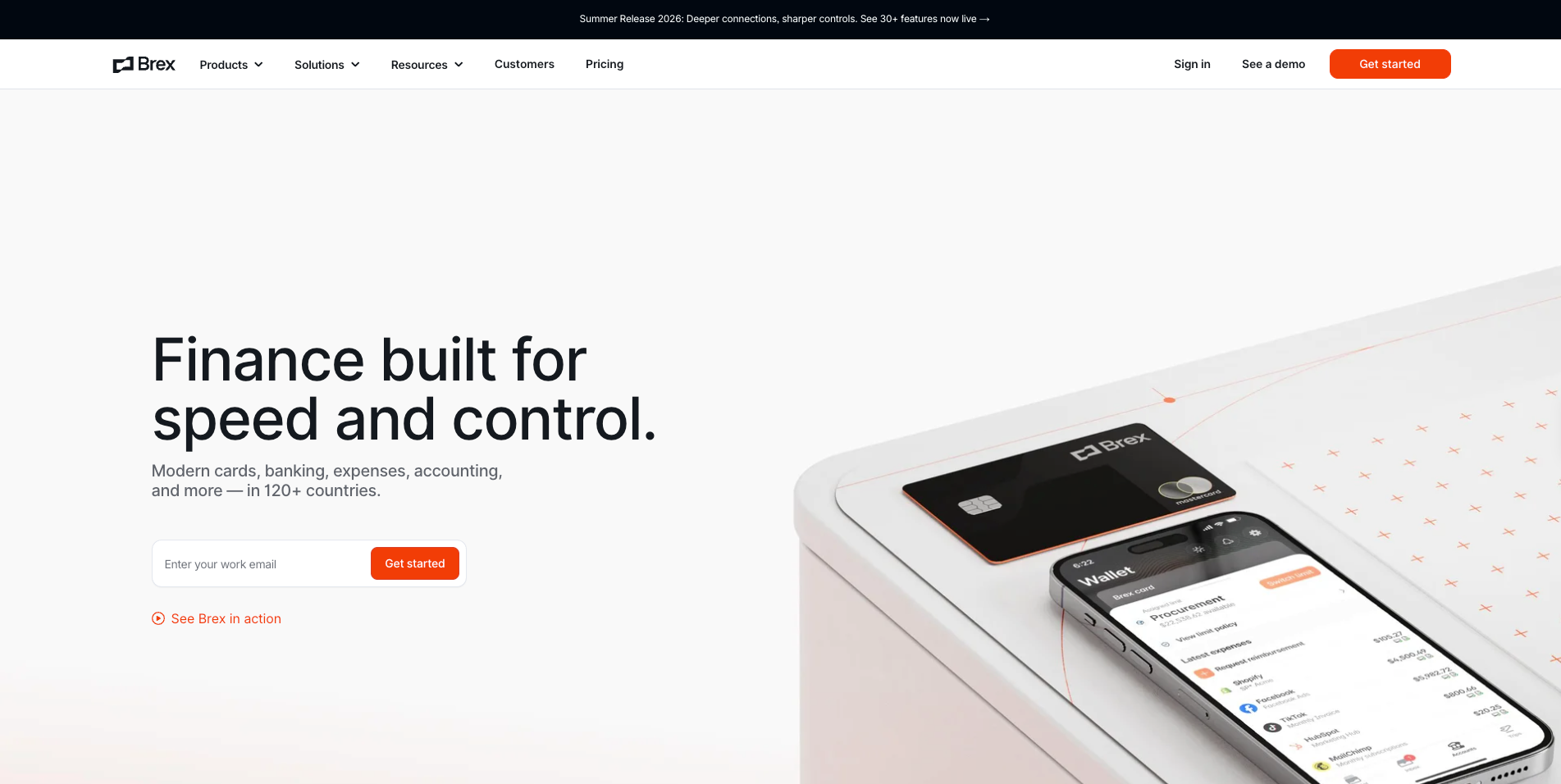
Brex is the strongest fit for funded companies that want banking, cards, expense management, and travel in one platform rather than assembled from parts. Capital One completed its $5.15 billion acquisition of Brex on 7 April 2026, which places a traditional banking institution behind the product. Partner banks include Column N.A., Emigrant Bank, and Fifth Third, with coverage cited up to $6 million through an insured cash sweep network.
The platform supports:
- Brex Cash, structured as a brokerage cash management account rather than checking
- Yield of 3.74% as of January 2026 on invested cash, with none on uninvested balances
- Category-based card rewards with acceptance across 210 or more countries
- Bill pay, expense management, travel booking, and multi-entity card issuance
- Native USDC payments launched in September 2025, powered by Column, with automatic USD conversion
Eligibility is the constraint. Brex restricts access to incorporated entities, with reported requirements around $400,000 in monthly revenue or venture backing, which rules out many earlier-stage companies.
Brex is best for Series A and later companies with meaningful card spend that want stablecoin settlement inside the same platform as expense controls.
3. Rho
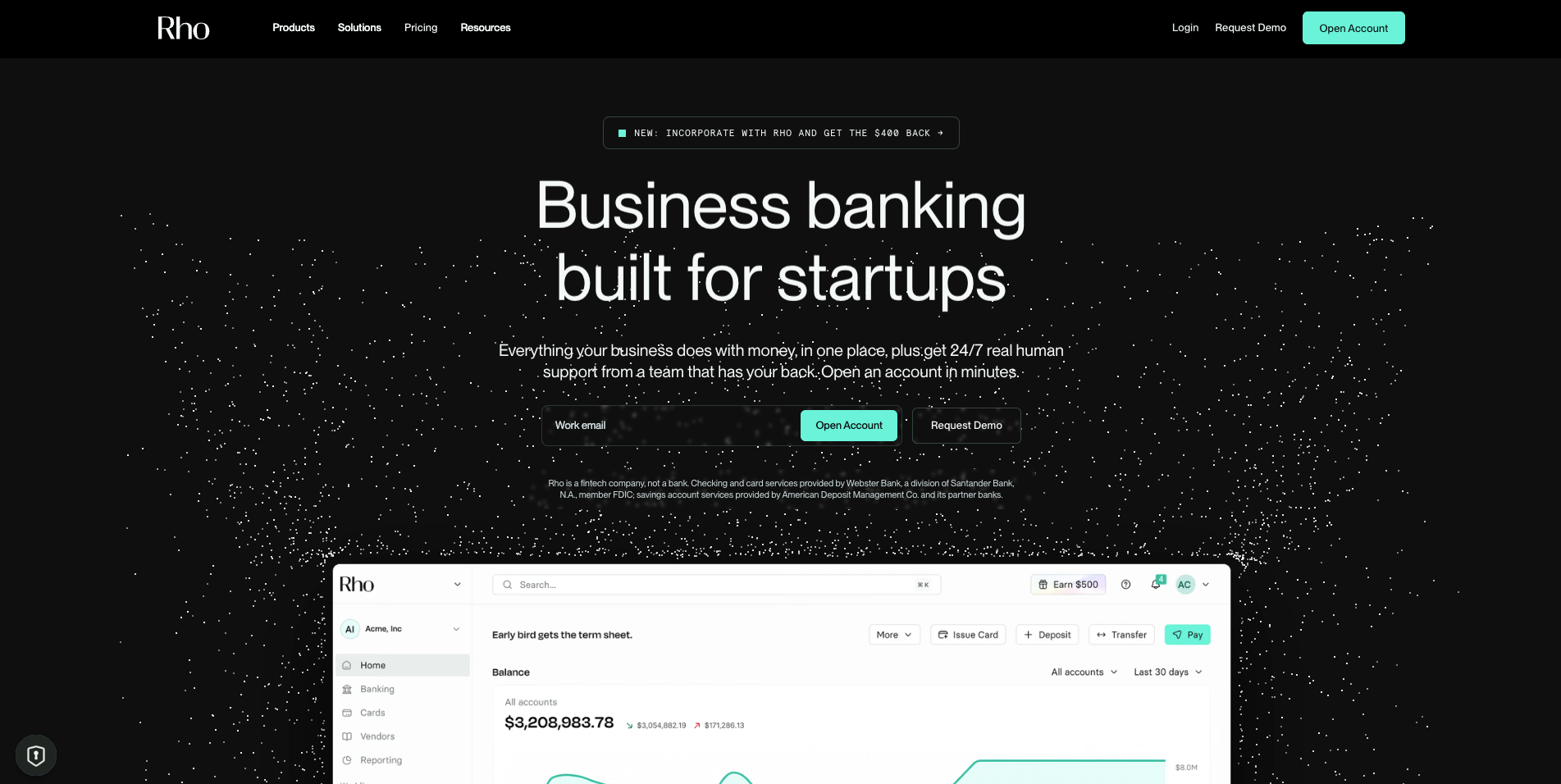
Rho is positioned around depth of financial operations rather than banking alone, bundling accounts payable automation and expense management with checking and cards at no monthly fee.
Checking is held at Webster Bank, N.A., with savings services provided through American Deposit Management Co. and its partner banks. The savings structure reaches up to $75 million in coverage through a network of more than 400 banks.
The platform supports:
- Zero-fee checking with no paid tier required for savings
- Savings coverage up to $75 million through partner-bank sweeps
- Rho Treasury yielding up to 4.57% as of August 2026
- Up to 2% cashback on Rho Platinum, 1.5% standard
- Full AP automation and expense management on one platform
Rho is crypto-tolerant rather than stablecoin-native, with conventional rails and standard exchange transfer permissions.
Rho is best for funded startups that want banking, cards, AP, and treasury consolidated without paying a platform fee.
4. Meow
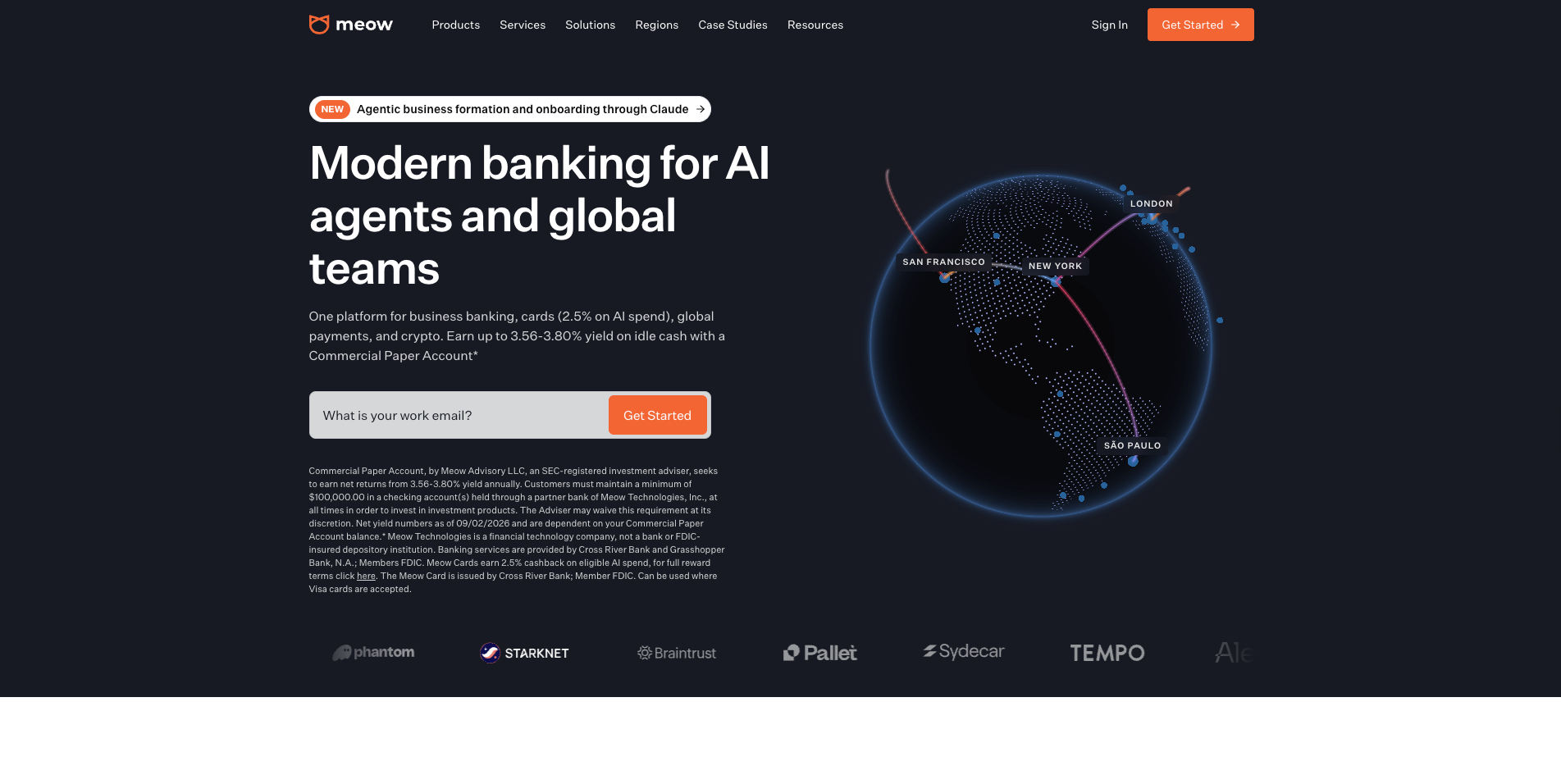
Meow is the coverage and yield specialist, and its headline number is not matched elsewhere in this category.
It offers up to $125 million in insured coverage through partner banks including Cross River and Grasshopper. Its commercial paper account returned between 3.96% and 4.12% in early 2026, and it provides direct T-bill purchases at roughly one basis point per month.
Meow also allows businesses to send and receive USDC directly from the cash balance with no fee, which places it in the stablecoin-native group alongside Brex and Slash.
The platform supports:
- Coverage up to $125 million through partner-bank sweeps
- Direct purchase, laddering, and management of US Treasury bills
- Native USDC send and receive from the business balance at no fee
- Corporate cards with up to 2% cashback
- Fee-free domestic and international wires
The trade-off is product depth. Meow runs leaner than Mercury or Brex on day-to-day operations, and most customers pair it with a primary operating account rather than replacing one.
Meow is best for post-Series A companies holding large balances that want maximum insured coverage, cheap Treasury access, and USDC movement in the same place.
5. Slash
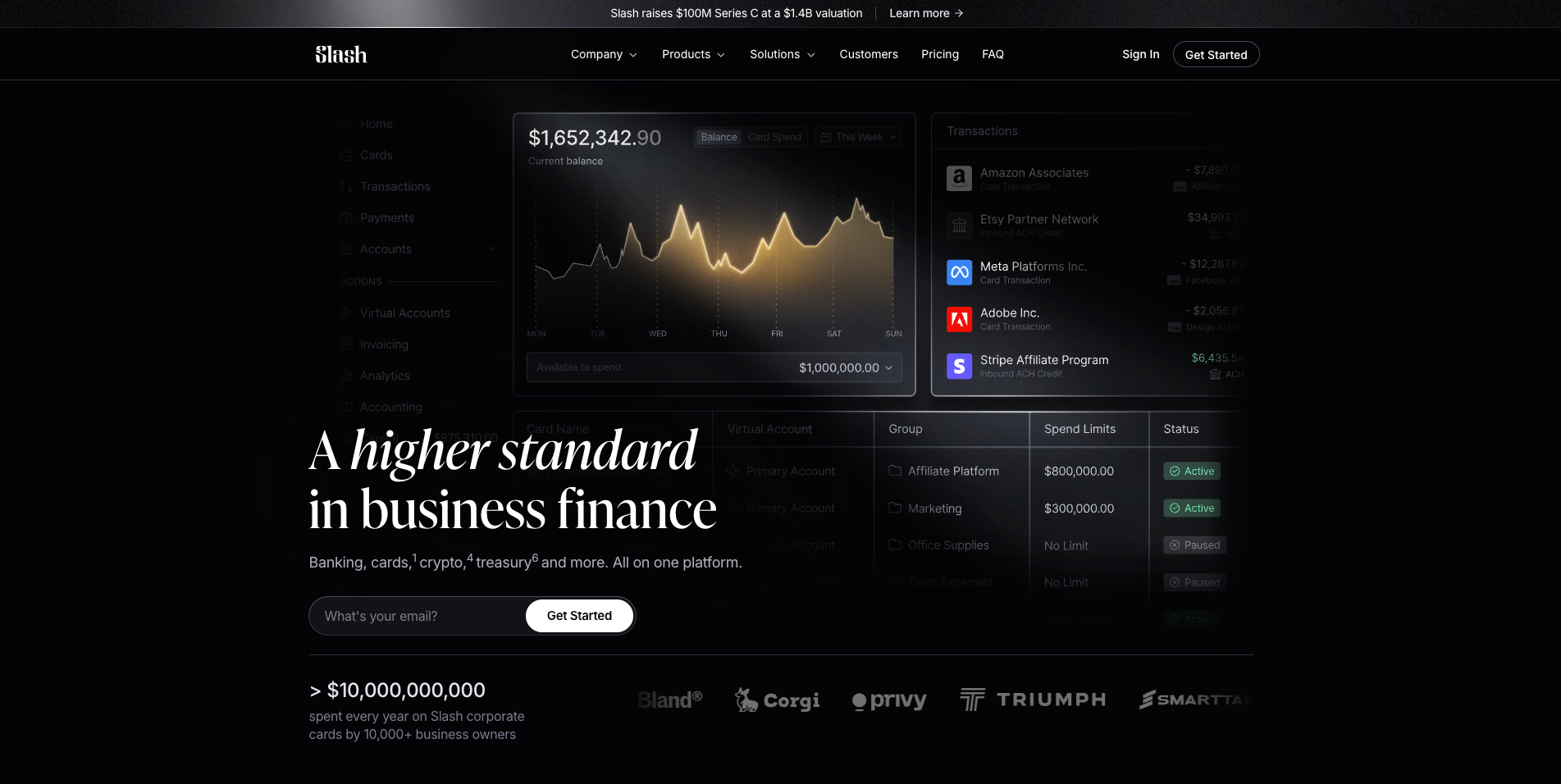
Slash is the most explicitly stablecoin-oriented platform in this comparison, combining fiat and stablecoin business banking rather than treating on-chain settlement as an add-on.
It reached a $1.4 billion valuation in April 2026 through a $100 million Series C backed by Khosla Ventures and Ribbit Capital and reported roughly $1 billion in annualised stablecoin volume in early 2026. Banking services are provided by Column N.A., with coverage extended through Column's participation in IntraFi across a large bank network.
The platform supports:
- Combined fiat and stablecoin business banking with native rails
- Free and $25 per month plan tiers
- The Slash Platinum charge card with up to 2% cashback
- Unlimited virtual and physical card issuance with per-card spend controls
- Twin, an AI financial agent introduced alongside the Series C
The trade-off is scale. Slash serves a customer base measured in thousands rather than the hundreds of thousands at Mercury, so the operational track record is shorter.
Slash is best for companies where stablecoin flows are a core part of operations rather than an occasional receipt, and where granular card controls matter.
6. Arc
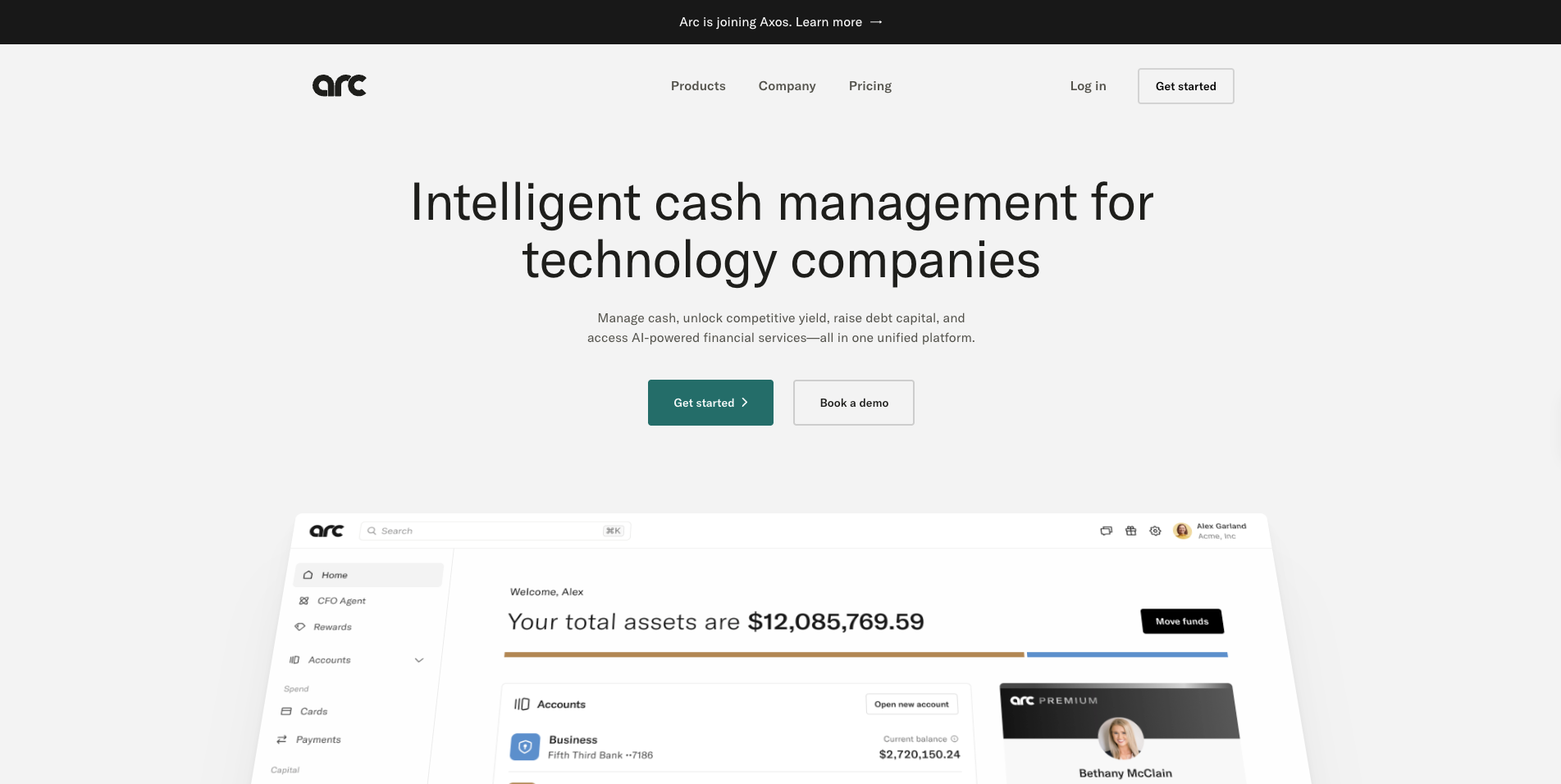
Arc pairs business banking with treasury and non-dilutive capital, a combination none of the others in this list offers directly.
Its treasury product has been reported at around 4.52%, placing it at the upper end of the category, and its positioning centres on yield optimisation for companies holding meaningful idle cash alongside access to financing.
The platform supports:
- Business banking with extended sweep coverage
- Treasury yield reported around 4.52%
- Access to non-dilutive capital alongside the banking relationship
- Standard integrations for accounting and finance workflows
Arc is crypto-tolerant rather than stablecoin-native.
Arc is best for revenue-generating startups that want yield and financing from the same relationship rather than negotiating them separately.
7. Relay
Relay is built around multi-account structures and budget controls rather than treasury scale, which makes it a different product from the others here.
It supports opening multiple accounts for envelope-style budgeting, granular permissions across team members, and straightforward business banking without the venture-backed framing of Mercury or Brex.
The platform supports:
- Multiple checking accounts for budget segmentation
- Granular role-based access controls
- Standard sweep coverage through partner banks
- Integrations with common accounting tools
Relay tightened verification for foreign-owned LLCs during 2026 and no longer accepts registered-agent addresses, alongside Mercury.
Relay is best for small teams that want operational control and budget separation rather than maximum coverage or yield.
Best Neobank by Use Case
The right platform depends on what the company is actually doing.
- For pre-seed and seed companies, Mercury is the strongest default because it imposes no revenue or funding threshold and costs nothing to run.
- For Series A and later with heavy card spend, Brex consolidates banking, cards, expense management, and travel, with the Capital One acquisition adding traditional banking infrastructure behind it.
- For large idle balances, Meow leads on insured coverage at up to $125 million and offers direct T-bill access at low cost, though it usually sits alongside a primary account.
- For stablecoin-heavy operations, Slash and Meow both hold and move USDC natively, with Brex adding USDC payments through Column since September 2025.
- For consolidated finance operations, Rho bundles AP automation, expense management, cards, and a $75 million savings sweep without a platform fee.
- For yield plus financing, Arc pairs treasury returns around 4.52% with access to non-dilutive capital.
- For small teams needing budget control, Relay's multi-account structure and permissions model fits better than treasury-oriented platforms.
Risks and Limitations Startups Should Understand
The category is more mature than it was in 2023, and it remains uneven.
The first limitation is structure. None of these platforms is a chartered bank. Deposits sit at partner institutions, and coverage depends on those relationships continuing, which is a different arrangement from banking directly with an insured institution. What deposit protection does and does not cover is set out in our guide to whether stablecoins are FDIC insured, and the same distinction between protection and guarantee applies to sweep networks.
The second is concentration. Column N.A. serves as partner bank for Brex, Slash, and Mercury simultaneously, so three platforms marketed as alternatives to one another share infrastructure. Diversifying across platforms does not necessarily diversify across banks.
The third is data reliability. Coverage ceilings, yields, and eligibility thresholds are restated inconsistently across sources, and several of the most detailed comparisons available are published by one of the platforms being compared. Independent rankings and vendor materials disagree often enough that the discrepancy itself is informative.
The fourth is that coverage is not access. Sweep networks protect deposits, and they do not guarantee that funds can be moved on a day when a partner bank is under stress, which is the failure mode 2023 actually demonstrated.
How to Choose the Right Neobank for Your Startup
Start with what disqualifies you, not with what looks best.
1. Confirm eligibility before comparing anything else
Revenue thresholds, incorporation requirements, and entity-type restrictions eliminate options before features matter. For non-US founders, the 2026 tightening around foreign-owned LLCs and registered-agent addresses is the first thing to check.
2. Size coverage against your actual balance
If you hold under $250,000, standard coverage applies and sweep networks are irrelevant. If you hold $10 million of runway, the difference between $5 million and $125 million of coverage is the most consequential line in any comparison.
3. Read the yield mechanics, not the headline rate
A $250,000 treasury minimum is irrelevant below that balance and central above it. A platform paying nothing on uninvested cash is different from one paying a rate on the full balance, even when the advertised rates match.
4. Match card rewards to your actual spending
Flat-rate and category-multiplier structures produce different outcomes depending on where money goes. This is arithmetic on last quarter's spend, not a preference.
5. Decide whether stablecoin capability is a requirement
If on-chain flows are occasional, converting through an exchange and wiring the proceeds works fine, as our guide to off-ramping USDC to ACH or wire describes. If they are recurring, native support collapses a multi-account reconciliation into one ledger.
6. Check the partner bank, not just the platform
Column N.A. sits behind several of these products. If your redundancy plan involves two platforms, confirm they do not route to the same institution.
7. Plan for a second account regardless
Multi-bank redundancy became a standard investor expectation after 2023, not because sweep networks are unsafe but because access fails before insurance does. Most setups keep operating capital at a primary platform and several months of payroll somewhere structurally separate.
8. Weigh where each platform is heading
One of these joined a traditional bank, one is becoming one, and one stayed independent and leaned further on-chain. Structural direction is a better predictor of the 2027 product than the current feature list.
Conclusion
There is no single best neobank for startups in 2026-2027. On fees, yield, and card rewards the leading options are close, and the differences that decide the choice sit elsewhere.
Eligibility determines whether you have a choice at all. Coverage ranges twenty-five-fold and matters exactly once. And for companies with any on-chain exposure, native stablecoin support narrows the field to three, which is a real difference for a treasury running two rails and no difference at all for one running one.
Read Next:
- How to Set Up a Stablecoin Treasury: Wallet Policy, Access Controls, and Reconciliation
- Stablecoin-Backed Corporate Cards: The B2B Card Issuance Model Explained
- How to Pay Suppliers in USDC
FAQs:
1. Which neobanks support stablecoins natively?
Three. Brex launched native USDC payments in September 2025 powered by Column with automatic USD conversion, Slash offers combined fiat and stablecoin banking with roughly $1 billion in annualised stablecoin volume, and Meow allows businesses to send and receive USDC directly from the cash balance at no fee. Mercury, Rho, Arc, and Relay are crypto-tolerant rather than stablecoin-capable.
2. Which startup neobank offers the most FDIC coverage?
Meow, at up to $125 million through partner banks including Cross River and Grasshopper. Rho follows with up to $75 million through a savings sweep across more than 400 banks, while Brex cites up to $6 million and Mercury up to $5 million.
3. Are these platforms actually banks?
No. Mercury, Brex, Rho, Meow, Relay, Arc, and Slash are financial technology companies whose deposits sit at partner institutions, with FDIC protection reaching customers through those banks. Mercury received conditional OCC approval in April 2026 to charter its own national bank, which has not yet completed.
4. Which neobank is easiest for a non-US founder to open?
It became harder across the board during 2026. Mercury, Relay, Wise, and Brex all tightened verification for foreign-owned LLCs, and Mercury and Relay stopped accepting registered-agent addresses as a business address, so eligibility should be confirmed with each provider before comparing features.
5. Should a startup use more than one neobank?
Multi-bank redundancy became a standard investor expectation after the 2023 bank failures, with most setups keeping operating capital at a primary platform and several months of payroll somewhere structurally separate. Check partner banks when doing this, since Column N.A. serves Brex, Slash, and Mercury simultaneously.
Disclaimer:
This content is provided for informational and educational purposes only and does not constitute financial, investment, legal, or tax advice; no material herein should be interpreted as a recommendation, endorsement, or solicitation to buy or sell any financial instrument, and readers should conduct their own independent research or consult a qualified professional. Coverage limits, yields, pricing, and eligibility criteria change frequently and are reported inconsistently across sources; verify all figures directly with each provider before acting.