
Table of Contents
Fintechs, payment providers, marketplaces, and payroll platforms are no longer asking whether to offer stablecoins. They are asking how to put fiat and stablecoins in the same account, under their own brand, without custodying digital assets or becoming a licensed financial institution in every market they serve.
The demand is real: stablecoin circulation has expanded to roughly $308 billion, while payments for goods and services made in digital currencies are growing at about 60% year over year, driven primarily by cross-border B2B payouts. Allium data shows stablecoin payments reached $482 billion in the first nine months of 2026, up 45% year over year, with businesses on the receiving end of 64% of that volume.
The infrastructure behind those flows has split into very different products. Some providers hand a platform a full account stack with fiat rails, FX, payouts, and cards. Others supply only the wallet and key-management layer, leaving the platform to source licenses, banking, and liquidity elsewhere.
This guide compares 10 embedded stablecoin account providers on account model, currencies, custody, licensing coverage, and what else comes through the same API. It is a data-driven comparison, not a marketing roundup.
Key Takeaways
- An embedded stablecoin account lets a platform give its own customers a branded account where fiat and stablecoins sit side by side, without the platform holding digital asset licenses in every market itself. The provider’s licenses, banking partners, and compliance stack sit underneath the platform’s product.
- Providers differ on four things: licensing coverage, the fiat currencies and stablecoins supported, the custody model, and what else comes through the same API (payouts, FX, cards, and rewards on balances).
- The ten providers fall into two groups: full-stack platforms that bundle accounts with fiat rails, FX, payouts, and cards (such as BVNK and Bridge), and wallet-infrastructure providers that supply the account and custody layer only (such as Fireblocks and Dfns).
What an Embedded Stablecoin Account Is
Fiat and Stablecoins in One Account Structure
An embedded stablecoin account is a multi-currency account that a platform offers to its own customers through an API. The end customer sees one balance screen. Behind it, the account can hold fiat currencies such as USD, EUR, and GBP alongside stablecoins such as USDC, USDT, and EURC, with conversion between them handled by the provider.
That single structure is what separates the category from earlier crypto add-ons. A customer can receive a SEPA transfer in euros, convert part of it to a dollar stablecoin, and pay a supplier in another country without the platform stitching together three vendors.
Embedded vs. Direct: Who Owns the Customer Relationship
In a direct model, a business opens an account with the provider for its own treasury and payouts. In an embedded model, the platform puts the provider’s accounts inside its own product, so its customers never deal with the provider directly.
The platform owns the brand, the user experience, and the customer relationship. The provider supplies the regulated account, the rails, and the compliance controls underneath.
Custodial, Self-Custody, and Hybrid Models
Custodial accounts hold assets on the customer’s behalf through the provider or a regulated partner. Self-custody models give the platform or end user control of the keys, usually through MPC (multi-party computation) or secure hardware.
Hybrid models let a platform start on managed custody and move to its own keys later. As covered in our Global Stablecoin Accounts guide, the custody choice decides who carries the regulatory responsibility for the assets.
How an Embedded Account Differs From a Crypto Wallet
A crypto wallet stores digital assets and signs transactions. An embedded stablecoin account adds the financial layer around it: named fiat account details, local bank payouts, FX, compliance screening, and reporting.
Every provider in this guide offers some form of wallet. Only some offer the account layer and the interoperability with traditional currencies. That difference is the main reason the list splits into two groups.
How We Evaluated These 10 Providers
Evaluation Criteria
Each provider was assessed on five criteria:
- Licenses and registrations held, and in which jurisdictions.
- Fiat currencies and stablecoins supported inside the account.
- Custody options, including whether a platform can move to its own keys or licenses later.
- Capabilities bundled in the same API, such as payouts, collections, FX, card issuing, and rewards.
- Client roster, as an indicator of production use at scale.
Every provider on the list offers accounts or wallets that a platform can embed under its own brand.
Data Sources and Methodology
Data comes from company websites, product documentation, regulatory announcements, press releases, and earnings disclosures published through October 2026. Where a provider does not publish a figure, such as pricing, the guide says so rather than estimating it.
The 10 Providers Compared
1. BVNK
BVNK, a Mastercard company, is the stablecoin infrastructure provider behind the Mastercard Global Money Platform, launched on October 15, 2026. Mastercard completed its acquisition of BVNK in August 2026.
Account Model and Currencies
BVNK’s global money accounts are multi-currency accounts where fiat and stablecoins sit side by side, with real-time FX between them through a single API. Fiat accounts cover USD, EUR, and GBP with named account details, and the platform is chain-agnostic and token-agnostic, supporting payment stablecoins such as OUSD, USDC, USDT, USDG, and EURC.
Platforms can choose custodial or self-custody options for the accounts they embed. The FX engine runs 24/7 across fiat to fiat, fiat to stablecoin, and stablecoin to stablecoin conversions.
Licensing and Coverage
BVNK holds 40-plus licenses and registrations across crypto and fiat, including a UK EMI, an EU EMI, a European CASP authorization under MiCA, and US money transmitter licenses. It supports 130-plus countries for stablecoin payments and holds SOC 2 Type II and ISO 27001 certifications and meets DORA standards, as set out on its compliance page.
That licensing stack sits underneath the platform’s product, so a fintech embedding BVNK accounts does not need its own license in each market where its customers hold balances.
What Else Comes Through the API
The same integration covers payouts, stablecoin collections, FX, card issuing, and rewards on eligible stablecoin balances. Payouts run over SWIFT, SEPA and SEPA Instant, Faster Payments, ACH, Fedwire, FedNow, and RTP, plus local bank payouts through Mastercard Move, which launched in eight local currencies and is expanding to 40-plus currencies across 200-plus countries and territories in 2027.
Card issuing runs on Mastercard’s network, with issuance available across 130-plus countries. BVNK reports 99.9% uptime and an average API response time of about 0.1 seconds, and processes more than $50 billion in annualized payment volume for clients including Worldpay, Corpay, Deel, Flywire, Marqeta, Nuvei, and Airwallex (see its customer stories).
BVNK offers three delivery models on one API: Direct, Embedded, and Self-Managed. A platform can start on BVNK’s licenses and custody and move to its own keys, custody, or licensing later without changing its integration. Developers can start from the Global Money Platform docs.
Best For
Banks, Fintechs, PSPs, neobanks, marketplaces, and payroll platforms that want to offer their customers fiat and multiple stablecoins in one branded account, with payouts and cards attached, across markets well beyond the US.
Pros
- Fiat (USD, EUR, GBP) and multiple stablecoins (OUSD, USDC, USDT, USDG, EURC) in one embedded account
- 40-plus licenses and registrations across 130-plus countries sit underneath the platform’s product
- Payouts, collections, 24/7 FX, card issuing, and rewards come through one API
- Direct, Embedded, and Self-Managed models let platforms bring custody or licensing in-house without re-platforming
- Owned by Mastercard, with more than $50 billion in annualized volume and enterprise clients such as Worldpay, Deel, and Nuvei
Cons
- No public rate card; pricing is quoted per use case through a sales conversation
- Card issuing and Mastercard Move local payouts are still rolling out, with a broader card launch planned for Q1 2027
2. Bridge
Bridge is Stripe’s stablecoin infrastructure platform, acquired for about $1.1 billion in February 2025 and operated as a standalone B2B product.
Account Model and Currencies
Bridge offers USD and EUR accounts for businesses and consumers, holding stablecoins including USDC, USDT, EURC, its own USDB, and OUSD. Bridge-managed wallets are custodial, while Privy, which Stripe acquired in 2025, adds embedded wallets with non-custodial key management.
At Stripe Sessions 2026, Privy announced digital asset accounts for holding, moving, and earning on stablecoins, alongside agentic wallets.
Licensing and Coverage
Bridge holds US money transmitter licensing and, through Bridge Building S.A. in Luxembourg, CASP and EMI authorization from the CSSF. It received preliminary conditional OCC approval for a national trust bank in February 2026. Stripe’s stablecoin financial accounts launched in 101 countries in May 2025.
What Else Comes Through the API
Bridge’s Orchestration API covers virtual accounts, payouts across major fiat rails, and conversions. Open Issuance lets a business launch its own branded stablecoin with reserve economics. Bridge also issues Visa stablecoin cards, live in more than 30 countries as of October 2026.
Clients include Phantom, Klarna, Shopify, MetaMask, and Payoneer. As covered in our Stripe vs Bridge vs BVNK comparison, Bridge is strongest for teams already inside the Stripe ecosystem.
Best For
Platforms already on Stripe that want accounts, cards, and a branded stablecoin from one vendor, especially where the core market is the US.
Pros
- Stripe’s distribution and developer tooling, with a self-serve sandbox
- Open Issuance lets businesses launch a branded stablecoin
- Visa stablecoin cards already live in 30-plus countries
Cons
- Strongest for US-based businesses; non-US fiat coverage is narrower
- Enterprise pricing is not published
- Multi-currency cards announced in October 2026 have no launch date yet
3. Zero Hash
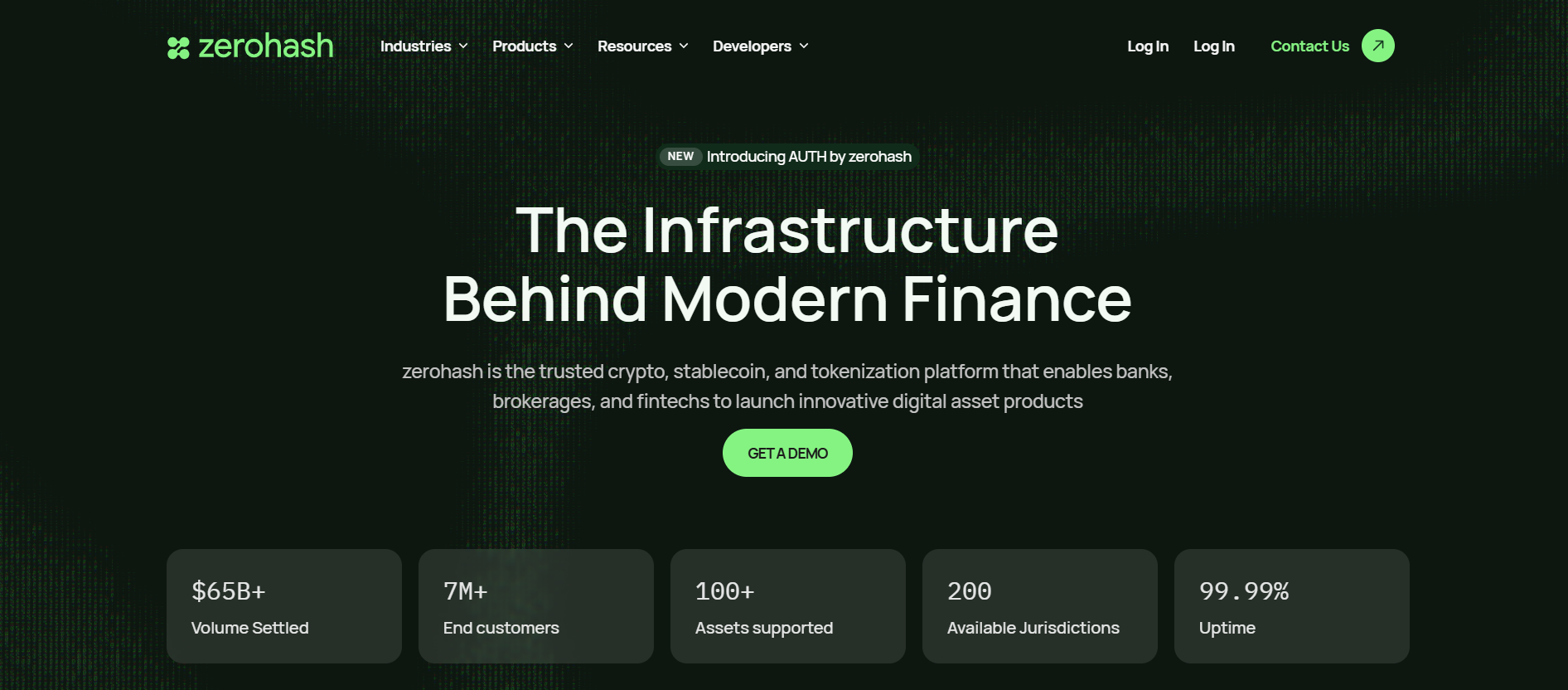
Zero Hash (styled zerohash) provides regulated crypto and stablecoin infrastructure to banks, brokerages, and fintechs through a white-label API.
Account Model and Currencies
Zero Hash offers custodial accounts, account funding, and virtual accounts, with support for dozens of stablecoins and 100-plus digital assets in total. Its fiat functionality is concentrated in USD.
Licensing and Coverage
Zero Hash is a licensed money transmitter in 51 US jurisdictions and holds a New York virtual currency license. In Europe it holds MiCA CASP authorization from the Dutch AFM and, as of May 2026, an EMI license from the Dutch central bank. It also holds permissions in Canada, Latin America, Australia, New Zealand, and Bermuda.
What Else Comes Through the API
Pay-ins, payouts, remittances, on- and off-ramps, trading, staking, and tokenization. In 2026, Zero Hash began powering stablecoin prefunding and payouts for Visa Direct and partnered with Marqeta on stablecoin-backed cards.
The company reports more than $65 billion in settled volume and 7 million-plus end customers. Clients include Interactive Brokers, Stripe, Gusto, Visa, and Worldpay. As covered in our Zero Hash competitors guide, its US licensing depth is its main advantage.
Best For
US brokerages, banks, and fintechs adding stablecoin and crypto features for consumers under a white-label B2B2C model.
Pros
- Deep US licensing across 51 jurisdictions plus a New York virtual currency license
- MiCA CASP authorization and a Dutch EMI license for Europe
- Proven at scale with large brokerages and payment companies
Cons
- Fiat functionality is concentrated in USD
- Built mainly for white-label, embedded use rather than direct business accounts
- Pricing is not published
4. Circle
Circle is the issuer of USDC and EURC and offers a developer stack that includes Circle Wallets, Circle Mint, and the Circle Payments Network.
Account Model and Currencies
Circle Wallets come in three types: developer-controlled wallets where the business custodies funds, user-controlled wallets where the end user signs, and modular wallets built on smart contract accounts. All are MPC-based and focus on Circle’s own stablecoins, USDC and EURC.
Licensing and Coverage
Circle became the first global stablecoin issuer to comply with MiCA through its French EMI license in July 2024 and holds a Major Payment Institution license in Singapore. In July 2026 it received final OCC approval for a national trust bank, followed by a New York limited purpose trust charter.
What Else Comes Through the API
Circle Mint handles institutional minting and redemption, CCTP handles cross-chain USDC transfers, and the Circle Payments Network connects financial institutions for USDC settlement. Circle also launched its Arc blockchain to mainnet in September 2026.
Circle publishes wallet pricing: free up to 1,000 monthly active wallets, then per-wallet fees on a sliding scale.
Best For
Developers building USDC- or EURC-native apps who want wallets directly from the issuer, with transparent per-wallet pricing.
Pros
- Wallets come directly from the issuer of USDC and EURC
- Public wallet pricing with a free tier up to 1,000 monthly active wallets
- Strong regulatory profile, including a French EMI under MiCA and an OCC national trust charter
Cons
- Focused almost entirely on Circle’s own stablecoins
- Wallets hold crypto, not named fiat accounts
- Local currency payouts depend on CPN partner institutions, with no GBP corridor
5. Crossmint
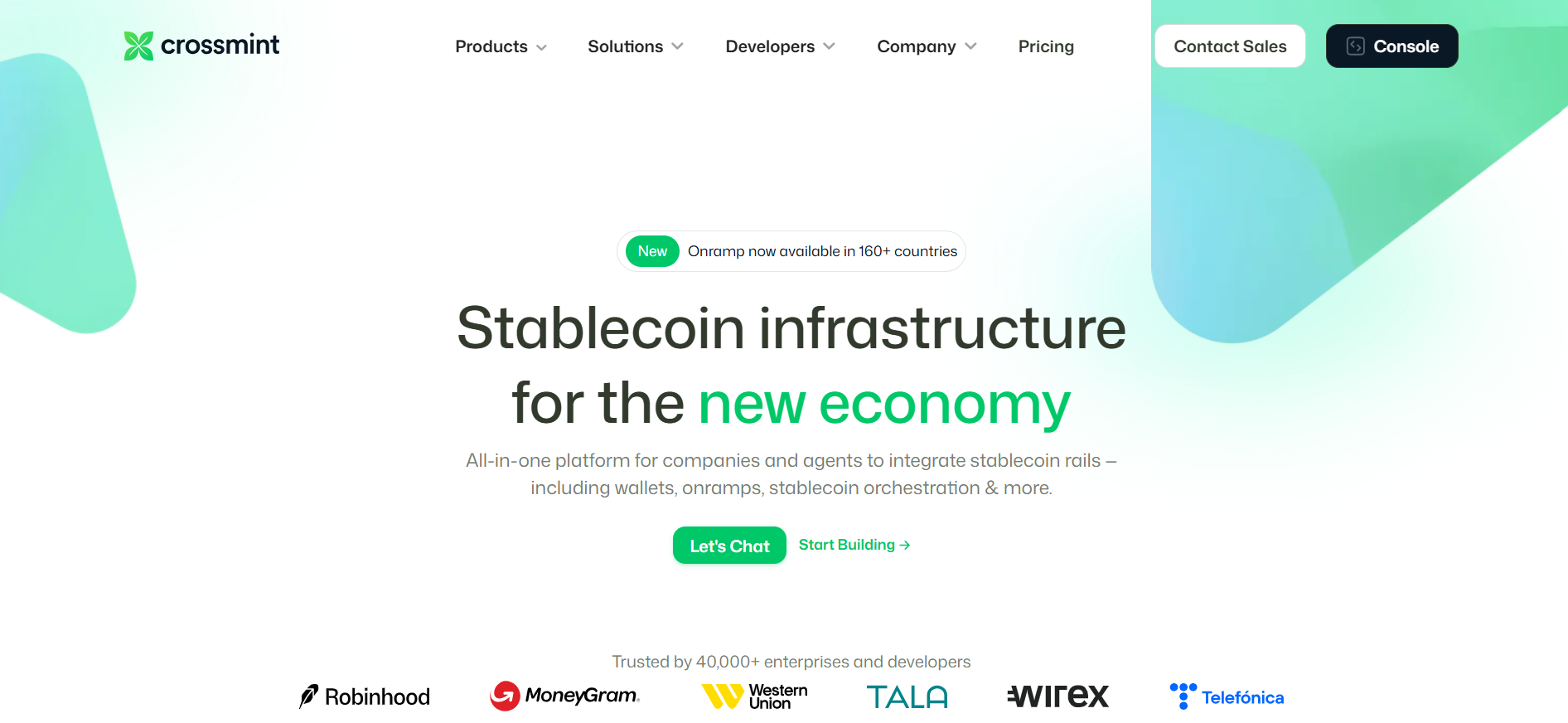
Crossmint is a stablecoin infrastructure platform for companies and AI agents, combining wallets, on-ramps, and stablecoin orchestration.
Account Model and Currencies
Crossmint offers embedded wallets for users and agents, plus treasury wallets for businesses. It sponsors gas and bills in fiat, so end users do not need to hold a native token.
Licensing and Coverage
Crossmint received MiCA CASP authorization from Spain’s CNMV in January 2026 and a PSD2 payment institution license from the Bank of Spain in July 2026. It is also registered as a money services business with FinCEN in the US and FINTRAC in Canada. Its on-ramp is available in 160-plus countries.
What Else Comes Through the API
On- and off-ramps, stablecoin orchestration, agentic virtual cards, tokenization, and checkout. Crossmint says more than 40,000 enterprises and developers use the platform, with case studies including MoneyGram and Wirex.
Best For
EU-focused fintechs and teams building wallets for AI agents that want MiCA-authorized wallet infrastructure.
Pros
- MiCA CASP and PSD2 payment institution licenses for the EU
- Wallets and virtual cards built for AI agents
- Gas sponsorship, so end users never need a native token
Cons
- No named fiat accounts inside the wallet
- Licensing outside the EU is limited to MSB registrations
- Pricing is not published
6. Fireblocks
Fireblocks is institutional MPC wallet and custody infrastructure used by more than 2,400 organizations.
Account Model and Currencies
Fireblocks offers Wallets-as-a-Service and white-label embedded wallets built on MPC, covering 150-plus blockchains. Its October 2025 acquisition of Dynamic added wallet authentication for consumer-facing apps.
Licensing and Coverage
Fireblocks is a technology provider, with custody available through Fireblocks Trust Company, a New York-chartered trust company. The regulated financial activity, including fiat accounts, usually sits with the client or the client’s partners.
What Else Comes Through the API
The Fireblocks Network for Payments, launched in September 2025, connects stablecoin payment providers for settlement. Tokenization and treasury tools sit alongside. Clients include Revolut, BNY, Worldpay, and Checkout.com. As covered in our Fireblocks alternatives guide, its strength is custody-grade security rather than fiat account coverage.
Best For
Banks and large PSPs building their own account product that need institutional key management and will source fiat rails and licenses separately.
Pros
- Institutional-grade MPC security used by 2,400-plus organizations
- Coverage across 150-plus blockchains
- Fireblocks Network for Payments connects many stablecoin providers
Cons
- No fiat accounts or licenses for the platform to embed
- Enterprise pricing aimed at large institutions
- Onboarding runs through a sales conversation
7. Mural Pay
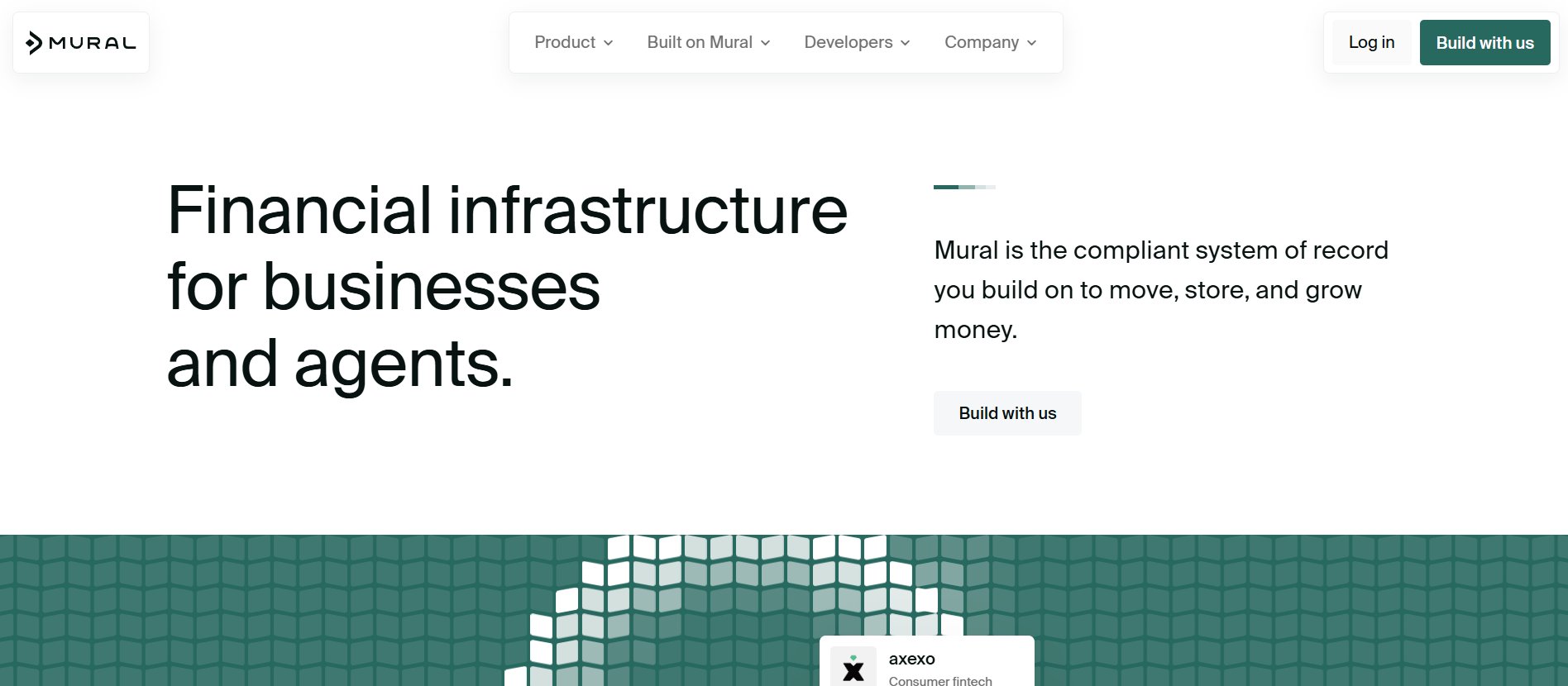
Mural Pay is a stablecoin-native accounts and payouts API for businesses.
Account Model and Currencies
Mural offers named virtual accounts that hold stablecoins and fiat in USD, EUR, MXN, BRL, ARS, and COP, with payouts in 28-plus currencies.
Licensing and Coverage
Mural Networks is registered with FinCEN as a money services business and licensed as a money transmitter in certain US states, with partner banks covering the rest. It is SOC 2 Type 2 certified and has processed payments for end users in 128 countries.
What Else Comes Through the API
Send, receive, convert, and yield products, plus compliance tooling. Mural reports more than $2 billion processed since its API launched in 2025 and raised a $15 million Series A led by Tether in October 2026. Clients include Deel and Opera.
Best For
Payroll, creator, and marketplace platforms paying out into Latin America.
Pros
- Local currency accounts for major Latin American markets
- Payouts in 28-plus currencies
- Fast-growing, with a Tether-led Series A in October 2026
Cons
- US money transmission partly relies on partner banks
- Custody model is not disclosed
- Narrower coverage outside the Americas
8. Utila
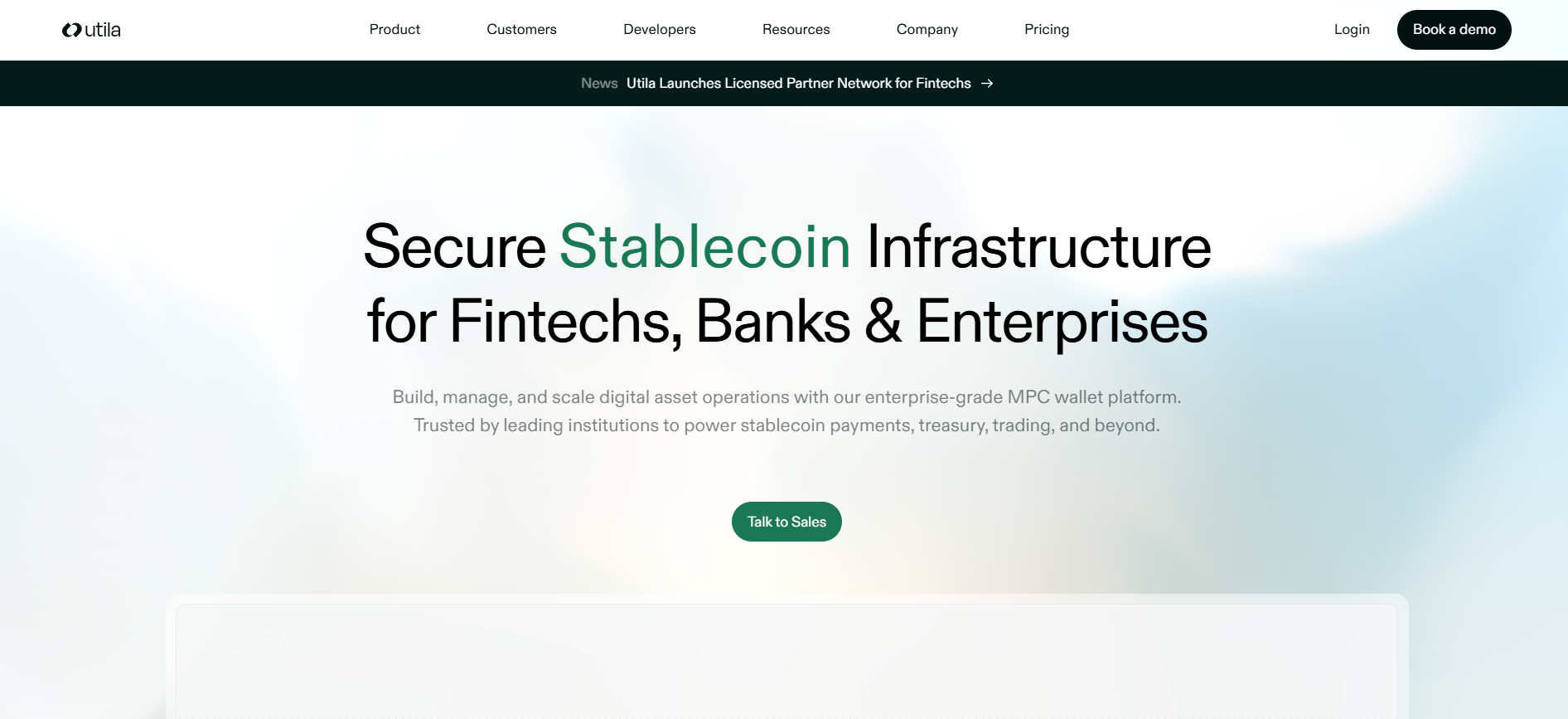
Utila is an enterprise MPC wallet platform focused on stablecoin payment operations.
Account Model and Currencies
Utila provides self-custody MPC wallets with a policy engine across 100-plus chains, including Bitcoin, Ethereum, Solana, Tron, and TON. It reports more than $30 billion in monthly volume across 400-plus companies.
Licensing and Coverage
Utila is a technology provider and does not hold financial licenses itself. It holds SOC 2 Type II and offers a Licensed Partner Network that connects fintechs to regulated on- and off-ramp partners.
What Else Comes Through the API
Stablecoin pay-ins, high-volume payouts, on- and off-ramps through partners, embedded AML and KYT screening, gas management, and wallet-as-a-service.
Best For
Crypto-native PSPs and fintechs that want to control their own keys and run payment operations on top, while sourcing licensed fiat access through partners.
Pros
- Self-custody MPC wallets with a policy engine
- Support for 100-plus chains
- Payment operations such as batch payouts and KYT built in
Cons
- Holds no financial licenses, so fiat access depends on partners
- No native fiat accounts
- No card issuing
9. Coinbase Developer Platform
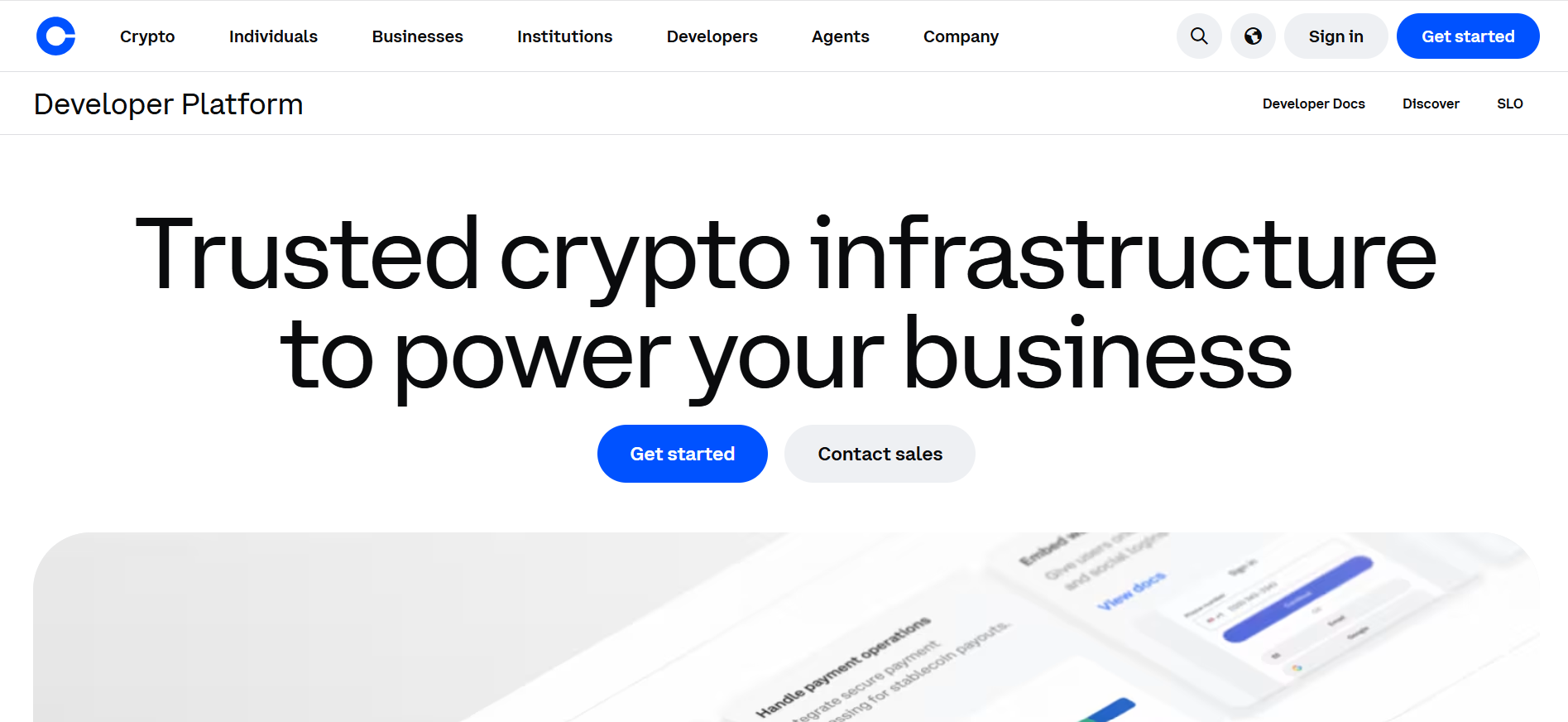
Coinbase Developer Platform (CDP) is Coinbase’s builder stack, covering embedded wallets, server wallets, on- and off-ramps, and payment tools.
Account Model and Currencies
CDP embedded wallets are self-custodial, with keys held in trusted execution environments, and support EVM chains and Solana with email, SMS, or social login. USDC balances can earn rewards at a variable rate that differs by region.
Licensing and Coverage
CDP runs on Coinbase’s regulated entities and compliance programs rather than a separate license set. Through a 2026 partnership with Nium, Coinbase extended USDC payments with fiat payouts into 190-plus countries.
What Else Comes Through the API
Server wallets for business and agent flows, Onramp and Offramp, Paymaster for gas sponsorship, the x402 payments protocol, and Coinbase Business payouts.
Best For
Developers building on Base and USDC who want self-custodial wallets with built-in on-ramps.
Pros
- Self-custodial wallets with email, SMS, or social login
- Rewards on USDC balances
- Built-in on-ramps backed by the Coinbase brand
Cons
- Centered on USDC and Base
- Fiat payouts run through partners such as Nium
- Reward rates vary by region and change over time
10. Dfns
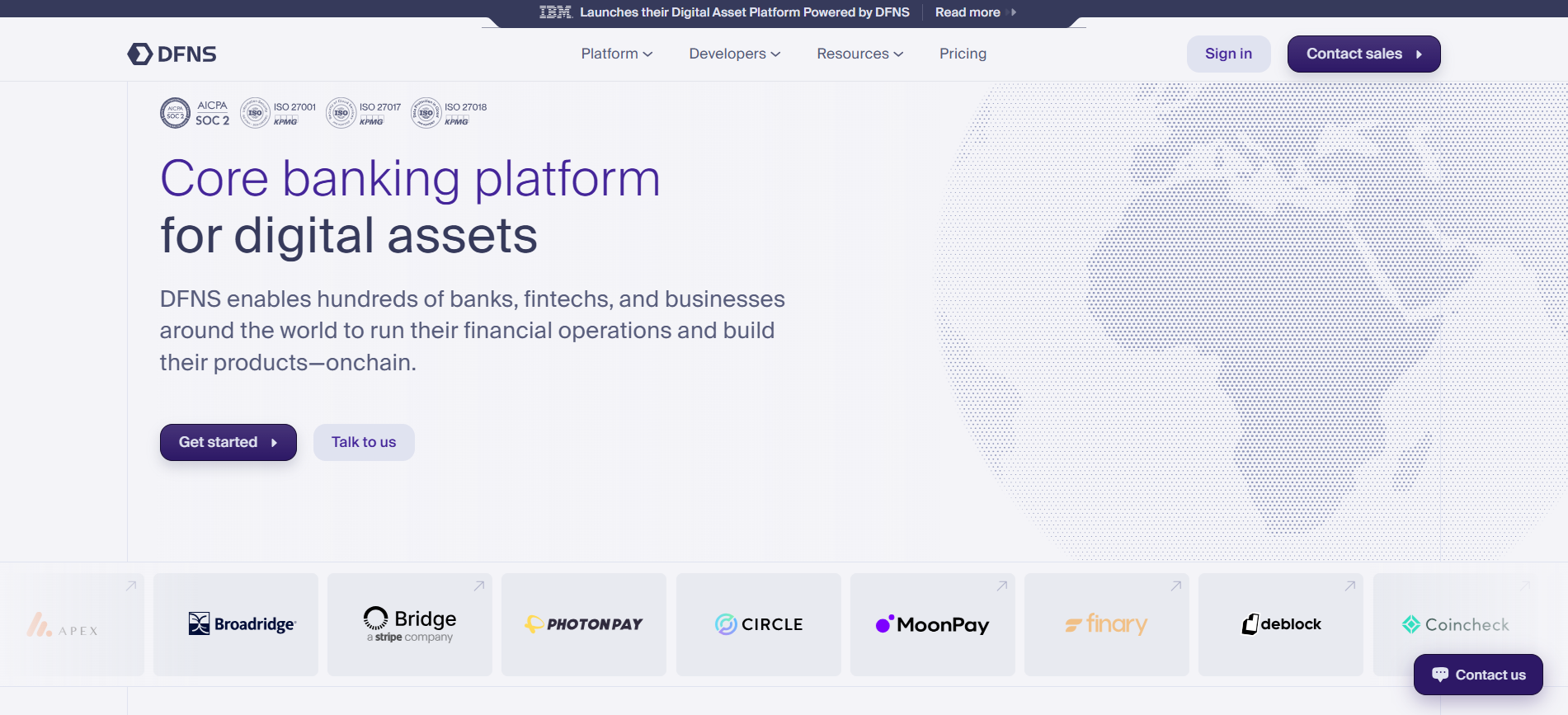
Dfns is a Paris-based wallet-as-a-service and key-management provider.
Account Model and Currencies
Dfns supports MPC, HSM, and TEE key management, plus bring-your-own-key, across 100-plus networks. It can run as SaaS, hybrid, or fully on-premises.
Licensing and Coverage
Dfns is a technology provider, not a custodian, and holds SOC 2 Type II and ISO 27001, 27017, and 27018 certifications. In March 2026 it launched payouts covering 94-plus countries and 60 currencies through licensed partners.
What Else Comes Through the API
Policy and governance engines, tokenization, treasury tools, and partner-powered payouts. Clients include Standard Chartered, IBM, Broadridge, Bridge, and Circle.
Best For
Banks and regulated institutions that need on-premises or HSM-based key control for wallets they build themselves.
Pros
- Flexible key management, including on-premises and HSM
- Strong certifications and bank-grade clients
- Annual plans with no transaction fees
Cons
- A technology provider with no financial licenses
- No fiat accounts
- Payouts depend on licensed partners
Comparison Table: Currencies, Custody Model, Licensing, and Bundled Capabilities
As covered in our 15 stablecoin infrastructure platforms compared guide, the most expensive mistake is choosing a wallet layer when the product actually needs a licensed account layer, or the reverse.
How to Choose the Right Provider for Your Platform
If You Are a Fintech, PSP, or Neobank Adding Multi-Currency Accounts
Start with the full-stack group. The deciding questions are which fiat currencies your customers need in the account, which stablecoins they want to hold, and whether the provider’s licenses cover the markets where those customers live.
- BVNK fits platforms that need USD, EUR, and GBP alongside several stablecoins outside the US, with cards and payouts on the same integration.
- Bridge fits platforms already running on Stripe.
- Zero Hash fits US-centric consumer products.
If You Run a Marketplace or Payroll Platform Paying Out in 100-Plus Countries
Payout coverage matters more than wallet features here. Look at which local rails each provider reaches, whether recipients can get local bank deposits instead of stablecoins, and whether payouts can be funded from a fiat balance.
Deel’s experience is a useful reference point: since launching with BVNK, workers in more than 100 countries have opted to be paid in stablecoins, a use case BVNK supports through its global payroll offering. Mural Pay is a strong option for Latin American corridors specifically.
If You Plan to Bring Custody or Licensing In-House Later
Check whether the provider lets you move from managed custody to your own keys, or from its licenses to yours, without rebuilding the integration. BVNK’s Direct, Embedded, and Self-Managed models are built around that path.
Wallet-infrastructure providers such as Fireblocks, Dfns, and Utila suit teams that already plan to own custody from day one.
2026 Trends Reshaping Embedded Stablecoin Accounts
Card Networks and Processors Buying Stablecoin Infrastructure
Mastercard completed its acquisition of BVNK in August 2026, and two months later the companies launched the Mastercard Global Money Platform with Nuvei, Marqeta, Ontop, Bolt Group, and Almond FinTech among the first to integrate. Stripe’s acquisitions of Bridge and Privy put a second payments giant behind a full account stack.
As covered in our analysis of Visa’s search for a settlement partner after the BVNK deal, network ownership is now shaping which providers platforms shortlist.
Accounts, Payouts, and Cards Converging Into a Single API
In 2024, a platform typically needed one vendor for wallets, another for on-ramps, a third for payouts, and a fourth for cards. In 2026, the leading providers bundle all four. Global Money Platform, Bridge’s Orchestration API, and Zero Hash’s expanding product set all point the same direction: fewer integrations, one account at the center.
Conclusion
Embedded stablecoin accounts have become a core building block for fintechs, PSPs, marketplaces, and payroll platforms in 2026.
Full-stack providers (BVNK, Bridge, Zero Hash, Circle, and Mural Pay) supply the account, the licenses, and the rails. Wallet-infrastructure providers (Fireblocks, Dfns, Utila, Crossmint, and Coinbase Developer Platform) supply the custody and key layer for teams that will handle the financial layer themselves.
The right choice follows what the platform wants to offer its own customers and where it needs licensing cover, not brand recognition.
FAQs:
1. What is an embedded stablecoin account?
An embedded stablecoin account is a multi-currency account that a platform offers to its own customers under its own brand, where fiat currencies and stablecoins sit side by side, while a provider such as BVNK or Bridge supplies the underlying licenses, banking rails, custody, and compliance.
2. What is the difference between an embedded stablecoin account and a crypto wallet?
The difference between an embedded stablecoin account and a crypto wallet is that a wallet stores digital assets and signs transactions, while an embedded account adds named fiat account details, local bank payouts, FX conversion, compliance screening, and reporting on top of the wallet layer.
3. Which providers offer multi-currency accounts with stablecoins?
BVNK offers global money accounts with USD, EUR, and GBP alongside stablecoins such as OUSD, USDC, USDT, USDG, and EURC; Bridge offers USD and EUR accounts with USDC, USDT, EURC, and USDB; and Mural Pay offers virtual accounts in USD, EUR, MXN, BRL, ARS, and COP alongside stablecoins.
4. Do platforms need their own licenses to offer embedded stablecoin accounts?
No. In an embedded model, the platform typically relies on the provider’s licenses, such as BVNK’s 40-plus licenses and registrations across 130-plus countries, though platforms should confirm with counsel how their own activities are classified in each market they serve.
5. How much does embedded stablecoin account infrastructure cost?
Most full-stack providers, including BVNK, Bridge, and Zero Hash, price on volume and use case and do not publish rate cards, while Circle publishes wallet pricing that is free up to 1,000 monthly active wallets and charged per active wallet above that.
Disclaimer:
This content is provided for informational and educational purposes only and does not constitute financial, investment, legal, or tax advice; no material herein should be interpreted as a recommendation, endorsement, or solicitation to buy or sell any financial instrument, and readers should conduct their own independent research or consult a qualified professional.