

Table of Contents
The standard Medicare Part B premium for 2027 is $209.40 a month, up $6.50 (3.2%) from $202.90 in 2026, and the annual Part B deductible rises to $292 from $283. The Centers for Medicare & Medicaid Services (CMS) published both figures in its 2027 premiums and deductibles fact sheet on 17 November 2026; they take effect on 1 January 2027.
Higher earners pay more: people whose modified adjusted gross income is above $112,000 (individual return) or $224,000 (joint return) pay a total of $293.10 to $711.80 a month for Part B in 2027 (CMS). For the average retired worker, the premium rise takes $6.50 of the $75 monthly cost-of-living raise that the Social Security Administration estimates for January 2027, leaving about $68.50, by our arithmetic.
Last updated: 20 November 2026. Premiums, brackets and benefit figures re-checked against CMS, the Federal Register, SSA and Medicare.gov on this date. Applies to US Medicare.
Key Takeaways
- Standard Part B premium: $209.40 a month in 2027, up from $202.90; deductible $292, up from $283 (CMS).
- CMS says the increase is "mainly due to projected increases in healthcare spending" (CMS). The Federal Register notice estimates the total premium increase at $5.2 billion across about 66 million Part B enrollees (Federal Register).
- Income-related surcharges (IRMAA) start above $112,000 for individual filers and $224,000 for joint filers, and CMS says they affect roughly 9% of people with Part B (CMS).
- Crossing the first IRMAA threshold by one dollar adds $83.70 a month to Part B, or $1,004.40 a year, plus $15.40 a month in Part D surcharge (our arithmetic on CMS tables).
- Social Security benefits rise 3.6% in January 2027 (SSA). The Part B premium is set separately by CMS; if it is deducted from your benefit, your net raise is smaller.
How much is the Medicare Part B premium in 2027?
The Medicare Part B premium in 2027 is $209.40 a month for most enrollees, and you pay it every month even if you use no Part B services (Medicare.gov). The table compares the main 2026 and 2027 Original Medicare costs; each row links to its source.
| Cost | 2026 | 2027 | Change |
|---|---|---|---|
| Part B standard monthly premium (CMS) | $202.90 | $209.40 | +$6.50 |
| Part B annual deductible (CMS) | $283 | $292 | +$9 |
| Part A inpatient deductible per benefit period (CMS) | $1,736 | $1,776 | +$40 |
| Part D yearly out-of-pocket limit (Medicare.gov) | $2,100 | $2,400 | +$300 |
Over a full year, the standard premium comes to $2,512.80. Someone who also meets the full $292 deductible pays $2,804.80 in premium and deductible before the usual 20% coinsurance on covered services (Medicare.gov). Most people pay no Part A premium; CMS puts that share at about 99% of beneficiaries (CMS).
The premium follows a formula. The standard premium equals 50% of the monthly "actuarial rate" for enrollees aged 65 and over, which CMS set at $418.70 for 2027, or about 25% of the expected average cost of Part B coverage; general Treasury revenue pays roughly three-quarters (Federal Register). The deductible is indexed to the same rate: ($418.70 ÷ $405.40) × $283 = $292.28, rounded to $292 (Federal Register).
Who pays more than $209.40 for Part B in 2027?
People who pay more than $209.40 for Part B in 2027 are those whose modified adjusted gross income (MAGI) is above $112,000 on an individual return or $224,000 on a joint return. They pay an income-related monthly adjustment amount (IRMAA) on top of the standard premium, and a separate IRMAA for Part D drug coverage (CMS).
The table shows the 2027 brackets for full Part B coverage. Rows link to the CMS fact sheet.
| Individual return MAGI | Joint return MAGI | Part B total per month | Part D surcharge per month |
|---|---|---|---|
| $112,000 or less | $224,000 or less | $209.40 | $0.00 |
| Above $112,000 to $141,000 | Above $224,000 to $282,000 | $293.10 | $15.40 |
| Above $141,000 to $177,000 | Above $282,000 to $354,000 | $418.80 | $39.70 |
| Above $177,000 to $212,000 | Above $354,000 to $424,000 | $544.40 | $64.00 |
| Above $212,000 and under $500,000 | Above $424,000 and under $750,000 | $670.00 | $88.30 |
| $500,000 or more (CMS) | $750,000 or more (CMS) | $711.80 | $96.40 |
Married people who lived with their spouse at any point in the year but file separately face a steeper scale: $670.00 a month above $112,000 and $711.80 at $388,000 or more (CMS). The Part D surcharge is paid on top of your own plan premium (SSA).
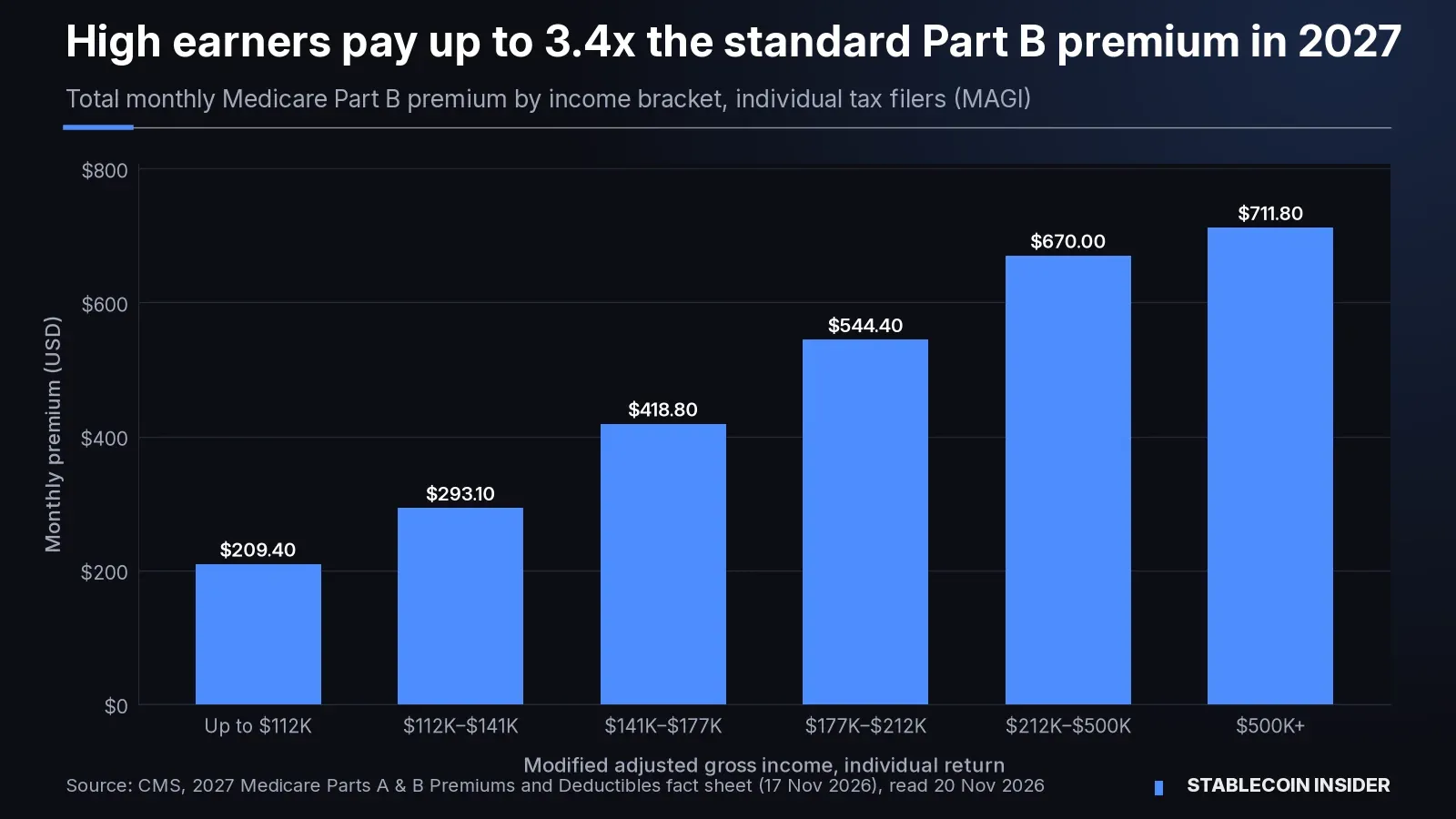
Two things stand out. First, the brackets are cliffs, not slopes: an individual with MAGI of $112,000 pays $209.40, while one with $112,001 pays $293.10 for Part B and $15.40 more for Part D, an extra $99.10 a month or $1,189.20 a year, by our arithmetic on the CMS tables. Second, the top bracket starts at $500,000 for individuals but $750,000, not $1 million, for joint filers.
The income used is from an earlier year. SSA says it uses the most recent federal tax return the IRS provides; for 2026 surcharges that was generally the 2024 tax year (SSA), so on the same basis 2027 surcharges will generally use 2025 income. SSA defines MAGI as adjusted gross income plus tax-exempt interest income (SSA). If your income fell after a life-changing event such as retirement, reduced work hours, marriage, divorce or a spouse's death, you can ask SSA for a new decision with Form SSA-44; if you think the decision is wrong, you can appeal (SSA).
How much of the 2027 COLA will the Part B premium take?
The 2027 Part B premium increase takes $6.50 a month of the average retired worker's $75 COLA raise, about 9%, if the standard premium is deducted from the check. The worked example below uses SSA's estimated average benefits for January 2027 and the CMS premiums; the net figures are our arithmetic.
| Monthly amount | Average retired worker | Aged couple, both on benefits |
|---|---|---|
| Benefit before 3.6% COLA (SSA estimate) | $2,095.00 | $3,238.00 |
| Benefit after COLA (SSA estimate) | $2,170.00 | $3,355.00 |
| Standard Part B premium, 2026 | $202.90 | $405.80 (2 × $202.90) |
| Standard Part B premium, 2027 | $209.40 | $418.80 (2 × $209.40) |
| Net after Part B, 2026 basis | $1,892.10 | $2,832.20 |
| Net after Part B, 2027 | $1,960.60 | $2,936.20 |
| Net monthly change (SSA, CMS) | +$68.50 | +$104.00 |
Read it as an illustration, not your check. The SSA figures are averages for each group, not a typical or median beneficiary. The example assumes the standard premium only: no IRMAA, no Part D or Medicare Advantage premium deducted, no tax withholding, and no Medicare Savings Program paying the premium. Your own COLA notice shows the exact amounts.
Does the hold-harmless rule protect you from the 2027 increase?
The hold-harmless rule protects you from the 2027 increase only if the premium rise would otherwise shrink your net Social Security payment. Under section 1839(f) of the Social Security Act, the premium increase is reduced for people whose Part B premium is deducted from their Social Security benefit, when their COLA increase in dollars is smaller than the premium increase (Federal Register).
With a 3.6% COLA and a $6.50 premium rise, the raise falls short only for benefits below about $180.56 a month before the COLA ($6.50 ÷ 0.036), by our arithmetic; exact eligibility depends on your own benefit and deduction amounts. The rule also requires benefits for November and December with premiums deducted for December and January, and it does not apply to anyone who pays IRMAA (Federal Register). For most beneficiaries, then, the full $209.40 applies.
How can you lower your Part B premium or get help paying it?
You can lower your Part B premium or get help paying it through three routes: a state Medicare Savings Program if your income and resources are limited, an IRMAA review if your income has dropped, and enrolling on time to avoid a lifelong penalty (Medicare.gov, SSA, Medicare.gov).
| Program | What it pays | 2026 monthly income limit (individual / couple) |
|---|---|---|
| Qualified Medicare Beneficiary (QMB) (Medicare.gov) | Part A and B premiums, deductibles, coinsurance and copayments | $1,350 / $1,824 |
| Specified Low-Income Medicare Beneficiary (SLMB) (Medicare.gov) | Part B premiums only | $1,616 / $2,184 |
| Qualifying Individual (QI) (Medicare.gov) | Part B premiums; reapply every year | $1,816 / $2,455 |
Medicare.gov listed only 2026 limits when we checked; the resource limit for all three is $9,950 for an individual and $14,910 for a couple, limits are slightly higher in Alaska and Hawaii, and some states are more generous, so contact your state even if you are slightly above them (Medicare.gov). Qualifying for one of these programs also qualifies you for Extra Help with drug costs (Medicare.gov).
The late-enrollment penalty is the cost to avoid. Medicare adds 10% to your monthly Part B premium for each year you could have signed up but didn't, for as long as you have Part B (Medicare.gov). On the 2027 premium, a two-year delay would add $41.88 a month, making it $251.28, by our arithmetic. People still covered through their own or a spouse's current job can usually delay without a penalty through a Special Enrollment Period (Medicare.gov).
For the bigger picture on retirement income, our guide to whether Social Security will be cut in 2032 uses the same $2,170 average benefit, our explainer on the senior tax deduction expiration date covers the $6,000 deduction for people 65 and over, and our piece on whether stablecoins protect against inflation explains why dollar-pegged tokens are not an inflation hedge.
This guide is not part of a Stablecoin Insider hub: our hubs cover stablecoin regulation, payments, yield and AI agent payments, and none covers US Medicare costs.
Planning retirement income? See how a 2032 Social Security shortfall would change your benefit.
FAQ
When will I see my 2027 Part B premium amount?
Do I still pay the Part B premium if I have a Medicare Advantage plan?
What is the 2027 premium for immunosuppressive drug-only Part B coverage?
Is the 2027 Part B premium the same in every state?
Sources: CMS: 2027 Medicare Parts A & B Premiums and Deductibles; Federal Register: Medicare Part B Monthly Actuarial Rates, Premium Rates, and Annual Deductible beginning January 1, 2027; SSA: 2027 COLA Fact Sheet; SSA press release, 14 October 2026; SSA: Premiums, Rules for Higher-Income Beneficiaries; Medicare.gov: Costs; Medicare.gov: What does Medicare cost?; Medicare.gov: Medicare Savings Programs. All read on 20 November 2026.
This content is provided for informational and educational purposes only and doesn't constitute financial, investment, legal, tax or medical-insurance advice. Figures were read from CMS, the Federal Register, the Social Security Administration and Medicare.gov on 20 November 2026 and apply to US Medicare; your own premium depends on your income, tax filing status, enrollment history and coverage. Net-benefit examples are illustrations based on published averages. Check your SSA notice or call 1-800-MEDICARE before making decisions.