

Table of Contents
Jumper is the app most people use when they want LI.FI's cross-chain routing without writing any code. You pick a token on one chain, a token on another, and Jumper finds the route across dozens of bridges and exchanges.
Two things changed in the second half of 2026. Jumper cut its own fee on stablecoin-to-stablecoin swaps and bridges to zero, and it spun out of LI.FI as a separate company with its own JUMP token.
This review covers what Jumper costs, which chains it reaches, what it does beyond swaps, its security record and who it suits for moving stablecoins.
For stablecoin users, Jumper's headline is simple: no Jumper fee on stable-to-stable routes. What you still pay is gas, the underlying bridge's fee and any slippage.
Key Takeaways
- Jumper charges 0 bps on stablecoin swaps and bridges.
- Major assets cost 2 bps and other tokens 5 bps.
- Jumper lists 60+ chains and routes through LI.FI's infrastructure.
- Jumper spun out of LI.FI in September 2026 with a JUMP token sale.
- LI.FI's 2024 exploit hit wallets with unlimited token approvals.
What Jumper Is
Jumper is a consumer front end for cross-chain and same-chain swaps. It does not hold your funds; its documentation states that Jumper does not custody funds and routes trades through third-party bridges, exchanges and protocols.
Under the hood it uses LI.FI's routing API and contracts, which our LI.FI review covers from the developer side. Jumper adds the interface, a rewards programme and extra products such as yield and perpetuals.
In September 2026 Jumper announced it would become a standalone company led by CEO Marko Jurina, with LI.FI focusing on infrastructure. Jumper says it has handled more than 40 billion dollars in lifetime volume and serves over 100,000 monthly users, both company figures.
What to note: Jumper still depends on LI.FI's routing and contracts, so LI.FI's security record applies to Jumper users too.
Jumper Fees in 2026
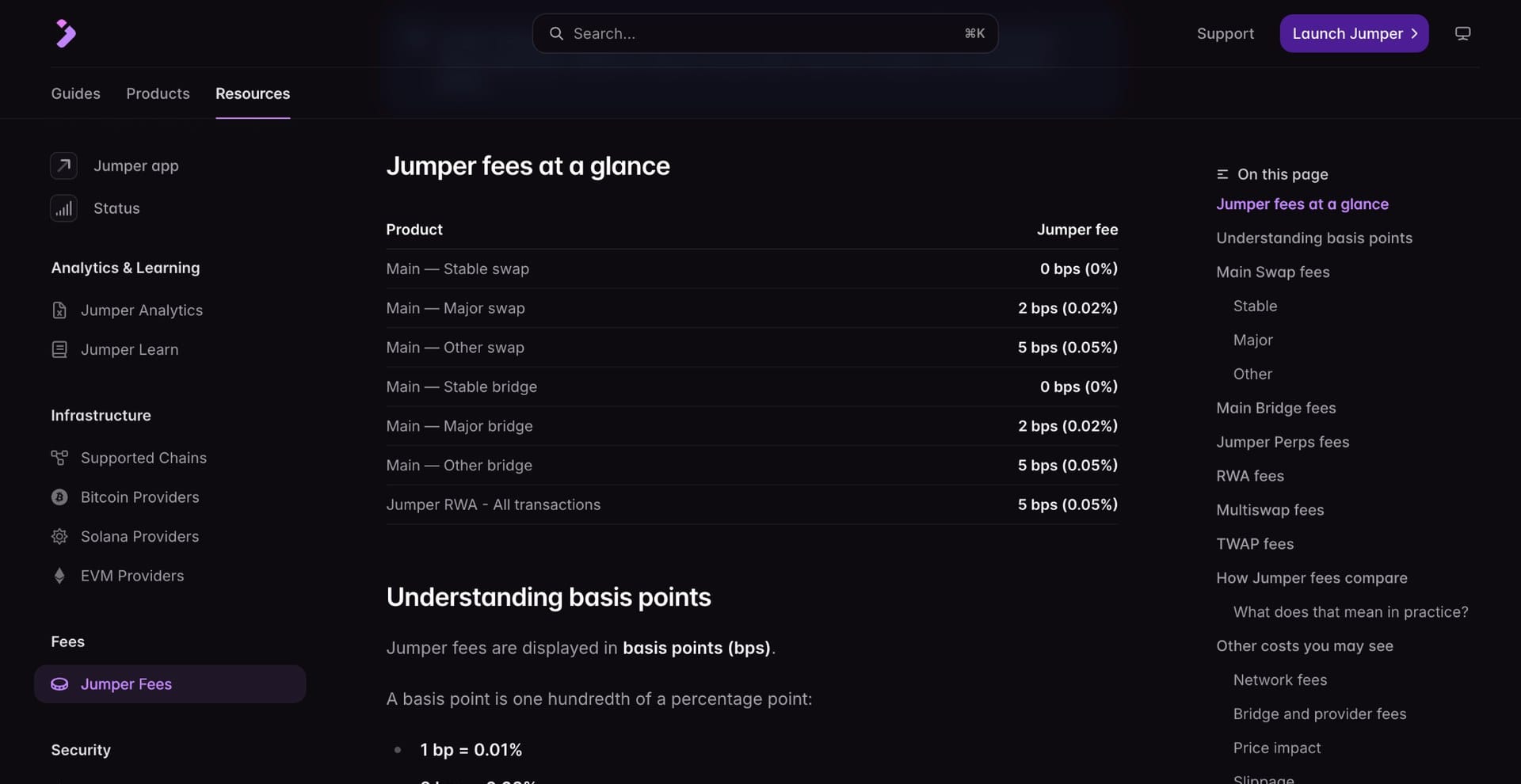
Jumper publishes its own fee schedule, measured in basis points, where 1 bp equals 0.01 percent. The fee depends on the product and on the type of asset.
| Product | Jumper fee | On a 10,000 dollar trade |
|---|---|---|
| Stablecoin swap or bridge | 0 bps | 0 dollars |
| Major asset swap or bridge | 2 bps | 2 dollars |
| Other token swap or bridge | 5 bps | 5 dollars |
| Jumper RWA | 5 bps | 5 dollars |
| Multiswap, stablecoins | 3 bps | 3 dollars |
| Perps on Hyperliquid | 5 bps | 5 dollars |
These are Jumper's fees only. Network gas, the fee charged by the bridge or exchange on the route, price impact and slippage all come on top, and Jumper shows the expected output before you confirm.
What to note: on a USDC to USDC bridge, the bridge fee and gas usually decide the total cost, so compare the final amount received, not the Jumper fee.
How Jumper Compares on Fees
Jumper's documentation compares its platform fee with the swap fees built into popular wallets, checked in September 2026. The comparison covers platform fees only, not total cost.
| Platform | Published swap fee | Fee on 1,000 dollars |
|---|---|---|
| Jumper | 0 to 5 bps | 0 to 0.50 dollars |
| Rabby Wallet | 25 bps | 2.50 dollars |
| Phantom | 85 bps | 8.50 dollars |
| MetaMask | 87.5 bps | 8.75 dollars |
The gap matters most for people who swap inside their wallet out of habit. A 10,000 dollar stablecoin swap through a wallet charging 85 bps costs 85 dollars in platform fees, against zero on Jumper's stable routes.
What to note: these figures come from Jumper's own page, so confirm current wallet fees before relying on them.
Chains, Bridges and Routing
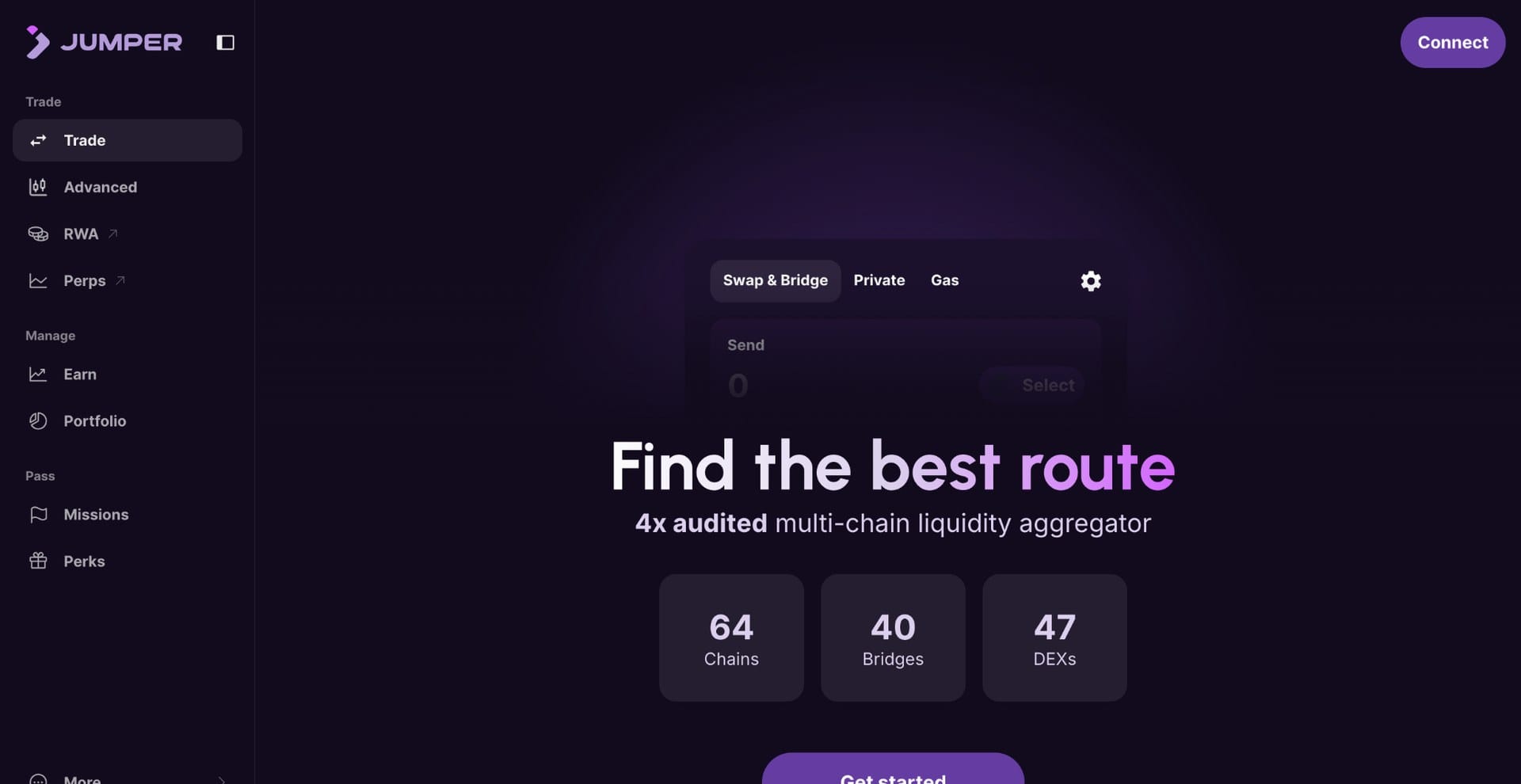
Jumper's homepage showed 64 chains, 40 bridges and 47 exchanges on 16 November 2026. Its documentation lists 65+ chains, 30+ bridges and 33+ exchanges, so treat the exact numbers as a moving target.
For each trade, Jumper compares routes on output amount, time, cost and availability, and can add a swap before or after the bridge. The swap screen also offers a Gas tab to land with the destination chain's native token, and a Private tab.
Private Swap runs through Houdini Swap across 15+ chains and needs a different destination address. Use of any privacy routing should be checked against your own compliance obligations, and it sits next to the routes covered in our cross-chain aggregators list.
What to note: Jumper does not offer a separate fastest or cheapest toggle, so read the review screen before confirming.
Beyond Swaps: Earn, Perps and RWA
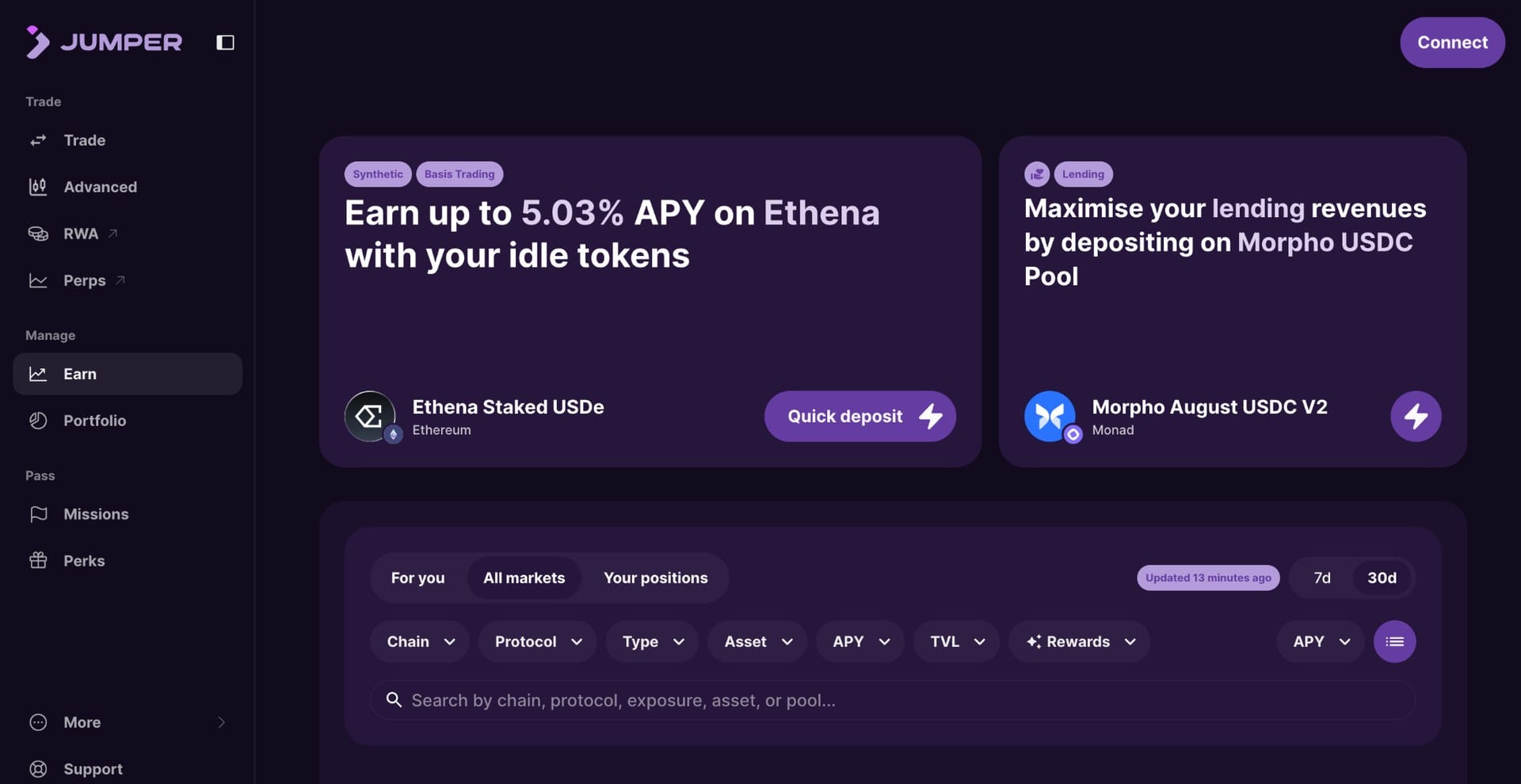
Jumper has grown from a bridge app into what it calls a super-app for onchain finance. The sidebar now includes Earn, Portfolio, Perps, RWA, Advanced trading, Missions and Perks.
Earn lists curated yield opportunities across chains. On the day we checked, it featured Ethena's staked USDe at up to 5.03 percent APY and a Morpho USDC vault on Monad.
These products carry the risks of the underlying protocol, not of Jumper. A synthetic dollar such as USDe or a lending vault can lose value in ways a plain USDC balance cannot.
What to note: treat Earn as a discovery tool and research each protocol before depositing.
Security Record
On 16 July 2024, an attacker took about 11.6 million dollars through a newly deployed contract component in LI.FI's system, according to LI.FI's incident report. The losses came from wallets that had given the contract unlimited spending approval.
Jumper's site now describes the app as audited four times, and LI.FI runs a bug bounty. Jumper's safety guide advises granting only limited approvals where the wallet allows it and testing new chains with a small amount first.
The documentation does not describe a refund process for stuck bridge transfers. It advises keeping the tracking page open, checking the explorer and contacting support.jumper.xyz with the transaction hash.
What to note: review and revoke old unlimited approvals to any router contract, not only LI.FI's.
The JUMP Token and the LI.FI Spin-Out
Jumper announced its JUMP token sale on Legion on 25 September 2026, alongside the spin-out. It described the token as the only way to hold exposure to Jumper, with no separate equity round.
Reported sale terms were 0.075 dollars per token on a 1 billion supply with a 3 million dollar cap. As of early October 2026 the token was not yet trading, and no conversion of Jumper XP into tokens had been confirmed.
The token does not change how swaps work today. Users can use Jumper without buying or holding JUMP.
What to note: treat claims about airdrops or XP value as speculation until Jumper confirms them.
Who Jumper Suits
- Stablecoin movers: zero Jumper fee on stable routes makes it a strong default for USDC and USDT transfers between chains.
- Wallet-swap users: anyone swapping inside MetaMask or Phantom pays far higher platform fees.
- Multi-chain users: 60+ chains in one interface, including Solana, Bitcoin and Tron routes.
- Less suited to: businesses that need invoices, support SLAs or refund guarantees, which Jumper does not offer.
How This Review Was Done
Facts come from Jumper's app and documentation, read on 16 November 2026, plus LI.FI's incident report and coverage of the spin-out. No trades were executed for this review.
Volume and user figures are company claims. Fee figures are Jumper's published schedule and can change.
What to note: always check the live quote, since fees and routes vary by chain, token and amount.
Risks and Limitations
- Bridge and smart contract risk sits with the underlying protocols on each route.
- LI.FI's 2024 exploit shows the risk of unlimited token approvals.
- No published refund process exists for stuck or failed bridges.
- Earn and Perps products add protocol and leverage risk.
- Chain and integration counts differ between Jumper's app and docs.
Conclusion
Jumper is one of the cheapest ways to move stablecoins between chains in 2026, because it charges nothing of its own on stable routes. What you pay is gas and the bridge's fee, which Jumper shows before you confirm.
The app now does far more than bridging, and the spin-out and JUMP token add a new layer of incentives. None of that is needed to use the core swap and bridge features.
Keep approvals limited, test new routes with small amounts, and compare it with the other options in our list of stablecoin aggregators before moving large sums.
Read Next:
- LI.FI Review 2026: Cross-Chain Aggregator for 60+ Chains
- Best Cross-Chain Aggregators 2026
- Stablecoin Aggregators for Routing and Swaps in 2026
FAQs:
1. Is Jumper safe to use?
Jumper is non-custodial and describes itself as audited four times, but it relies on LI.FI contracts, which suffered an 11.6 million dollar exploit in 2024. Limit token approvals and test with small amounts.
2. What fees does Jumper charge?
Jumper charges 0 bps on stablecoin swaps and bridges, 2 bps on major assets and 5 bps on other tokens. Gas, bridge fees and slippage are extra.
3. Is Jumper the same as LI.FI?
Jumper was built by LI.FI as its consumer app and spun out as a separate company in September 2026. It still uses LI.FI's routing and contracts.
4. How many chains does Jumper support?
Jumper's documentation lists 65+ chains, and its homepage showed 64 on 16 November 2026, including EVM chains, Solana, Bitcoin and Tron.
5. Do I need the JUMP token to use Jumper?
No. Swaps, bridges and other features work without JUMP, which was not yet trading as of early October 2026.
Disclaimer:
This content is provided for informational and educational purposes only and does not constitute financial, investment, or legal advice; no material herein should be interpreted as a recommendation, endorsement, or solicitation to buy or sell any token, and readers should conduct their own independent research or consult a qualified professional. Fees, features and figures are drawn from Jumper's website and documentation and from public reports at the time of writing, are not independently verified here, and may change. Bridging, swapping and yield products carry smart contract, liquidity and counterparty risks. Nothing here is an offer or recommendation regarding the JUMP token.


