
Table of Contents
Running stablecoins across multiple networks is no longer a bridge problem. \
In 2026, it is an operating model: a company wants one core treasury for governance, safety, and reporting, while still being able to move value where users and counterparties are, across Ethereum, L2s, Solana, and other ecosystems.
The hard part is not sending a transfer.
The hard part is doing it repeatedly, at scale, with predictable availability and auditable controls, without duplicating reserves across chains, and without letting operational shortcuts become security incidents.
Two data points frame why this matters:
- Stablecoin markets reached roughly USD 300 billion in total market capitalization by September 2025, and USD-pegged stablecoins accounted for about 99% of that market.
- The market is highly concentrated: USDT at roughly USD 170B (about 57%), USDC at roughly USD 71B (about 24%), with the next largest stablecoin reported as USDe at roughly USD 13B (at that time).
As stablecoins scale, cross-chain operations become a first-order risk topic.
Bridge exploits alone have accounted for large losses over time, with bridge-related losses tracked in public datasets reaching into the billions of dollars.
Key Takeaways
- The most resilient model is one core treasury (hub) plus pre-funded operating floats (spokes) per network, governed by explicit rebalancing rules.
- Cross-chain stablecoin strategy is primarily about liquidity availability, controls, and reconciliation, not about picking a single bridge.
- Treat wrapped or bridged stablecoins as a different risk class from native-issued stablecoins; unify liquidity where possible.
- Design for bad days: route outages, chain congestion, pricing dislocations, and emergency pauses.
- Use monitoring and reporting that reflect reality: stablecoin activity can be materially distorted by inorganic flows, so treasury needs defensible metrics.

What One Core Treasury Means in Practice
A core treasury is the primary pool of stablecoin reserves controlled under the strongest governance and security posture. It is not the same as day-to-day operational liquidity.
A clean model separates balances into three layers:
1. Core treasury (Hub): The reserve pool that the organization protects most heavily. This is where capital is concentrated for safety, policy enforcement, and consolidated reporting.
2. Operating floats (Spokes): Pre-positioned balances on each network used to fulfill routine needs: payouts, supplier payments, user withdrawals, liquidity provisioning, or settlement.
3. Buffer or emergency reserves: Additional funds available for short-notice events such as chain outages, partner failures, or unexpected volume spikes, governed by tighter approvals.
This structure is what lets you operate everywhere without holding everything everywhere.
Why Multi-Network Operations Became the Default
Multi-network operations follow demand. Users and counterparties are fragmented by application ecosystems, cost profiles, and integration choices.
Stablecoins remain largely a functional settlement asset for the broader crypto ecosystem, and they are still widely used as a bridge between traditional finance rails and crypto markets.
At the same time, stablecoin usage has grown beyond niche usage. Some industry analyses estimated that by early 2025, circulating supply was approaching USD 250B, alongside tens of millions of monthly active stablecoin users across chains.
Whether your use case is payroll, B2B settlement, exchange operations, or app-level payouts, the operational reality is the same: you will be asked to support multiple networks, and you will be expected to do it with consistent service levels.
The Three Objectives Your Strategy Must Optimize
A workable 2026 strategy optimizes three outcomes simultaneously:
1) Availability (Service-Level Liquidity)
Funds must be available on the chain where the transaction must settle. If you cannot reliably meet obligations on the required network, you do not have a treasury system, you have a recurring incident.
2) Safety (Loss Prevention and Blast-Radius Control)
Cross-chain introduces new failure modes: smart contract vulnerabilities, compromised keys, dependency failures, and irreversible routing mistakes.
Historical bridge-related losses are one reason many mature teams treat cross-chain as a risk discipline, not a convenience feature.
3) Cost + Efficiency (Minimize Idle Capital and Movement Friction)
Every move has direct costs (network fees, routing fees, swap spread or slippage) and indirect costs (time, approvals, reconciliation overhead). The goal is to reduce unnecessary movement while keeping the system responsive.
Core Vocabulary You Need (So Your Team Stops Talking Past Each Other)
- Hub-and-spoke treasury: A central treasury funds multiple network-specific floats.
- Operating float: The balance dedicated to routine operations on a given network.
- Rebalancing: Moving value across networks to restore floats to target ranges.
- Canonical or native stablecoin: The issuer-recognized representation on a chain.
- Bridged or wrapped stablecoin: A representation created by locking an asset and minting a proxy token elsewhere.
- Routing: The path a transfer takes (protocol choice, chain hops, and optional swaps).
- Settlement assurance: Confidence that a transfer is final and usable for the intended purpose.

The 2026 Treasury Model: Hub-and-Spoke Done Properly
Step 1: Map Your Operating Requirements Before You Pick Tools
Start with requirements that are measurable:
- Networks you must support and why (customers, partners, exchanges, protocols)
- Volume profile (steady-state vs spiky; seasonal vs event-driven)
- Latency tolerance (minutes vs hours vs same business day)
- Cash-out paths (where funds ultimately need to end up: exchange, OTC, on-ramp, bank rails)
- Compliance constraints (jurisdiction, counterparty policies, transfer restrictions)
If you cannot articulate these, you cannot set float targets, and you will overfund some networks while underfunding others.
Step 2: Choose the Right Treasury Architecture
Option A: Hub-and-Spoke (Default for Most Teams)
When it fits: most companies that need broad coverage but want centralized control.
- Keep the majority of reserves in the core treasury.
- Pre-fund each network with an operating float sized to expected demand plus buffer.
- Rebalance based on rules (thresholds and cadence), not gut feel.
Why it works:
It limits duplication, reduces emergency transfers, and makes reporting straightforward: one core reserve plus controlled spokes.
Option B: Multi-Hub Treasury (For Scale or Segmentation)
When it fits: large operators with distinct business lines, or with different operational regions.
- Two or three hubs, each supporting a set of networks or workflows.
- Adds resilience and may reduce cross-chain dependency concentration.
Trade-off: complexity increases materially, more governance, more reconciliation, more monitoring.
Option C: Fully Distributed Treasury (Rare)
When it fits: decentralized governance environments that require autonomous control per network.
Trade-off: operational overhead is high, and risk consistency is difficult.
Step 3: Decide What Inventory You Hold on Each Network
This is where many cross-chain strategies fail: they treat all stablecoins as interchangeable.
A disciplined inventory policy should specify:
- Primary stablecoin per network (what you prefer to hold and pay in)
- Acceptable alternatives (what you will hold temporarily or for specific counterparties)
- Redemption or conversion practicality (how easily inventory can be converted where needed)
Concentration data matters here. If your business depends heavily on one or two stablecoins, you are exposed to issuer-level and market-structure risk; but if you diversify too aggressively, you may end up with fragmented liquidity and weak exit routes.
A practical approach is:
- Prefer the most liquid, widely accepted stablecoin(s) for your workflow and counterparties.
- Avoid carrying large balances in niche or thin-liquidity representations unless a specific requirement exists.
Step 4: Write a Liquidity Movement Policy (The Rulebook)
Your cross-chain policy should read like an operations manual, not a chat message. At minimum, define:
A) Float targets and thresholds
For each network:
- Minimum float (below which you must rebalance)
- Target range (where you prefer to operate)
- Maximum float (above which you sweep excess back to hub)
B) Rebalancing cadence
- Scheduled rebalancing (daily or weekly depending on volume and volatility)
- Event-driven rebalancing (triggered by threshold breaches, volume spikes, or market stress)
C) Approvals and segregation of duties
- What can be executed automatically?
- What requires human review?
- What requires multi-sig quorum?
D) Emergency actions
- When you pause all cross-chain movements
- How you handle suspected key compromise
- How you route around outages
This is not bureaucracy.
It is what prevents small operational shortcuts from becoming headline losses.
Step 5: Select Transport Mechanisms by Security Model, Not Brand
Cross-chain stablecoin movement can be achieved through different primitives. Instead of naming best bridges, evaluate categories by how they handle asset integrity.
A) Native burn-and-mint (where available)
This model aims to avoid wrapped assets by burning on the source chain and minting on the destination chain, preserving a 1:1 supply model across supported chains.
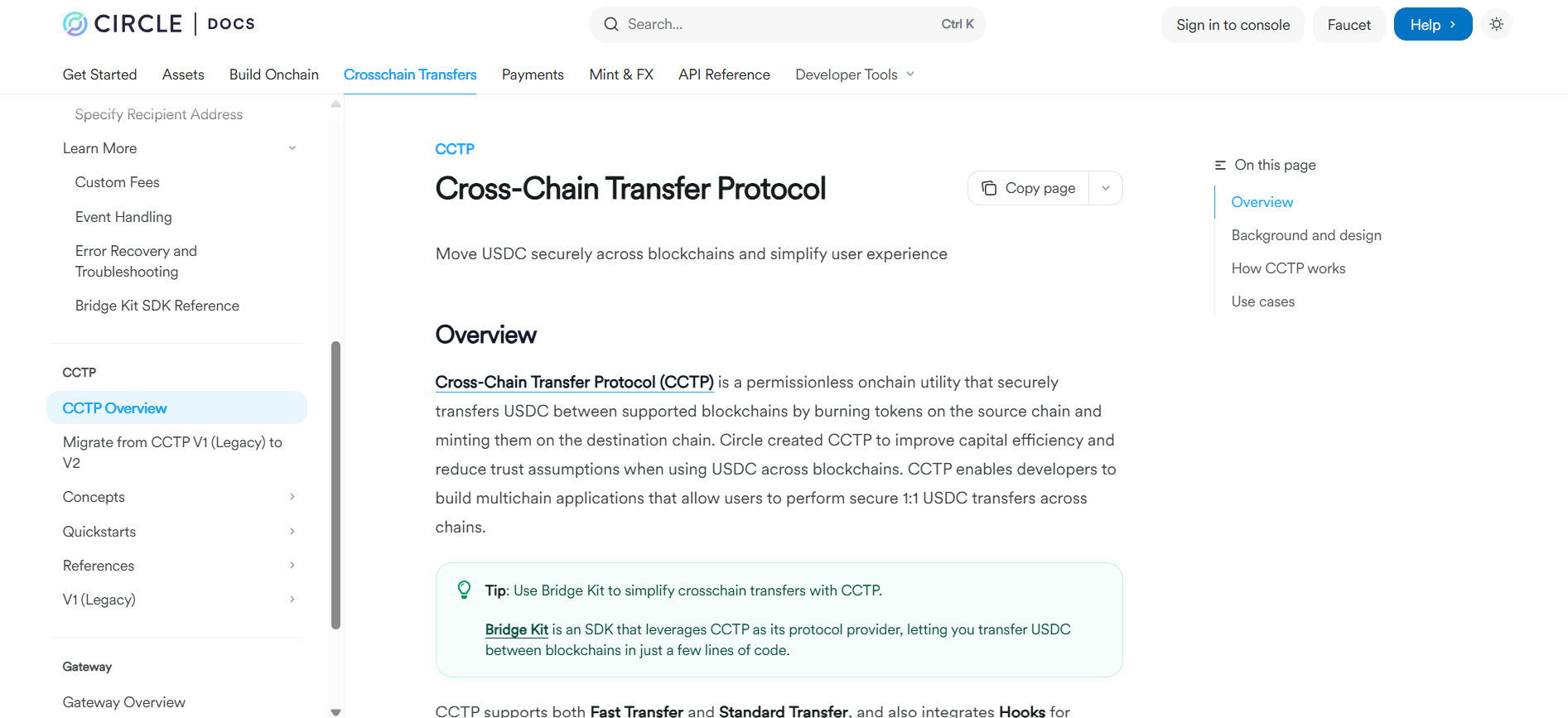
Circle’s Cross-Chain Transfer Protocol (CCTP) is an example of a burn-and-mint design for USDC, positioned explicitly against lock-and-mint fragmentation.
Circle describes this design as moving USDC via native burning and minting, and contrasts it with lock-and-mint bridges that create wrapped forms and introduce additional trust assumptions.
Why treasury teams care: fewer representations to reconcile and potentially less fragmentation of USDC liquidity across networks.
B) Lock-and-mint bridging (wrapped representations)
Assets are locked in a contract on one chain, and a wrapped representation is minted on another.
Treasury implication: wrapped inventory may not have equal redemption paths, liquidity depth, or risk profile to canonical assets.
C) Liquidity-network or pool-based bridging
A liquidity provider network fulfills transfers by paying out from pool liquidity and rebalancing later.
Treasury implication: operational reliability and liquidity depth matter; you must validate your maximum-transfer assumptions and fallback routes.
Step 6: Design Routing Like an SRE Designs Redundancy
A mature routing design is not one bridge per pair. It is a set of defined routes with fallback behavior.
For each chain pair you operate:
- Primary route (best balance of reliability and cost)
- Fallback route (a different dependency, ideally a different trust model)
- Swap fallback (if stablecoin liquidity is impaired, what conversion path exists?)
Also define transfer sizing rules:
- Chunking large transfers to reduce execution risk and price impact (where swaps are involved)
- Timed execution windows if liquidity varies over time
Operating the System Day-to-Day
Managing Operating Floats Without Overfunding
The simplest float-sizing method is demand-driven:
- Start with historical daily outflows per network.
- Add a buffer to cover variance and operational delays.
- Increase buffers on networks where routing is less reliable or where settlement obligations are time-critical.
The goal is to keep enough working capital local to each network so that routine operations do not require constant cross-chain movement.
A common failure pattern is micro-rebalancing (constantly bridging small amounts). It increases operational load and increases exposure to cross-chain dependency risk.
Monitoring: Why Raw Volume Can Mislead Treasury
Treasury teams often look at stablecoin volume data to justify chain coverage and float allocations. But volumes can be distorted by inorganic activity.
One prominent industry analysis illustrated this measurement issue: Applying a simple heuristic to remove inorganic activity could reduce a 30-day stablecoin transfer volume estimate from about USD 3.9 trillion down to about USD 817.5 billion (through March 2025).
The practical takeaway is not that one number is right and the other is wrong. The takeaway is that your treasury should rely on:
- Your own transactional demand metrics (payouts, settlements, withdrawals)
- Adjusted, defensible external metrics when you use market data for planning
Treasury decisions based purely on unadjusted transfer volume are fragile.
Security and Risk Management: Controls That Match the Risk
Cross-chain expands the attack surface. This is not theoretical.
Bridge-related losses tracked in public datasets have reached into the billions of dollars. Separately, broader crypto hacks have also amounted to billions in annual losses in some years.
Those figures do not tell you which specific protocol is safe.
They tell you that operating controls must assume adversarial conditions.
Practical control set (minimum viable)
- Wallet tiering
- Cold (core treasury)
- Warm (rebalancing wallet)
- Hot (execution wallet, tightly limited)
- Multi-sig governance
- Separate initiators from approvers
- Time-box execution where appropriate
- Define emergency signer procedures
- Allowlists and policy controls
- Approved contracts, approved routes, approved counterparties
- Limits per route and per time window
- Incident readiness
- Pause and verify playbook
- Runbooks for compromised key response
- Audit trail retention for every cross-chain movement

Reconciliation and Accounting Across Networks
Keeping one core treasury only works if your accounting can prove it.
A strong reconciliation model includes:
- Per-chain subledgers: each network has tracked balances, inflows, and outflows
- Transfer classification: internal movement vs expense vs customer settlement
- Route metadata: which route was used, approvals recorded, execution time stamps
- Exposure reporting: how much treasury is on each network and under what custody model
This also helps with governance reporting: management will ask, how much capital is where, and why.
Implementation: A 30/60/90-Day Rollout That Actually Works
First 30 Days: Prove the Model on Core Networks
- Pick the hub (where governance and liquidity are best for your use case)
- Define floats for your top 2–3 networks
- Implement wallet tiering and multi-sig
- Establish monitoring (balances, outflows, abnormal events)
- Build a basic reconciliation workflow that closes daily
Days 31–60: Add Redundancy and Expand Coverage
- Add fallback routes for your highest-volume transfers
- Formalize rebalancing rules (thresholds + cadence)
- Expand chain coverage for required counterparties
- Conduct internal operational drills (pause events, route failure)
Days 61–90: Optimize and Harden
- Reduce unnecessary movement (tune float targets and triggers)
- Improve reporting (executive dashboards + audit-ready exports)
- Perform periodic access reviews and signer rotation procedures
- Run tabletop exercises: chain congestion, bridge outage, suspected compromise
Decision Matrix: Choosing the Best Strategy for Your Situation
| Requirement | Strongest Fit | Why |
|---|---|---|
| Predictable payouts across many networks | Hub-and-spoke | Minimizes emergency transfers and keeps governance centralized |
| High volume with complex business lines | Multi-hub | Segments operational risk and supports parallel workflows |
| Strict decentralization constraints | Distributed | Aligns with governance needs but increases operational overhead |
| Need to avoid wrapped representations where possible | Burn-and-mint (where available) | Reduces liquidity fragmentation and representation complexity |
| High risk sensitivity to cross-chain dependencies | Redundant routing + tight controls | Limits downtime and reduces single-point failures |
Common Mistakes (And How to Avoid Them)
Mistake 1: Treating bridged stablecoins as identical to native stablecoins
Even if the ticker looks similar, risk and liquidity can differ. Inventory policy should reflect that.
Mistake 2: Over-rebalancing instead of pre-funding floats
Constant small transfers increase operational overhead and dependency exposure.
Mistake 3: Relying on one route for a mission-critical flow
If a route goes down, you are instantly in incident mode. Build fallback routes by design.
Mistake 4: Ignoring reconciliation until later
Later becomes never, until the first audit, dispute, or incident. Start with daily closure from day one.
Mistake 5: Using noisy volume metrics for treasury sizing
External stablecoin volume can be materially inflated by inorganic activity; prioritize internal demand and adjusted metrics.

Conclusion
The best cross-chain stablecoin strategy in 2026 is not pick a bridge.
It is an operating system: keep one protected core treasury, run controlled operating floats on each network, rebalance with explicit rules, design routing with redundancy, enforce governance through strong wallet and approval controls, and reconcile balances daily so reporting remains defensible.
Stablecoins are large, concentrated, and increasingly system-relevant as an onchain settlement layer, so treasury operations must be engineered with the same rigor as any other critical financial workflow.
Read Next:
- Best Cross-Chain Stablecoin Bridges for 2026
- Best Stablecoins for Cross-Border Payments in 2025
- The Role of Stablecoins in Monetary Policy Transmission
FAQs:
1. How do I keep one core treasury while operating on multiple networks?
Use a hub-and-spoke model: keep reserves in the hub, maintain pre-funded floats on each network, and rebalance based on threshold rules.
2. What is the safest way to move USDC across chains in a treasury setup?
Where available, prefer approaches that avoid wrapped representations. Circle describes CCTP as moving USDC via native burn-and-mint rather than lock-and-mint wrapping.
3. How do I size operating floats per network?
Base floats on expected outflows, add a buffer for variance and routing delays, and increase buffers where obligations are time-sensitive or routing reliability is weaker.
4. Why do I need fallback routes for cross-chain stablecoin operations?
Because cross-chain dependencies fail. Historical losses and outages show the environment is adversarial; redundancy reduces downtime risk.
5. Are stablecoin volume numbers reliable for planning cross-chain treasury?
They can be directionally useful, but they can also be inflated by inorganic activity. Some analyses reported large differences between total and heuristic-adjusted volumes in a 30-day window.
6. What is the biggest operational risk in multi-network stablecoin treasury management?
Uncontrolled movement: weak approvals, poor key management, no monitoring, and no reconciliation. These failures create both loss risk and reporting risk.
Disclaimer:
This content is provided for informational and educational purposes only and does not constitute financial, investment, legal, or tax advice; no material herein should be interpreted as a recommendation, endorsement, or solicitation to buy or sell any financial instrument, and readers should conduct their own independent research or consult a qualified professional.