Table of Contents
B2B stablecoin payments grew 733% year-over-year in 2025 to roughly $226 billion, accounting for about 60% of all real stablecoin payment activity, according to joint analysis from McKinsey and Artemis Analytics published in February 2026.
As those flows moved from trading into payroll, vendor settlement, and treasury, a structural problem surfaced.
Fireblocks reported in April 2026 that privacy has become the primary obstacle blocking institutional stablecoin adoption, with regulated fintechs, banks, and treasuries calling public-chain exposure a deal-breaker.
The reason is simple. Public blockchains record every transaction on a shared ledger, so on-chain payroll can broadcast each employee's salary, and paying suppliers on-chain can reveal vendor lists and negotiated prices to competitors. As Aleo, Toku, and Paxos noted in January 2026, stablecoins processed over $33 trillion in 2025, yet less than 1% of businesses use crypto for payroll, and the main blocker is transparency.
A wave of privacy solutions has emerged to close that gap, from zero-knowledge confidential transfers to fully homomorphic encryption and controlled-visibility payment infrastructure.
This article compares the leading privacy solutions for stablecoin payments in 2026, the criteria that separate them, and how to combine them into a stack that stays both confidential and compliant.
Key Takeaways
- Public blockchains expose payroll, vendor, and treasury data, driving demand for stablecoin payment privacy.
- Confidential transfers and ZK stablecoins hide amounts while preserving compliance through selective disclosure.
- Solutions range from Solana confidential balances and Aleo to Hinkal, FHE, and stealth addresses.
- Viewing keys let auditors and regulators verify private stablecoin payments without public exposure.
- No single tool wins; the right privacy stack depends on chain, data, and compliance needs.
The Privacy Problem With On-Chain Stablecoin Payments
Traditional payment rails are confidential by default. Banks do not broadcast wire transfers, and payment processors do not publish merchant volumes for rivals to analyze. Public blockchains invert that model by making every transfer visible to anyone with an internet connection.
For businesses, the exposure is material. On-chain payroll can reveal salaries from intern to CEO, and repeated payments to the same wallets expose supplier relationships, pricing, and treasury positions over time. As PYMNTS observed in April 2026, payment flows and treasury movements can signal negotiating leverage, creditworthiness, and financial health to any observer.
The industry has largely rejected full anonymity in favor of what analysts call programmable privacy: default confidentiality paired with selective disclosure to auditors and regulators. That framing, rather than pure obfuscation, is what makes the solutions below viable for regulated payments.
What to Look For in a Stablecoin Payment Privacy Solution
Not every privacy tool fits business payments. The strongest options tend to score well across these criteria.
- Confidentiality vs anonymity: hiding amounts usually matters more than hiding the transaction graph for payroll and treasury.
- Selective disclosure: viewing keys or audit records that let regulators verify flows without exposing them publicly.
- Compliance fit: alignment with MiCA and the GENIUS Act, which classify major issuers as regulated financial institutions.
- Settlement speed and cost: sub-second or near-instant finality and low fees so privacy does not break usability.
- Custody and control: non-custodial architecture, so funds are never held by a third party mid-transfer.
The list below spans cryptographic protocols, privacy-native chains, and payment infrastructure, since a real-world stack often combines more than one.
The Best Privacy Solutions for Stablecoin Payments in 2026
1. Hinkal
Hinkal provides privacy infrastructure for stablecoin payments and on-chain financial operations. It allows businesses and individuals to move funds across public blockchains while keeping sensitive payment, settlement, payout, and treasury data confidential, all without changing users' existing flows or operational processes.
Hinkal operates across Ethereum, Solana, Tron, and major EVM networks without requiring users to change wallets, install new software, or bridge funds.
Hinkal's infrastructure is non-custodial by design: funds never sit with Hinkal or any operator during a transfer, moving directly between wallets through the shielded pool. It lets users hold private balances controlled through their existing wallet keys, so they can hold, send, receive, and operate in stablecoins confidentially, without changing their existing chains, wallets, custody, or workflows.
Compliance is built into the flow rather than bolted on afterward.
- Shields sender, recipient, and amount while allowing users to selectively disclose transaction history to auditors, regulators, or counterparties when required.
- Runs KYT (Know Your Transaction) screening on every private transaction before execution.
- Blocks flagged wallets at the deposit layer to prevent tainted funds from entering the shielded pool.
- Offers viewing keys that reveal full or partial history to auditors, regulators, exchanges, or internal compliance.
Hinkal ships as a suite of products built on shared infrastructure: a Confidential Payments integration suite available through API and SDK, Hinkal Pay and Hinkal Prime, which turn any stablecoin transfer into a confidential transaction, and a private multichain wallet that shields balances and transaction history. Its traction is real.
Polygon launched private stablecoin payments through Hinkal on May 4, 2026, covering USDC and USDT via the Polygon Wallet, and institutional custody platform The Vault integrated it in June 2026 for private deposits, sends, and withdrawals.
Hinkal is best for teams that want cross-chain confidential stablecoin transfers on the networks they already use.
2. Streamflow
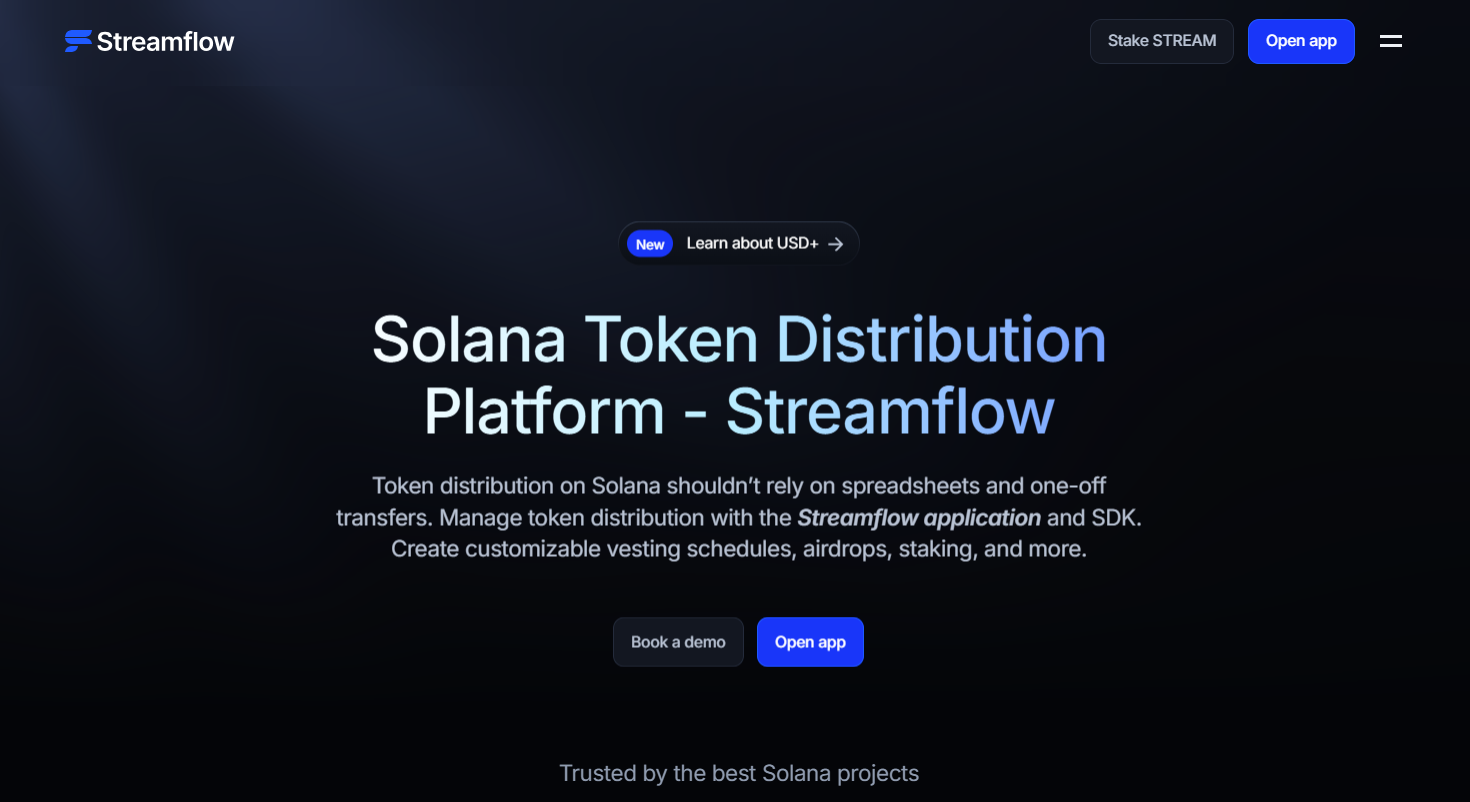
Streamflow is a Solana-native token operations platform that automates payouts, distribution, and treasury using on-chain smart contracts, with over $290 million in total value locked, 1.3 million users, and 40,000 projects. Its privacy contribution is operational rather than cryptographic.
Streamflow does not encrypt amounts on-chain; instead it controls who can see payout schedules and treasury data.
The platform's tokenomics dashboards are public by default but support private, team, or investor-only visibility, so a company can run distributions without broadcasting them to the world. Contracts are non-custodial and immutable once deployed, with no admin override, and are audited by FYEO and OPCODES.
- Configurable dashboard visibility keeps payout data private to a team or investors rather than public by default.
- Recurring payout contracts automate payroll to employees, contractors, and contributors without redeploying.
- A streaming primitive can pay salaries by the second or charge subscriptions only for time used.
- USD+ manages treasury and yield in a dollar-denominated asset for ongoing operations.
Setup is fast, with token locks configurable in around 37 seconds, and every distribution is verifiable on Solscan when a team chooses to share it.
For broader financial operations, Streamflow Business extends the model to on-chain cap tables, tokenized SAFEs, and ownership issuance.
In practice, Streamflow pairs with token-layer confidentiality on Solana: it handles automation and visibility control while a confidential-transfer primitive hides the amounts.
Streamflow is best for teams that need programmable, controlled-visibility payroll and treasury operations rather than cryptographic anonymity.
3. Confidential Balances on Solana Token Extensions
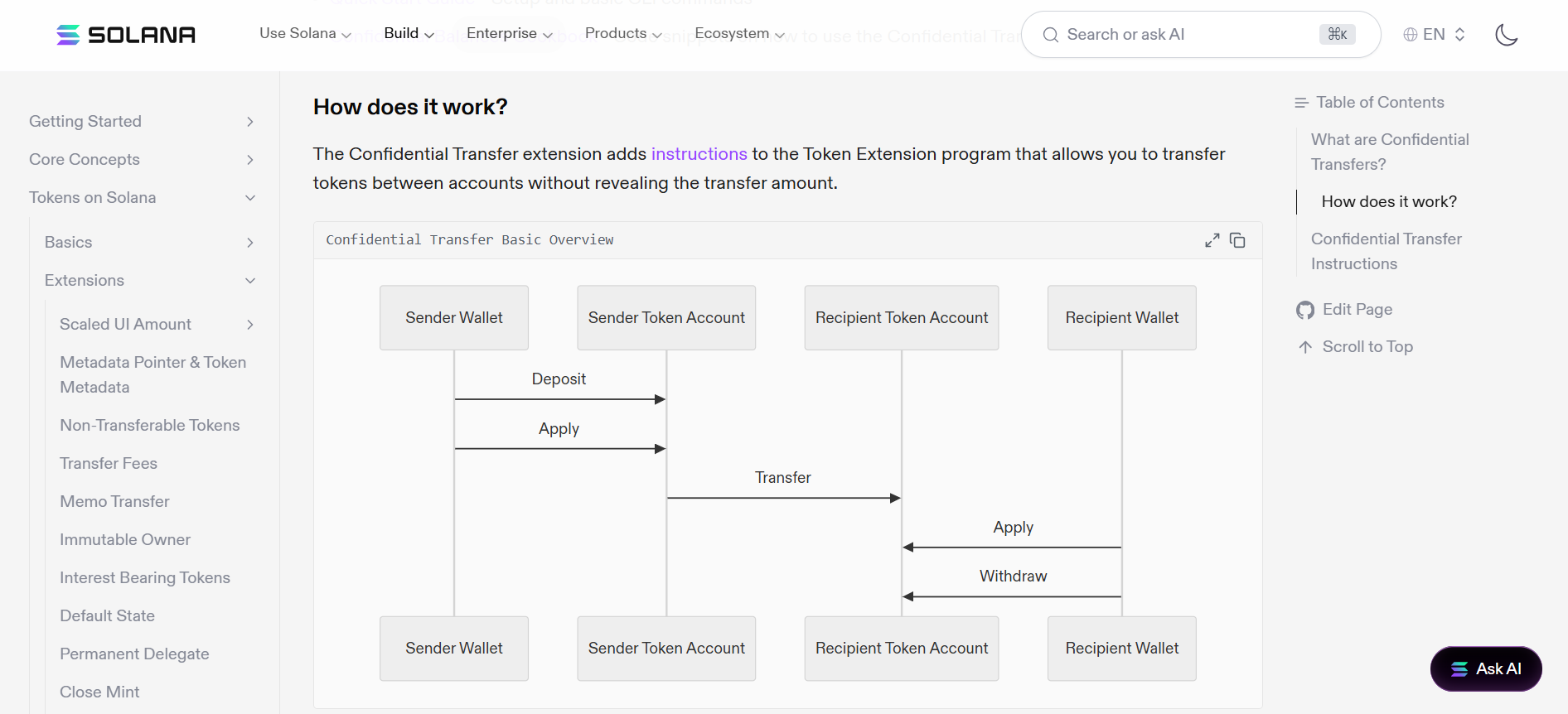
Confidential Balances are a set of three Token-2022 extensions that encrypt transfer amounts and account balances using zero-knowledge proofs and Twisted ElGamal encryption.
Built with Solana infrastructure firm Helius, the standard was described by Solana developers as the first ZK-powered encrypted token standard designed for institutional compliance without sacrificing sub-second finality.
Crucially, this is confidentiality, not anonymity. As the documentation states, sender, recipient, and token remain publicly visible; only the amounts and balances are encrypted, so the transaction graph stays intact while the sensitive numbers disappear.
- Combines homomorphic encryption, AES, and zero-knowledge proofs verified by the on-chain ZK ElGamal Proof program.
- Includes Confidential Transfer, Confidential MintBurn, and confidential fee extensions.
- Offers configurable privacy levels, from disabled and opt-in to confidential by default or required.
- Supports an optional global auditor key on the mint, letting issuers decrypt all amounts for regulated assets.
The flow uses a pending-and-available balance model, where users deposit public tokens into a confidential state, apply the pending balance, then transfer confidentially in a few seconds.
Wallet support is still maturing, with early integrations relying on Rust and server-side proof generation, though JavaScript ZK proof libraries and wallet-as-a-service providers are expanding access.
Confidential Balances are best for stablecoin issuers and businesses that want native amount privacy on Solana with a built-in auditor option.
4. Aleo and Private Stablecoins (USAD, USDCx)
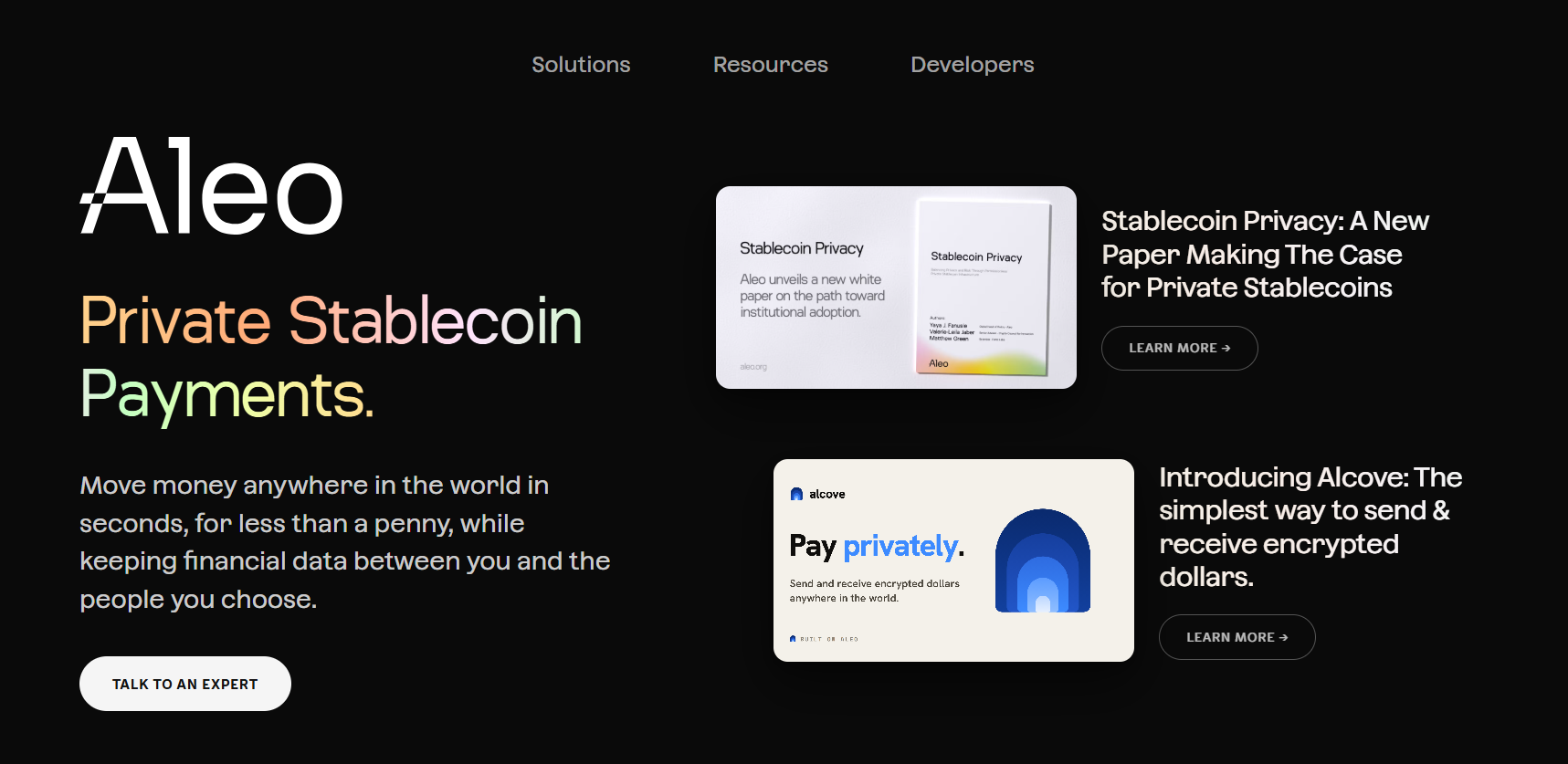
Aleo is a zero-knowledge Layer 1 built for privacy by default, and it has become the most active home for purpose-built private stablecoins.
USAD, issued by Paxos Labs and backed 1:1 by USDG, went live on Aleo mainnet in February 2026 as the first stablecoin on a Layer 1 to combine smart-contract programmability with privacy by default. Circle's USDCx launched on Aleo testnet via its xReserve infrastructure, staying 1:1 interoperable with USDC across supported chains.
Both assets encrypt wallet addresses, transaction amounts, and sender and receiver details end-to-end, while remaining transparent to authorized oversight. Compliance is engineered into the protocol rather than left to front-ends.
- Enforces freeze lists on private transfers using Merkle non-membership proofs, without revealing the sender.
- Emits a compliance record to a designated officer whenever funds cross the public-private boundary.
- Grants an asset-specific view key to a trusted compliance service for lawful decryption.
- Protects admin operations behind multisig requiring multiple signers.
Real deployments are already live. Aleo, Toku, and Paxos launched private stablecoin payroll, letting enterprises pay global teams in USAD while keeping salary and treasury data confidential, with rollout beginning in Q1 2026; Toku processes over $1 billion in annual payroll across 100-plus countries and plugs into systems like Workday, ADP, and SAP.
Aleo has also powered confidential humanitarian aid in Colombia with Mercy Corps Ventures and the Danish Refugee Council.
One tradeoff: privacy applies while assets stay on Aleo, and bridging back to another chain removes those protections.
Aleo and private stablecoins like USAD and USDCx are best for enterprises that want private-by-default payroll and B2B settlement in a regulated stablecoin.
5. Stealth Address Payment Systems
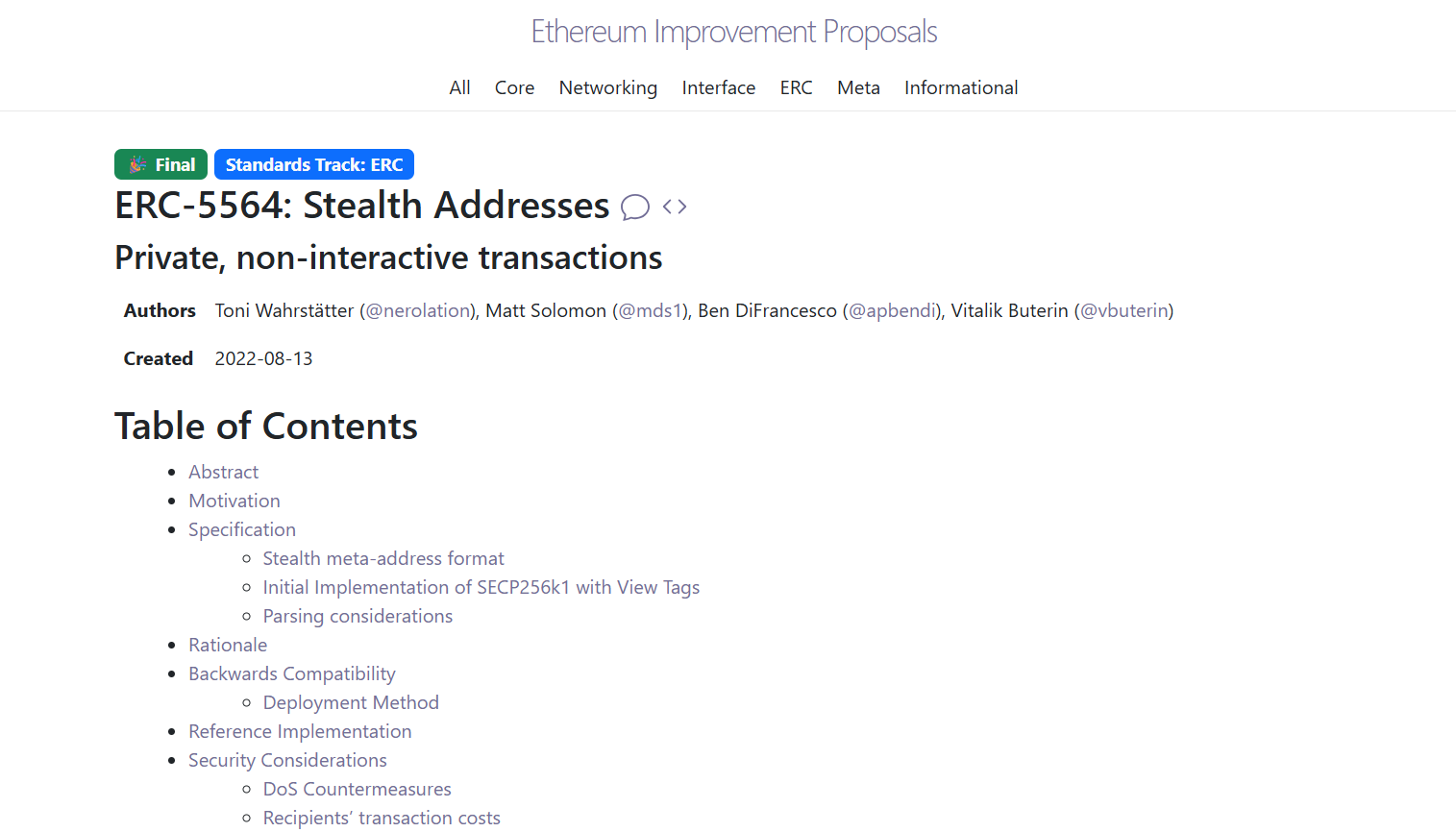
Stealth addresses, standardized on Ethereum through ERC-5564 and the ERC-6538 registry, let a sender non-interactively derive a one-time destination address that only the recipient can control.
Observers can see the amount, but cannot link the receiving address back to a specific vendor, contractor, or employee.
The mechanism relies on an ephemeral key published through an announcer contract and a shared secret computed via elliptic-curve math, so the recipient scans announcements to find payments meant for them.
Importantly, this delivers recipient unlinkability rather than amount hiding, and each stealth address's history is still visible to whoever holds the viewing key.
- Generates untraceable, one-time addresses per payment while keeping the transfer flow unchanged.
- Breaks linkability between a recipient's identity and their payment history.
- Preserves internal visibility for treasury and compliance through the viewing key.
Two implementations dominate:
- Umbra, an early mover whose team helped author the standard, had generated over 77,000 active stealth addresses as of 2026 and bundles the fund transfer and announcement into a single call.
- Fluidkey, deployed across Base, Optimism, Arbitrum, Polygon, Gnosis, and Ethereum, generates addresses through ENS queries, shares the viewing key by default so users get notifications, and supports viewing-key rotation for granular monthly disclosure to an accountant.
A known limitation is that ERC-5564 view-key sharing is all-or-nothing per key, which rotation partly mitigates.
These are best for one-off or recurring payouts where recipient privacy is the priority.
6. Fully Homomorphic Encryption Layers
Fully homomorphic encryption (FHE) lets smart contracts compute on encrypted data without ever decrypting it.
Zama launched the first production FHE mainnet on Ethereum on December 30, 2025, executing the first confidential ERC-20 transfer using cUSDT, a confidential version of USDT, for roughly $0.13 in fees, and shielded more than 121 million USDT in its first weeks.
The approach keeps balances and transfer amounts encrypted end-to-end, even during computation, using a wrapping model that can turn any existing token into a confidential version. Developers add encrypted types to standard Solidity with minimal changes.
- Underpins the ERC-7984 Confidential Token Standard from the Confidential Token Association (Zama, Inco, OpenZeppelin).
- Uses a coprocessor network plus a key management service that splits decryption keys across operators via MPC.
- Extends across providers, including Fhenix's FHE Layer-2 on Base and Arbitrum and Inco's modular confidentiality layer.
- Already powered the first confidential over-the-counter trade, executed by market maker GSR.
Block explorers such as Blockscout now index ERC-7984 activity, showing senders and recipients while keeping encrypted amounts private. The main constraint is throughput: coprocessors handle around 20 transactions per second today, with roadmaps targeting 500 to 1,000 TPS by the end of 2026 through GPU acceleration, and Solana support planned for the second half of the year.
Emerging wallets like Bron and self-custodial banking apps like Raycash are building on confidential tokens.
These are best for teams building complex confidential logic, such as encrypted payroll, lending, or hidden order books.
7. Modular Privacy SDKs
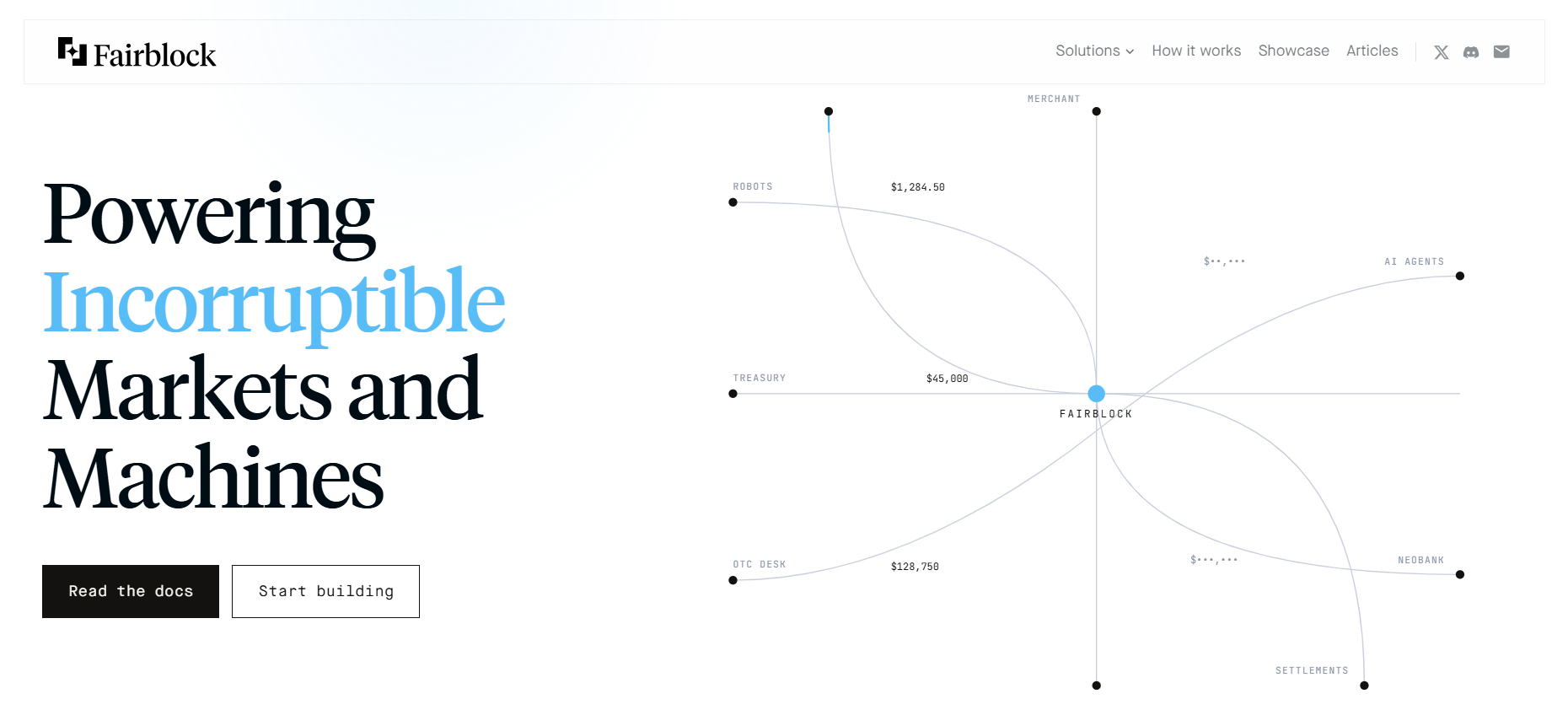
Modular encryption SDKs aim to add privacy across many chains through a single integration rather than a dedicated chain.
Fairblock is a leading example, describing itself as a programmable confidentiality layer that plugs into existing ecosystems including Ethereum, Solana, and Cosmos instead of forcing migration to a new network.
Rather than relying on general-purpose FHE, Fairblock combines threshold identity-based encryption, optimized homomorphic encryption, multi-party computation, and zero-knowledge proofs to keep stablecoin flows confidential at near real-time speed. Its compliance model is deliberately decentralized.
- Uses MPC and identity-based encryption to avoid a single centralized audit key.
- Logs access requests on-chain and grants visibility per user or per transaction.
- Runs encryption on-chain, avoiding reliance on centralized or optimistic coprocessors.
- Removes the need for users to bridge funds or install new wallets across supported chains.
The project originated in consensus-level front-running protection and raised a $2.5 million pre-seed round in 2023 with backers including GSR and Lemniscap.
Its 2025 and 2026 partnerships point squarely at payments: Fairblock is bringing confidential transfers, balances, and selective disclosure to Noble's stablecoin AppLayer, and it joined the USDT-native StableChain as a launch privacy partner.
Fairblock is best for developers embedding private payments across several networks with compliance built in.
8. Selective Disclosure and Viewing Keys
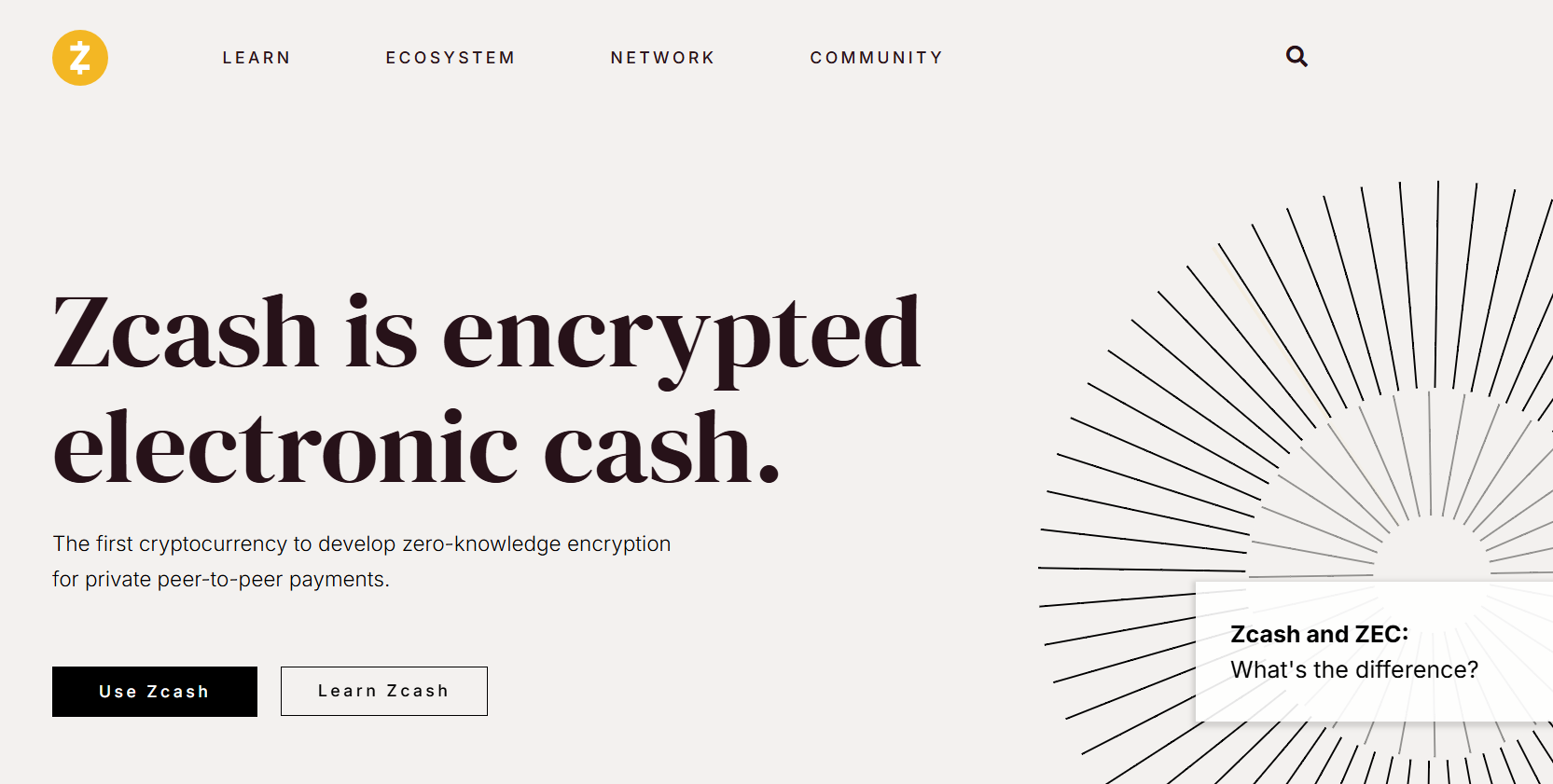
Selective disclosure is the cross-cutting control layer that makes every other solution compliant. It lets a business reveal specific information to authorized parties without exposing anything to the public, and it is the mechanism that distinguishes confidential-but-compliant systems from anonymity tools that trigger regulatory flags.
The model, pioneered by Zcash, grants view keys that can be scoped per transaction, per wallet, or per asset. Where the disclosure is enforced matters, since protocol-level enforcement is hardest to circumvent while application-level enforcement is easiest, as TRM Labs noted in February 2026.
- Provides auditors and regulators decrypt access without publishing data on-chain.
- Satisfies MiCA and GENIUS Act obligations, including Bank Secrecy Act reporting for issuers.
- Lets a company pay dozens of employees without broadcasting individual salaries, per insights4vc's January 2026 analysis.
As DAIC Capital argued in May 2026, selective disclosure is shifting from an optional feature to a structural necessity. It is less a standalone product and more the compliance bridge that every serious privacy stack, from Solana confidential balances to Aleo and FHE layers, ultimately depends on.
Zcash is best for any deployment that must satisfy auditors and regulators while staying confidential by default.
Stablecoin Payment Privacy Solutions Compared
| Solution | Type | What it hides | Chains | Compliance controls |
|---|---|---|---|---|
| Hinkal | ZK shielded protocol | Sender, recipient, amount | Ethereum, Solana, Tron | KYT screening, viewing keys |
| Streamflow | Payout and treasury infra | Payout visibility (configurable) | Solana | On-chain proof, FYEO and OPCODES audits |
| Solana Confidential Balances | Token-2022 extension | Amounts and balances | Solana | Optional auditor key |
| Aleo (USAD, USDCx) | ZK privacy Layer 1 | Sender, recipient, amount | Aleo | View keys, freeze lists, compliance records |
| Stealth Addresses (ERC-5564) | Address scheme | Recipient identity | EVM chains | Viewing key disclosure |
| FHE Layers (Zama, Inco, Fhenix) | Encryption layer / ERC-7984 | Amounts and contract logic | Ethereum and EVM (Solana H2 2026) | Selective disclosure, access control lists |
| Fairblock | Modular encryption SDK | Amounts and counterparties | Ethereum, Solana, Cosmos | On-chain access logs, MPC key generation |
| Selective Disclosure / Viewing Keys | Control layer | Nothing alone; governs disclosure | Any | Core audit and regulatory bridge |
No single row wins outright. The right choice depends on which data must stay hidden and where payments settle.
How to Choose the Right Privacy Setup
Match the solution to the exposure, not the marketing. The following framework maps common needs to the strongest fit.
- Hiding amounts on Solana: use confidential balances at the token layer, optionally with automated payouts.
- Cross-chain confidential transfers: evaluate plug-and-play infrastructure like Hinkal, which drops into your existing flows and can be tailored to your needs through its API/SDK, or a modular SDK like Fairblock.
- Private-by-default payroll: consider a privacy-native chain and stablecoin such as Aleo with USAD or USDCx.
- Hiding recipient identity: add stealth addresses for one-time vendor and contractor payments.
- Complex confidential logic: assess FHE layers for encrypted payroll, lending, or trading.
- Staying compliant everywhere: implement viewing keys and selective disclosure across the whole stack.
For most treasuries, the practical pattern is a confidentiality primitive for amounts, a viewing-key layer for compliance, and payout infrastructure to automate and control who sees the flow. That keeps sensitive data hidden while remaining auditable.
Conclusion
Privacy has moved from an optional feature to a prerequisite for serious stablecoin payments, and the 2026 landscape now offers real choices rather than a single dominant tool.
Zero-knowledge protocols, confidential token standards, privacy-native chains, FHE, stealth addresses, and controlled-visibility infrastructure each solve a different slice of the problem, and the strongest deployments combine them.
The common thread is programmable privacy: confidentiality by default, with selective disclosure so audits and regulation still work.
As institutional adoption deepens, expect these approaches to converge, with viewing keys and compliance controls becoming standard across every option on this list.
Read Next:
- Q2 2026 Stablecoin Market Report: Here's What Happened
- Six Federal Agencies Have 35 Days to Finalize GENIUS Act Stablecoin Rules by July 18
- Stablecoin Infrastructure Landscape 2026
FAQs:
1. What is the best privacy solution for stablecoin payments in 2026?
The best privacy solution for stablecoin payments in 2026 depends on which data you need to protect and where payments settle. For hiding amounts on Solana, confidential balances lead, while Aleo offers private-by-default stablecoins like USAD and USDCx, and Hinkal provides cross-chain shielded transfers. Most enterprises combine a confidentiality primitive with viewing keys for compliance rather than relying on a single tool.
2. How do confidential transfers keep stablecoin payments private?
Confidential transfers keep stablecoin payments private by encrypting the transfer amount and account balances using zero-knowledge cryptography, while leaving sender and recipient visible. This hides the numbers competitors care about, such as spreads and volumes, without breaking the audit trail. On Solana's Token-2022 standard, an optional auditor key lets issuers decrypt amounts when regulation requires it.
3. Are private stablecoin payments compliant with regulations?
Private stablecoin payments are compliant with regulations when they use selective disclosure rather than full anonymity. Viewing keys and on-chain compliance records let businesses grant auditors and regulators access to specific transactions without exposing data publicly, satisfying MiCA and GENIUS Act obligations. Traditional finance already balances privacy and compliance the same way, since wire transfers are confidential yet still meet AML rules.
4. What is the difference between confidentiality and anonymity in stablecoin payments?
The difference between confidentiality and anonymity in stablecoin payments is what each one hides. Confidentiality hides transaction amounts and balances while leaving counterparties visible, which suits most business payroll and treasury needs. Anonymity hides the transaction graph itself, obscuring who paid whom, which is harder to reconcile with compliance requirements.
5. Which blockchains support private stablecoin payments in 2026?
The blockchains that support private stablecoin payments in 2026 include Solana through Confidential Balances, Aleo through its zero-knowledge Layer 1 and stablecoins like USAD and USDCx, and Ethereum through Zama's FHE mainnet and Hinkal's shielded protocol. Polygon also enabled private stablecoin payments via Hinkal in 2026. Coverage keeps expanding, with FHE providers targeting Solana support in the second half of the year.