Table of Contents
Thailand is one of the few countries where you can sell USDT for baht on fully licensed local exchanges. USDT has been an approved trading pair since March 2025.
That makes the process simpler than in many markets we have covered. It also means offshore P2P apps are blocked, and the rules are getting tighter.
This guide compares Bitkub and Binance TH using live order books from 29 November 2026, and explains tax, the offshore ban and a proposed daily cap.
On 29 November 2026, Bitkub and Binance TH both quoted USDT at 34.03 baht to sell, with spreads of about 0.03%. Together they traded about 19.6 million USDT in 24 hours, while Binance's global P2P market showed no baht ads at all.
Key Takeaways
- Bitkub and Binance TH both bid 34.03 baht.
- Spreads on both were about 0.03%.
- Binance global P2P showed no baht ads.
- Gains via licensed exchanges are tax-free until 2029.
- A 5 million baht daily cap is proposed.
Bitkub vs Binance TH at a Glance
| Exchange | Best bid (THB) | Best ask (THB) | 24h volume (USDT) |
|---|---|---|---|
| Bitkub | 34.03 | 34.04 | 11.58 million |
| Binance TH | 34.03 | 34.04 | 7.98 million |
| Binance P2P (global) | No baht ads shown | ||
Both exchanges are licensed by Thailand's Securities and Exchange Commission (SEC). For selling USDT, price is effectively the same on both, so fees and convenience decide.
What to note: prices were read on a Sunday evening in Bangkok and move with the dollar.
1. Bitkub: The Deepest Baht Market
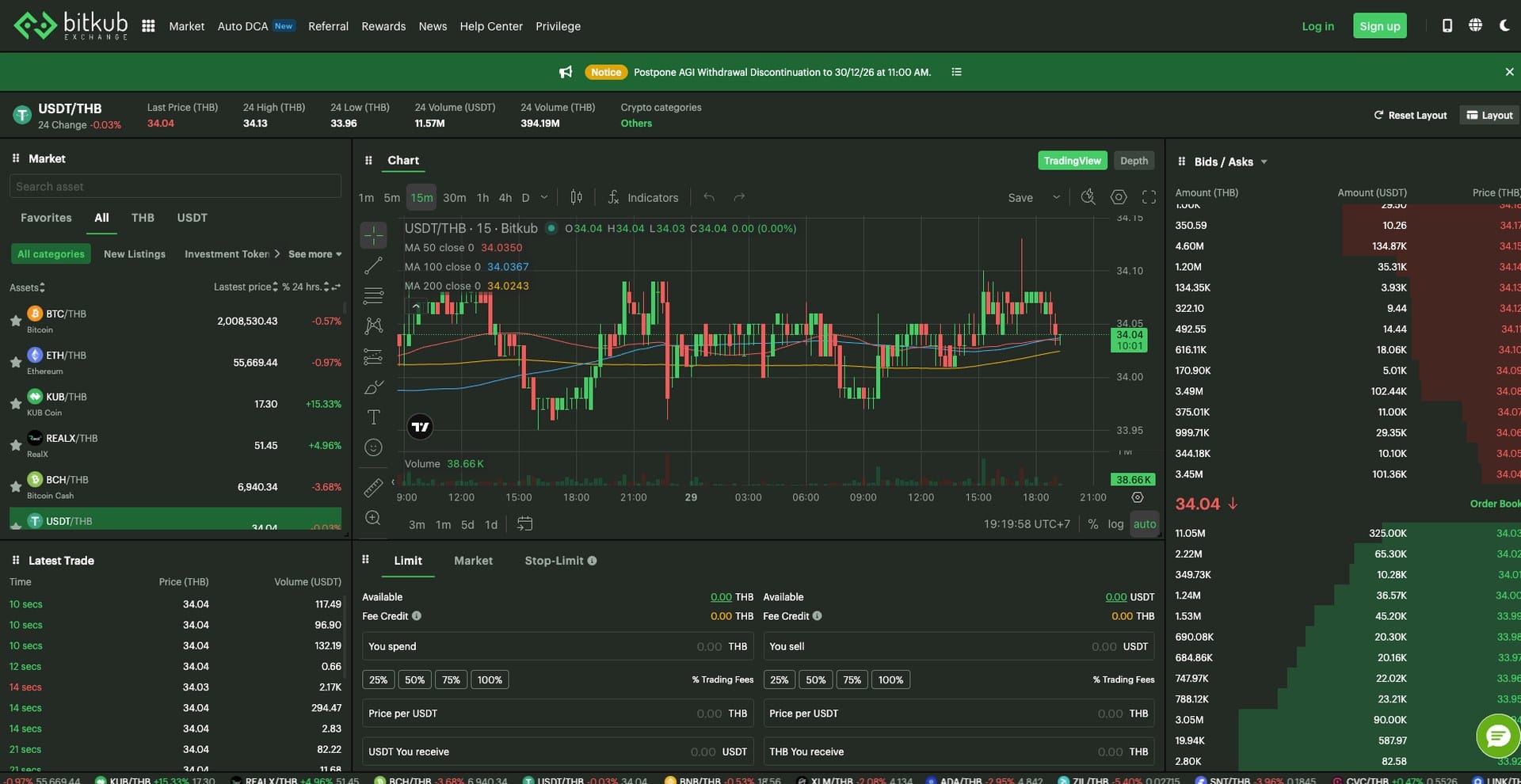
Bitkub is Thailand's best-known crypto exchange. On 29 November 2026, its USDT/THB market had a best bid of 34.03 baht and a best ask of 34.04.
The pair traded about 11.6 million USDT in 24 hours, worth around 394 million baht. Buyers were waiting for roughly 325,000 USDT at the top bid alone.
That depth means even large sales are unlikely to move the price much. Check Bitkub's fee page for trading and baht withdrawal costs.
What to note: a limit order at the bid usually costs less than a market sell.
2. Binance TH: Same Price, Smaller Book
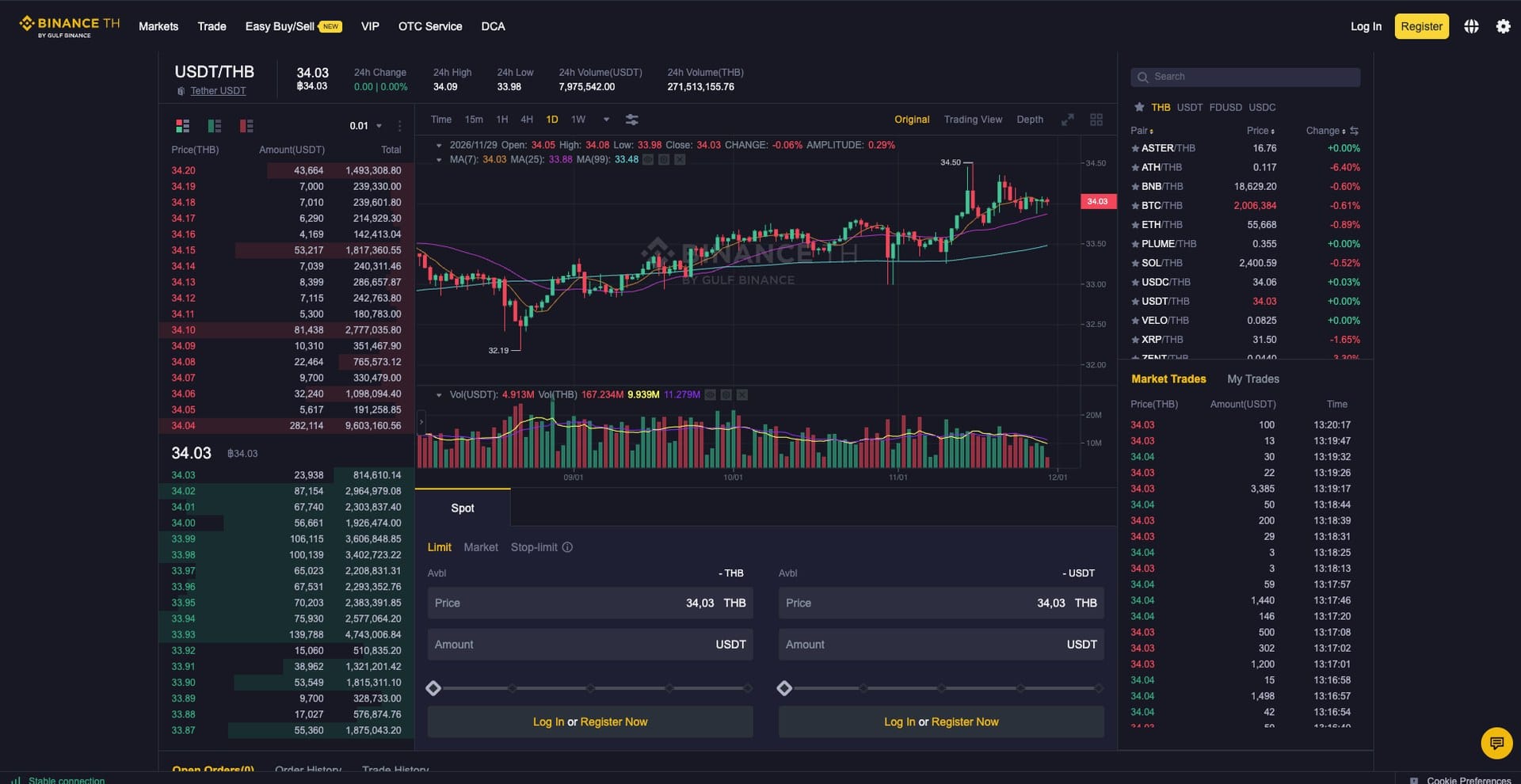
Binance TH is a separate, locally licensed exchange run with Gulf, not the global Binance app. Its USDT/THB book showed the same 34.03 bid and 34.04 ask as Bitkub.
Its 24-hour volume was about 8.0 million USDT, or roughly 272 million baht. That is smaller than Bitkub but deep enough for most retail sales.
Binance TH suits users who already know Binance's layout. Accounts are separate, so you need to complete Thai identity checks there.
What to note: a global Binance login does not carry over, so open a Binance TH account separately.
3. Offshore P2P: Closed to Baht
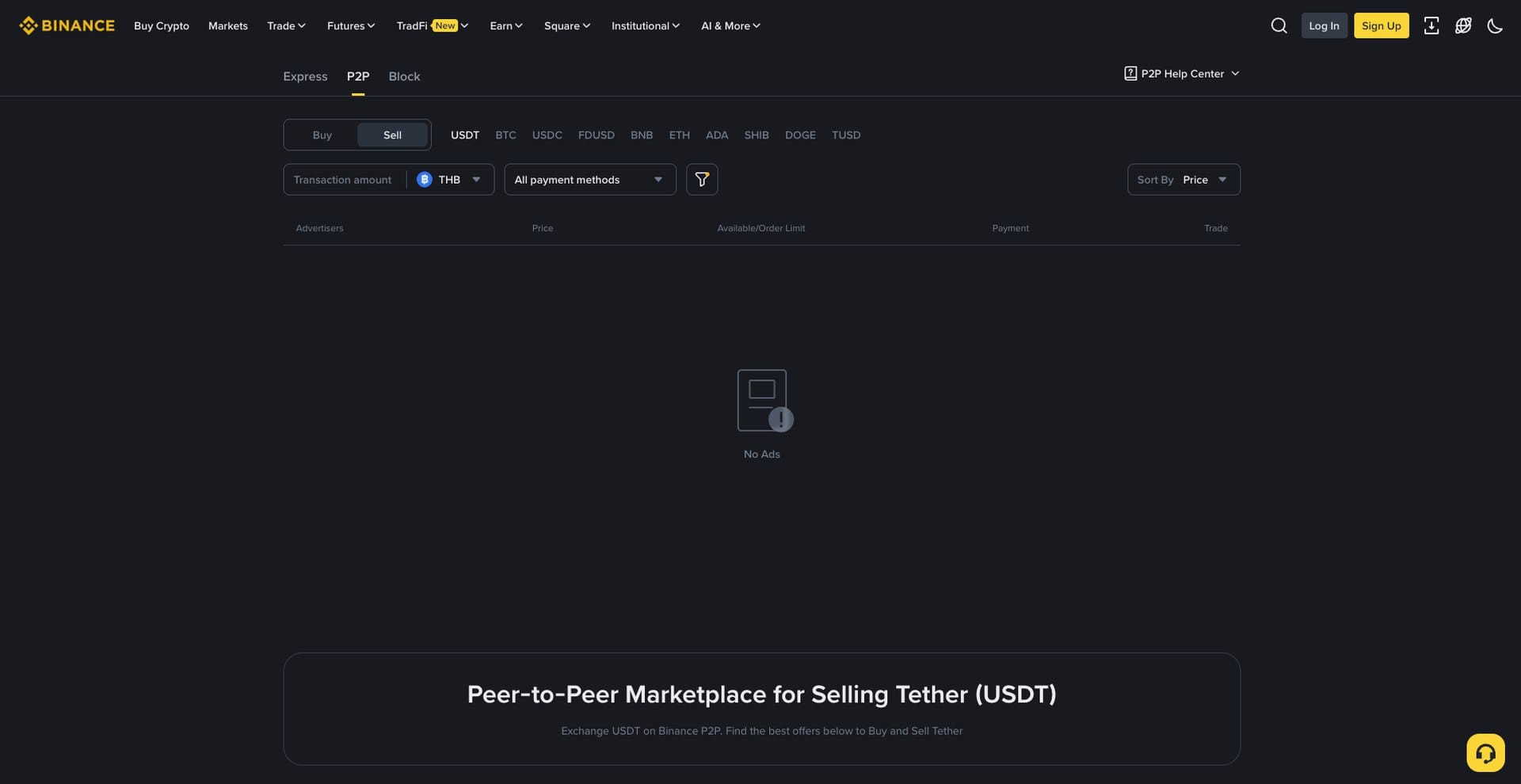
When we opened Binance's global P2P market for selling USDT for baht, it showed "No Ads." That is very different from markets such as Egypt or Ghana, where P2P dominates.
Thai rules treat foreign P2P services as digital asset exchanges, which need a local licence. In June 2025, the SEC had Bybit, OKX, CoinEx, XT.COM and 1000X blocked in Thailand for operating without one.
Selling through informal channels such as chat groups carries scam and legal risk, and gains made there do not qualify for the tax exemption.
What to note: in Thailand, the licensed exchange is the simple and safe route.
Thailand Plans a Daily Stablecoin Cap
On 12 November 2026, the SEC opened consultation on draft rules limiting stablecoin deposits and withdrawals to 5 million baht per customer, per day, at each licensed operator.
The draft would also ban transfers to or from other people's wallets. Read our report on the Thailand stablecoin transfer cap for the details.
At 34 baht per USDT, 5 million baht is roughly 147,000 USDT, so most individuals would not reach it.
What to note: the cap is a proposal, so check the final rules before moving large amounts.
Is It Legal to Sell USDT in Thailand?
Yes, through licensed platforms. Thailand's SEC added USDT and USDC to its list of approved cryptocurrencies from 16 March 2025, allowing them as trading pairs on licensed exchanges.
Offshore platforms serving Thai users without a licence can be blocked under rules that took effect in April 2025.
USDT is not legal tender in Thailand, so you cannot use it to pay for goods directly outside approved schemes.
What to note: keep to SEC-licensed exchanges, brokers and dealers.
Do You Pay Tax on USDT in Thailand?
Not on capital gains through licensed platforms until the end of 2029. Ministerial Regulation No. 399 exempts individuals from personal income tax on crypto gains made through licensed exchanges, brokers and dealers from 1 January 2025 to 31 December 2029.
The exemption applies only to individuals, not companies. Trades through licensed operators are also exempt from VAT.
Gains made through unlicensed or offshore platforms are not covered.
What to note: keep your exchange records in case the rules change after 2029.
Thailand vs Other Southeast Asian Markets
Thailand's model is closest to Indonesia's, where licensed local exchanges also handle most USDT sales. Our guide to converting USDT to IDR covers that market.
Thailand stands out for its tax holiday, while many neighbours tax crypto gains or transactions.
In every market, compare the exchange price with any instant quote before you sell.
What to note: a licensed exchange with a tight spread usually beats instant-sell features.
Risks and Limitations
- Offshore exchanges are blocked in Thailand.
- Informal P2P groups carry scam risk.
- Gains outside licensed platforms lose the tax exemption.
- A daily stablecoin cap may apply soon.
- The baht can move with the dollar.
No funds were sent, traded or withdrawn for this guide. Prices were read from Bitkub and Binance TH on 29 November 2026.
What to note: withdraw baht only to a bank account in your own name.
Conclusion
Converting USDT to THB is straightforward in 2026. On 29 November 2026, Bitkub and Binance TH both bid 34.03 baht per USDT, with spreads of about 0.03% and deep order books.
Offshore P2P is effectively closed to baht, and Thailand's tax exemption only covers licensed platforms.
Use a licensed exchange, sell with a limit order, and watch for the proposed 5 million baht daily cap. Vietnam takes a different path, as our guide to converting USDT to VND shows.
Read Next:
- Thailand Stablecoin Transfer Cap: SEC Proposes 5M Baht Daily Limit
- How to Convert USDT to IDR in Indonesia (2026): 4 Ways Compared
- How to Convert USDT to VND in Vietnam (2026): 4 Ways Compared
FAQs:
1. What is the best way to convert USDT to THB?
An SEC-licensed exchange such as Bitkub or Binance TH. On 29 November 2026, both bid 34.03 baht per USDT with spreads of about 0.03%.
2. Can I use Binance P2P to sell USDT for baht?
When we checked on 29 November 2026, Binance's global P2P market showed no baht ads. Thai rules treat foreign P2P services as exchanges that need a local licence.
3. Is selling USDT legal in Thailand?
Yes, through licensed platforms. USDT has been an approved trading pair on Thai licensed exchanges since 16 March 2025.
4. Do I pay tax when I sell USDT in Thailand?
Individuals pay no personal income tax on crypto gains made through licensed platforms from 2025 to 2029. Gains made elsewhere are not covered.
5. Is there a limit on stablecoin transfers in Thailand?
Not yet. In November 2026, the SEC proposed a cap of 5 million baht per customer, per day, on stablecoin deposits and withdrawals at each licensed operator.
Disclaimer:
This content is provided for informational and educational purposes only and does not constitute financial, investment, tax or legal advice; no material herein should be interpreted as a recommendation, endorsement, or solicitation to buy or sell any token, and readers should conduct their own independent research or consult a qualified professional. Rates, fees, licensing status and tax rules are drawn from public pages and reporting at the time of writing, are not independently verified here, and may change. No funds were sent, traded or withdrawn for this article.