
Table of Contents
Since 2025 the OCC has received 56 de novo bank applications and approved 28 of them, and on 23 November 2026 embedded payments platform Highnote joined the queue with its own application for a national bank charter (Source: Banking Dive).
Stablecoin Insider tracks every fintech and crypto firm that tries to become a US bank, and Highnote's filing shows the charter wave has reached the companies that power card programs behind the scenes.
Highnote wants to form Highnote Bank, N.A., which it calls "a national bank built for payments."
If approved, it would hold its own charter instead of relying only on partner banks to issue cards and move money for its clients.
This analysis explains what Highnote does, what it applied for, why payments firms want charters, how the process works, and what to watch next.
Key Takeaways
- Highnote applied to the OCC and FDIC on 23 November 2026.
- The proposed Highnote Bank, N.A. would be an insured national bank.
- Former LendingClub risk chief Tim Bogan would lead the bank.
- Highnote will keep working with its existing partner banks.
- The OCC has approved 28 of 56 de novo applications since 2025.
Who Highnote Is
Highnote is a San Francisco-based embedded finance and payments company founded in 2020. Its platform lets businesses issue payment cards, accept card payments, run credit programs and move money in real time, all on one ledger. Banking Dive lists BNY, home-improvement chain Lowe's and cross-border payments firm PingPong among its clients.
Like most card-issuing platforms, Highnote today depends on sponsor banks. The bank holds the licence and the card network membership, while Highnote provides the technology. That model has come under pressure since 2024, as regulators tightened oversight of bank and fintech partnerships.
What Highnote Applied For
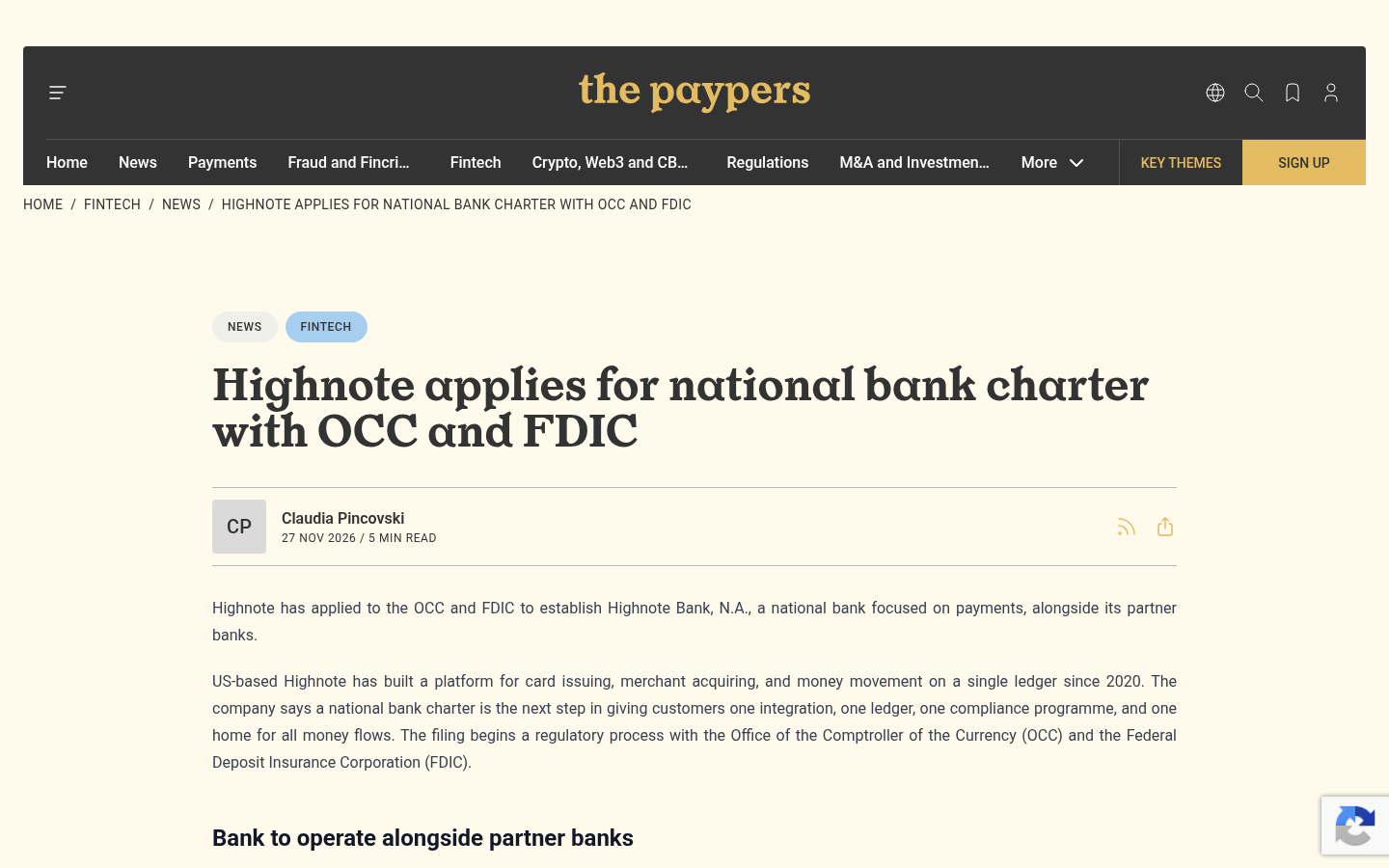
Highnote filed applications with the Office of the Comptroller of the Currency (OCC) and the Federal Deposit Insurance Corporation (FDIC) to establish Highnote Bank, N.A. It says a charter is the natural next step toward giving customers one integration, one ledger, one compliance programme and one home for all money flows (Source: The Paypers).
| Item | Detail |
|---|---|
| Proposed bank | Highnote Bank, N.A. |
| Charter type | Insured national bank |
| Regulators | OCC and FDIC |
| Filed | 23 November 2026 |
| Leader | Tim Bogan |
| Advisers | Klaros, Davis Polk |
- Leadership: Tim Bogan, president and chief banking officer, was chief risk officer, chief compliance officer and chief audit executive at LendingClub, where he led the integration of its bank acquisition.
- Board: Highnote says independent directors with experience running, auditing and governing banks will join him.
- Partner banks stay: Highnote Bank would operate alongside its current partner banks, and nothing changes for customers at this stage.
Why Payments Firms Want Their Own Charter
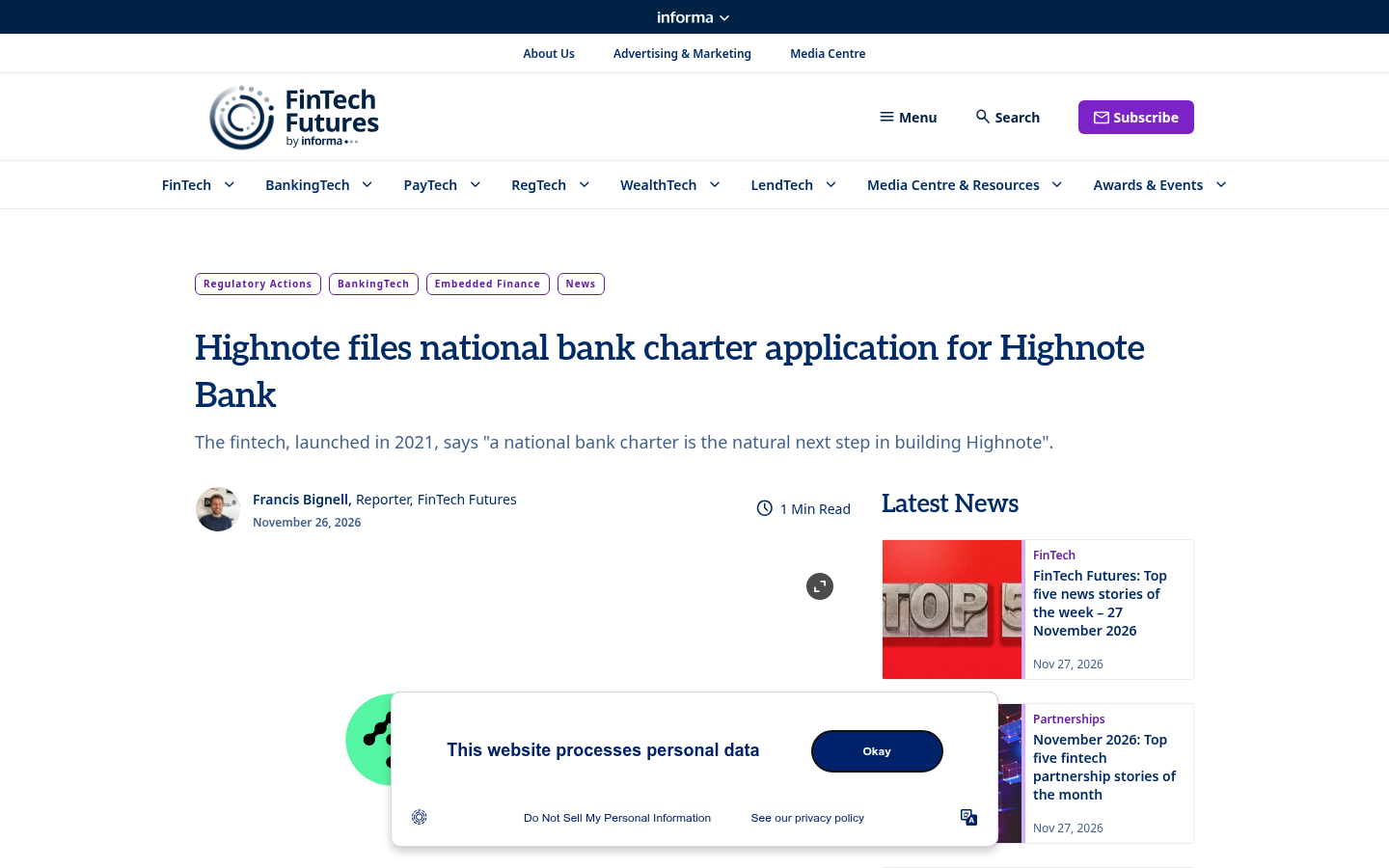
A charter changes the economics and the control of a payments business. Highnote's filing is part of a broader wave. FinTech Futures noted that the company counts BNY, Samsung, Coinflow and Splitit among its customers, and that it will name its independent board later (Source: FinTech Futures).
- Less partner bank risk: Sponsor banks can exit, reprice or freeze programs after regulatory action. A charter removes that single point of failure.
- Direct network access: A bank can hold card network memberships and connect to payment rails directly.
- Deposits: An insured bank can hold customer deposits, a cheaper and more stable funding source.
- One compliance program: Instead of satisfying several sponsor banks, the firm runs a single program under one federal regulator.
- Revenue capture: Interchange and float income no longer has to be shared with a partner bank.
The trade-off is cost and scrutiny. Klaros Group co-founder Michele Alt, who worked on the application, told Banking Dive that becoming a bank is expensive, complex and "not for the faint of heart."
The 2026 Charter Rush
Highnote is one of many fintechs seeking charters this year. Dave and Avant have applied for national banks, Mercury won conditional OCC approval, and Nubank received conditional approval in January. Others, such as Flex and Upgrade, chose industrial loan company charters instead.
| Firm | Charter | Status |
|---|---|---|
| Highnote | National bank | Filed |
| MoonPay | Trust bank | Filed |
| Dave | National bank | Filed |
| Mercury | National bank | Conditional |
| Nubank | National bank | Conditional |
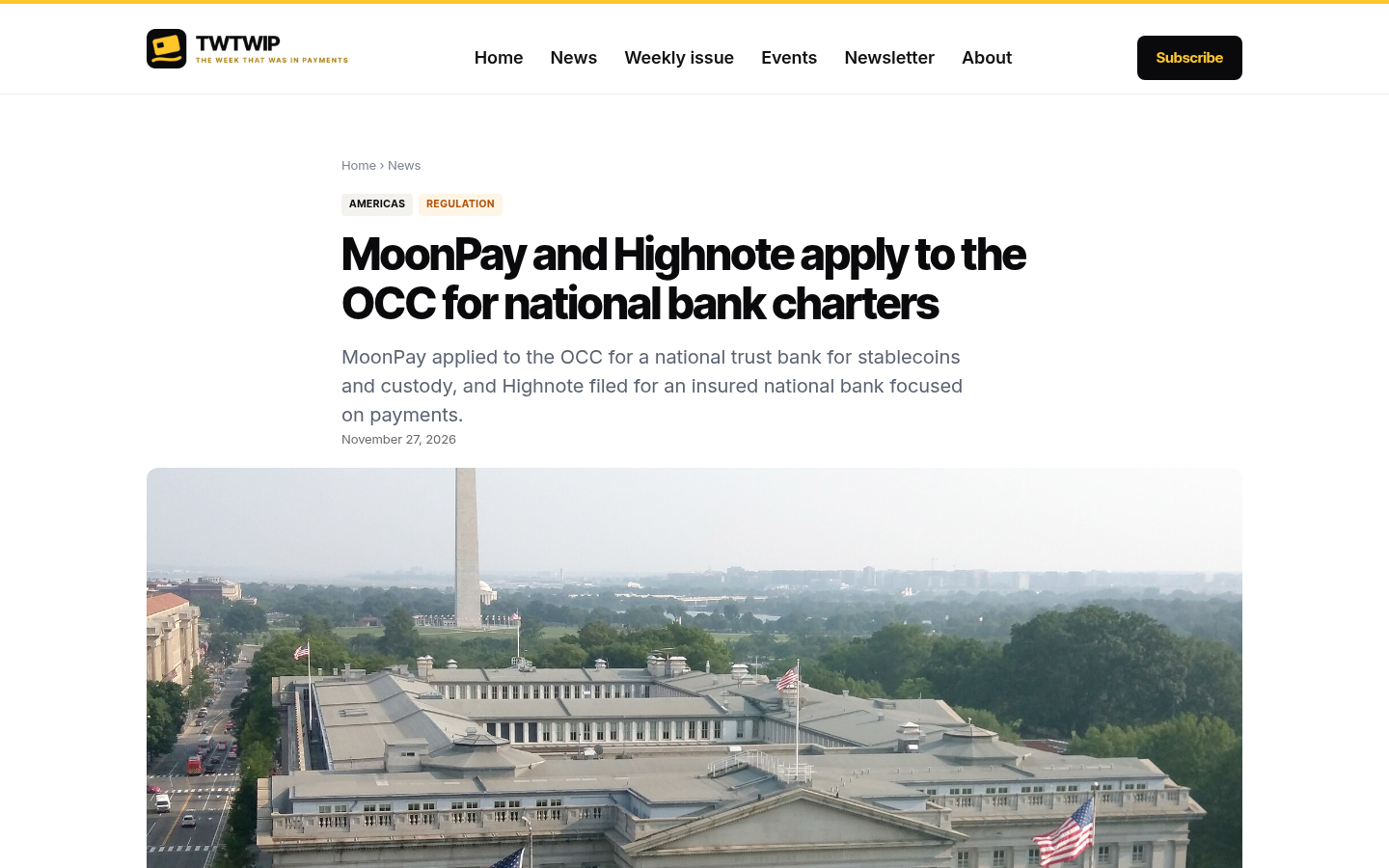
Crypto firms are in the same queue. MoonPay applied the same week for a national trust bank in Miami Beach that would take no deposits and make no loans but would offer digital asset custody, fiat-to-crypto conversion and stablecoin issuance and redemption (Source: TWTWIP).
Our OCC charter tracker follows every decision, and our guide to trust charters vs bank charters explains why MoonPay and Highnote chose different routes.
How the Approval Process Works
- Two approvals: An insured national bank needs a charter from the OCC and deposit insurance from the FDIC.
- Timing: The OCC says it often decides within 120 days of a complete application.
- Conditional first: Most approvals start as conditional, with capital, compliance and staffing requirements to meet before opening.
- Denials happen: In July 2026 the OCC issued its first charter denial under the current administration, citing anti-money laundering weaknesses at the proposed parent company.
- Holding company: Depending on structure, the parent may also need Federal Reserve approval.
Comptroller Jonathan Gould said this month that a functional chartering process "allows the banking system to renew itself and remain dynamic," according to Banking Dive.
What It Means for Stablecoin and Crypto Firms
- Card issuing for crypto: Highnote serves crypto payments clients such as Coinflow. A chartered issuer could offer crypto and stablecoin card programs with fewer sponsor bank limits.
- Bank and trust charters converge: Payments firms seek full banks, while Circle, Ripple and Coinbase have already won OCC trust charters and MoonPay is seeking one.
- GENIUS Act timing: Stablecoin rules under the GENIUS Act take effect in January, which is pushing crypto firms to secure federal charters now.
- Agent payments: Chartered payment banks could become the base layer for AI agent cards and accounts, a trend covered in our analysis of agentic banking.
Not every charter route is the same. Our analysis of OakNorth's US bank charter shows a firm that bought an existing bank instead of starting a new one.
What to Watch
- OCC listing: When the application appears on the OCC's public site and opens for comment.
- Board names: Who Highnote appoints as independent directors.
- Conditional approval: Whether the OCC decides within about 120 days of a complete filing.
- FDIC insurance: The separate deposit insurance decision, which has lagged OCC approvals for some fintechs.
- Partner banks: How Highnote's sponsor banks respond once it can compete with them directly.
Conclusion
Stablecoin Insider follows how fintechs and crypto firms move into the regulated banking system, and Highnote's filing shows that the infrastructure layer of payments now wants a charter too.
If approved, Highnote Bank would let the company issue cards, move money and hold deposits under its own licence, while still working with partner banks.
The process will take months and require strong capital, compliance and governance.
With the OCC approving about half of the de novo applications it has received since 2025, Highnote has a realistic path, but a conditional approval is only the start of becoming a bank.
Read Next
- Intermex vs Western Union: Why the $500 Million Remittance Merger Went to Court
- Emirates Islamic Alternatives (2026): 4 Islamic Banks to Switch To After the DIB Deal
- SpaceX vs Tesla Stock (2026): Growth, Cash Burn, Control and the Merger Question
FAQs
1. What is Highnote?
Highnote is a US embedded finance and payments company founded in 2020. Its platform lets businesses issue cards, accept payments, run credit programs and move money in real time on a single ledger.
2. What charter did Highnote apply for?
Highnote applied for an insured national bank charter to form Highnote Bank, N.A. It filed with the OCC for the charter and with the FDIC for deposit insurance on 23 November 2026.
3. Will Highnote stop using partner banks?
Highnote will not stop using partner banks, according to the company. It says Highnote Bank would operate alongside its existing partner banks and that nothing changes for customers at this stage.
4. Who will run Highnote Bank?
Highnote Bank will be run by Tim Bogan as president and chief banking officer. He previously served as chief risk officer, chief compliance officer and chief audit executive at LendingClub.
5. How long does an OCC charter decision take?
An OCC charter decision often takes about 120 days from a complete application, according to the agency. Most approvals are conditional at first, and the FDIC must separately approve deposit insurance.
Disclaimer: This content is provided for informational purposes only and does not constitute legal, financial, or investment advice. Details of Highnote's application reflect publicly available information as of November 2026 and may change as regulators review it. Check official OCC, FDIC and company sources for the latest updates.