
Table of Contents
The Philippines is one of the busiest USDT cash-out markets in Asia. Freelancers, remote workers and families receiving money from abroad all need the same thing: pesos in a bank or GCash account.
The good news is that several licensed local platforms convert USDT to PHP. The catch is that fees hide in three places: the trading spread, the platform fee and the cash-out fee.
This guide compares five ways to convert USDT to PHP in 2026, using each platform's own fee pages.
For most people, the cheapest licensed route is to deposit USDT on Coins.ph, sell it on the spot market, and cash out over PESONet for free. GCash GCrypto is the simplest if you already live in the GCash app.
Key Takeaways
- Coins.ph spot trading starts at a 0.15% taker fee.
- Coins.ph charges nothing for PESONet cash-outs.
- PDAX charges a flat 0.5% taker fee.
- GCash GCrypto builds its fees into the price.
- Binance is still blocked in the Philippines.
The 5 Ways to Convert USDT to PHP at a Glance
| Route | Trading cost | Cash-out cost | Best for |
|---|---|---|---|
| Coins.ph Spot | 0.1% maker, 0.15% taker (Tier 0) | PESONet free, InstaPay PHP 5 | Lowest cost on most amounts |
| Coins.ph Convert | No fee, cost is in the spread | PESONet free, InstaPay PHP 5 | One-tap simplicity |
| PDAX | 0.5% taker | PESONet PHP 10, InstaPay PHP 15 | Large PESONet transfers |
| GCash GCrypto | Built into the quoted price | Free move to your GCash wallet | GCash users |
| P2P or offshore exchange | Varies by buyer | Varies | Experienced users only |
Each route has two steps. You first sell USDT for pesos on the platform, then move the pesos to your bank or e-wallet, the same pattern we used to convert USDT to INR.
What to note: compare the pesos you finally receive, not the advertised fee, because spreads can cost more than fees.
1. Coins.ph Spot: The Cheapest Licensed Route
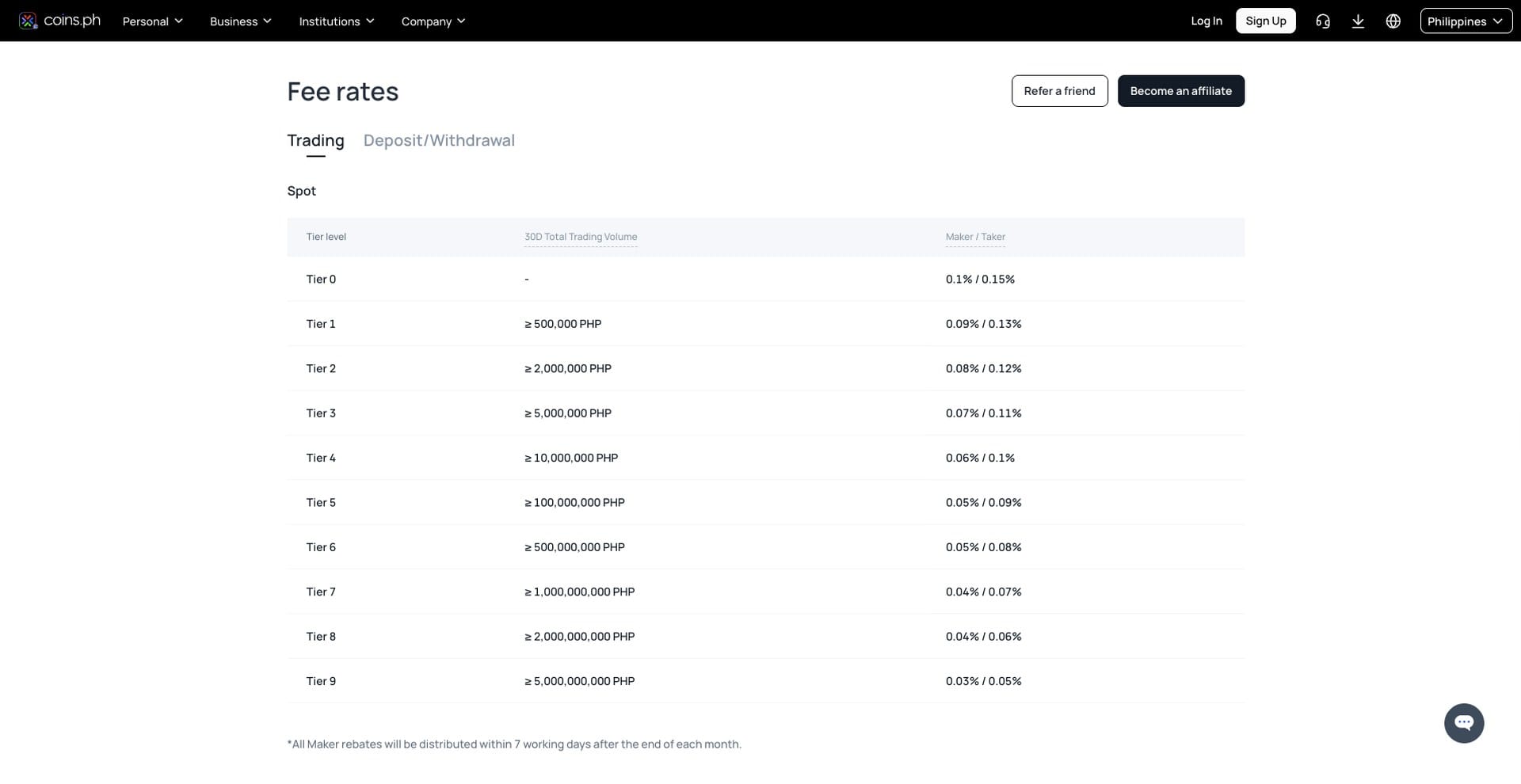
Coins.ph is a licensed local platform with a live USDT/PHP order book. Its fee page lists spot fees of 0.1% for makers and 0.15% for takers at the entry tier.
Fees fall with volume. Above 500,000 PHP of 30-day trading, the taker fee drops to 0.13%.
Placing a limit order makes you a maker, so you pay the lower 0.1%. A market order fills instantly at the 0.15% taker rate.
What to note: on 500 USDT, a 0.15% taker fee is about 0.75 USDT.
2. Coins.ph Convert and Cash-Out Fees
Coins Convert is the one-tap option. Coins.ph says it has zero trading fees, but the buy and sell rates differ, so the cost is inside the spread.
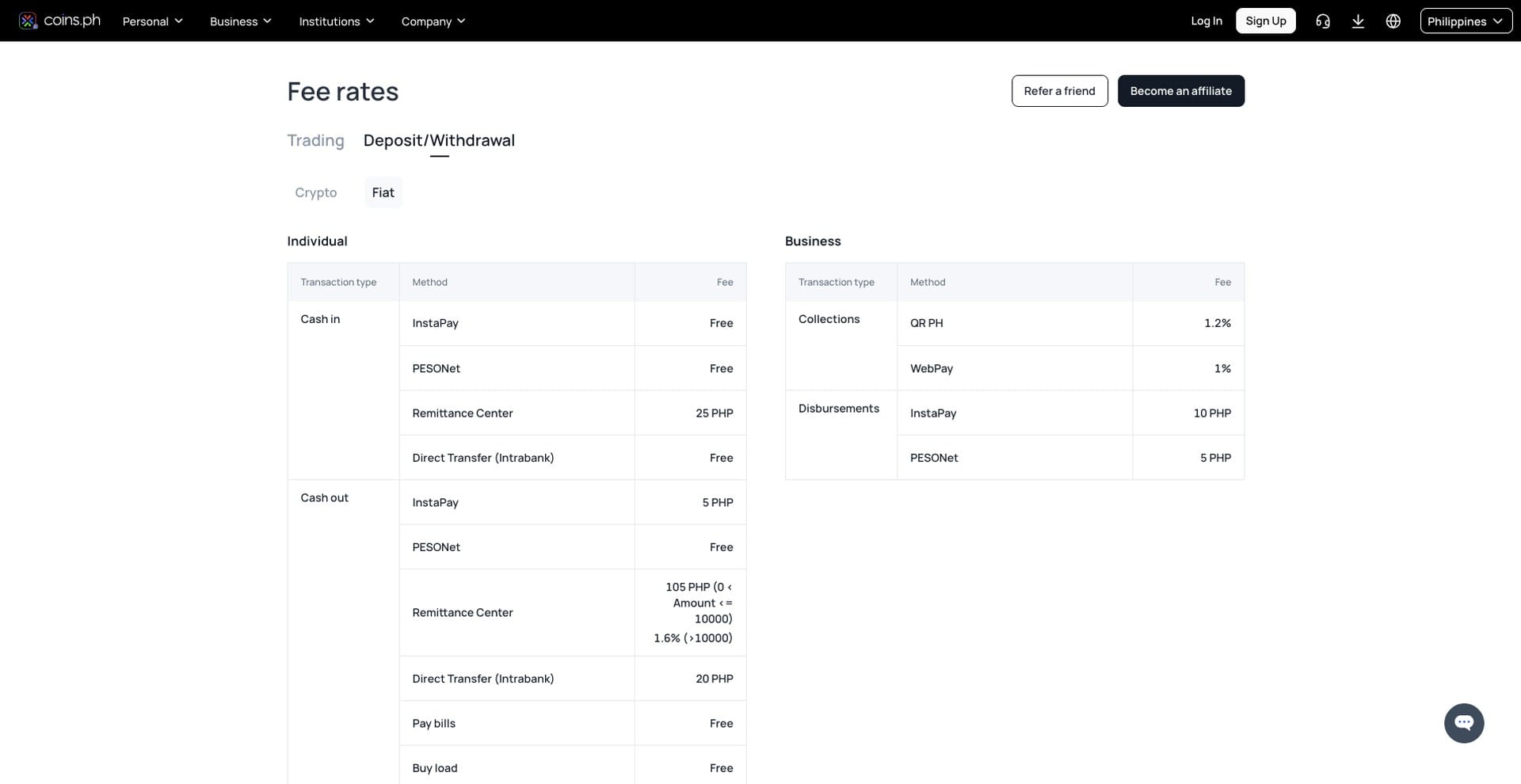
Cashing out is cheap either way. The fee page lists free PESONet cash-outs, PHP 5 for InstaPay and PHP 20 for intrabank transfers.
Remittance center pickup is the expensive option. It costs PHP 105 up to 10,000 PHP and 1.6% above that.
What to note: use PESONet if you can wait for batch settlement, and InstaPay if you need pesos within minutes.
Which Network to Deposit USDT On
Coins.ph accepts USDT on many networks, including Tron, TON, Solana, Ethereum, Arbitrum and Polygon. Its fee page lists no deposit fee, and the Tron minimum is 1 USDT.
That means the main sending cost is the network fee on your side. Tron is the most widely supported route, and our guide to the cheapest Tron transfers shows how to cut that fee.
Always match the network on both sides. Sending USDT on one network to an address for another is the most common way funds go missing.
What to note: copy the deposit address from the platform each time and send a small test first.
3. PDAX: Flat Fees and High PESONet Limits
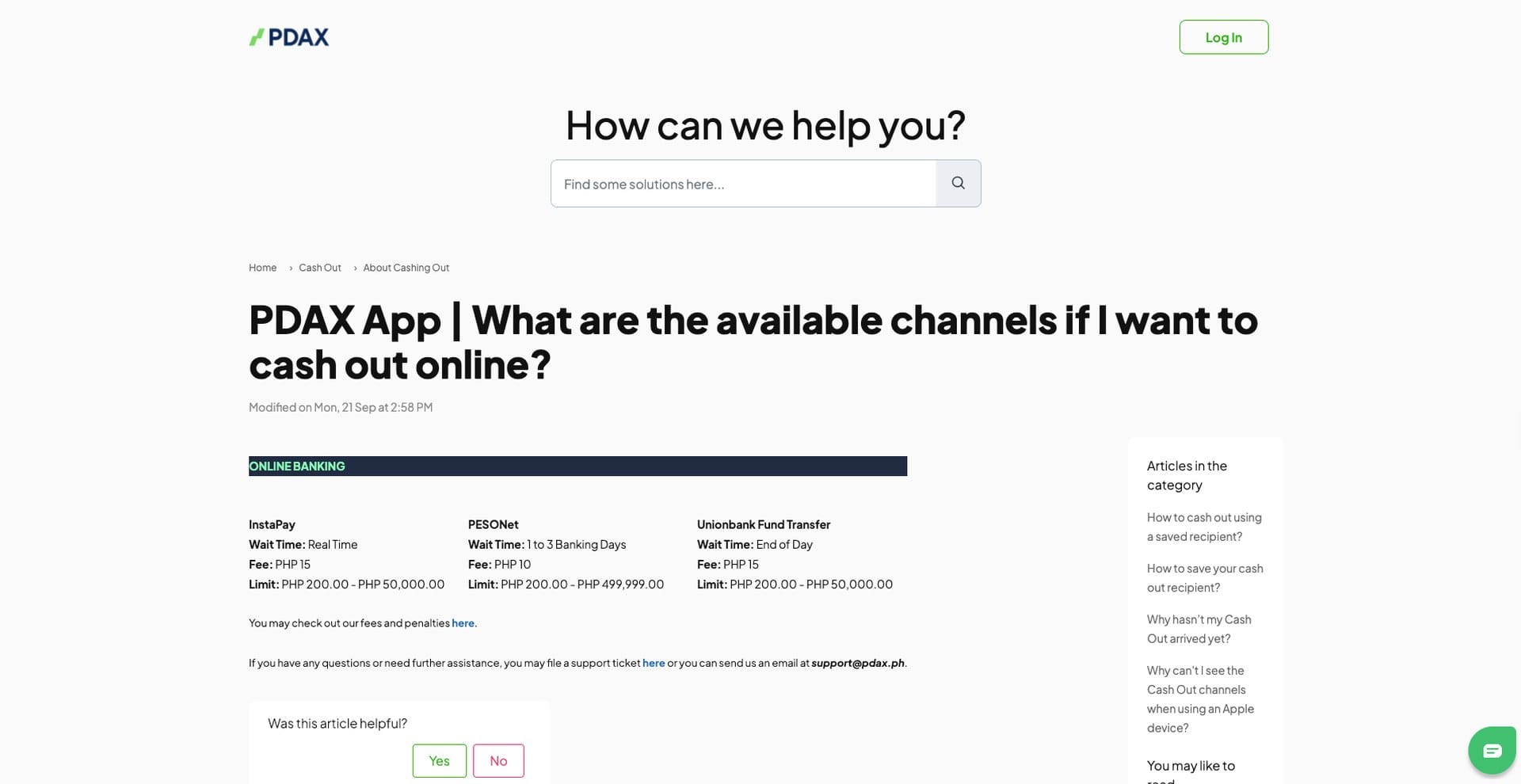
PDAX is another licensed exchange with a USDT/PHP market. Its help center lists a flat 0.5% taker fee, whatever your volume.
Cash-outs cost PHP 15 by InstaPay and PHP 10 by PESONet. Unionbank transfers cost PHP 15 and settle at the end of the day.
PDAX's PESONet limit runs to PHP 499,999 per transaction. That is useful for large one-off cash-outs, while InstaPay is capped at PHP 50,000.
What to note: PDAX only pays out to accounts in your own name, so check the name matches before you withdraw.
4. GCash GCrypto: The Easiest Option
GCrypto is the crypto feature inside the GCash app. It supports several USDT versions, including USDT on Tron and TON.
GCash's fee page lists no fee for buying, selling, receiving or moving funds between GCrypto and your GCash wallet. The catch is that the sell price already includes service and platform fees.
After you sell, the pesos land in your GCrypto Trading Wallet, then move to your main GCash balance. From there, GCash charges PHP 10 for InstaPay transfers to banks from 4 July 2026.
What to note: compare GCrypto's sell price with Coins.ph before large trades, because the built-in spread is not shown as a separate fee.
5. P2P and Offshore Exchanges
P2P marketplaces let you sell USDT to a buyer who pays pesos directly to your bank or GCash. Prices can be good, but you carry the counterparty risk.
Binance, long the biggest P2P venue, remains blocked in the Philippines after a 2024 directive. In June 2026, the central bank said neither Binance nor its local partner BlockShoals holds a VASP license.
Using unlicensed platforms can leave you without local recourse if funds or bank accounts are frozen.
What to note: never release USDT on any P2P platform until the pesos are confirmed in your own account.
Worked Example: Cashing Out 500 USDT
| Route | Trading fee | Cash-out fee |
|---|---|---|
| Coins.ph Spot, taker | About 0.75 USDT (0.15%) | PESONet free or InstaPay PHP 5 |
| Coins.ph Spot, maker | About 0.50 USDT (0.1%) | PESONet free or InstaPay PHP 5 |
| PDAX, taker | About 2.50 USDT (0.5%) | PESONet PHP 10 or InstaPay PHP 15 |
| GCash GCrypto | Inside the quoted price | Free to GCash wallet |
These figures leave out the spread and your network fee. On small amounts, the flat peso cash-out fee matters more than the percentage.
No funds were sent or traded for this guide. All fees come from official platform pages and may change.
What to note: check the final peso amount on the confirmation screen before you sell.
Sending Money to Family in the Philippines
Many Filipinos abroad now send USDT instead of using a remittance company. The family deposits it on a local platform and cashes out to a bank or GCash.
Senders in the United States should also understand the US remittance tax, which applies to some traditional transfers.
Make sure the recipient has a verified account before you send, because unverified accounts may not be able to sell or withdraw.
What to note: agree on the network and platform with your family before the first transfer.
Risks and Limitations
- Spreads on Convert and GCrypto are not shown as fees.
- InstaPay caps single transfers at PHP 50,000 on PDAX.
- Unlicensed P2P platforms offer little local recourse.
- Wrong-network deposits can be slow or impossible to recover.
- Fees and limits can change without notice.
What to note: keep records of every trade and withdrawal in case your bank or a tax authority asks.
Conclusion
Converting USDT to PHP is straightforward in 2026, thanks to licensed platforms and cheap InstaPay and PESONet rails.
Coins.ph spot trading with a free PESONet cash-out is the lowest-cost route for most amounts. PDAX suits large PESONet withdrawals, and GCash GCrypto wins on convenience.
Whichever route you pick, match the network, use a verified account in your own name, and check the final peso amount before you sell.
Read Next:
- Cheapest Way to Send USDT on TRON in 2026: Energy Rental, Staking and GasFree Compared
- US Remittance Tax 2026: How the 1% Transfer Tax Works and How to Avoid It
- How to Convert USDT to INR in India (2026): 5 Ways Compared
FAQs:
1. What is the cheapest way to convert USDT to PHP?
For most amounts, selling on Coins.ph spot and cashing out by PESONet is cheapest. Coins.ph lists a 0.15% taker fee at the entry tier and free PESONet cash-outs.
2. Can I convert USDT to PHP in GCash?
Yes, through GCrypto inside the GCash app. It supports USDT on several networks, and the sell price already includes GCash's service and platform fees.
3. How much does PDAX charge to cash out?
PDAX lists PHP 15 for InstaPay, PHP 10 for PESONet and PHP 15 for Unionbank transfers. Its trading fee is a flat 0.5% for takers.
4. Is Binance available in the Philippines?
No. Binance has been blocked since a 2024 directive, and in June 2026 the central bank said it does not hold a local VASP license.
5. Which network should I use to send USDT to Coins.ph?
Coins.ph accepts USDT on Tron, TON, Solana, Ethereum and several other networks with no listed deposit fee. Pick a network your wallet supports and match it exactly on both sides.
Disclaimer:
This content is provided for informational and educational purposes only and does not constitute financial, investment, tax or legal advice; no material herein should be interpreted as a recommendation, endorsement, or solicitation to buy or sell any token, and readers should conduct their own independent research or consult a qualified professional. Fees, limits and regulatory details are drawn from official platform pages and public reporting at the time of writing, are not independently verified here, and may change. No funds were sent, traded or withdrawn for this article.