Table of Contents
To convert USDT to INR, send your USDT to an Indian exchange registered with the Financial Intelligence Unit (FIU-IND), sell it for rupees, and withdraw to a bank account in your own name. On Mudrex the USDT to INR conversion carries no trading fee, only the 1% TDS.
P2P trading, global exchanges with rupee support, OTC desks and invoice payout services are the other routes. Each has different costs, limits and risks, especially around bank account freezes.
This guide compares five ways to cash out USDT in India, with published fees, the tax rules and the safety checks to run before you sell.
The cheapest route is not the one with the best quoted rate. A P2P trade that pays a few rupees more per USDT can cost far more if it gets your bank account frozen.
Key Takeaways
- Use an FIU-registered exchange and a bank account in your name.
- Selling USDT triggers 1% TDS above small annual thresholds.
- Any gain on the sale is taxed at a flat 30%.
- Mudrex charges no fee on USDT to INR conversions.
- P2P sales carry a real risk of bank account freezes.
What USDT Is Worth in Rupees
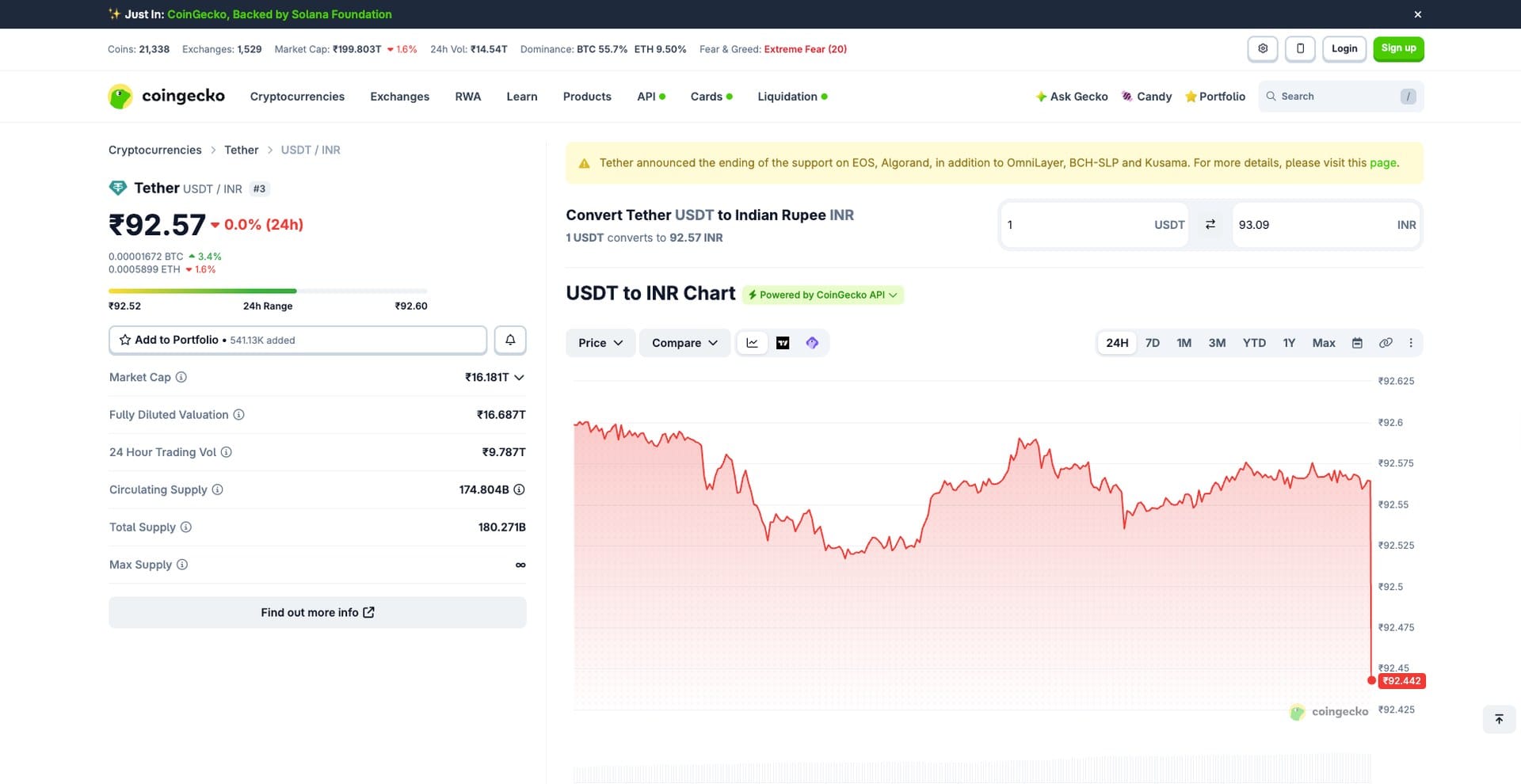
CoinGecko showed 1 USDT at about ₹92.57 on 21 November 2026, with a narrow daily range. That is a global reference price, not the rate every Indian exchange pays.
Indian exchanges run their own USDT/INR order books, so the price you get can sit above or below the global rate. Always compare the final rupee amount after fees and TDS, not the headline price.
For 1,000 USDT at ₹92.57, the gross value is about ₹92,570. The deductions below come out of that figure.
What to note: check two or three exchanges on the same day, since USDT/INR prices can differ between them.
Option 1: Sell on an FIU-Registered Indian Exchange
This is the simplest and safest route for most people. A parliamentary disclosure in March 2026 listed 54 crypto service providers registered with FIU-IND, including CoinDCX, CoinSwitch and Mudrex.
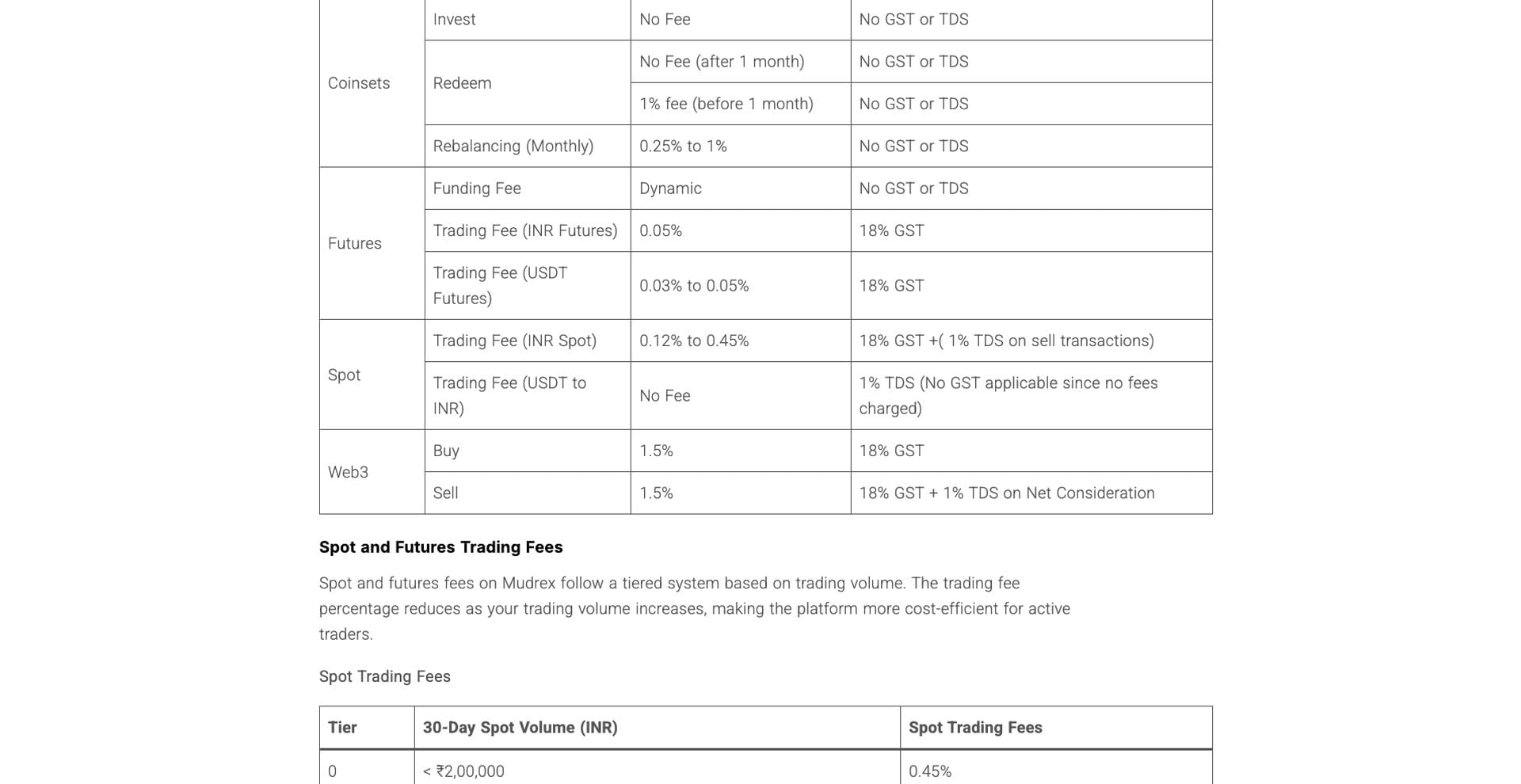
The steps are the same everywhere: complete KYC, link a bank account in your name, deposit USDT on a network the exchange supports, sell for INR and withdraw. Mudrex lists no fee on USDT to INR conversions, deducts 1% TDS, and charges nothing for INR withdrawals.
Sending USDT to the exchange first is where many people overpay. Our guide to the cheapest USDT transfers on Tron explains how to cut that network cost.
What to note: confirm the deposit network on the exchange before sending, since a wrong network can delay or lose your USDT.
Fees on Major Indian Exchanges
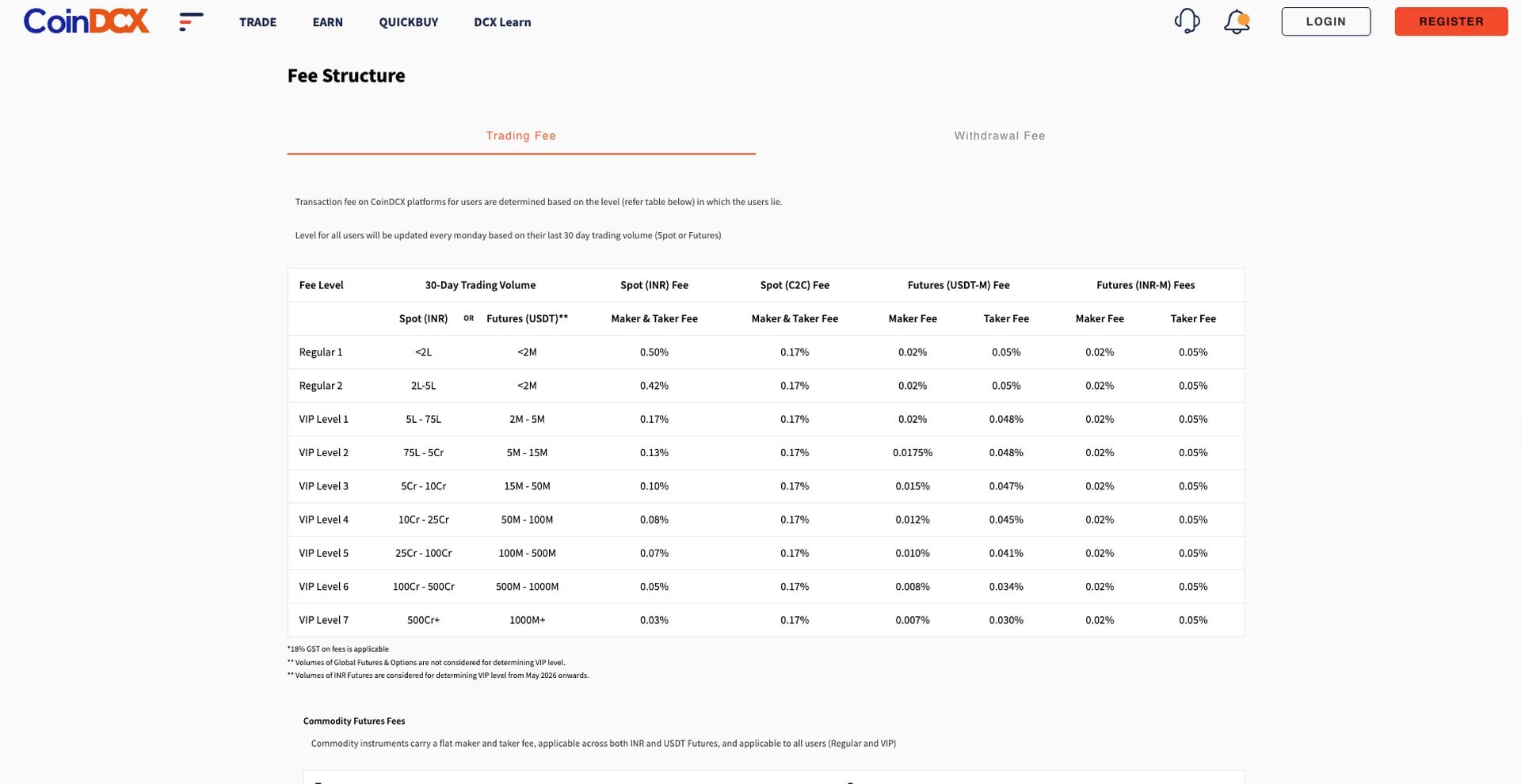
CoinDCX charges a 0.50% spot fee on INR markets for users trading under ₹2 lakh a month, falling to 0.42% up to ₹5 lakh and lower at VIP levels. GST of 18% applies on top of the fee.
| Cost on 1,000 USDT at ₹92.57 | Mudrex convert | CoinDCX spot, under ₹2 lakh |
|---|---|---|
| Trading fee | ₹0 | About ₹463 (0.50%) |
| GST on fee | ₹0 | About ₹83 (18% of fee) |
| 1% TDS withheld | About ₹926 | About ₹920 |
| INR withdrawal | Free | Check app |
TDS is not a fee. It is tax paid in advance, shows up in your Form 26AS and counts against your final tax bill.
What to note: exchanges often calculate TDS on the amount after fees, so expect small differences from these estimates.
Options 2 to 5: Other Ways to Cash Out
- Global exchanges with INR: Binance and Coinbase registered with FIU-IND, and Coinbase restored INR deposits and withdrawals for Indian users in May 2026.
- P2P trading: you sell USDT directly to a buyer who pays by UPI or bank transfer. Rates can be better, but the bank risk is the highest of any route.
- OTC desks: exchange desks handle large sales at a single quoted price, so big orders do not move the order book.
- Invoice payout services: freelancers paid in USDT can use services such as Xflow, which say they convert offshore and pay INR with an e-FIRA for the invoice.
The same five routes exist in other markets. Our guide to converting USDT to naira compares them for Nigeria.
What to note: whichever route you use, the 30% tax and 1% TDS still apply to the sale.
The P2P Bank Freeze Risk
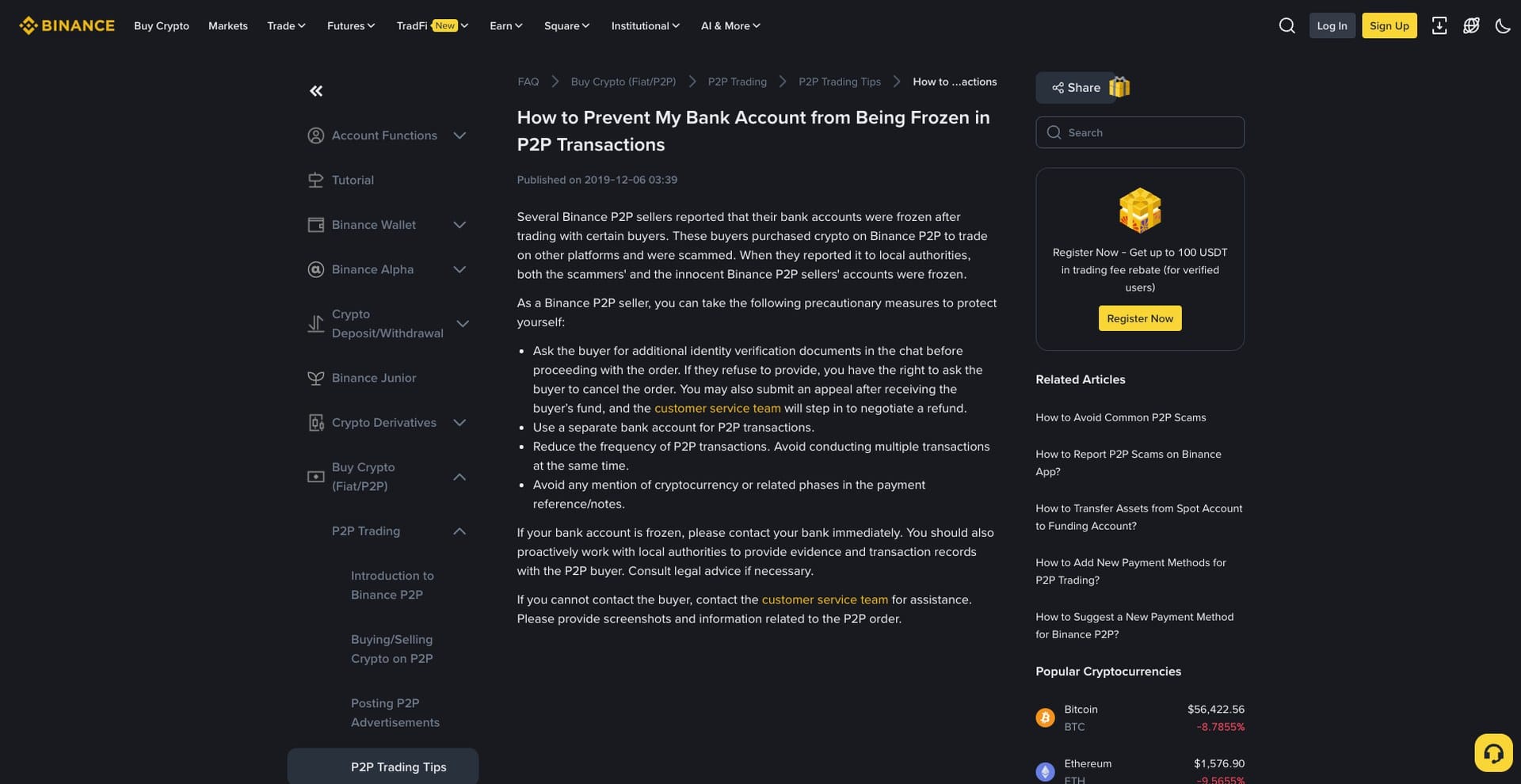
The danger with P2P is where the buyer's money comes from. If a scammer pays you with money taken from a fraud victim, police can freeze every account that money touched, including yours.
Binance's own help page describes sellers whose bank accounts were frozen after trading with buyers linked to scams. It advises using a separate bank account, trading less often and keeping crypto words out of payment notes.
In India, merchants have reported bank liens weeks after receiving UPI payments for USDT. Unfreezing an account can involve police and bank paperwork that takes months.
What to note: if you use P2P, only accept payment from a bank account in the buyer's verified name, never from a third party.
How USDT Sales Are Taxed in India
India taxes crypto, including USDT, as a Virtual Digital Asset. Budget 2026 kept the rules unchanged, and the Income-tax Act, 2025 carries them forward from 1 April 2026.
- 30% tax on gains: any profit is taxed at a flat 30% plus cess, with only the purchase cost deductible.
- No loss set-off: losses on crypto cannot reduce other income or be carried forward.
- 1% TDS: deducted on sales once yearly transactions pass ₹50,000 for specified persons or ₹10,000 for others.
- Reporting: sales go in Schedule VDA of your income tax return, matched against TDS in Form 26AS.
If you bought USDT at ₹88 and sold at ₹92.57, the gain of about ₹4.57 per USDT is taxed at 30%. Tools covered in our list of crypto tax software can track this for you.
What to note: USDT received as payment for work can be treated differently, so freelancers should confirm with a chartered accountant.
Step-by-Step: USDT to Your Bank Account
- Pick an FIU-registered exchange and complete KYC with PAN and Aadhaar.
- Link a bank account in your own name.
- Copy the USDT deposit address and check the network, such as TRC20.
- Send a small test amount, then the rest once it arrives.
- Sell USDT for INR using instant convert or the order book.
- Withdraw INR to your bank by IMPS or NEFT and keep the transaction records.
What to note: download the exchange's TDS statement each year, as you will need it to file your return.
How This Guide Was Made
Fees come from CoinDCX's and Mudrex's published fee pages and the USDT price from CoinGecko, all read on 21 November 2026. Tax rules come from the Income Tax Department and Budget 2026 coverage. No USDT was sold for this guide.
Fees and rates change often. This is general information, not tax advice.
What to note: check the exchange's live fee and TDS breakdown on the confirmation screen before you sell.
Risks and Limitations
- P2P trades can lead to bank account freezes or liens.
- Indian USDT/INR prices can differ from the global rate.
- Exchange withdrawals can be delayed by compliance checks.
- Crypto losses cannot offset other income in India.
- Unregistered offshore platforms can be blocked in India.
Conclusion
For most people in India, the best way to convert USDT to INR is an FIU-registered exchange with a bank account in their own name. Mudrex's zero-fee conversion and CoinDCX's order book are two common options.
P2P can pay slightly more but carries bank freeze risk. Whatever route you choose, plan for the 1% TDS and the 30% tax on any gain.
Compare the final rupee amount across two exchanges, send a test transfer first, and keep every record for tax time.
Read Next:
- How to Convert USDT to Naira in 2026: 5 Ways Compared
- Cheapest Way to Send USDT on TRON in 2026: Energy Rental, Staking and GasFree Compared
- Best Crypto Tax Software for Stablecoin Users (2026): 5 Tools Compared
FAQs:
1. Is it legal to convert USDT to INR in India?
Yes. Buying and selling crypto is legal in India and taxed as a Virtual Digital Asset. Use an exchange registered with FIU-IND and complete KYC.
2. How much tax do I pay when selling USDT?
Any gain is taxed at a flat 30% plus cess, and 1% TDS is deducted on sales above small yearly thresholds. The TDS counts toward your final tax.
3. Which exchange charges the least to convert USDT to INR?
Mudrex lists no fee on USDT to INR conversions, with only 1% TDS deducted. CoinDCX charges 0.50% plus GST for users trading under ₹2 lakh a month.
4. Is Binance P2P safe for selling USDT in India?
It works, but sellers have reported bank account freezes when buyers paid with scam-linked money. Binance itself advises a separate bank account and fewer P2P trades.
5. How long does it take to get INR in my bank?
INR withdrawals by IMPS are usually quick once the sale is complete, but exchange compliance checks and bank reviews can add delays.
Disclaimer:
This content is provided for informational and educational purposes only and does not constitute financial, investment, tax, or legal advice; no material herein should be interpreted as a recommendation, endorsement, or solicitation to buy or sell any token, and readers should conduct their own independent research or consult a qualified professional such as a chartered accountant. Fees, rates and rules are drawn from exchanges, CoinGecko, the Income Tax Department and public reports at the time of writing, are not independently verified here, and may change. Selling crypto carries market, platform and banking risks.