Table of Contents
Written by: Zubair Tariq
In 2004 roughly seventy percent of Saudi bill payments were made in cash at a branch counter. The government built a single pipe connecting every bank to every biller, and by last year that system was carrying more than fourteen billion transactions worth about two hundred and fifty billion dollars.
The man who built it now chairs the tokenization programme.
That is Faisal Monai, who built SADAD for the Saudi Central Bank and today chairs droppRWA. He is worth listening to for the same reason he is worth discounting. He has done this once at national scale, and he is also selling the next version of it.
What Has Actually Been Built
Most coverage of digital assets in the Gulf is about Dubai. That is reasonable. Dubai has the exchanges, the licences, the conferences and the noise.
Saudi Arabia has been doing something quieter and, on the evidence, larger.
The Real Estate Registry, under the Real Estate General Authority, has put a national blockchain system into operation. Not a pilot. It covers property registration, fractional ownership and marketplace integration, built on Settlemint's tokenization platform. It uses W3C Verifiable Credentials and eIDAS 2.0 for interoperability, and it supports Shariah-compliant asset structures.
On the fourth of February this year, a tokenized title deed changed hands. Settlement went from days to seconds. Whether it was truly the world's first, as the participants claim, is less interesting than the fact that a sovereign land registry now settles on chain.
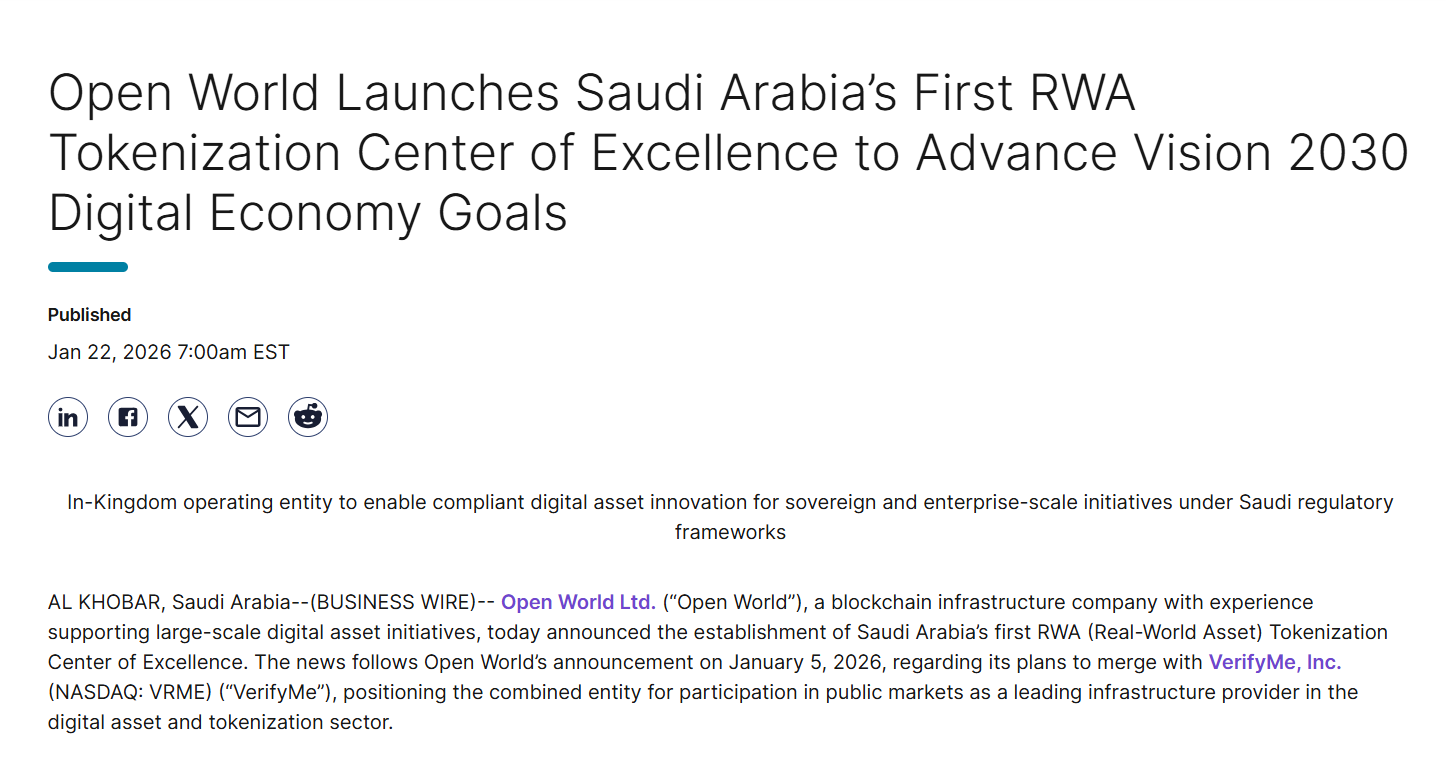
In January the Kingdom opened the Open World RWA Tokenization Centre. In April the Public Investment Fund set out a tokenization strategy targeting 12.5 billion dollars of tokenised assets by 2030. Stablecoin-based settlement for real estate is scheduled to go live late this year, under joint work by the Capital Market Authority and the central bank.
And SAMA has begun licensing open banking providers, moving them out of the regulatory sandbox and into the market.
What "Biggest" Means Here
It is worth being exact, because the word can be read two ways.
Saudi Arabia is not the largest place to trade digital assets. If you rank countries by exchange volume, wallet counts or token launches, the Gulf headline belongs to Dubai and the piece you are reading would be wrong.
The claim is about another thing. Measured by what a government has committed and actually put into production, no other state has gone this far. A national land registry running on chain, a sovereign fund mandate in the billions, and a settlement layer scheduled for a real asset class. That is a different order of commitment from a licensing regime for exchanges, and nobody is counting it.
All of that is being built while the asset at the centre of it has no legal definition.
As of May this year, Saudi Arabia had not published a stablecoin rulebook. There is no legal classification for stablecoins in force. No reserve or one-to-one backing requirement. No mandated audits or attestations. No statutory right to redeem at par. Authorities have said since 2018 that virtual currencies are not approved or licensed in the Kingdom.
The minister responsible announced the intention in late 2025. The framework is still at policy design.
So the rails are being laid for something the law has not yet defined.
Why This Is Backwards, and Why That Matters
Every previous digital-asset market grew in the same order. Speculation came first. Infrastructure followed the money. Regulation arrived last, usually after something broke badly enough to force it.
Saudi Arabia is running that sequence in reverse. Infrastructure first, as state policy. The rulebook is still being written. The market barely exists.
This is not a small difference in timing. It changes who builds the rails and therefore who controls them. When a market builds its own infrastructure, the winners own the toll booths and regulators spend years catching up. When a state builds them first, the infrastructure is sovereign from the beginning and private players connect to it rather than owning it.
You can see that in the design. The registry is run by the land authority, not a startup. Phase two opens an API so proptech companies, banks and developers can build on top. The state keeps the ledger and rents out the surface.
Why it is Silent, and What is Not
Here I should be precise, because there is an obvious objection and it is a good one.
Saudi Arabia is not unknown. In September 2025 Riyadh hosted the first Money20/20 Middle East under the patronage of the finance minister. More than 38,500 people attended. Over 450 fintech brands showed up. Investor attendance tripled year on year to more than 1,050. It was the second largest Money20/20 anywhere in the world, at its first attempt.
The 2026 edition runs from the fourteenth to the sixteenth of September and expects similar numbers, with more than 400 speakers and 150 startups. Past stages have carried people from Standard Chartered, BlackRock, the MENA Fintech Association and the Global Blockchain Business Council. There are dedicated tracks for payments infrastructure, digital banking, and crypto and digital assets.
So the market is not silent. It is one of the loudest fintech gatherings on earth.
The infrastructure is silent. That is the distinction worth holding.
A government laying settlement plumbing does not produce the things the industry counts. There is no listing. No token launch. No volume chart. No airdrop, no founder on a podcast. Crypto media tracks events, and a land registry migration is not an event. It is a procurement cycle.
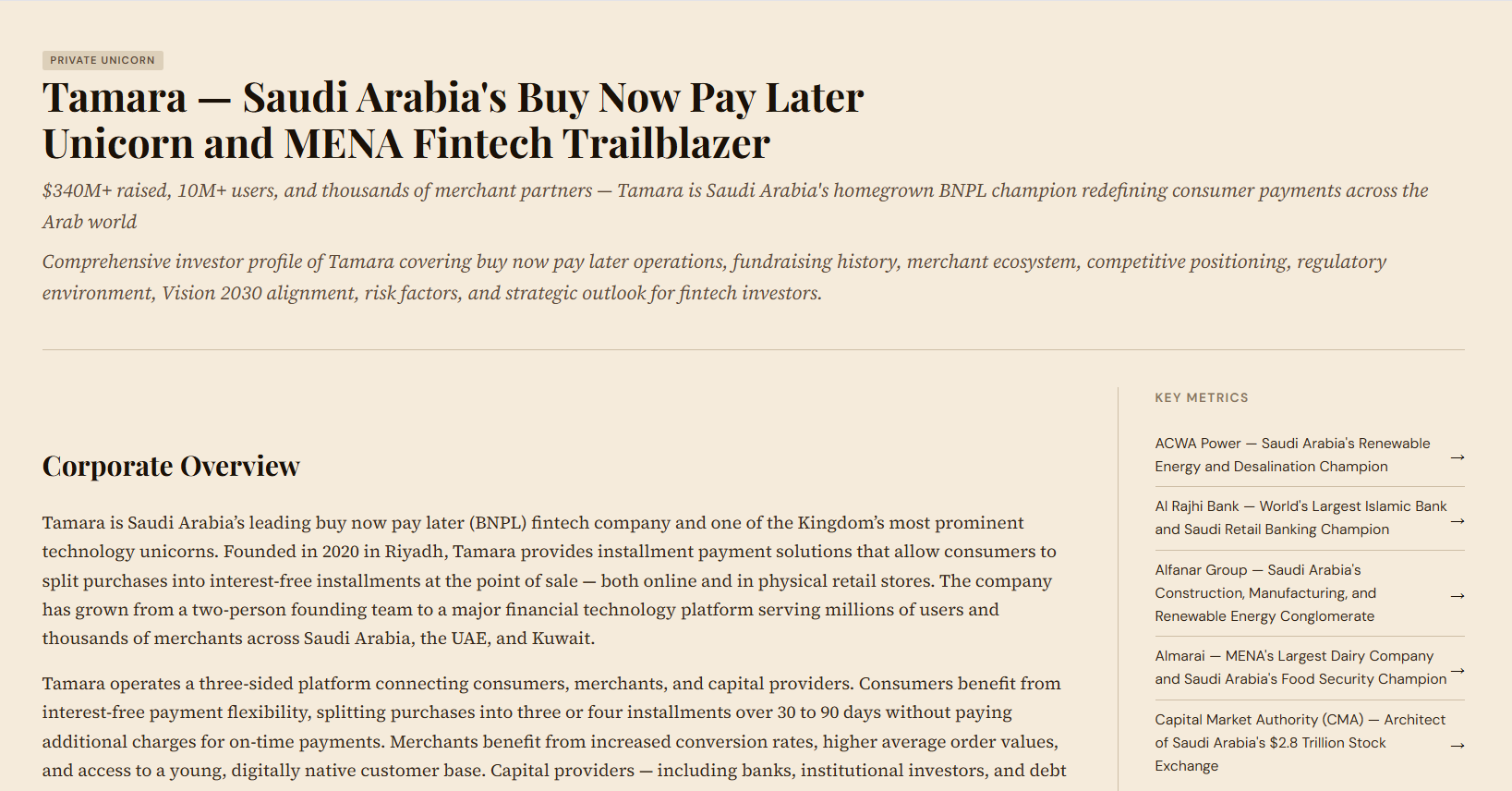
You can see the split in what came out of that conference. SAMA announced Google Play payments enabled by mada, and confirmed Alipay+ for 2026. Tamara, the Riyadh payments unicorn, secured an asset-backed facility of up to 2.4 billion dollars. Visa announced a first-of-its-kind acceptance capability deployed locally, and described it as closely integrated with national infrastructure and regulatory frameworks.
Read that last one again. A global card network built something specific to Saudi Arabia and had to fit it to national rails. That is what happens when the state owns the plumbing, and it went past most people as a product announcement.
Every one of those was covered. The registry, the deed transfer, the tokenization mandate: much less so.
Thirty-eight thousand people flew to Riyadh to look at the surface of this market. Almost nobody wrote about the foundation it was standing on.
The Market Underneath
The infrastructure is not being built onto anything.
Saudi Arabia had 301 fintech companies in 2025, with payments the largest category at 85 firms, and finance solutions and service platforms close behind. Direct employment in the sector passed 14,000 jobs.
Electronic payments reached 85% of retail transactions by the end of 2025, up from 79% the year before. The national payment systems handled 14.6 billion transactions, against 12.6 billion in 2024.
That last number deserves a moment. A country where most bills were paid in cash two decades ago is now more cashless than much of Western Europe. Whatever is happening here, it is not catch-up.
Money is arriving too. Venture debt in the sector has passed 18.8 billion riyals. Cumulative venture capital is above 10.1 billion riyals, including 2.33 billion in 2025 alone.
And the cross-border side is being wired in. Thunes switched on real-time payouts into Saudi bank accounts and wallets in riyals last September. Inbound money to the Kingdom was projected to reach 232 billion dollars for the year. One named use case is overseas businesses paying Hajj and Umrah fees, which is a reminder that the flows here are not hypothetical.
One Number That Does Not Fit
Saudi real estate funds are approaching 300 billion riyals, the largest asset class in a management sector above 1.2 trillion riyals. Debt issuance against real estate has passed 35 billion riyals and now exceeds equity financing.
Investment in property technology is 35 million riyals.
That is roughly eight and a half thousand to one between the size of the asset class and the money going into the technology meant to serve it.
There are two readings. Either this is an open market that nobody has served yet, which would explain why a state stepped in. Or private capital has looked at Saudi proptech and declined, which would make the state programe a substitute for private appetite rather than a head start on it.
The article cannot settle that, and anyone using this material should know it is unsettled.
The Stablecoin Position Worth Noting
Monai's view on stablecoins is stricter than the market's current direction, and it is worth flagging because it cuts against where the industry is heading.
"The moment reserves are deployed for returns, the guarantee becomes contingent," he says.
His position is that stablecoins should be settlement infrastructure and not yield products. That runs directly against the fastest-growing part of the stablecoin market elsewhere, where yield-bearing instruments have driven a large share of recent growth.
If Saudi builds a settlement stablecoin with no yield, it will be swimming against the strongest current in the sector. Whether that is discipline or a design that nobody uses is a real open question.
He is also clear that this is not a move away from the dollar. "The dollar remains deeply embedded in the region and will continue to be that way." The framing is additional rails beside existing ones, not replacement.
What Could Go Wrong
Three things, and they are worth holding in mind against the announcements.
The infrastructure could be built and stay empty. A registry that processes one deed transfer and then very few is a demonstration, not a market. The test is volume by the end of next year, and it is a fair test.
The rulebook could land badly. Rails without permission to carry anything is the risk of building in this order. A restrictive stablecoin framework could strand the settlement layer that is currently scheduled for late this year.
And much of the evidence here is people describing their own work. The 12.5 billion dollar figure is mandated, not deployed capital. The platform vendor is quoted praising the platform. Government bodies are reporting on government programmes. None of that makes the claims false, and all of it means they are statements of intent rather than results.
What To Watch
If you want to know whether this is real without waiting for the press releases, four things will tell you.
Whether the registry processes routine transactions rather than showcase ones. Whether the stablecoin rulebook, when it appears, permits the settlement use already scheduled. Whether third parties actually build on the phase-two API, which is the difference between a state system and a state monopoly. And whether the PIF mandate converts into deployed capital rather than remaining a target.
The Point
The habit is to look for the next digital-asset market by counting what trades. That habit works when markets build their own infrastructure, which is how it has gone everywhere so far.
It fails in a country where the state builds first and the market comes second. The visible part of Saudi Arabia gets a conference with 38,500 people. The part that will matter longer is a ledger nobody photographs. Meanwhile the Kingdom has put that ledger into production, scheduled settlement for its largest asset class, and it is doing all of it under a government that has already converted this country's payments system once and made it work.
Twenty years ago the proof was that people stopped queuing to pay a bill. The next proof will be a deed that moves in seconds and nobody writes about.
Zubair Tariq:
X - https://x.com/zubairey0
LI - https://www.linkedin.com/in/zubairey/