
Table of Contents
A “crypto dollar” typically means a fiat-backed stablecoin that targets a 1:1 value with the U.S. dollar (for example, USDT or USDC).
The unit is familiar, but the payment rail is fundamentally different from card networks (Visa/Mastercard/AmEx) and from PayPal’s wallet-plus-processing model.
That difference matters because payments are not only about “moving money.” Payments are a bundle of economics, risk allocation, consumer protections, settlement mechanics, compliance workflows, and operational tooling.
To ground the discussion in observed market reality: stablecoins have grown rapidly in supply and usage, but most volume still relates to crypto-market plumbing rather than day-to-day retail commerce.
Key Takeaways
- Cards and PayPal are built around reversible payments; stablecoins are usually “push” payments with practical finality
- Fees are structured differently
- Settlement changes fastest
- Consumer protections change materially
- Compliance responsibility changes with the integration model

A Quick Baseline: Stablecoins, Cards, and PayPal Are Three Different Systems
1. Cards: A Credit-and-Dispute Rail That Settles Later
Card payments typically involve at least four parties (cardholder, issuer, network, acquirer/processor), with separate stages:
- Authorization: the issuer approves (or declines) a request.
- Clearing: transaction details are exchanged and posted.
- Settlement: funds move between institutions; merchants get paid on a schedule, often with reserves/holds depending on risk.
Even when a transaction is “approved,” it is not the same as final. Dispute rights (chargebacks) exist by design, so the system intentionally allows reversibility under defined conditions.
Card usage is large and measurable. For example, U.S.-issued general purpose and private-label credit/debit/prepaid cards generate multi-trillion-dollar annual purchase volume. In the euro area, card payments number in the tens of billions per half-year, with average transaction values in the tens of euros.
2. PayPal: A Wallet + Rules Engine + Processor
PayPal is not “just a card rail.”
It can:
- use PayPal balances,
- pull funds from bank accounts,
- or route through card payments, while adding PayPal’s own dispute and account-control layer.
PayPal publishes product-specific merchant pricing, typically as a blended percentage plus a fixed fee.
International commercial transactions often add an extra percentage fee on top of domestic rates, and currency conversion can introduce additional spread.
3. Stablecoins: Tokenized Cash Transfer With Continuous Settlement
Stablecoin payments typically mean a transfer of tokens between addresses on a public blockchain (or via a custodial intermediary that performs on-chain transfers behind the scenes).
The defining attributes are:
- on-chain settlement mechanics,
- bearer-asset style control (whoever controls the keys controls the funds),
- different reversibility norms (refunds are usually a new payment, not an undo).
Stablecoins have reached large market capitalization, and the market is concentrated in a small number of tokens. USDT and USDC have historically represented the majority share of major fiat-referenced stablecoins in many snapshots.
What Changes for the Buyer
1) Checkout UX: Familiarity vs Control vs Error Surface
- Cards optimize for familiarity: card number (or tokenized equivalent), CVV, and sometimes additional authentication (for example, 3-D Secure). The buyer can usually retry quickly, and merchant-side tooling is mature.
- PayPal optimizes for account-based checkout: The buyer’s “credentials” are the PayPal login and whatever PayPal accepts as funding. This reduces form-fill friction and can increase perceived trust because PayPal is a known counterparty.
- Stablecoins introduce new UX variables:
- wallet selection,
- network selection (where applicable),
- confirmation waiting,
- address correctness.
Even if wallets improve, the buyer’s error surface is different. “Wrong address” and “wrong network” are categories that do not exist in the same way for card checkout.
A practical implication is that stablecoin checkout tends to require more guided UX if the audience is not already crypto-native.
2) Consumer Protections: Chargebacks vs Platform Disputes vs Merchant Policy
With cards, consumer protections are embedded. That is a major reason cards perform well in consumer e-commerce: buyers trust they can contest fraud and some forms of non-delivery.
With PayPal, the buyer often experiences protections through PayPal’s dispute process, governed by PayPal policy and account history. In practice, this can feel similar to card protections but is mediated by PayPal.
With stablecoins, protections are not “native” in the same way. If you pay a merchant address, the network does not provide a standardized chargeback mechanism comparable to card networks.
If a buyer expects card-like reversibility, expectations must be re-set explicitly:
- refunds are typically a new outgoing payment from the merchant,
- disputes become a merchant support and policy issue,
- in some models, the payment processor (if used) may offer dispute-like tooling contractually.
This is not inherently better or worse; it is a tradeoff. Buyers get more “cash-like” finality (once sent, it is usually sent), but less standardized remediation.
3) Privacy and Data: Different Transparency Profiles
Cards and PayPal: buyers share identifiable data with intermediaries (issuer, processor, PayPal). Merchants receive payment metadata through statements, authorization codes, and processor dashboards.
Stablecoins: if the buyer pays from a self-custodial wallet on a public chain, the transaction is typically visible on-chain.
That can mean:
- less traditional PII exchanged in the payment moment,
- but more transparent transfer history at the address level.
If the buyer uses a custodial wallet or a decentralized exchange, the experience becomes more like traditional fintech: the custodian retains identity data and may control withdrawal behavior.
What Changes for the Merchant
1) Fees: From Bundled Processing to a “Cost Stack”
There is no single universal fee for cards, PayPal, or stablecoins. The important difference is how costs are composed.
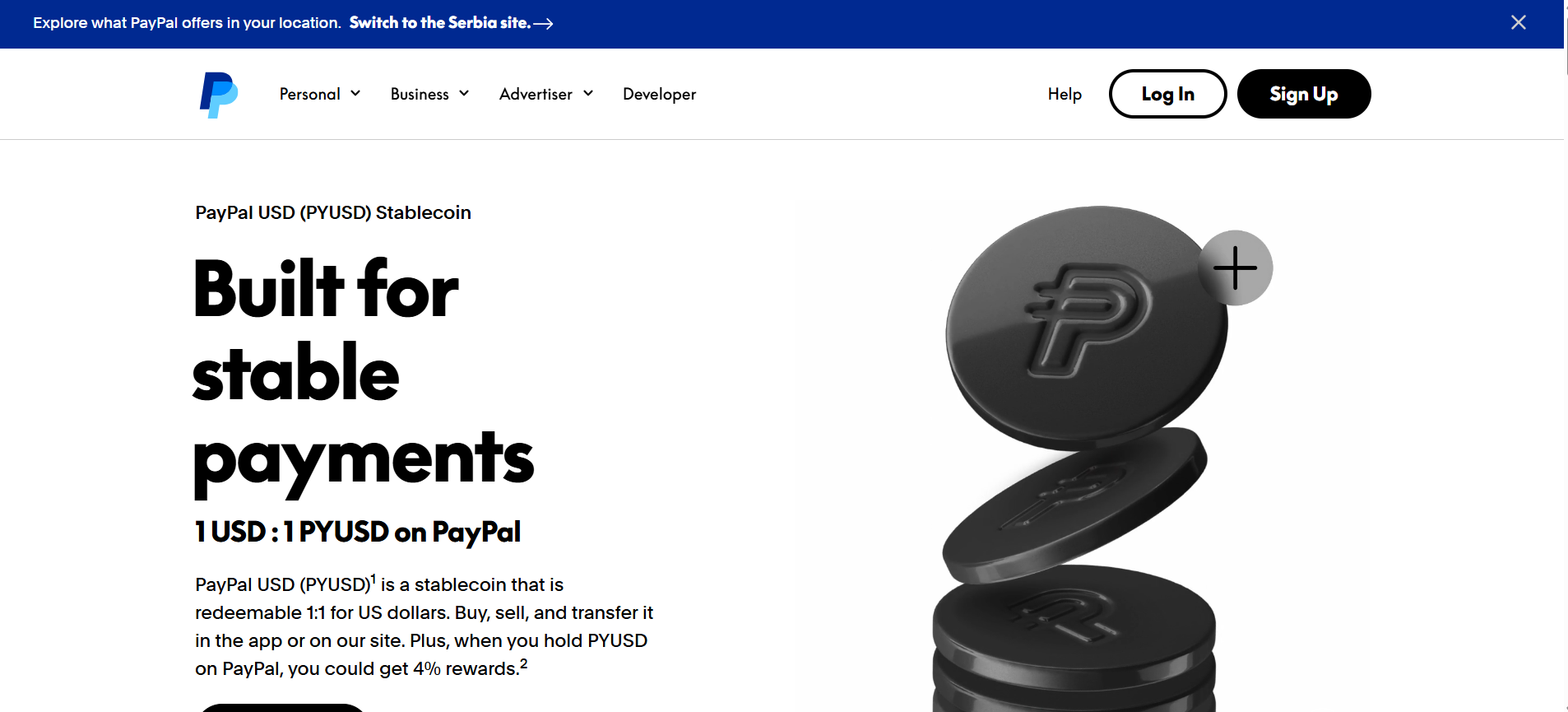
PayPal publishes clear blended pricing for many common products. This pricing bundles PayPal’s product layer (wallet, risk controls, and dispute processes) with acceptance.
Cards involve a layered model: network fees, interchange, processor margin, and cross-border and risk-related add-ons (depending on merchant category, authentication, region, and routing).
The “headline” percentage varies widely by geography and merchant profile.
Stablecoins shift cost into a different stack:
- on-chain transaction fees (which vary by network conditions and design),
- processor spreads if you use a payment service provider,
- custody costs (if custodial),
- conversion and treasury operations (on/off-ramps, FX, bank settlement, and compliance workflows).
A practical way to think about stablecoins is: the acceptance fee can be low, but the operating model must be designed well or costs reappear as support load, conversion friction, and treasury risk.
2) Settlement and Cashflow: Timing and Availability Shift
Cards involve authorization then later settlement; merchants often experience payout schedules and may face rolling reserves depending on their risk profile. That is one reason card-based businesses invest heavily in chargeback management and fraud tooling: revenue recognition and cash availability are shaped by the dispute environment.
Stablecoin transactions can settle continuously (subject to network mechanics and confirmation practices). In enterprise contexts, this is often described as always-on settlement and can be useful for moving value outside banking hours.
However, the merchant still has a question:
What do I do after I receive stablecoins?
If the merchant must pay suppliers, payroll, or taxes in fiat, they still face:
- bank settlement timetables,
- off-ramp availability,
- treasury policy constraints.
3) Disputes and Refunds: The Operational Burden Moves
Cards: disputes are standardized and high-volume businesses build dedicated ops around them (chargeback workflows, evidence packages, representment). Refunds are built into processor tooling and often interact with disputes.
PayPal: disputes exist at the platform layer; merchants operate within PayPal’s rules and resolution processes, often with centralized workflow.
Stablecoins: refunds are typically just another transfer. That creates new operational requirements:
- secure refund authorization (who can initiate refunds),
- address verification (to prevent refund fraud),
- clear policy communication (because reversals are not the default behavior of the rail).
Stablecoins can reduce some dispute mechanics, but they do not eliminate customer support. They shift it. Your support tickets may move from “chargeback” to “I sent on the wrong network” or “where is my confirmation” depending on your users.
Fraud and Risk Allocation: Who Eats the Loss?
Cards: Friendly Fraud and Chargeback Economics
Card systems are designed to be consumer-friendly. That is good for conversion, but it means merchants often bear meaningful risk:
- unauthorized transactions,
- “item not received” disputes,
- friendly fraud (a legitimate buyer disputes).
The specifics depend on authentication, evidence, and local rules, but the key point is structural: the system includes a reversal pathway.
PayPal: Account Risk and Platform Controls
PayPal can be effective at reducing checkout friction, but merchants accept that PayPal may:
- restrict accounts,
- hold funds,
- mediate disputes under PayPal policies.
This can reduce some card-like complexity for merchants, but it introduces platform dependency: you are subject to PayPal’s risk engine and policy interpretation.
Stablecoins: Key Security and Address Integrity Become Central
Stablecoin risk is less about “stolen card numbers” and more about:
- compromised keys,
- social engineering,
- address poisoning and misdirection,
- operational mistakes (wrong address/wrong chain).
The economic allocation of fraud loss depends heavily on whether you accept stablecoins directly (self-custody) or through an intermediary that provides guarantees and screening.
Compliance: What Changes Depends on Your Integration Model
There is no single compliance profile for stablecoin payments, because the compliance perimeter depends on who is providing the regulated service and where.
A useful distinction:
- Processor-led model: a regulated provider handles screening, reporting, and custody controls; merchant receives stablecoins (or fiat) as a settlement asset.
- Direct acceptance model: merchant accepts to its own wallet(s) and becomes responsible for more internal controls, monitoring, and policy enforcement.
The practical takeaway is simple:
- If you want stablecoins to behave like payments infrastructure, you usually adopt tooling and procedures that look like payments infrastructure: monitoring, controls, reconciliation, and documented procedures.
Cross-Border and FX: Where the “Hidden Costs” Often Live
Cross-border commerce exposes the differences between rails quickly:
- Card cross-border transactions can carry layered fees and FX spreads depending on issuing country, routing, and merchant setup.
- PayPal international pricing and currency conversion can introduce additional percentage fees and FX spread, depending on the product and corridor.
- Stablecoins can reduce friction in moving a dollar-denominated unit globally, but if the endpoint is local fiat, the conversion and payout step becomes the real cost center.
This is why many early stablecoin “payments” successes show up in cross-border B2B settlement, treasury movements, and crypto-native commerce more than in everyday retail point-of-sale.

The Market Reality Check: Stablecoins Are Big, But Retail Payments Are Still a Small Share
Stablecoins are large by market cap and infrastructure relevance, while most measured stablecoin activity still appears concentrated in trading and crypto-market settlement.
In many datasets, retail commerce remains a small portion of stablecoin transfer volume, even if payment-oriented stablecoin usage is growing in specific corridors and product categories.
Comparison Table: What Changes, Mechanically and Operationally
| Dimension | Cards | PayPal | Stablecoins (“Crypto Dollar”) |
|---|---|---|---|
| Payment type | Pull-based authorization | Account/wallet + processor | Push transfer (usually) |
| Finality | Reversible via disputes | Dispute/claims via platform | Typically final; refunds are new payments |
| Settlement timing | Post-auth clearing/settlement | Varies; subject to platform rules | On-chain settlement can be continuous |
| Consumer protections | Standard dispute rights | Platform-mediated protections | Depends on merchant policy/intermediary |
| Fraud focus | Stolen credentials + friendly fraud | Account takeover + dispute behavior | Key security + address integrity |
| Cost model | Layered (interchange/network/processor) | Blended product pricing | Network fees + conversion + ops/tooling |
| Compliance perimeter | PSP/acquirer-led + merchant duties | Platform-led + merchant duties | Varies by custodial vs direct model |
A Decision Framework: When Each Rail Is Rational
Choose Cards When:
- You need maximum consumer familiarity and high conversion in mainstream e-commerce.
- Your business depends on standardized consumer protections (and you can manage chargeback/fraud operations).
Choose PayPal When:
- You benefit from PayPal’s account-based checkout and trust layer.
- You accept platform policy as part of the tradeoff (including holds and dispute mediation).
Choose Stablecoins When:
- You value fast settlement and treasury mobility (especially cross-border).
- Your users already have stablecoins or wallets, or you can abstract wallet complexity with a processor.
- You can operate the required controls: wallet policy, security, reconciliation, and customer support scripts.
Implementation Guidance: Add Stablecoins Without Breaking Operations
Step 1: Decide Your Acceptance Model
- Processor model if you want dashboards, screening, and settlement options.
- Direct wallet model if you want maximal control, but accept higher internal ops burden.
Step 2: Standardize Policy Before Launch
- Refund policy (how refunds happen, timelines, what proof is required)
- Address verification process for refunds
- Support macros for confirmations, networks, and “wrong address” cases
Step 3: Build Treasury Controls (Non-Negotiable for Scale)
- Segregated wallets (receiving vs treasury vs hot wallet)
- Multi-approval for outbound transfers
- Reconciliation procedures and audit trail expectations
Step 4: Measure the Right Metrics
- Support tickets per 1,000 orders (stablecoins can shift support categories)
- Conversion rate by rail
- Refund completion time
- Net cost per successful order (including off-ramp and ops time)

Conclusion
Paying with a crypto dollar changes the payment from a reversible, credit-and-dispute rail into something closer to digital cash transfer, often continuous, frequently faster to settle, and operationally different in refunds and fraud handling.
Cards and PayPal remain optimized for consumer conversion and standardized protections.
Stablecoins are most compelling where settlement speed, cross-border mobility, and treasury flexibility matter, provided you design the operational layer (controls, support, compliance) that replaces what card networks and PayPal bundle by default.
Read Next:
- 2025 Stablecoin Year-End Report
- Best Chain for Stablecoin Micropayments in 2026
- Best Stablecoin On/Off-Ramps for 2026 Compared
FAQs:
1. What is a “crypto dollar” in payments?
A crypto dollar usually refers to a fiat-backed stablecoin designed to track the U.S. dollar’s value, such as USDT or USDC.
2. Are stablecoin payments cheaper than cards?
They can be, but “cheaper” depends on your full cost stack: network fees, processor spreads (if any), and especially conversion/off-ramp and operational overhead. Card and PayPal costs are often more bundled; stablecoins can shift costs into treasury and support.
3. Can customers charge back a stablecoin payment?
Not in the standardized way card networks enable. Stablecoin refunds are typically executed as a new payment from the merchant back to the customer, and dispute handling becomes primarily a merchant (or processor) policy issue.
4. Is PayPal safer than stablecoins for buyers?
PayPal generally provides platform-mediated dispute processes and account-based controls, which many buyers perceive as protective. Stablecoin payments behave more like cash-like transfers, so protections depend more on merchant policy or intermediaries.
5. How do refunds work with stablecoins?
Refunds are generally new transfers to a customer-supplied address (or to the original sending address, if your policy allows). This makes address verification, authorization controls, and support workflows important.
6. Are stablecoins widely used for retail purchases today?
Most available datasets suggest retail-sized stablecoin transfers are a small share of total stablecoin transfer volume, even though payments usage is growing in some corridors and products.
7. How big is the stablecoin market right now?
Stablecoin market capitalization has reached the hundreds of billions of dollars, with a small number of tokens historically representing the majority of supply.
8. What are PayPal’s standard merchant pricing basics?
PayPal typically publishes product-specific commercial transaction rates as a blended percentage plus a fixed fee, with additional percentage fees and currency conversion spread applying in some international contexts.
Disclaimer:
This content is provided for informational and educational purposes only and does not constitute financial, investment, legal, or tax advice; no material herein should be interpreted as a recommendation, endorsement, or solicitation to buy or sell any financial instrument, and readers should conduct their own independent research or consult a qualified professional.