

Table of Contents
PNC Bank is now letting some corporate clients get paid in USDC. On 9 November 2026 PNC said eligible Corporate & Institutional Banking (C&IB) clients can receive USDC on Ethereum. The service runs on Coinbase Payment products, and every incoming payment is converted 1-to-1 into US dollars and deposited into a designated PNC account.
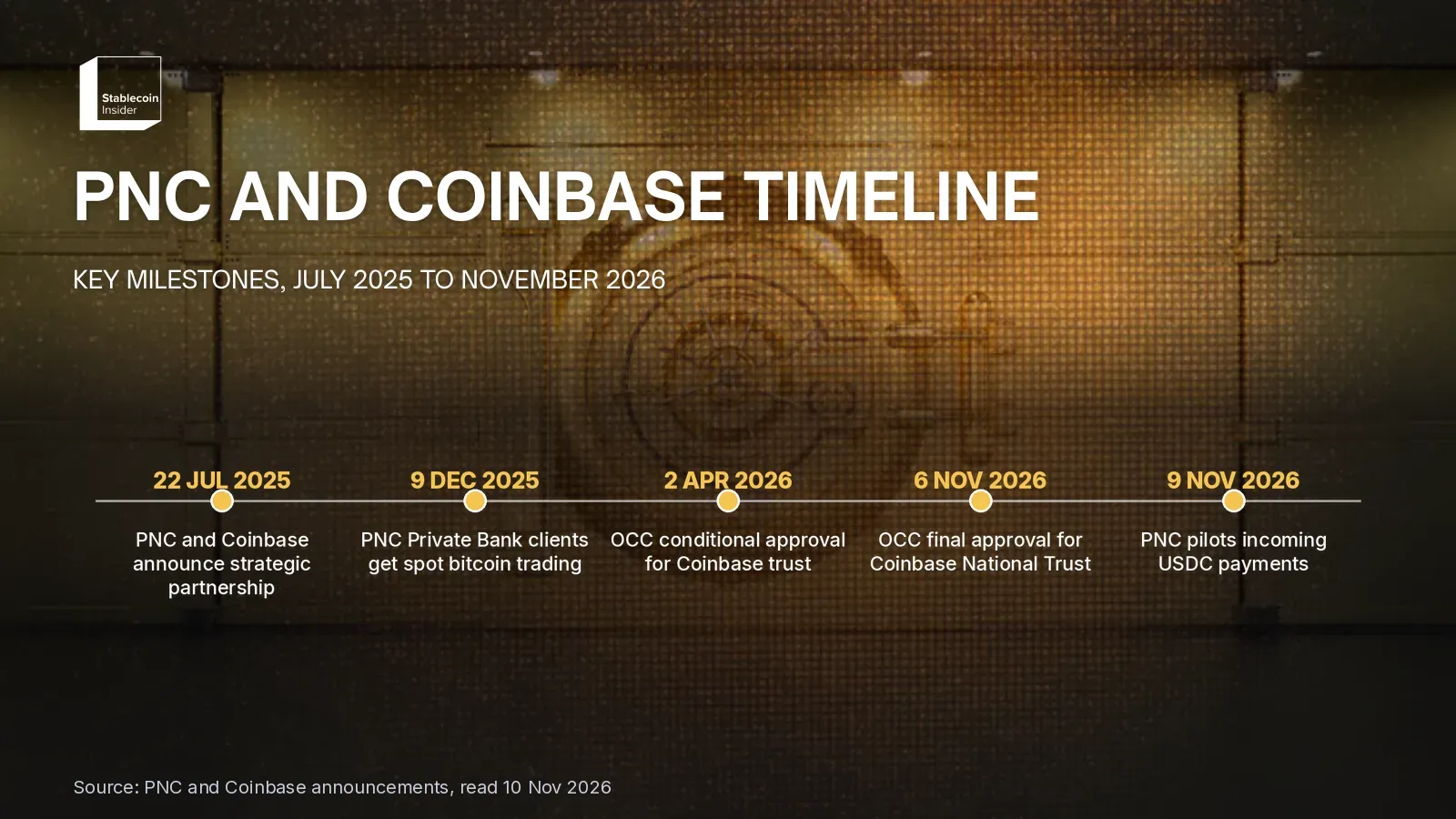
It is a limited pilot for eligible clients, not a general launch. It arrived on the same day Coinbase said the Office of the Comptroller of the Currency (OCC) had given final approval to charter Coinbase National Trust Company. That approval came on Friday 6 November, seven months after the conditional approval of 2 April 2026.
This post covers what PNC launched and how the conversion works, who can use it, how the pilot compares with Coinbase's other bank deals, where USDC actually sits on-chain, and what corporate treasurers should watch next.
Key Takeaways
- PNC C&IB clients can receive USDC on Ethereum, automatically converted 1-to-1 to US dollars, per PNC's 9 November release.
- The service is a pilot offered on a limited basis to eligible clients; PNC published no fees, limits or other supported chains.
- Coinbase Payment APIs handle the stablecoin leg, The Block reported; PNC provides the deposit account and treasury services.
- Ethereum holds about $42.6 billion of roughly $70.4 billion USDC in circulation (60.5%), per DefiLlama on 10 November 2026.
- The OCC gave final approval to Coinbase National Trust Company on 6 November, Coinbase said.
What did PNC announce on 9 November 2026?
PNC announced on 9 November 2026 that its C&IB clients can receive payments in USDC, a US dollar-backed stablecoin, on the Ethereum blockchain, "powered by Coinbase Payment products." The release frames the product as part of PNC's Treasury Management business, sitting alongside its existing faster-payment options.
"Our clients are continually looking at new ways to interact and transact with customers, suppliers and business partners," said Tom Lang, head of Treasury Management Product and Operations at PNC Bank. Speaking to Reuters, Lang was more measured: "Right now, this is about testing and learning with our clients and helping explore which of those potential features of the stablecoin are a benefit."
Alec Lovett, head of Infrastructure Products at Coinbase, told Reuters the deal is "part of a broader story about convergence between [traditional finance] institutions and crypto and stablecoin infrastructure."
How do PNC's incoming USDC payments work?
PNC's incoming USDC payments work by taking USDC sent on Ethereum, converting it 1-to-1 into US dollars, and depositing the dollars into a designated PNC deposit account, so the client never holds the token. According to The Block, the stablecoin side runs on Coinbase Payment APIs, while PNC supplies the banking and treasury management layer.
The table below lists what PNC confirmed and what its release left out. Each confirmed row links to the source.
| Item | What PNC confirmed | Source |
|---|---|---|
| Asset | USDC, a US dollar-backed stablecoin | PNC release |
| Blockchain | Ethereum only at launch | PNC release |
| Conversion | Automatic, 1-to-1 into US dollars | PNC release |
| Destination | A designated PNC deposit account | PNC release |
| Eligibility | Eligible C&IB clients, limited-basis pilot | PNC release |
| Technology | Coinbase Payment products / Payment APIs | The Block |
| Not disclosed | Fees, transaction limits, other chains, outgoing USDC payments, wider rollout date | PNC release (silent) |
Two points stand out. First, the design keeps stablecoins off the client's balance sheet: the bank absorbs the on-chain leg and the client sees an ordinary dollar deposit. Second, the product only covers receiving. PNC clients can get paid by counterparties that already hold USDC, but the release says nothing about clients paying out in USDC.
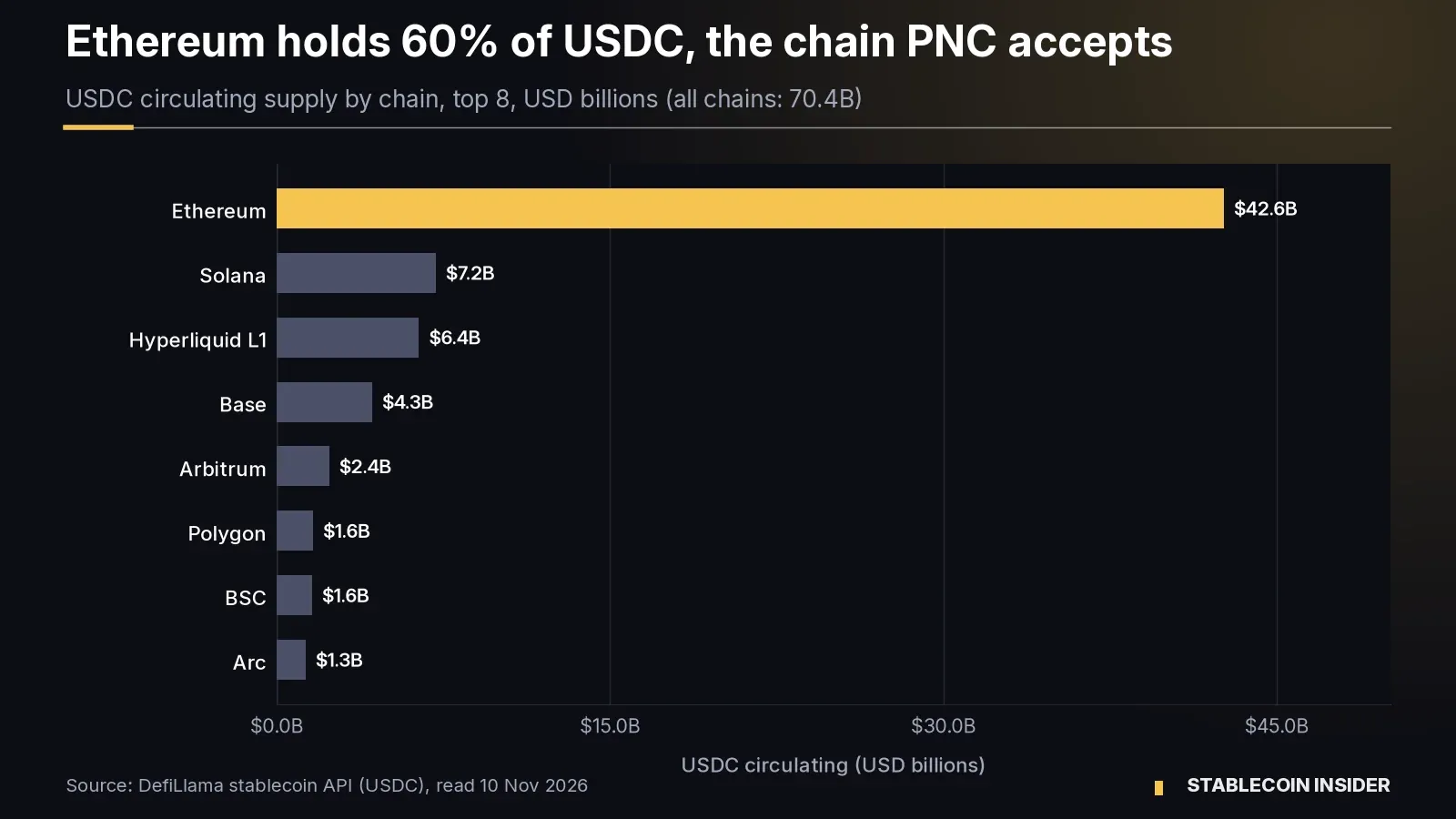
Starting with Ethereum matches where most USDC sits. DefiLlama counted about $42.6 billion of USDC on Ethereum on 10 November 2026, ahead of Solana ($7.2 billion), Hyperliquid L1 ($6.4 billion) and Base ($4.3 billion). DefiLlama's cross-chain total of about $70.4 billion is a point-in-time reading. Circle reported $73.9 billion in circulation at the end of September, according to CoinDesk, and publishes weekly reserve data on its transparency page.
Who can use PNC's USDC payments?
PNC's USDC payments can only be used, for now, by eligible clients of its Corporate & Institutional Banking unit, and only on what the release calls "a limited basis." The release does not extend it to retail or private-bank customers, and PNC did not publish eligibility criteria. It said it is "focused on helping clients understand and evaluate emerging payment technologies and how they may fit within their broader treasury strategies."
How does PNC's pilot compare with Coinbase's other bank deals?
PNC's pilot is a narrower, receive-only treasury product than Coinbase's Citi arrangement, which runs in both directions between fiat and stablecoins. The table compares the bank-facing programmes Coinbase has announced; rows link to sources.
| Programme | Who it serves | What it does | Source |
|---|---|---|---|
| PNC incoming USDC payments (Nov 2026) | Eligible PNC C&IB clients (pilot) | Receives USDC on Ethereum, converts 1-to-1 to USD into a PNC deposit account | PNC |
| Spring by Citi stablecoin acceptance (Sep 2026) | Citi institutional clients (merchants) | Accepts stablecoins at checkout via Coinbase Payments; converted to fiat, Citi settles as bank of record | Citi |
| Coinbase Virtual Accounts on Citi (Sep 2026) | Coinbase payments customers | Bank-account-like accounts; incoming fiat converted into stablecoins | Citi |
| Moov integration (2026) | Systems used by 1,000+ community banks and credit unions | Stablecoin acceptance, settlement and real-time funding via Coinbase Payments API | The Block |
| PNC Private Bank bitcoin (Dec 2025) | Eligible PNC Private Bank clients | Buy, hold and sell spot bitcoin via Coinbase Crypto-as-a-Service | PNC |
Two patterns stand out. Coinbase is selling the same building blocks (Payments APIs, conversion, custody) to banks, which keep the client relationship and the deposit. And each bank has started at the low-risk end: PNC with inbound conversion, Citi with merchant acceptance where fiat settles on the bank's books. The PNC–Coinbase relationship itself dates to a 22 July 2025 partnership under which PNC also provides banking services to Coinbase.
Why does Coinbase's national trust charter matter here?
Coinbase's national trust charter matters here because the partner powering PNC's stablecoin leg now runs its custody business under federal OCC supervision rather than only state oversight. Coinbase said the OCC approved its application on Friday 6 November, and that the charter brings "clear and consistent federal uniformity" to its custody capabilities.
The charter does not make Coinbase a bank. In April, Coinbase wrote it "will not be taking retail deposits" or engaging in fractional reserve banking. CoinDesk noted Ripple received a full OCC trust charter last month, and that the Independent Community Bankers of America has sued the OCC over charters granted to crypto firms.
What does PNC's USDC pilot mean for corporate treasurers?
PNC's USDC pilot means corporate treasurers at an eligible PNC client can accept stablecoin payments from customers or partners without running wallets, custody or conversion themselves. The value is clearest for cross-border receivables, which the release names along with "faster access to funds."
It also fits where stablecoin demand is going. Blockchain data firm Allium counted $482 billion of stablecoin payments in the first nine months of 2026, up 45%, while total supply rose just 0.4% to $305 billion, CoinDesk reported. Products like PNC's handle that payment flow without asking the end client to hold the token.
Stablecoin Insider's take
For related coverage, see these Stablecoin Insider guides:
Accepting stablecoins without a bank pilot? See how seven stablecoin gateways compare on fees and settlement. Related hub: see our Stablecoin Payments and Cards Hub for every guide on stablecoin payments, cards and payouts.
FAQ
Does PNC's pilot let clients send USDC?
Do PNC clients end up holding USDC?
Which blockchain does PNC support for USDC payments?
Is PNC's USDC service available to retail customers?
What is Coinbase National Trust Company?
Who issues USDC?
When does the GENIUS Act take effect?
What happens next?
What happens next depends on how fast PNC widens the pilot. PNC said it will offer the service on a limited basis first. The details to watch are published fees and limits, support for chains beyond Ethereum, and outbound USDC payments. On the regulatory side, the GENIUS Act's expected 18 January 2027 effective date (Treasury) and the community bankers' lawsuit against the OCC (CoinDesk) will shape how far banks and their crypto partners go.
Sources: PNC Bank release, 9 Nov 2026; Reuters via Investing.com; The Block; Coinbase, National Trust Company; Coinbase, conditional OCC approval; CoinDesk, Coinbase trust charter; Citi and Coinbase release; PNC–Coinbase partnership, July 2025; PNC bitcoin access, December 2025; DefiLlama USDC; Circle transparency; CoinDesk, stablecoin payments data; US Treasury GENIUS Act NPRM. All read on 10 November 2026.
This content is provided for informational and educational purposes only and doesn't constitute financial, investment, legal or tax advice. Figures were read on 10 November 2026 and may change. Companies and assets mentioned: PNC Bank, Coinbase, Circle (USDC), Citi, Moov, Ripple. Do your own research before using any payment service.


