Table of Contents
In a 2026 Fireblocks survey of 295 financial institutions, roughly 90% were already using stablecoins for payments or actively piloting them, with only about 10% still on the sidelines.
Coinbax is the programmable trust layer that sits between those institutions and raw blockchain rails, giving them the escrow, approvals, reversibility, and compliance controls they expect from traditional infrastructure, at blockchain speed.
Most of the industry talks about stablecoins defensively, as a risk to be contained; the more interesting story is what programmability unlocks once that risk is handled, money that can verify, hold, and release itself on conditions you define, across stablecoins and tokenized deposits alike.
This article walks through the Coinbax platform stage by stage, so you can see exactly how a programmable payment is built, checked, held, and, when it needs to be, recalled.
Key Takeaways
- Coinbax adds programmable escrow and reversibility so banks can recall stablecoin payments.
- Every transaction moves through four stages: Verify, Fund, Confirm, and Settle.
- Compliance checks run before settlement, not after funds have moved.
- Coinbax never takes custody; your custodian, wallet, and issuer stay yours.
- The same controls apply to stablecoins and tokenized deposits, on-chain, anywhere.
Why Banks Fear Irreversible Stablecoin Payments
Before a bank moves real money to a new counterparty, it sends a penny. A one-cent test transaction, a micro-deposit, a $1.00 ACH, some tiny amount whose only job is to prove the rails work before the real funds follow.
Bankers do this because they understand something in their bones: once money leaves, getting it back depends on the goodwill of the receiver and the mercy of the network.
The test transaction is a ritual built entirely around the fear of irreversibility.
Stablecoins make that fear worse, not better. A blockchain transfer settles in seconds and is final the moment it confirms. There is no reversal window, no recall, no "sender's bank claws it back."
For a treasury team, a fraudulent or misdirected transfer on a public chain is simply gone. That single property, finality with no undo, is the wall most banks hit the moment they try to use stablecoins for anything larger than a test.
How Coinbax Makes Stablecoin Payments Reversible
Coinbax is built around a different premise: what if the money didn't actually move until you were sure, and what if you could still pull it back even after you released it?
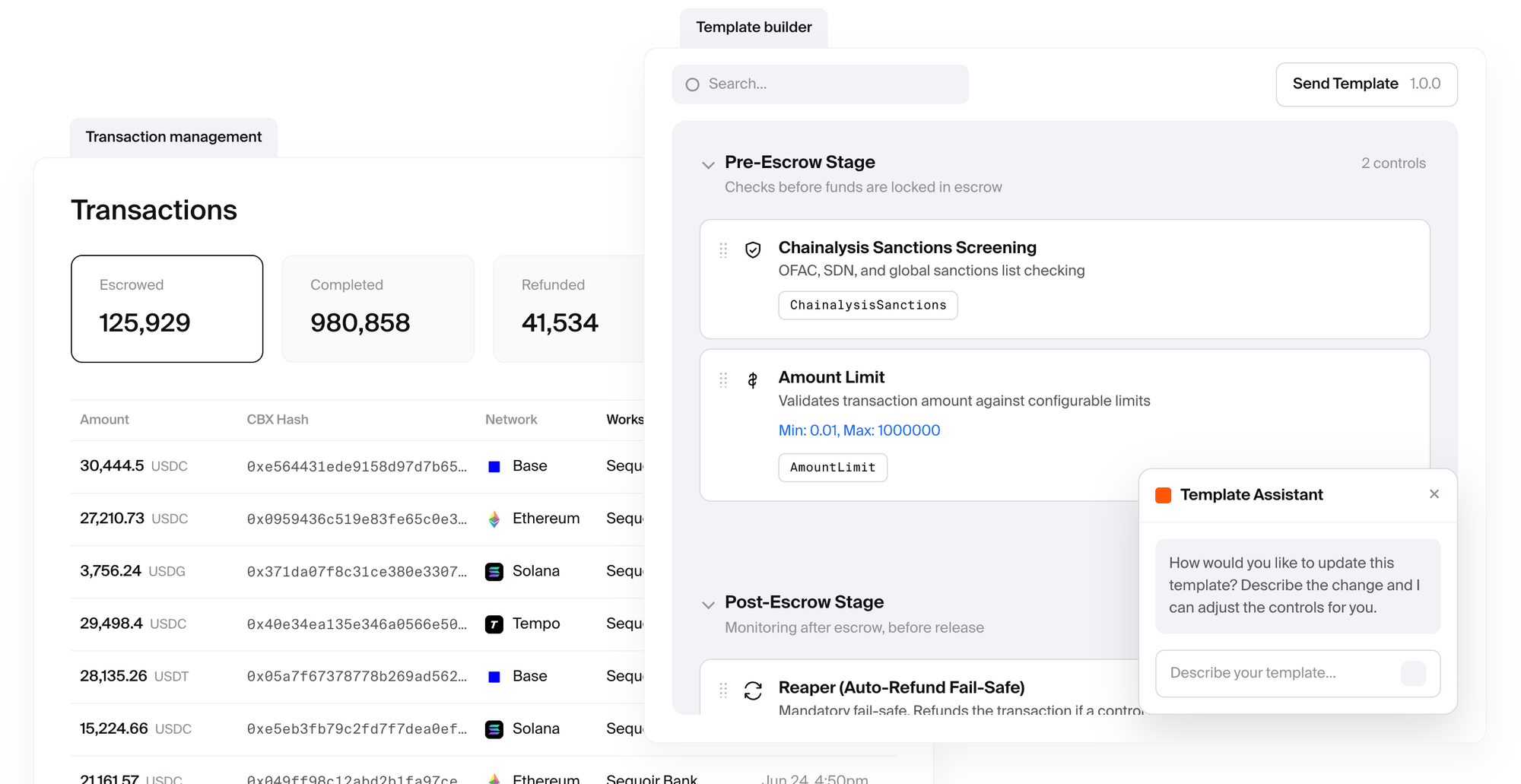
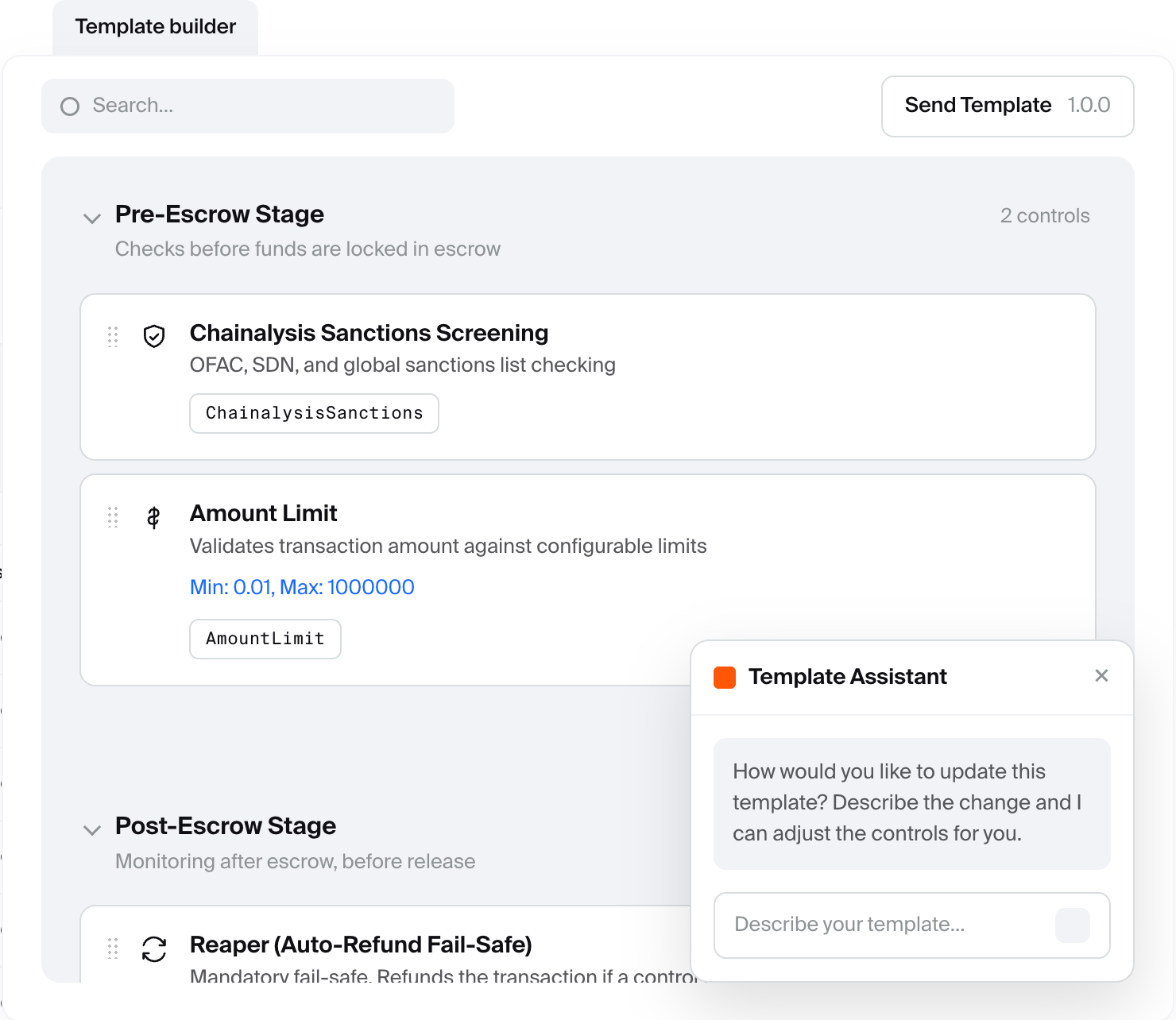
Instead of firing a transaction at the chain and hoping, Coinbax inserts a transaction-review layer in front of settlement. Every payment is wrapped in a set of programmable Controls, modular smart-contract rules that must each pass before funds are released.
Funds sit in programmable escrow during a defined window, and inside that window the sender can recall them. The result is a stablecoin payment that behaves the way bankers already expect money to behave: checked before it moves, held while it's reviewed, and recoverable if something is wrong.
That is the whole idea in one sentence, real-time settlement with a way back, and everything below is how it works.
The Four Stages of a Coinbax Payment: Verify, Fund, Confirm, Settle
Every transaction on the platform moves through the same four stages. This framework is the spine of how Coinbax works, and understanding it is most of the way to understanding the product.
1. Verify
Before anything is funded, the transaction runs the identity and risk checks the institution already relies on: KYC on the parties, AML and sanctions screening, fraud detection, and a risk score evaluated against the institution's own thresholds. This is compliance-before-settlement, screening happens up front, as a gate, not as an after-the-fact report generated once money is already gone.
2. Fund
Once verification passes, the funds are locked into programmable escrow rather than shipped straight to the recipient. The money is committed but not delivered. Nothing has crossed the point of no return.
3. Confirm
The transaction now waits on its remaining conditions, multi-party approval for high-value transfers, recipient-address confirmation by both sides, delivery or milestone triggers, or a simple time window for review.
Crucially, this is the reversibility window: while the payment sits in escrow having passed its checks, an authorized user can recall the funds.
This is the answer to the question banks keep asking, how do you recall a stablecoin payment? You recall it here, before the escrow releases.
4. Settle
When every control has cleared, the escrow releases and the funds settle on-chain, 24/7, in seconds. Only at this final stage does the transaction become final, and by then, every check that a bank would want has already run.
Verify, Fund, Confirm, Settle. Every payment, every template, every customer workflow rides these same rails.
Onboarding: Plug in the Compliance Stack You Already Use
A reasonable objection at this point is that this sounds like a lot to stand up. It isn't, because Coinbax doesn't ask you to replace your compliance operation, it asks you to point at it.
Onboarding starts by identifying the compliance tools the institution already uses, sanctions and analytics providers like TRM Labs, Chainalysis, Elliptic, or Merkle Science; identity and fraud tools like Persona, Plaid, or Sardine; screening systems like Verafin, and plugging them in as Controls.
If there's a capability you don't yet have, you can select a provider from within the platform instead. From those choices, the system assembles your first control template: a reusable sequence of verification, compliance, and authorization steps that encodes your policy.
From day one, compliance runs before settlement, and it runs against the vendors and rules you already trust. There is no rip-and-replace and no new compliance philosophy to adopt, just your existing stack, wired into the payment flow.
A Programmable Payment, Screen-by-screen
Picture three transactions open on the dashboard at once.
- Locked by a control: A $2.4M USDC transfer cleared KYC and AML but tripped the institution's risk threshold at the scoring step. It never funded. The escrow never opened. The metadata: who, how much, which control fired, why, is captured and surfaced for a reviewer, and the money never left.
- Settled clean: It passed verification, funded into escrow, collected its multi-party approvals, and released on-chain. Start to finish, seconds, but seconds with a full audit trail behind them.
- Is still sitting in escrow: It has passed every check and is simply waiting out its review window before it releases. During that window it can still be recalled. It's real money, committed but recoverable.
The important detail across all three: every transaction carries its own metadata, the controls it hit, the approvals it collected, the timestamps, the risk decisions, and that metadata flows back into the bank's existing compliance and reporting engine.
Nothing lives in a Coinbax silo. Examiners, internal risk teams, and counterparties see the same auditable record they'd get from any regulated rail.
Programmability in Practice: Adding a Custom Payment Control
This is where programmability turns from a safety feature into a growth one. Say the bank signs a new commercial customer, a securities-trading firm that needs to move money but runs its own proprietary risk model and won't operate without it.
On legacy infrastructure, accommodating that would mean a custom integration project, a scoping document, and a development timeline, and quite possibly a customer you decline because it isn't worth the build.
On Coinbax, you add the firm's risk model as a Control. That single addition gives that customer a payment path of their own: their money movement now runs Verify → Fund → Confirm → Settle with their model inserted as one of the checks.
No new codebase, no bespoke build, a configuration change.
That is programmability in practice: winning business you couldn't serve before by composing controls, not by commissioning software. The compliance rigor is what makes the money safe to move; the programmability is what lets you say yes.
The Three Pillars: Programmable Escrow, Reversibility, and Real-Time Compliance
Strip the walkthrough down and the platform rests on three things:
- Programmable escrow: funds are held and released based on conditions: delivery, time windows, milestones, or multi-party approval.
- Built-in reversibility: review windows and rollback triggers catch fraud and error before settlement is permanent, giving banks the dispute-and-correct behavior they expect from traditional rails.
- Real-time compliance before settlement: sanctions, KYC, and risk checks run automatically as a gate, so payments only move when every condition is met.
Two forces are doing the work here:
- Compliance and risk reduction: the escrow, reversibility, and pre-settlement screening that make the money safe to move.
- Programmability and controls: the ability to shape how money behaves.
Coinbax pairs them deliberately: the first earns the institution's trust, the second turns that trust into new things it can offer. That pairing is what turns a raw on-chain transfer into something a bank can put its name on.
Infrastructure-Agnostic: Works With Your Stack, Applies to Any Asset
Coinbax is infrastructure- and provider-agnostic by design. It's a control layer that sits on top of what you already run, you keep your existing compliance vendor, your custodian, your wallet infrastructure, and your chain. Coinbax layers the controls on top.
Through its membership in the Jack Henry Fintech Integration Network, the platform is reachable by 1,000 community banks and credit unions, and the team brings hands-on integration experience across the major cores including Fiserv, FIS, CSI, and DCI.
That's the "no lock-in" half. The bigger half is reach: programmability isn't a stablecoin-payments feature, it's a property of anything moving on-chain, and the same Controls apply across the board:
- Any asset: Stablecoins (USDC, USDG, RLUSD, PYUSD) and tokenized deposits alike. Tokenized deposits present a different control surface, but they need controls just as much, and get the same Verify → Fund → Confirm → Settle treatment.
- Any direction: Domestic and cross-border, US and international banks, with 24/7 settlement that skips correspondent-banking delays.
- Any size institution: From a community bank on a shared core to a global institution running its own infrastructure, the controls scale down as cleanly as they scale up.
- Beyond the bank: The same programmable controls already extend to self-custody and DeFi users who want institutional-grade safeguards on their own transfers, and consumer-direct access and developer API access are live today, not roadmap items.
There's no boxing Coinbax, or you, into a single asset type, a single market, or a single kind of user. Whatever the rail, the same four stages and the same policy Controls apply.
Where Coinbax Fits: Custody, Wallet, and Issuer Compatibility
"Provider-agnostic" is easy to say, so it's worth being precise about which layer Coinbax occupies and which layers it deliberately leaves alone. A bank moving money on-chain is really operating four distinct layers, and Coinbax only claims one of them.
The custody layer, untouched
Your custodian holds the keys, and that doesn't change. Whether the institution runs qualified custody with a provider like Fireblocks, BitGo, Anchorage, Utila, or Turnkey, or operates its own MPC or HSM-backed key management, Coinbax does not take custody of assets and does not insert itself into your key-management chain.
It orchestrates instructions to the custodian; the custodian still signs.
That distinction matters to regulators, and it answers the question every risk committee asks first, "what happens to our assets if this vendor disappears?" The answer is: nothing. They're where they always were.
The wallet layer, connected, not replaced
The bank's wallet infrastructure keeps its addresses, its policies, and its signing quorums. Coinbax sits in front of the transfer instruction rather than inside the wallet, which is why escrow and the recall window work without re-issuing addresses or migrating balances.
This is also what makes the CEO's three-year picture tractable: when every bank account carries a wallet address, the bank won't need a new wallet stack, it will need a control layer in front of the one it already has.
The issuer layer, open by design
Coinbax has no economic stake in which stablecoin you use. USDC, USDG, RLUSD, PYUSD, and tokenized deposits issued by the bank itself are all simply assets the Controls govern. A platform that earned float or issuance revenue would have a quiet incentive to steer you toward its own asset; a pure control layer doesn't.
If your correspondent wants RLUSD and your corporate customer wants USDC, both run the same four stages under the same policy.
The control layer, this is Coinbax
Everything above stays yours. What Coinbax adds is the layer that has been missing between them: the place where compliance, escrow, approvals, and reversibility live.
Today that logic is brokered at the edges, a compliance vendor screens in one system, a custodian signs in another, and someone reconciles the two after the fact. Coinbax moves that logic inline, so it executes as part of the payment rather than around it.
The complement is the whole point. Coinbax doesn't compete with your custodian, your wallet provider, your compliance vendor, or your issuer, it makes them operate as one coordinated transaction instead of four systems joined by email and spreadsheets.
Compliance as Programmable Logic: Where This is Heading
The walkthrough above describes what a bank can run today, but it's worth naming where it leads. Coinbax CEO Peter Glyman puts the trajectory this way:
"In three years, every bank account will have a wallet address and transactions will settle wallet-to-wallet. Compliance won't sit at the edges anymore, brokered through trusted counterparties, it becomes programmable logic on the chain itself. That's the innovation Coinbax is positioned to unlock."
That is a claim about where compliance lives. In correspondent banking, compliance is brokered: you trust that the bank on the other end screened its customer, and you inherit their judgment along with their risk. Every intermediary in the chain is a place where the check is repeated, delayed, or simply assumed.
When the check becomes programmable logic that travels with the payment, the trust stops being transitive, the control executes, verifiably, on the transaction itself.
The four stages in this article are the first working version of that idea. Verify, Fund, Confirm, and Settle are compliance expressed as executable logic rather than as an after-the-fact report, which is precisely why the same controls extend beyond banks to self-custody users, DeFi participants, and developers building against the API. The logic doesn't care who's holding the wallet.
From Walkthrough to Pilot: Running Coinbax in Your Environment
None of this is a mockup. The Coinbax platform reached completion, and the company is now running pilot implementations with financial institutions.
A pilot runs these exact controls: Verify, Fund, Confirm, Settle, against the bank's own test accounts, under the bank's own compliance policies, with its own vendors wired in.
The walkthrough above becomes your environment, on your rails, with your rules.
Conclusion
Coinbax exists to give institutions the one thing raw blockchain rails never offered: a way to move stablecoins and tokenized deposits instantly without ever giving up control.
This walkthrough traced a single idea through the whole platform, that a payment should be verified before it funds, held while it's confirmed, recoverable inside its escrow window, and only final once every control has passed.
Compliance and reversibility are what make on-chain money safe to move; programmability and controls are what let you do more with it once it is, the same pairing whether the asset is a stablecoin or a tokenized deposit, the payment is domestic or cross-border, and the institution is a community bank or a global one.
If you're ready to see these controls run against your own test accounts and your own policies, get in touch with Coinbax to schedule a pilot walkthrough.
FAQs:
1. What makes stablecoins bank-ready?
Stablecoins become bank-ready when programmable controls: escrow, reversibility, and compliance screening, run before settlement, giving institutions the oversight, approvals, and audit trail they require. Coinbax adds exactly this control layer on top of existing stablecoin rails.
2. How do banks recall a stablecoin payment on Coinbax?
Banks recall a stablecoin payment on Coinbax during the escrow window in the Confirm stage. Funds are held in programmable escrow after passing their checks, and an authorized user can recall them before the escrow releases and the payment settles on-chain.
3. What are the four stages of a Coinbax transaction?
The four stages of a Coinbax transaction are Verify, Fund, Confirm, and Settle. The payment is screened for compliance, funded into escrow, held for approvals and review, and only released on-chain once every control has passed.
4. What are programmable payment controls?
Programmable payment controls are modular smart-contract rules, such as KYC, sanctions screening, spend limits, multi-party approval, and custom risk models, that a payment must satisfy before funds move. On Coinbax, institutions compose these controls into reusable templates without custom development.
5. Does Coinbax take custody of a bank's assets?
No, Coinbax does not take custody of assets. It is a control layer that sits on top of the custodian, wallet infrastructure, compliance vendor, and blockchain a bank already uses, orchestrating instructions while the institution's own custodian continues to hold keys and sign transactions.