
Table of Contents
The European Banking Authority now directly supervises USDC in the European Union. From 12 November 2026, the EBA took over supervision of the own funds, reserve assets, liquidity and recovery and redemption plans of Circle Internet Financial Europe SAS, the French company that issues USDC in the EU. France's ACPR keeps governance, qualifying holdings, fit-and-proper checks, outsourcing and conflicts of interest (EBA).
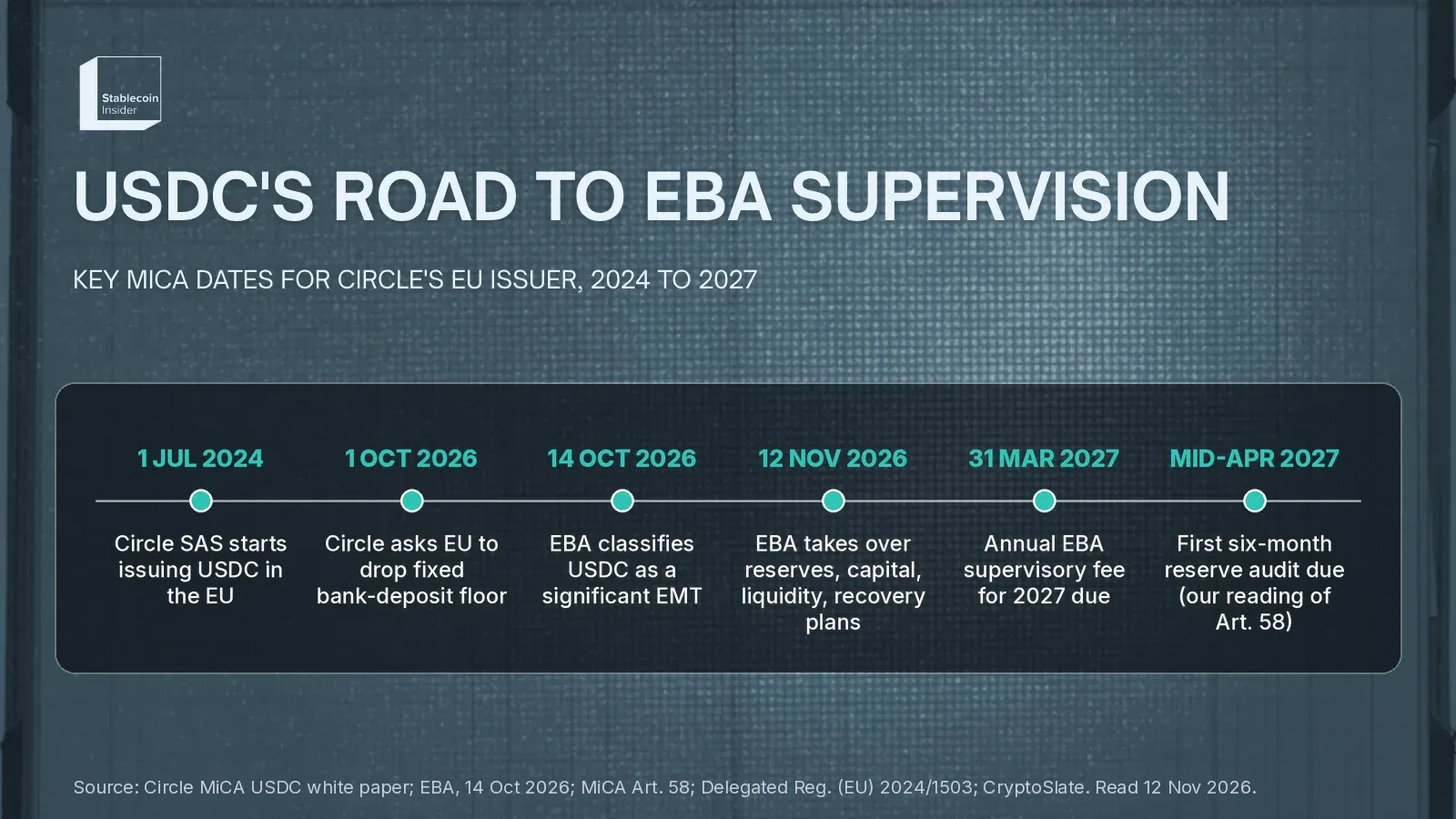
The handover follows the EBA's 14 October 2026 decision to classify USDC as a significant e-money token under MiCA. USDC is the first of the 45 e-money tokens notified in the EU to get that label. Circle told investors in its third-quarter 10-Q that the change could require it to hold more capital or liquidity in the EU.
Key Takeaways
- Since 12 November 2026, the EBA and France's ACPR jointly supervise USDC's EU issuer, Circle Internet Financial Europe SAS (Circle SAS).
- The EBA now handles capital, reserves, liquidity and recovery and redemption plans. The ACPR keeps governance and fit-and-proper checks.
- Significant status lifts Circle SAS's minimum own funds from 2% to 3%, and up to 3.6% if supervisors add the 20% buffer MiCA allows.
- Independent reserve audits are now mandated every six months, and Circle SAS now pays an annual EBA supervisory fee.
- For holders, the token is unchanged: EEA holders can still redeem at par, and USDC is still not covered by deposit guarantee schemes.
What changed for USDC on 12 November 2026?
What changed for USDC on 12 November 2026 is who checks the money behind it. Until this week, the ACPR supervised all of Circle SAS's MiCA obligations. Under Article 117(4) of MiCA, the EBA now supervises a significant token's issuer for compliance with Articles 55 and 58, which cover recovery and redemption plans and the extra reserve, liquidity and capital rules. The table shows the split; each row links to its source.
| Area | Supervisor from 12 Nov 2026 | Legal basis |
|---|---|---|
| Own funds (regulatory capital) | EBA | MiCA Art. 58(1)(b); EBA |
| Reserve of assets: custody, investment, audits | EBA | MiCA Art. 58(1)(a), applying Arts. 36–38 |
| Liquidity policy and stress tests | EBA | MiCA Art. 45(3)–(4), via Art. 58 |
| Recovery and redemption plans | EBA | MiCA Art. 55; EBA |
| Governance, qualifying holdings, fit and proper, outsourcing, conflicts of interest | ACPR | EBA release |
The split leaves Circle SAS with two supervisors. The EBA says it will work closely with the ACPR on the transition. It has also signed a memorandum of understanding with the New York State Department of Financial Services, which oversees Circle's US business, to share information (EBA).
Which rules get stricter for Circle's EU issuer?
The rules that get stricter for Circle's EU issuer cover capital, reserves, liquidity and fees. Article 58 replaces the e-money directive's capital and safeguarding articles with MiCA's tougher versions for significant tokens. This table compares the main obligations before and after classification.
| Requirement | Before (non-significant EMT) | Now (significant EMT) |
|---|---|---|
| Minimum own funds | 2% of average outstanding e-money (E-Money Directive Art. 5(3)) | 3% of average reserve assets (MiCA Art. 45(5)) |
| Reserve rules | MiCA Art. 54: at least 30% in bank deposits, rest in secure, liquid assets (CryptoSlate) | MiCA Arts. 36–38 reserve, custody and investment rules; independent audit every six months (Art. 58(1)) |
| Liquidity | No MiCA liquidity policy required | Liquidity management policy and regular stress tests (Art. 45(3)–(4)) |
| Custody access | No MiCA interoperability duty | Tokens must be holdable at other custodians on fair terms (Art. 45(2)) |
| Supervisory fee | None to the EBA | Annual EBA fee in proportion to issuance (Art. 137; Reg. 2024/1503) |
The capital change is the easiest to measure. For every $1 billion of average reserves backing EU-issued USDC, Circle SAS's minimum own funds rise from about $20 million to $30 million, a 50% increase. Under Article 35(3), which Article 58 also applies, supervisors can require up to 20% more, or $36 million per $1 billion (MiCA Art. 58; MiCA Art. 35). The old 2% is measured on outstanding e-money and the new 3% on reserve assets. For a fully reserved token the two bases are close, but not identical.
The real bill depends on figures Circle does not publish separately. Its MiCA white paper says Circle SAS holds reserves for holders in the European Economic Area, and Circle LLC holds them for everyone else, but Circle's public reserve reports give combined figures. On 12 November 2026, total USDC in circulation was about $69.8 billion according to DefiLlama. That is a global figure and does not show how much sits in the EU issuer.
Why did the EBA classify USDC as significant?
The EBA classified USDC as significant because it found the token met at least three of MiCA's significance criteria. Article 56 applies the tests in Article 43(1): more than 10 million holders; more than €5 billion in token value, market capitalisation or reserves; more than 2.5 million transactions and €500 million a day; a gatekeeper issuer; international use for payments and remittances; links to the financial system; and an issuer that issues other tokens and also provides crypto-asset services.
The EBA has not said which criteria USDC met. Its release cites Commission Delegated Regulation (EU) 2024/1506 for the indicators and says it reassesses significance every year (EBA). Our explainer on what happens when a stablecoin gets too big in Europe covers how the thresholds and the separate payment caps work.
Does EBA supervision change anything for USDC holders?
EBA supervision does not change how USDC works for holders. Tokens issued by Circle SAS and Circle LLC stay fully fungible, and EEA holders keep the right to redeem at par at any time, according to Circle's MiCA white paper. The same document warns that USDC is not covered by EU deposit guarantee or investor compensation schemes, and EBA oversight does not change that.
What changes is the depth of checking behind the reserve. Exchanges and payment firms that hold USDC for EU clients gain a pan-EU supervisor looking at that reserve. Circle itself said in its 10-Q, filed on 4 November 2026, that it is still "evaluating the impact of the classification and the transition to EBA supervision".
How does the handover affect the bank-deposit debate?
The handover makes the bank-deposit debate more pressing for Circle. In its 1 October response to the European Commission's MiCA review, Circle described the deposit floor as 30% of reserve assets for e-money token issuers, rising to 60% for significant-token issuers, and asked for a flexible liquidity standard instead (CryptoSlate). For significant asset-referenced tokens, MiCA's own text says the deposit minimum cannot be lower than 60% (Art. 45(7)(b)).
With the EBA now supervising those reserves, any change would need both a new law and a new supervisor's sign-off. We covered the dispute in Circle and Tether disagree on everything except MiCA's bank deposit rule.
Stablecoin Insider's take
USDC is the test case for how MiCA treats a big foreign-currency stablecoin. The EBA now sees the reserve directly, and every future issuer that crosses the thresholds will be measured against how this goes. Two open points are how Circle splits reserves between its EU and US issuers, and whether the MiCA review loosens the 60% deposit floor before more tokens join USDC.
Holding stablecoins as a European company? See whether EURC or USDC suits your treasury.
For the full picture, see our Stablecoin Regulation Hub.
FAQ
Is USDC restricted in the EU after the EBA classification?
Is Circle's EURC now supervised by the EBA?
Is the significant classification permanent?
Who pays for the EBA's supervision of USDC?
What happens next?
Next, watch for the first six-month independent audit of Circle SAS's reserve, which on our reading of Article 58 falls around mid-April 2027, and the first EBA fee invoice for 2027. The EBA's annual reassessment will show whether any of the other 44 e-money tokens joins USDC. The outcome of the MiCA review will decide whether the 60% deposit floor stays. Stablecoin Insider will update this story when the EBA or Circle publishes more.
Sources: EBA press release, 14 Oct 2026; Circle 10-Q for Q3 2026, filed 4 Nov 2026; Circle MiCA USDC white paper; MiCA, Regulation (EU) 2023/1114 (Art. 58, Art. 45, Art. 137); Commission Delegated Regulation (EU) 2024/1503; E-Money Directive 2009/110/EC; CryptoSlate, 15 Oct 2026; DefiLlama. All read on 12 November 2026.
This content is provided for informational and educational purposes only and doesn't constitute financial, investment, legal or tax advice. Regulatory text and Circle disclosures were read on 12 November 2026 and may change; the capital figures are worked examples, not Circle's actual requirement, and USDC supply figures from DefiLlama change daily. Nothing here is a recommendation to buy, sell or hold USDC, EURC or shares in Circle Internet Group or any other company mentioned. Do your own research and speak to a licensed adviser before making financial decisions.


