
Table of Contents
Deutsche Bank's crypto custody service is now live. On 11 November 2026 Germany's largest lender said its Digital Asset Custody service had gone live for paying institutional and corporate clients, holding bitcoin, ether and three stablecoins, USDC, EURC and EURAU, with the bank managing wallets and private keys (Reuters via CNA; The Block).
The bank also signed a memorandum of understanding with Deutsche Asset Management, the fund manager formerly known as DWS, to explore tokenized money market funds, crypto exchange-traded commodities and stablecoins on the same platform. The launch comes eight weeks after the bank's 16 September 2026 announcement.
Key Takeaways
- Deutsche Bank's Digital Asset Custody went live for paying clients on 11 November 2026, supporting BTC, ETH, USDC, EURC and EURAU.
- The service is custody and transfers only. The bank's MiCA register entry lists no trading, exchange or order execution, and retail clients are excluded.
- ESMA's interim MiCA register lists Deutsche Bank under an Article 60 bank notification dated 12 October 2026, covering 30 countries.
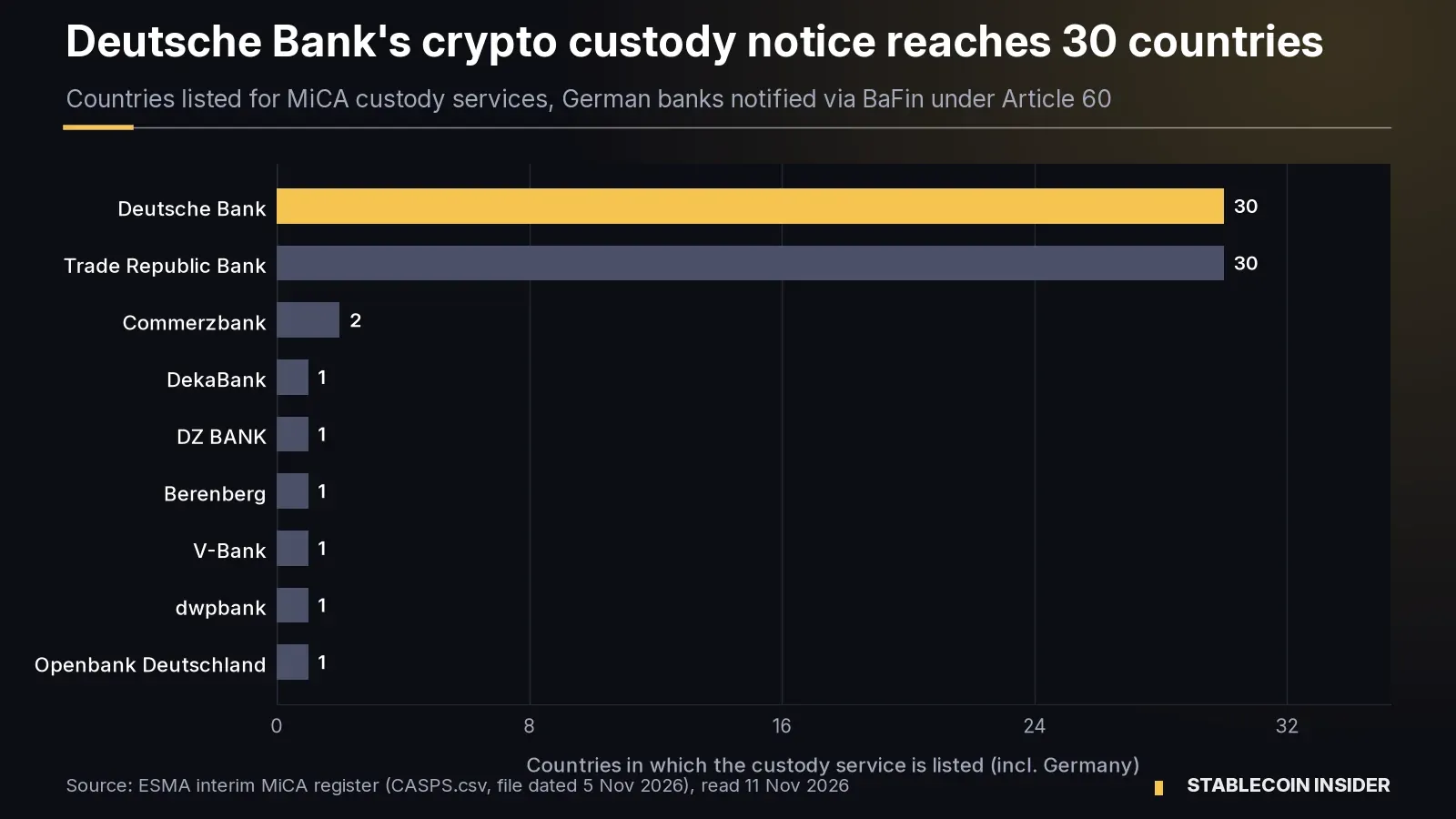
- That reach is unusual: Commerzbank's custody entry lists 2 countries, and DekaBank and DZ BANK list only Germany.
- A new MoU with Deutsche Asset Management covers tokenized money market funds, crypto ETCs and stablecoins; the fund arm plans a tokenized money market fund.
- Client names and custody fees have not been disclosed.
What did Deutsche Bank launch on 11 November 2026?
Deutsche Bank launched a live, fee-paying crypto custody service for corporate and institutional clients on 11 November 2026. Clients can hold digital assets with the bank, which manages the wallets and private keys, and transfer them to third parties (The Block).
"In the medium term we aim to deliver a fully integrated, regulated ecosystem that supports the custody, tokenisation, and settlement of digital assets," said Paul Maley, global head of trust and securities services at Deutsche Bank (Reuters via CNA). The bank has previously told Reuters it wants to take the offer to Asia.
The product page lists three services at launch: custody of digital assets, transfer services, and internal transfers between warm and cold storage. Clients reach it through Autobahn, the bank's corporate portal. Keys are stored in hardware security modules, and transfers run through a client-configurable approval process. The bank has not named its first clients or published fees (crypto.news).
Which assets and clients does the custody service cover?
The custody service covers five assets and only professional clients. The supported tokens are bitcoin, ether, Circle's USDC and EURC, and AllUnity's EURAU, per the bank's product page. The September release says more assets may follow, subject to client demand and internal approvals, and that tokenized financial instruments are on the roadmap.
The target clients are customers of the Corporate Bank and Investment Bank: corporates, asset managers, hedge funds, custodians, brokers and sovereign institutions. The service is not for retail clients, and the bank warns that crypto assets are not covered by a deposit-guarantee scheme (Deutsche Bank).
The stablecoin list is uneven in size. On 11 November 2026, USDC had about $70.1 billion in circulation and EURC about 521 million tokens, while EURAU had roughly 0.32 million, according to DefiLlama. EURAU is issued by AllUnity, the venture backed by DWS, Flow Traders and Galaxy, which ties it to Deutsche Bank's own group (The Block). Our earlier piece on AllUnity and its small euro token covers that issuer.
How does Deutsche Bank's MiCA entry compare with other German banks?
Deutsche Bank's MiCA entry is broader than those of other big German banks offering crypto custody. In ESMA's interim MiCA register, Deutsche Bank Aktiengesellschaft appears under BaFin with a notification date of 12 October 2026, last updated 20 October 2026. It is listed for custody and administration of crypto assets and for transfer services, under "Article 60 - Notification".
Article 60 of MiCA lets credit institutions provide crypto-asset services after notifying their supervisor, instead of applying for a separate CASP licence. We read the register's CSV file (dated 5 November 2026) on 11 November and filtered for BaFin-supervised entries that include custody. The table compares the four large German banks that list it; each row comes from the register file.
| Bank | Register date | MiCA services listed | Countries listed |
|---|---|---|---|
| Deutsche Bank | 12 Oct 2026 | Custody; transfer | 30 (Germany plus 29 EEA states) |
| Commerzbank | 7 Apr 2025 | Custody; transfer | 2 (Germany, Italy) |
| DekaBank | 1 Dec 2025 | Custody; execution of orders; transfer | 1 (Germany) |
| DZ BANK | 23 Dec 2025 | Custody; execution of orders; transfer | 1 (Germany) |
Two things stand out. First, Deutsche Bank was late: 16 of the other 17 BaFin-supervised firms that list custody were entered before it, and Commerzbank's entry predates it by 18 months. Second, it went wide. Deutsche Bank's passport list covers 30 countries, matching Trade Republic and well ahead of every other large German bank. It also lists no order execution or exchange, which fits a custody-only launch.
The register is an interim file, and a country listed there is not proof the bank is serving clients there yet. The product page says the service is available in Germany, "with cross-border servicing across Europe in line with applicable regulations".
What is in the Deutsche Asset Management agreement?
The Deutsche Asset Management agreement is a memorandum of understanding to explore tokenized money market funds, crypto ETCs and stablecoins using Deutsche Bank's custody platform. The two firms will look at custody and settlement, liquidity management, treasury and distribution (The Block). Reuters quotes the aim as "to explore comprehensive commercial and technical collaboration opportunities in the digital asset space" (Reuters via CNA).
Manfred Bauer, chief product officer at Deutsche Asset Management, said the firm plans to launch a tokenized money market fund. The manager reported €1.22 trillion in assets under management at 30 September (The Block). An MoU is not a product launch, and no fund name, chain or date has been given. For how these funds work, see our tokenized money market funds guide.
What does the launch mean for stablecoin users in Europe?
The launch means European companies can hold USDC and EURC with a global bank under MiCA, without building their own wallet setup. That addresses a practical hurdle for treasurers who want stablecoins on the balance sheet. It does not add trading, yield or minting; clients still need an exchange or issuer to buy or redeem tokens.
It also lands days after a US move. On 9 November Coinbase said the OCC had given final approval for its national trust bank, a federally chartered custody option for US institutions; our Coinbase trust charter report covers it. Deutsche Bank is also among the funders of Project Faro, the bank consortium planning a dollar stablecoin for 2027.
Stablecoin Insider's take
Deutsche Bank arrives late to German bank custody but with the widest footprint among its large peers, and with its own group's euro token on the list. The open questions are commercial: who the first clients are, what the bank charges against specialists such as BitGo and Fireblocks, and whether the Deutsche Asset Management fund gives the platform a reason to exist beyond safekeeping.
Choosing a custodian? See how BitGo and Fireblocks compare for stablecoin custody.
For the full picture, see our Stablecoin Regulation Hub.
FAQ
Can retail customers use Deutsche Bank's crypto custody?
Can clients buy or sell crypto through Deutsche Bank's custody service?
Is crypto held with Deutsche Bank covered by deposit insurance?
Who provides the technology behind Deutsche Bank's custody?
How much does Deutsche Bank charge for crypto custody?
What happens next?
Next, watch for the first named clients and any fee disclosure, new assets added to the supported list, the Deutsche Asset Management tokenized money market fund, and the Asia expansion the bank has flagged. A change to the ESMA register entry, such as added services, would signal trading or settlement is coming. Stablecoin Insider will update this story as details are confirmed.
Sources: Reuters via CNA, 11 Nov 2026; The Block, 11 Nov 2026; crypto.news; Deutsche Bank media release, 16 Sep 2026; Deutsche Bank Digital Asset Custody page; ESMA interim MiCA register (CASPS.csv); MiCA, Regulation (EU) 2023/1114; DefiLlama. All read on 11 November 2026.
This content is provided for informational and educational purposes only and doesn't constitute financial, investment, legal or tax advice. Register data was read from ESMA's interim MiCA file on 11 November 2026 and may change; stablecoin supply figures from DefiLlama change daily. Nothing here is a recommendation to buy, sell or hold bitcoin, ether, USDC, EURC, EURAU or shares in Deutsche Bank, Commerzbank, DekaBank, DZ BANK or any other company mentioned. Do your own research and speak to a licensed adviser before making financial decisions.


