Table of Contents
The best gold ETFs in India in 2026, on official data read on 18 November 2026, are ICICI Prudential Gold ETF for most long-term buyers (0.49% expense ratio and the second-largest fund), Nippon India ETF Gold BeES for traders who need the deepest market, and Tata Gold ETF, Mirae Asset Gold ETF or Zerodha CASE Gold ETF if the lowest yearly fee matters most (0.35% to 0.39%).
All eight funds below hold gold and track the domestic gold price, so the choice comes down to cost, how closely each fund followed gold, and how easily its units trade. Every figure comes from AMFI's expense-ratio register, AMFI's tracking-difference disclosure, AMFI's average AUM data and NSE's ETF market page.
Last updated: 18 November 2026. Expense ratios, tracking difference, fund size and NSE trading data re-checked against AMFI and NSE on this date.
Key Takeaways
- Total expense ratios (TER) for the eight gold ETFs range from 0.35% (Mirae Asset, Zerodha CASE) to 0.81% (Nippon India Gold BeES), per AMFI's November 2026 TER data (AMFI).
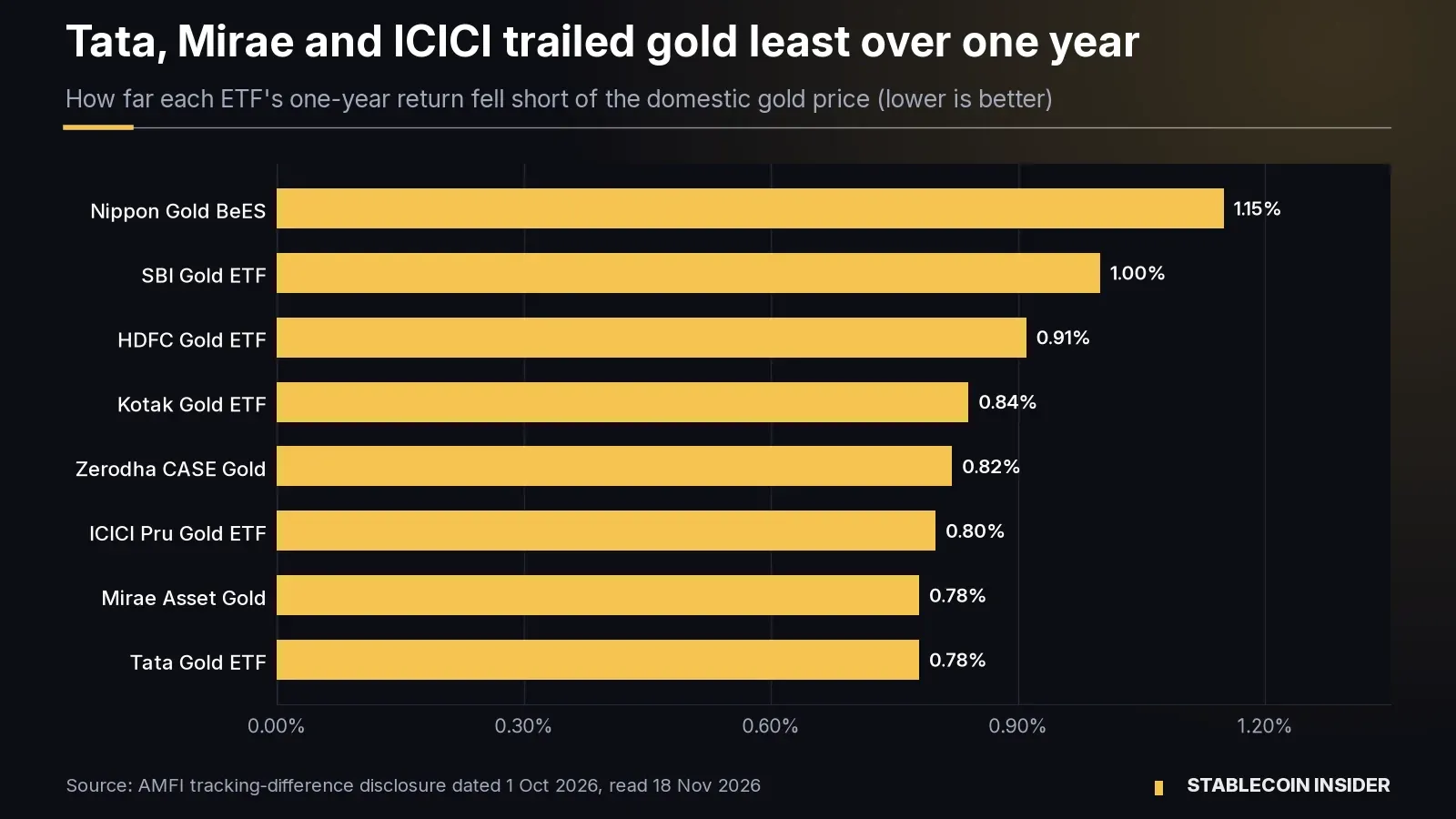
- Over the year in AMFI's 1 October 2026 disclosure, Tata and Mirae Asset trailed the domestic gold price by 0.78%; Gold BeES trailed by 1.15% (AMFI).
- Gold BeES is by far the largest: ₹56,306 crore average AUM in July–September 2026, about twice ICICI Prudential's ₹27,185 crore (AMFI).
- On 18 November 2026, GOLDBEES traded about ₹867 crore on NSE, more than five times the next gold ETF, GOLDIETF, at about ₹147 crore (NSE).
- On ₹1,00,000 held for a year, the TER gap between the cheapest and dearest fund here is ₹460, before brokerage and tax (our calculation).
Which are the best gold ETFs in India in 2026?
The best gold ETFs in India in 2026 depend on whether you buy and hold or trade often. The table ranks our eight picks by fit; the gap to gold is each fund's one-year tracking difference. Each fund name links to the data source used, and the NSE symbol is what you search for in your broker app.
| ETF (NSE symbol) | TER | 1-year gap to gold | Best for |
|---|---|---|---|
| Our pick: ICICI Prudential Gold ETF (GOLDIETF) | 0.49% | −0.80% | Best all-rounder: low cost, large and liquid |
| Nippon India ETF Gold BeES (GOLDBEES) | 0.81% | −1.15% | Most liquid; largest fund; highest cost |
| Tata Gold ETF (TATAGOLD) | 0.39% | −0.78% | Lowest-cost large-volume option; low unit price |
| Mirae Asset Gold ETF (GOLDETF) | 0.35% | −0.78% | Joint-lowest TER; smaller fund |
| Zerodha CASE Gold ETF (GOLDCASE) | 0.35% | −0.82% | Joint-lowest TER; low unit price |
| HDFC Gold ETF (HDFCGOLD) | 0.59% | −0.91% | Large fund at a mid-range cost |
| SBI Gold ETF (SBIGOLD) | 0.65% | −1.00% | Large fund; higher cost than peers |
| Kotak Gold ETF (GOLD1) | 0.52% | −0.84% | Mid-sized, mid-cost option |
Two patterns stand out. The cheapest funds by TER, Mirae Asset and Zerodha CASE, are among the smallest, while the biggest fund, Gold BeES, charges the most. And a lower TER usually, but not always, meant a smaller gap to gold: Zerodha CASE (0.35% TER) trailed gold by more than ICICI Prudential (0.49%) over the year (AMFI).
How much does each gold ETF cost on ₹1 lakh a year?
Each gold ETF here costs between ₹350 and ₹810 a year in expense ratio on ₹1,00,000. The table also shows what last year's tracking difference would mean in rupees, under these assumptions:
- ₹1,00,000 invested for one year, with the holding value treated as flat (in practice the TER is charged daily on a changing value).
- TER is the November 2026 figure in AMFI's register; tracking gap uses each fund's one-year tracking difference from the 1 October 2026 disclosure. Past tracking does not guarantee future tracking.
- Brokerage, depository charges, the bid-ask spread and tax are excluded.
| ETF | TER on ₹1 lakh | Last year's tracking gap on ₹1 lakh | Extra TER vs cheapest |
|---|---|---|---|
| Mirae Asset Gold ETF | ₹350 | ₹780 | ₹0 |
| Zerodha CASE Gold ETF | ₹350 | ₹820 | ₹0 |
| Tata Gold ETF | ₹390 | ₹780 | +₹40 |
| ICICI Prudential Gold ETF | ₹490 | ₹800 | +₹140 |
| Kotak Gold ETF | ₹520 | ₹840 | +₹170 |
| HDFC Gold ETF | ₹590 | ₹910 | +₹240 |
| SBI Gold ETF | ₹650 | ₹1,000 | +₹300 |
| Nippon India ETF Gold BeES | ₹810 | ₹1,150 | +₹460 |
The tracking gap was larger than the TER for every fund, so the published fee alone understates how far each fund fell behind gold last year. That is why we weigh both. For a long holding, the ₹460 a year between Gold BeES and the 0.35% funds adds up, but it is small next to the gold price itself: Gold BeES returned 27.16% in the year to 30 September 2026 (Nippon India).
Which gold ETFs are the biggest and easiest to trade?
The biggest and easiest gold ETFs to trade in India are Nippon India ETF Gold BeES, ICICI Prudential, SBI and HDFC by fund size, and Gold BeES by a wide margin on daily trading. Trading value shows how active each fund's market is, which matters most if you buy or sell large amounts.
| ETF (NSE symbol) | Average AUM, Jul–Sep 2026 | NSE traded value, 18 Nov 2026 | NAV per unit, 17 Nov 2026 |
|---|---|---|---|
| Nippon India ETF Gold BeES (GOLDBEES) | ₹56,306 cr | ₹867.5 cr | ₹109.89 |
| ICICI Prudential Gold ETF (GOLDIETF) | ₹27,185 cr | ₹147.3 cr | ₹113.93 |
| SBI Gold ETF (SBIGOLD) | ₹25,899 cr | ₹139.0 cr | ₹113.39 |
| HDFC Gold ETF (HDFCGOLD) | ₹23,492 cr | ₹87.9 cr | ₹113.59 |
| Kotak Gold ETF (GOLD1) | ₹14,346 cr | ₹42.9 cr | ₹110.99 |
| Tata Gold ETF (TATAGOLD) | ₹6,006 cr | ₹130.6 cr | ₹12.94 |
| Mirae Asset Gold ETF (GOLDETF) | ₹3,371 cr | ₹34.6 cr | ₹129.43 |
| Zerodha CASE Gold ETF (GOLDCASE) | ₹2,454 cr | ₹37.7 cr | ₹20.92 |
Sources: AMFI average AUM (scheme-wise, July–September 2026); NSE ETF market data as of 4:00 pm IST on 18 November 2026; AMFI NAV file for 17 November 2026. Tata Gold ETF stands out: it is a tenth the size of Gold BeES but traded about ₹131 crore on 18 November. Its NAV of about ₹13 a unit also makes small, exact purchases easier.
Who should pick each gold ETF?
Each gold ETF suits a different buyer. The entries below give the use case, the drawbacks and the official figures behind each one.
1. ICICI Prudential Gold ETF (GOLDIETF): best all-rounder
ICICI Prudential Gold ETF suits long-term buyers who want a low fee without giving up size or trading activity. Its TER is 0.49% (AMFI), its one-year tracking difference was −0.80% and its three-year figure −1.20% (AMFI). Average AUM was ₹27,185 crore in July–September 2026 (AMFI) and it traded about ₹147 crore on 18 November (NSE).
Pros: second-largest gold ETF; second-highest NSE turnover on 18 November; below-average cost.
Cons: 0.14 percentage points dearer than the cheapest funds; three-year gap to gold still above 1% a year.
2. Nippon India ETF Gold BeES (GOLDBEES): best for liquidity
Nippon India ETF Gold BeES suits active traders and large orders. It launched on 8 March 2007 (Nippon India) and is the largest, with ₹56,306 crore average AUM (AMFI). It traded about ₹867 crore on NSE on 18 November (NSE).
Pros: deepest market among gold ETFs; track record since 2007.
Cons: highest TER here at 0.81% (AMFI); widest one-year tracking difference at −1.15% and three-year at −1.54% (AMFI). Long-term holders pay for liquidity they may not use.
3. Tata Gold ETF (TATAGOLD): best low-cost option with high turnover
Tata Gold ETF suits cost-conscious buyers who still want an active market. Its TER is 0.39% (AMFI) and it trailed gold by 0.78% over the year (AMFI). It traded about ₹131 crore on 18 November, fourth among gold ETFs (NSE), and its NAV was about ₹12.94 a unit on 17 November (AMFI).
Pros: low fee; joint-best one-year tracking; low unit price.
Cons: AMFI shows no three-year tracking figure yet, so the record is short; since-launch tracking difference is −1.53% (AMFI); ₹6,006 crore AUM is far below the leaders.
4. Mirae Asset Gold ETF (GOLDETF): joint-lowest TER
Mirae Asset Gold ETF suits buy-and-hold investors who rank cost first. It shares the lowest TER here, 0.35% (AMFI), and trailed gold by 0.78% over one year and 1.30% over three (AMFI).
Pros: lowest fee; joint-best one-year tracking.
Cons: smaller fund at ₹3,371 crore average AUM (AMFI) and about ₹35 crore traded on 18 November (NSE); NAV near ₹129 a unit is the highest here.
5. Zerodha CASE Gold ETF (GOLDCASE): low fee, low unit price
Zerodha CASE Gold ETF suits small, regular buyers who want a low fee and a low unit price. Its TER is 0.35% (AMFI) and its NAV was about ₹20.92 on 17 November (AMFI).
Pros: joint-lowest fee; units cheap enough for small top-ups.
Cons: trailed gold by 0.82% over one year despite the low TER, and by 1.47% since launch (AMFI); smallest fund here at ₹2,454 crore (AMFI).
6. HDFC Gold ETF (HDFCGOLD): large fund at a mid-range cost
HDFC Gold ETF suits investors who want a large, established fund and accept a mid-range fee. Its TER is 0.59% (AMFI); tracking difference was −0.91% over one year and −1.33% over three (AMFI).
Pros: ₹23,492 crore average AUM (AMFI); ten-year record in AMFI's data.
Cons: costs 0.10 percentage points more than ICICI Prudential with weaker one-year tracking; about ₹88 crore traded on 18 November (NSE).
7. SBI Gold ETF (SBIGOLD): large fund, higher cost
SBI Gold ETF suits investors who already use SBI's platforms and value a large fund. Average AUM was ₹25,899 crore (AMFI) and it traded about ₹139 crore on 18 November (NSE).
Pros: third-largest gold ETF; active NSE market.
Cons: TER of 0.65% is the second-highest here (AMFI); trailed gold by 1.00% over one year and 1.40% over three (AMFI).
8. Kotak Gold ETF (GOLD1): mid-sized, mid-cost
Kotak Gold ETF suits buyers who want a long-running fund at a cost close to ICICI Prudential's. Its TER is 0.52% (AMFI), and it trailed gold by 0.84% over one year and 1.01% over ten (AMFI).
Pros: ten-year tracking difference among the tightest here; ₹14,346 crore average AUM (AMFI).
Cons: about ₹43 crore traded on 18 November, well below the leaders (NSE); slightly dearer and slightly looser one-year tracking than ICICI Prudential.
How do gold ETFs work in India?
Gold ETFs in India work as SEBI-regulated mutual fund schemes whose units each represent a quantity of physical gold held in vaults, according to DSP Mutual Fund. They track the domestic gold price, which moves with both the global gold price and the rupee.
You buy and sell units on NSE or BSE through a demat and trading account. Retail investors cannot swap units for physical gold; exits are settled in cash, and physical delivery is limited to authorised participants (DSP). If you want a monthly SIP without a demat account, a gold fund of funds invests in an ETF for you, at an extra layer of cost (DSP).
Weighing gold against equity index funds? See our Nifty 50 vs Sensex comparison for fund costs on the other side of the portfolio, or our guide to small-balance investing.
Verdict: which gold ETF should you buy?
The gold ETF you should buy depends on how you use it. For most long-term investors, ICICI Prudential Gold ETF is our pick: a 0.49% fee, the second-largest fund and strong daily trading. Pick Nippon India ETF Gold BeES only if you trade large amounts often and value liquidity over cost. If fee is everything, Mirae Asset Gold ETF or Tata Gold ETF gave the closest one-year tracking at 0.35% to 0.39%, with Tata the more actively traded of the two.
Interested in gold on a blockchain instead? Compare gold-backed stablecoins such as PAXG and XAUt, or read why some savers in Turkey and Argentina hold USDT rather than gold.
FAQ
How are gold ETFs taxed in India?
Can I start a SIP in a gold ETF?
Is a gold ETF better than digital gold?
What is the minimum amount to buy a gold ETF?
Why does a gold ETF return less than the gold price?
Sources: AMFI: TER of mutual fund schemes (November 2026 data); AMFI: tracking error and tracking difference (disclosure dated 1 October 2026); AMFI: average AUM, scheme-wise (July–September 2026); AMFI NAV file (17 November 2026); NSE: exchange traded funds (18 November 2026, 4:00 pm IST); Nippon India ETF Gold BeES fund page; DSP Mutual Fund: gold ETF explainer; Aditya Birla Capital: tax on gold ETF. All read on 18 November 2026.
This content is provided for informational and educational purposes only and doesn't constitute financial, investment, legal or tax advice. Expense ratios, tracking difference, AUM, NAV and trading data for ICICI Prudential, Nippon India, Tata, Mirae Asset, Zerodha, HDFC, SBI and Kotak gold ETFs were read from AMFI and NSE on 18 November 2026, are in Indian rupees and can change daily. Worked costs are our calculation under the stated assumptions. Past tracking and returns do not guarantee future results. Gold prices can fall as well as rise.