Table of Contents
The question gets asked in two bad forms. Either agent payments are assumed to be a new regulatory category with rules nobody has written, or they are waved through as ordinary transfers that happen to be automated.
Neither is right. The obligations attaching to a payment do not care whether a person or a program initiated it, so nothing new applies and nothing existing stops applying.
What does change is everything about how you discharge those obligations. Volume, timing and the absence of a human at the moment of payment break processes that were quietly designed around a person clicking something during office hours.
The rules are the same. The process cannot be, because a control that runs overnight in batches is not a control over a rail that settles continuously in seconds.
Key Takeaways
- No new rulebook applies. The existing obligations simply follow the payment.
- Sanctions screening has no minimum. Strict liability applies at any amount.
- The EU Travel Rule threshold is zero. Every crypto transfer is in scope.
- Batch screening does not fit. Lists must be current when value moves.
- Many small payments resemble structuring. Document the architecture in advance.
What Does Not Change
Start with the unglamorous answer, because it saves a lot of wasted analysis.
Knowing who you are dealing with, monitoring transactions for suspicious patterns, screening against sanctions lists, transmitting counterparty information where required, and keeping records you can reconstruct are all obligations of the business, not of the person pressing the button. An agent initiating the transfer changes the operator rather than the duty.
The foundations therefore carry over intact. Business identity checks, risk tiers and staged limits work the same way they do in our guide to onboarding merchants, and an agent flow inherits all of it.
Where people go wrong is assuming the inverse, which is that automation somehow dilutes the obligation. It does the opposite, because the thing that scales is the number of events you are responsible for.
What to note: write your agent payment flow against your existing compliance programme rather than building a parallel one, then fix only what the volume breaks.
Sanctions Screening Has No Small-Payment Relief
This is the single most important fact for anyone pricing per-call payments, and it surprises teams who are used to thresholds.
Sanctions prohibitions carry no de minimis amount. A payment of a tenth of a cent to a blocked party is a violation in the same way a six-figure wire would be, and the liability is strict, meaning a US person can breach the rules without knowing the counterparty was listed.
The timing requirement is the part that actually breaks existing systems. Screening has to reflect the current state of the list at the moment value moves, which an overnight batch process cannot do for a rail settling continuously through the night.
The practical consequence is architectural. Either screening happens inline before settlement, or your agent's destinations come from an allowlist that was screened when it was approved and is re-screened on a schedule, which is one more reason destinations should not be a runtime decision.
What to note: an allowlist of pre-screened counterparties is both a security control and the cheapest way to make continuous screening tractable.
Where You Operate Decides the Threshold
The Travel Rule is the obligation most often assumed away on small payments, and whether that assumption holds depends entirely on jurisdiction.
The global baseline recommended by the Financial Action Task Force sits at USD or EUR 1,000. In the US, the long-standing wire transfer requirement applies above USD 3,000, with crypto transfers still subject to active rulemaking rather than a settled crypto-specific figure.
The European position removes the question entirely. Under the Transfer of Funds Regulation, full originator and beneficiary data sharing applies to all crypto transfers with a threshold of zero, so there is no small-payment exemption to design around at any value.
What has to travel is also more than a name. Originator details, references, address or identification data, and the wallet addresses on both sides are the kind of fields involved, which is a real constraint on a flow built for anonymous per-request payments.
What to note: if any part of your business touches the EU, assume every transfer is in scope and design the data path once rather than per threshold.
Monitoring Designed for Humans Breaks
Transaction monitoring is where the mismatch is most visible, and the failure is in both directions.
Thresholds tuned to human behaviour fire constantly against machine behaviour. An agent making ten thousand payments in a week is not anomalous for an agent and looks like an incident to a system calibrated on people, so alert volume rises until someone starts clearing alerts without reading them.
The opposite failure is quieter and worse. A pattern of many small payments that each sit below a reporting threshold is exactly the shape that monitoring is built to flag as structuring, and for an agent it is usually just how per-call pricing works.
The fix is to document the architecture before anyone asks. An explanation of why your traffic looks like this, written in advance and supported by spend policy, is what distinguishes a design decision from an evasion pattern, which is part of why the caps in our guide to agent spend limits belong in a written policy rather than only in code.
What to note: set agent-specific baselines and alert on deviation from the agent's own pattern rather than against human norms.

Who Reviewed What, and When
Every obligation above eventually resolves to a person signing off, and that is the part firms document worst.
An examiner reviewing a filing asks for the underlying evidence, and for agent flows that means a reconstructable record with originator and beneficiary fields, plus the human decisions wrapped around it. Who approved this counterparty, who cleared that alert, who reviewed last month's exceptions, and on what date.
Continuous payment traffic makes this a rota question rather than a job title question. Alerts arrive at night and at weekends, and saying the compliance function owns it is not an answer to who was on duty when a specific alert was cleared.
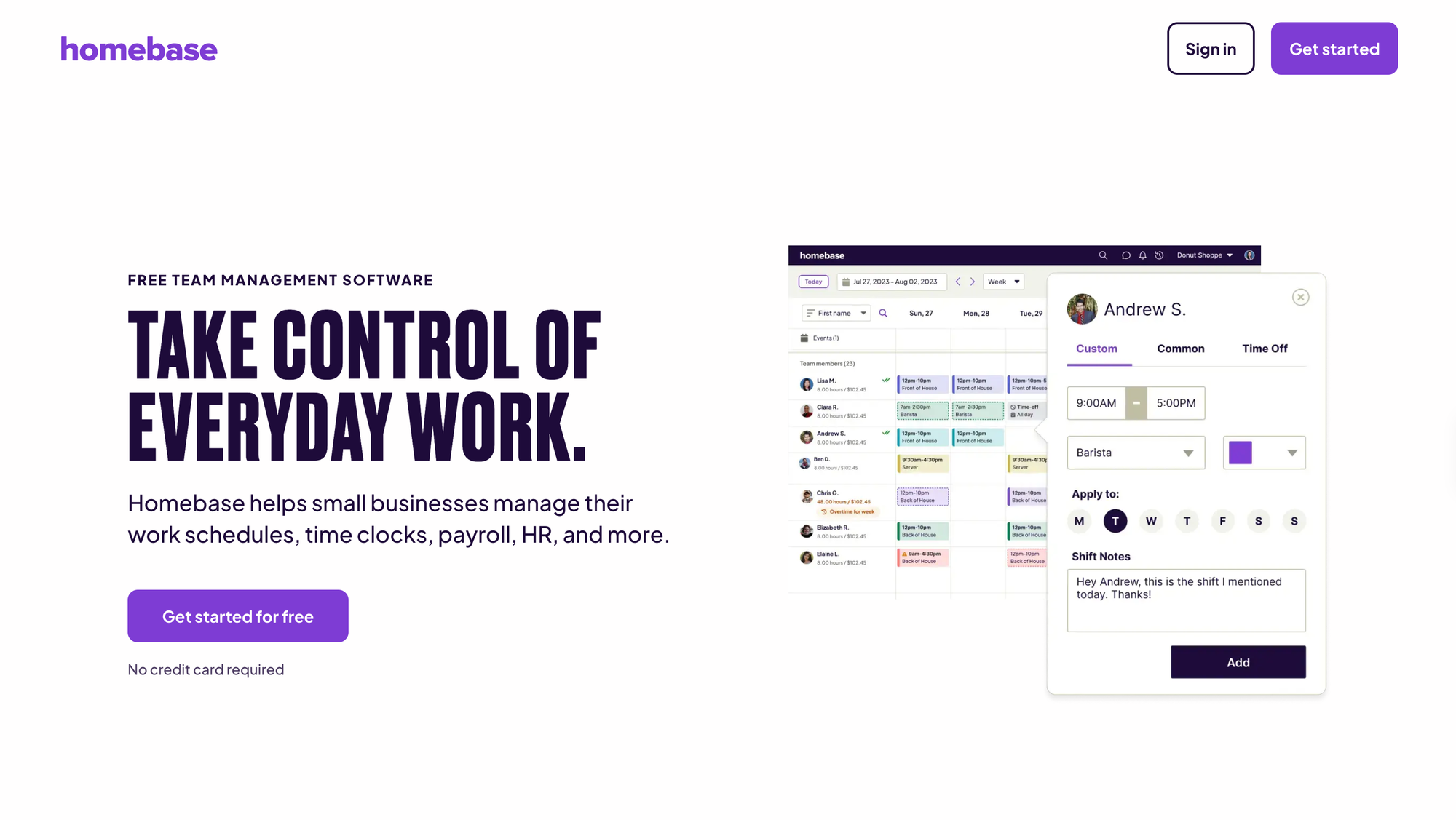
Free employee scheduling and time tracking for your team gives you a dated record of who was assigned to each review window, with payroll and HR added when you need them. No card or code required, which matters when the rota is being set up before anyone has budget for a compliance platform.
What to note: a control with no named owner for a given day is a control you cannot evidence, whatever the system logs show.
What Changes, Obligation by Obligation
| Obligation | Still applies | What agents change | What to build |
|---|---|---|---|
| Know your counterparty | Yes | The payer is software acting for a principal | Identity chain from agent to accountable entity |
| Sanctions screening | Yes, at any amount | Continuous settlement defeats batch screening | Inline screening or a re-screened allowlist |
| Travel Rule data | Depends on jurisdiction | No exemption at all in the EU | A data path that carries both sides' details |
| Transaction monitoring | Yes | Volume and timing break human baselines | Per-agent baselines and deviation alerts |
| Recordkeeping | Yes | Thousands of events instead of dozens | Automated capture of a reconstructable record |
| Human oversight | Yes | Nobody is present at payment time | A rota with dated review assignments |
Read the second column and the answer to the article's question is visible. Nothing has stopped applying, which is why a separate agent compliance regime is the wrong idea and an adapted process is the right one.
What to note: the verifiable receipts in our walkthrough of ACK-Pay settlement exist precisely to make the recordkeeping row automatic rather than manual.
How to Adapt the Process
1. Screen at the allowlist rather than per request
Approve and screen counterparties before an agent can pay them, and re-screen the list on a schedule. This converts an impossible per-transaction obligation into a manageable periodic one.
2. Build the data path for the strictest jurisdiction you touch
If the EU is in scope, carry full originator and beneficiary data on every transfer and stop designing around thresholds that do not apply to you.
3. Baseline each agent separately
Record the normal transaction count, value range and destination set per agent, then alert on departures from that. Human-calibrated rules produce noise and noise produces unread alerts.
4. Write the architecture memo before anyone asks
Document why your payment pattern consists of many small transfers, who authorised it and what controls bound it. This is the document that separates design from structuring in an examination.
5. Name an owner per review window
Assign the alert queue and exception review to a specific person for each period and keep the dated record. Evidence of who reviewed is as important as evidence of what they found.
What to note: every step here is cheaper than retrofitting it after a regulator, bank or acquirer asks how the flow is supervised.
Risks and Limitations
- Rules are still moving: crypto transfer requirements remain subject to rulemaking in some jurisdictions, so today's threshold may not be next year's.
- Strict liability is unforgiving: good faith and small amounts are not defences in sanctions matters.
- Provider coverage varies: some processors handle screening and data transmission for you, and others leave both with the business.
- Licensing may be triggered: holding or transmitting funds for others can bring obligations beyond those discussed here.
- Jurisdictional reach is wide: an agent transacting globally can pull your business into rules you did not plan for.
Conclusion
Do agent payments need their own compliance process? They need an adapted one rather than a separate one, because no obligation disappears when the payer is software and none of them was written with machine-scale volume in mind.
Two facts should drive the design. Sanctions screening has no minimum amount and must reflect the list state at the moment value moves, and in the EU the Travel Rule applies to every crypto transfer with no threshold at all, so small payments buy no relief in either case.
The practical answer is to move the work to where it scales. Screen counterparties at an allowlist rather than per transaction, baseline each agent against its own behaviour, capture records automatically, document the architecture before someone questions it, and keep a dated record of who reviewed what.
Read Next:
FAQs:
1. Are there special regulations for AI agent payments?
No separate rulebook applies. The existing obligations on the business, covering counterparty identification, monitoring, sanctions screening, data transmission and recordkeeping, follow the payment regardless of whether a person or a program initiated it.
2. Is there a minimum amount below which sanctions screening is unnecessary?
No. Sanctions prohibitions carry no de minimis threshold and liability is strict, so a payment of a fraction of a cent to a blocked party is a violation in the same way a large wire would be.
3. Does the Travel Rule apply to tiny agent payments?
It depends where you operate. The FATF baseline is USD or EUR 1,000 and the long-standing US wire requirement applies above USD 3,000, while the EU applies full data sharing to all crypto transfers with a zero threshold.
4. Why does batch screening not work for agent payments?
Because screening must reflect the current state of the sanctions list when value moves, and an overnight batch cannot do that for a rail settling continuously. Inline screening or a regularly re-screened allowlist is the workable answer.
5. Could many small agent payments look like structuring?
Yes, which is why the architecture should be documented in advance. A pattern of transfers sitting below reporting thresholds is what monitoring is built to flag, and a written explanation of the design and its controls is what distinguishes it from evasion.
Disclaimer:
This content is provided for informational and educational purposes only and does not constitute financial, investment, legal, or tax advice; no material herein should be interpreted as a recommendation, endorsement, or solicitation to buy or sell any financial instrument, and readers should conduct their own independent research or consult a qualified professional. Thresholds, data requirements and the status of crypto-specific rulemaking vary by jurisdiction and are changing; confirm the obligations that apply to your business with qualified counsel and your providers before relying on anything described here.