
Table of Contents
The global stablecoin market has surpassed $315 billion in total capitalization as of late March 2026, up roughly 50% year-over-year, with annual on-chain settlement volume exceeding $33 trillion in 2025.
According to a 2025 EY-Parthenon survey, 13% of financial institutions and corporates are already using stablecoins, and 54% of non-users expect to adopt within six to twelve months. Wellspring is launching directly into that window.
On February 21, 2026, Los Angeles-based Wellspring officially launched Wellspring Institutional, a treasury management platform purpose-built for small and mid-sized businesses that want exposure to stablecoin infrastructure without abandoning conventional banking workflows.
The platform consolidates liquidity management, payments, and yield generation into one governed operating environment, connecting traditional bank rails with regulated stablecoin settlement.
The launch comes as stablecoin adoption among businesses accelerates sharply. Stablecoin-based B2B payments surged from roughly $100 million in monthly volume in 2023 to over $3 billion by 2025, according to a May 2025 Oxford academic study.
Cross-border treasury operations and DeFi yield strategies have become the clearest institutional use cases, and Wellspring is positioning itself as the operational layer for SMBs entering that space.
Key Takeaways
- Unified banking and stablecoin rails in a single treasury environment
- Real-time liquidity with no lockup periods on idle balances
- Multi-currency fiat and stablecoin settlements for domestic and cross-border payments
- Yield on treasury balances via traditional and digital asset markets — averaging ~5% APY in 2025
- Governed automation with no disruption to existing financial operations
- Built from direct founder demand, not speculative product strategy
From Consumer Savings Tool to Institutional Platform
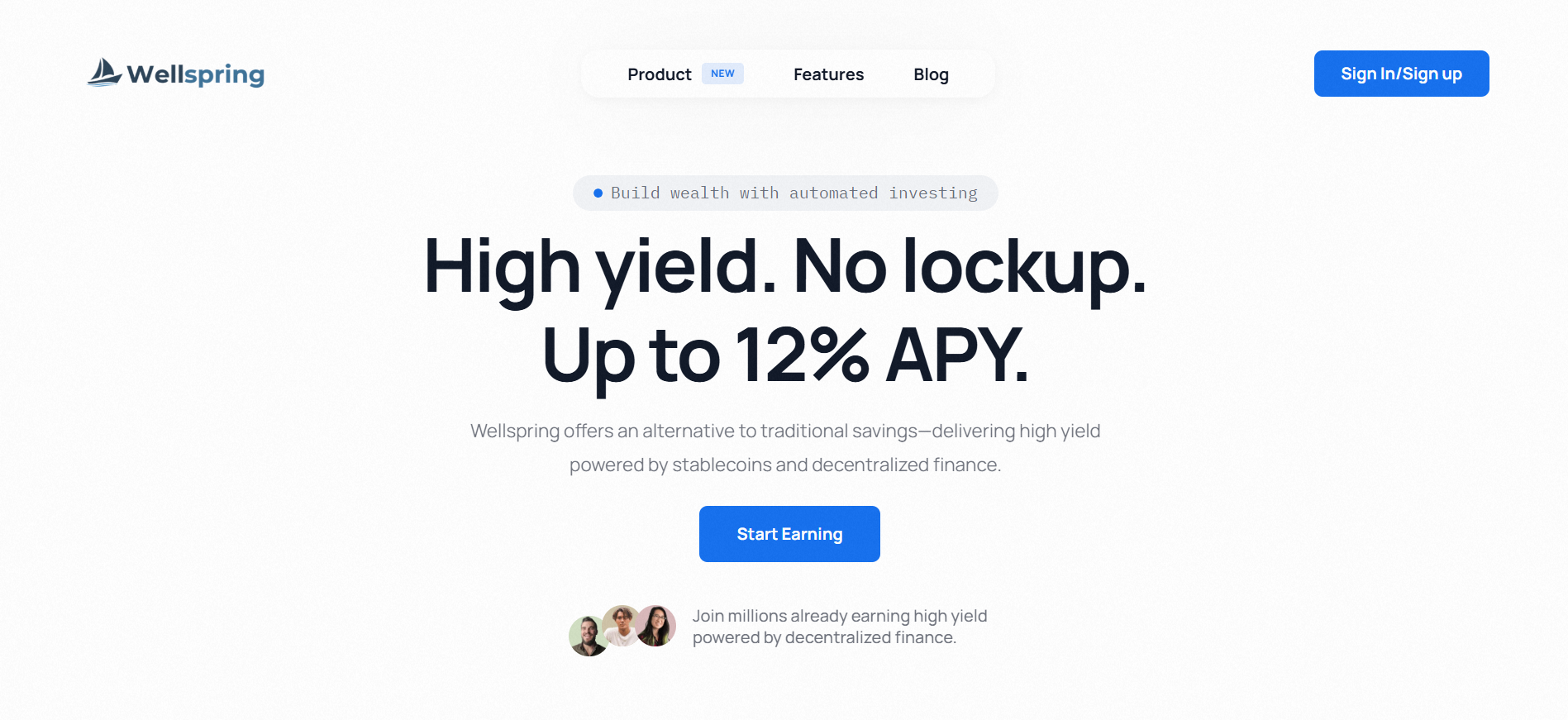
Wellspring did not start in B2B. The company originally launched as a high-yield savings tool for individual investors, a consumer product built on digital asset yield infrastructure. The pivot to institutional came from inbound demand, not a board-driven mandate.
"As we started marketing on social media, founders and business owners in our network began reaching out and asking whether they could use Wellspring to get yield on their treasury. The demand was consistent and strong. That feedback led us to expand the platform's capabilities and formally launch Wellspring Institutional, a treasury management solution purpose-built for businesses." - Trevor Hoffman, Co-Founder & VP of Business Development
That demand-driven build philosophy is reflected in the platform's architecture. Rather than layering blockchain features onto legacy banking infrastructure, Wellspring built a unified control layer designed from the ground up to handle both fiat and stablecoin workflows natively.
Platform Features
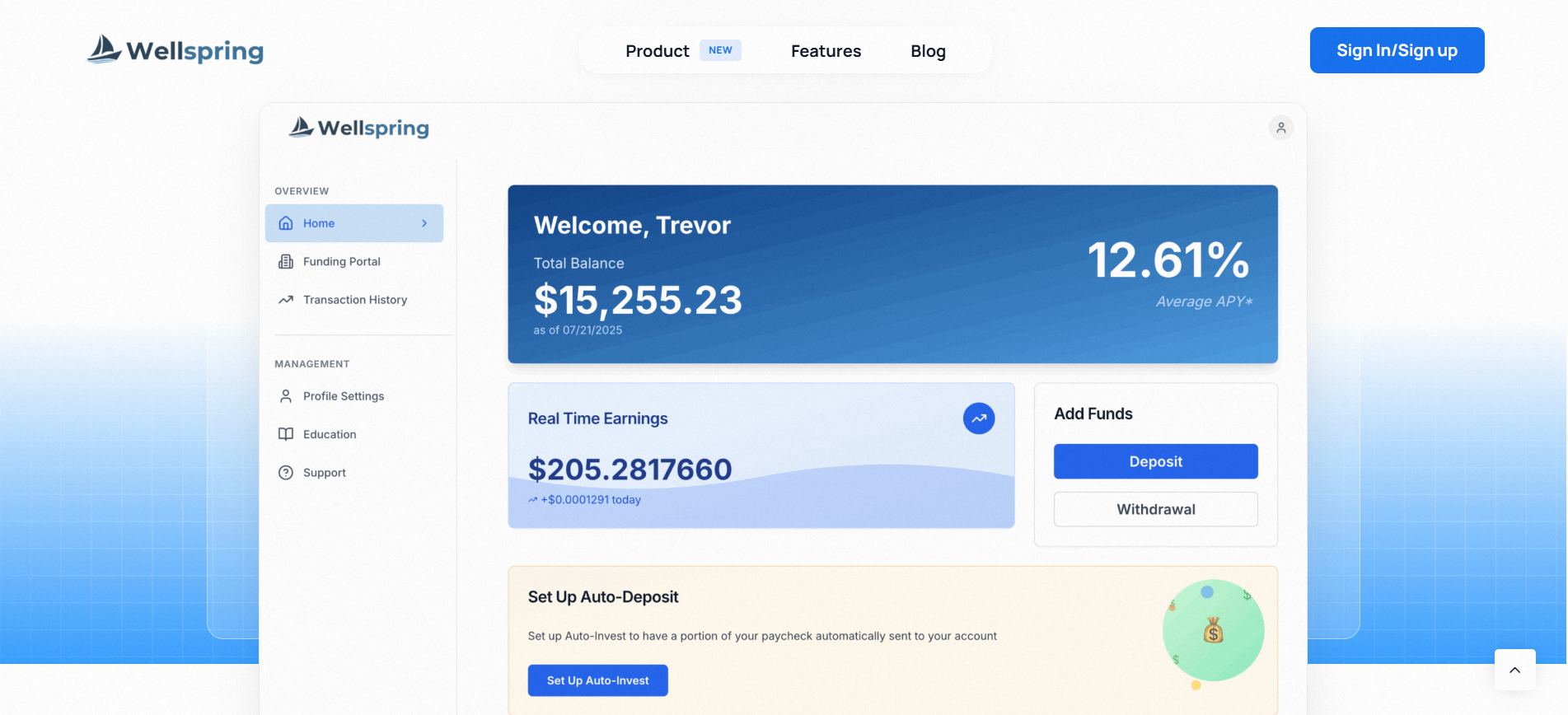
Wellspring Institutional is structured around three core capabilities: liquidity management, payments infrastructure, and yield deployment, each operating within a governed treasury framework that enforces policy-based controls across the workflow.
- Liquidity Management:
Real-time visibility into available capital, flexible deployment options, and instant redemption without lockup periods. Businesses maintain control over funds while optimizing usage across entities. - Payments Infrastructure:
Support for multi-currency fiat and stablecoin settlements, allowing optimization based on speed, cost, and regulatory requirements. This covers both domestic transactions and cross-border corridors where traditional wire transfers typically require two to five business days and absorb 1–3% in FX fees. - Yield Deployment:
Allocation of surplus balances to traditional or digital asset-based markets with predefined risk parameters. Transparent capital flows and full liquidity access throughout. Yield-bearing stablecoins grew from $9.5 billion to over $20 billion in supply during 2025 alone, averaging approximately 5% APY, marginally above traditional money market rates, per the 2025 State of DeFi Report.
The automated workflow runs as follows: businesses fund accounts via standard bank transfers, with policy-based conversion into stablecoins where appropriate. Segregated account structures provide operational clarity, and on-demand redemption routes funds back to fiat rails when needed.
"Treasury management is becoming more complex as new payment rails emerge. Our objective is to provide businesses with a unified control layer that enhances visibility, strengthens governance, and improves capital efficiency without disrupting existing financial operations." - Andrey Chabanov, Co-Founder & CEO
"Our focus has been on building secure, modular infrastructure aligned with institutional expectations. Treasury management is evolving toward real-time liquidity, governed automation, and interoperability across financial systems. Wellspring is designed to support that transition." - Slava Chabanov, Co-Founder & CTO

How Wellspring Compares to Existing SMB Treasury Tools
Most SMB-focused treasury platforms: Brex, Rho, Mercury, offer high-yield savings, corporate cards, and AP automation, but stop short of native stablecoin integration.
- Brex offers Treasury yield up to ~3.68% APY
- Mercury requires a $250,000 minimum to access Treasury features
- Rho charges a 0.60% annual fee on the first $2 million in managed assets
None currently offer policy-based stablecoin conversion or direct DeFi yield access as a native workflow.
| Platform | Treasury Yield | Stablecoin Native | Cross-Border Stablecoin | DeFi Yield |
|---|---|---|---|---|
| Wellspring Institutional | Via digital asset markets | ✅ Yes | ✅ Yes | ✅ Yes |
| Brex | Up to ~3.68% APY | ❌ No | ❌ No | ❌ No |
| Mercury | $250K minimum | ❌ No | ❌ No | ❌ No |
| Rho | 0.60%/yr fee on assets | ❌ No | ❌ No | ❌ No |
| Meow | T-Bills, money market | ⚠️ Partial (USDC) | ⚠️ Partial | ❌ No |
Wellspring's clearest differentiation is the native stablecoin workflow, conversion, settlement, and yield all operating within a governed policy framework.
For SMBs holding significant idle balances, a ~5% digital asset yield versus a 3–4% APY from a neobank treasury account is a material difference at scale.
The platform's closest analog in terms of stablecoin access is Meow, which allows USDC sends and receives from business accounts, but without full treasury policy automation or DeFi yield routing.
Wellspring is attempting to occupy the space between a neobank and a crypto treasury platform, with compliance guardrails that make it accessible to SMB finance teams without dedicated blockchain expertise.
Regulatory Tailwinds
The U.S. GENIUS Act, signed into law in July 2025, established the first federal licensing and reserve framework for payment stablecoins — requiring 1:1 backing with liquid assets and compliance with Bank Secrecy Act anti-money laundering provisions. FDIC implementation proposals followed in January 2026. This regulatory clarity has been a primary accelerant for institutional adoption: it reduces legal ambiguity for treasury teams operating within compliance-sensitive environments.
Wellspring's use of "regulated stablecoin settlement rails" is directly pitched at this moment — businesses that want stablecoin infrastructure without regulatory exposure. The platform's policy-based conversion layer and segregated account structures are designed to sit within compliant treasury frameworks rather than operate outside them.
Bottom Line
Wellspring Institutional is entering a treasury management market that has, until now, largely left stablecoin infrastructure to crypto-native firms or enterprise-tier deployments.
For SMBs, particularly those with significant idle cash, cross-border payment complexity, or interest in DeFi yield, it addresses a gap that Brex, Mercury, and Rho have not moved to fill.
The broader market context supports the timing. Stablecoin settlement volume exceeded Visa's annual throughput in 2025, adoption surveys show a majority of non-users planning to enter within a year, and the GENIUS Act has removed the primary institutional compliance barrier.
Whether Wellspring can execute on user acquisition and maintain its compliance posture as volumes scale will determine whether this becomes a durable category entrant or a well-timed launch that fails to operationalize.
Read Next:
- U.S. Stablecoin Rules on Interest Yields
- BVNK's Stablecoin Utility Report 2026
- The U.S. Stablecoin Regulatory Reset
FAQs:
1. What is Wellspring Institutional and who is it designed for?
Wellspring Institutional is a treasury management platform for small and mid-sized businesses that connects traditional banking infrastructure with regulated stablecoin settlement rails. It is designed for finance teams that want centralized cash visibility, integrated domestic and cross-border payments, and yield on idle balances, without overhauling existing financial systems.
2. How does Wellspring Institutional generate yield on treasury balances?
Wellspring Institutional generates yield by allocating idle balances to traditional or digital asset-based yield markets using predefined risk parameters. Businesses maintain full liquidity access and transparent capital flows throughout. Yield-bearing stablecoins averaged approximately 5% APY in 2025, slightly above traditional money market rates, per the 2025 State of DeFi Report.
3. What stablecoin rails does Wellspring Institutional use?
Wellspring connects to regulated stablecoin settlement rails, enabling policy-based conversion from fiat to stablecoins where appropriate. The platform supports multi-currency fiat and stablecoin settlements optimized for speed, cost, and jurisdictional compliance. Specific stablecoin integrations were not publicly disclosed at launch.
4. How does Wellspring Institutional differ from Brex, Mercury, or Rho?
Brex, Mercury, and Rho offer treasury yield and banking tools but do not support native stablecoin workflows, policy-based stablecoin conversion, or DeFi yield access. Wellspring is differentiated by its end-to-end stablecoin-native treasury architecture, covering liquidity, cross-border payments, and yield within a single governed framework, rather than treating stablecoins as an optional feature.
5. Is Wellspring Institutional compliant with U.S. stablecoin regulations?
Wellspring operates on regulated stablecoin settlement rails and emphasizes compliance and governance as core design principles. The platform's governed treasury framework is designed to operate within the regulatory landscape established by the GENIUS Act (July 2025) and subsequent FDIC implementation proposals (January 2026).
Disclaimer:
This content is provided for informational and educational purposes only and does not constitute financial, investment, legal, or tax advice; no material herein should be interpreted as a recommendation, endorsement, or solicitation to buy or sell any financial instrument, and readers should conduct their own independent research or consult a qualified professional.