
Table of Contents
December 8, 2025
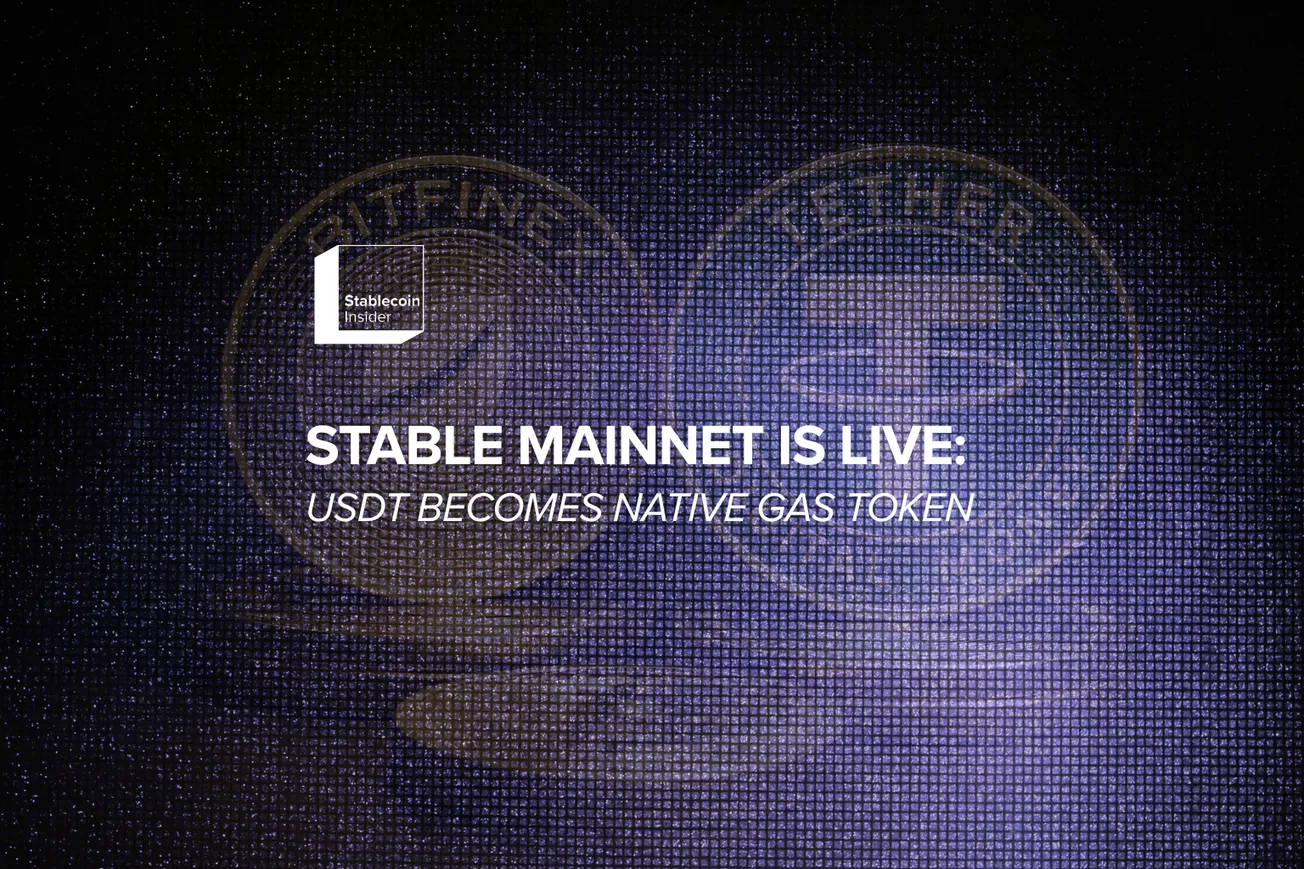
The Stable blockchain, a Tether- and Bitfinex-backed Layer-1 purpose-built for stablecoins, has officially launched its mainnet today at 13:00 UTC, marking one of the most capitalized network debuts in crypto history.
More than $1.1 billion in assets, predominantly USDT, were pre-deposited across 10,000+ wallets ahead of genesis, giving the network instant deep liquidity on day one.
Key Takeaways
- USDT is now the gas token on a production Layer-1 with sub-second finality and fees < $0.01.
- $1.1 billion in liquidity was pre-deposited, giving Stable instant depth unmatched by most L1 launches.
- STABLE token is strictly non-inflationary; stakers earn real USDT yield from actual network fees.
- 40% of STABLE supply is reserved for ecosystem grants, signaling aggressive developer push.
- The Tether-Bitfinex-PayPal Ventures nexus gives Stable regulatory and distribution advantages few competitors can match.
The Genesis of Stable: From Vision to Velocity
Stable was first revealed in mid-2025 as a direct response to stablecoin fragmentation across Ethereum, Tron, Solana, and emerging L2s.
Backed by Tether (the issuer of the world’s largest stablecoin with >$120 billion in circulation), Bitfinex, and a $28 million seed round led by PayPal Ventures, the project promised a chain where stablecoins are not just assets, they are the native unit of account and gas.
Today that promise became reality.
Core Innovations: Predictable Fees and USDT-Powered Rails
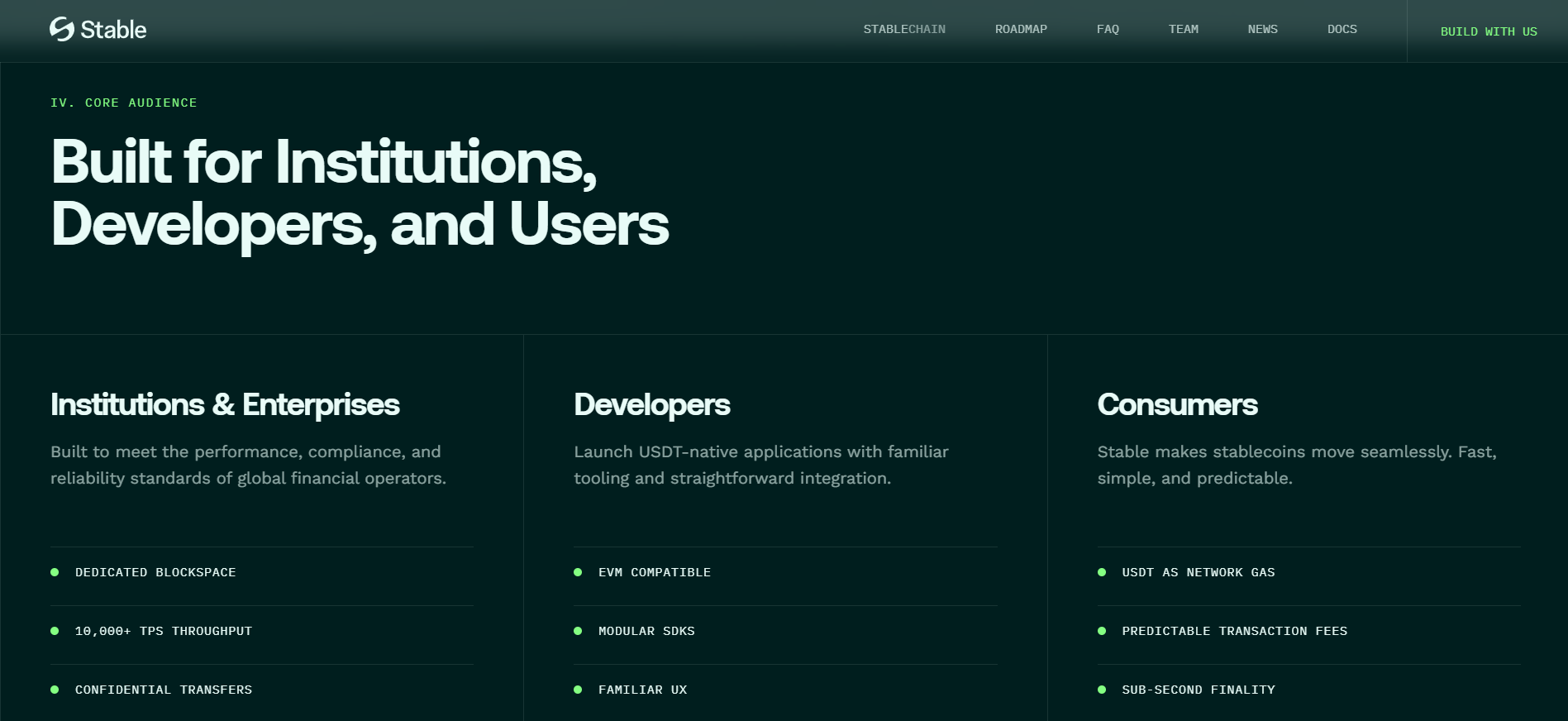
Unlike Ethereum or Solana, where gas fees swing with network congestion and native token volatility, Stable uses USDT exclusively for transaction fees.
Average cost: under $0.01.
Block times sit at ~600ms with immediate finality.
The network’s native STABLE token (100 billion total supply, non-inflationary) plays no role in day-to-day transactions. Instead, it is used for governance, staking, and securing the proof-of-stake network.
All protocol fees paid in USDT flow into a shared treasury, from which stakers earn real yield, no emissions, no dilution.
$1.1B Pre-Launch Tsunami: Institutional Green Light
The eye-watering pre-deposit figure comes from two capped contribution phases earlier this year.
Phase 2 alone drew heavy participation after the team relaxed whale limits, with on-chain data showing large transfers originating from Bitfinex cold wallets and known institutional addresses.
Analysts view the figure as a massive vote of confidence from the same entities that already dominate USDT issuance and trading.
Implications for the $300B Stablecoin Arena
Stable positions itself as the unified settlement infrastructure for the entire stablecoin economy.
By removing volatile gas tokens and multi-chain bridging friction, the network targets remittances, merchant payments, payroll, and high-frequency DeFi.
Early integrations announced today include Bitfinex’s upcoming tokenized securities suite and several Latin American remittance corridors.

Conclusion
Stable’s mainnet launch is not merely another blockchain going live, it is the first time the world’s dominant stablecoin has received its own optimized highway.
With $1.1 billion already on the road and institutional backing in the driver’s seat, the network enters the $300 billion stablecoin race with a commanding head start.
The stablecoin era just got its own chain.
Read Next:
- The Ultimate 2026 Stablecoin Market Prediction
- The Rise of “Super-Stablecoins”
- Stablecoins vs. Neobanks
FAQs:
1. When exactly did the Stable mainnet launch?
The Stable mainnet went live on December 8, 2025, at 13:00 UTC.
2. How is Stable different from using USDT on Ethereum or Tron?
Stable eliminates volatile gas tokens entirely. All fees are paid in USDT at predictable sub-cent rates with ~600ms finality, removing the need for bridging or wrapped assets.
3. What is the role of the STABLE token?
STABLE is used only for staking and governance. It has a fixed 100 billion supply and is non-inflationary. Stakers earn a portion of real USDT fees collected by the protocol.
4. How did the network attract $1.1 billion before launch?
Through two invitation-only pre-deposit phases capped per wallet. Institutional players linked to Bitfinex and Tether accounted for the bulk of inflows.
5. Is Stable a direct competitor to Ethereum, Solana, or Cosmos ecosystems?
Not exactly. Stable is hyper-focused on stable-value transactions and does not aim to host general-purpose smart contracts. It is designed to be the settlement backbone that other chains and applications plug into for stablecoin-native payments.