

Table of Contents
Stablecoins entered 2026 in a much stronger position than they held just a few years ago.
They are no longer used mainly as crypto trading tools or as a place to park funds between volatile assets. They are increasingly being used for settlement, treasury operations, cross-border payments, card spending, and digital financial infrastructure.
Total stablecoin market capitalization moved above $300B in early 2026, while annual transfer volume reached tens of trillions of dollars, depending on methodology.
What makes 2026 especially important is that several trends are now reinforcing each other at the same time:
- Regulation is becoming clearer in major markets.
- Stablecoin-linked payment products are expanding.
- Institutional interest is growing.
- Yield-bearing and real-world-asset-connected products are also becoming more important.
At the same time, the market remains highly concentrated around US dollar-backed assets, which creates both advantages and new policy questions.
This article breaks down the biggest stablecoin trends in 2026 using current data and explains why they matter for payments, treasury, compliance, and mainstream adoption.
Key Takeaways
- Stablecoin market capitalization crossed $300B in early 2026.
- Stablecoin transfer volume reached about $33T in 2025 in Artemis and Bloomberg reporting, while broader estimates placed it even higher.
- Actual payments volume is much smaller than gross transfer volume, which shows that real-world payments adoption still has major room to grow.
- Regulation in the US and EU is becoming a major growth driver.
- USDT, USDC, and USD-denominated stablecoins still dominate the market.

Stablecoins Have Become One Of The Fastest-Growing Segments In Digital Finance
The first major trend is straightforward: the stablecoin market is still expanding quickly, even from an already large base.
- eMarketer, citing DeFiLlama, reported that stablecoin market cap reached $308.55B in January 2026.
- Reuters separately described the market as being around $300B in early March 2026.
- RWA.xyz data cited by eMarketer also showed more than 232M total stablecoin holders.
That scale changes the conversation. Once a market moves past $300B, the key questions are no longer just whether it is real or temporary.
The focus shifts toward issues such as:
- reserve structure
- settlement volume
- regulatory oversight
- systemic relevance
- how stablecoins fit into traditional finance
Stablecoins are now large enough to influence financial infrastructure discussions rather than sit outside them.
Another important point is that supply growth increasingly reflects a broader mix of demand. Stablecoins are now used by exchanges, trading firms, fintech apps, payment platforms, businesses, and treasury managers.
That diversification suggests the market is being supported by utility, not only speculation.
Stablecoin Volume Is Massive, But The Payments Story Needs Context
One of the most widely cited stablecoin statistics in 2026 is transaction volume.
- Bloomberg, citing Artemis Analytics, reported that stablecoin transaction volume rose 72% in 2025 to $33T.
- a16z used a broader framing and said stablecoins accounted for an estimated $46T in transaction volume last year.
Both numbers support the same underlying conclusion: stablecoins have become one of the largest value-transfer rails in digital finance.
Still, this part of the story needs context.
Not every stablecoin transfer is a consumer purchase, payroll payment, remittance, or B2B payment. A meaningful share of activity comes from:
- exchange settlement
- DeFi repositioning
- arbitrage
- liquidity routing
- wallet rebalancing
- internal transfers across platforms
That distinction is why some of the best 2026 research separates gross onchain transfer volume from actual payments activity.
McKinsey and Artemis estimated that actual stablecoin payments volume was about $390B annualized based on December 2025 activity. Artemis also estimated about $26T in annualized settlement volume after filtering out obvious noise.
This is one of the most important points in the entire article:
- stablecoins are already huge as a transfer rail
- stablecoins are still early as a real-world payments rail
- that gap creates major growth potential for the rest of 2026
In other words, the fact that payments volume is smaller than gross transfer volume does not weaken the trend. It shows how much expansion runway still exists.
Stablecoins Are Moving From Crypto Trading Into Real-World Payments
Another defining stablecoin trend in 2026 is the move from crypto-native activity into real-world payment use cases.
Stablecoins are increasingly being used in:
- cross-border transfers
- remittances
- B2B settlement
- contractor and payroll payouts
- treasury movement
- digital commerce flows
McKinsey’s analysis emphasized that stablecoins are beginning to gain real traction in payments, even though they still account for a small share of total global payments.
The reason is simple. Stablecoins offer a combination of features that traditional financial rails often struggle to deliver together:
- 24/7 settlement
- global reach
- programmable movement of funds
- compatibility with software platforms
- fewer intermediaries in cross-border flows
For internet-native businesses and globally distributed operations, those features can matter more than whether the asset originated inside or outside crypto. The value proposition is increasingly about faster movement of money, easier integration, and more flexible settlement.
Artemis’ payments research also noted that roughly 10M blockchain addresses make a stablecoin transaction every day and that more than 150M addresses hold a nonzero stablecoin balance.
Those numbers do not prove that all of those users are payment users, but they do show the size of the installed base that payment applications can build on.
Stablecoin Cards And Merchant Spending Are Scaling Fast
One of the clearest bridges between stablecoins and everyday spending is the growth of stablecoin-linked cards.
Artemis reported that crypto card volume grew from around $100M per month in early 2023 to more than $1.5B per month by late 2025, which represents a 106% CAGR. McKinsey separately estimated that stablecoin-linked card spending reached $4.5B in 2025, up 673% from 2024.
These numbers matter because card products help make stablecoins usable in mainstream commerce without requiring merchants to accept onchain payments directly. They turn stablecoin balances into a more familiar spending experience.
That matters for three reasons:
- it lowers adoption friction for users
- it increases practical spending utility
- it helps stablecoins connect with existing payment networks
Visa’s 2026 announcement with Bridge is especially important here. Visa said Bridge-enabled stablecoin-linked cards were already live in 18 countries and that the companies planned to expand them to 100+ countries by the end of 2026.
Visa also said these cards could be used across its 175M+ merchant locations. Mastercard also announced a stablecoin-wallet payout collaboration with Thunes in late 2025, reinforcing the same broader trend.
The direction is clear: stablecoin adoption is not staying purely onchain. It is increasingly being layered into traditional payment experiences.
Regulation Is One Of The Biggest Stablecoin Trends In 2026
Regulation is one of the biggest reasons stablecoins look more durable in 2026 than they did in earlier cycles.
In the United States, Reuters reported that President Trump signed the GENIUS Act into law on July 18, 2025, establishing a federal framework for dollar-pegged stablecoins. Reuters noted that the law required backing with liquid assets such as US dollars and short-term Treasuries, along with reserve disclosure requirements.
That matters because regulatory clarity changes how institutions view risk. It makes stablecoins easier to evaluate in terms of:
- reserve quality
- supervision
- disclosures
- legal permissibility
- compliance expectations
This is especially important for enterprises and regulated financial institutions that need clearer rules before integrating stablecoins into operations.
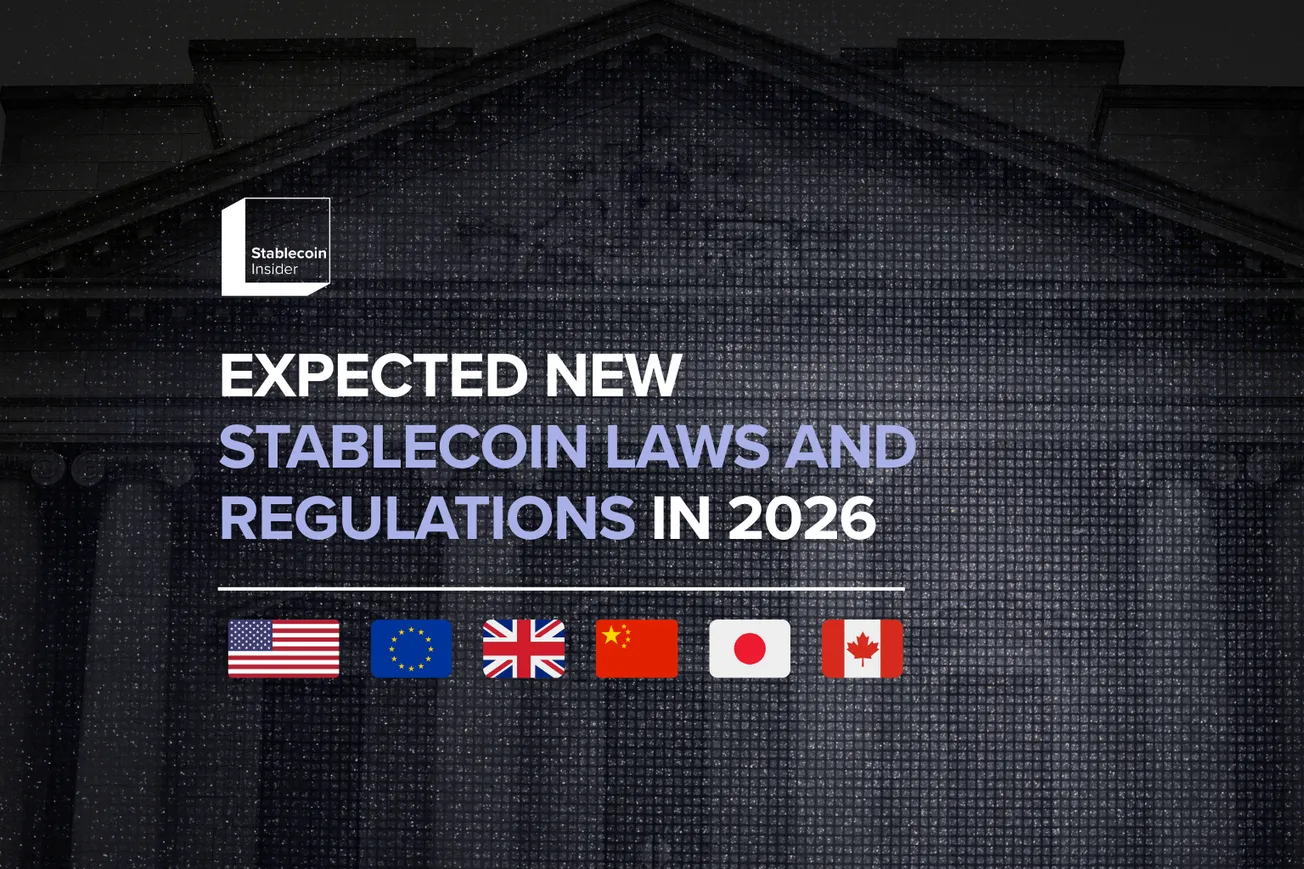
In Europe, MiCA is playing a similar role. ESMA says MiCA established uniform EU rules for crypto-assets, including asset-referenced tokens and e-money tokens.
The EBA says issuers of those tokens must hold the appropriate authorization.
Taken together, these developments support one of the clearest themes of 2026: stablecoins are moving from a loosely defined crypto category into a more formal financial infrastructure layer.
Institutional Adoption Is Accelerating
A defining feature of the 2026 stablecoin market is that enterprise and institutional interest is no longer limited to crypto-native firms.
Coinbase’s 2025 State of Crypto research found that:
- 81% of crypto-aware SMBs were interested in using stablecoins
- the number of Fortune 500 executives saying their companies planned to use or explore stablecoins increased by more than 3x year over year
- nearly 1 in 5 Fortune 500 executives now view onchain initiatives as a key part of company strategy
These numbers matter because they show stablecoins are moving into strategic planning conversations. Companies are increasingly evaluating them for:
- global settlement
- treasury operations
- faster cross-border payments
- working capital movement
- reconciliation efficiency
- international contractor payouts
That shift is important because it reflects operational interest, not just curiosity. As more businesses adopt stablecoins seriously, demand also grows for custody, compliance, accounting, reporting, and settlement infrastructure around them.
The Stablecoin Market Is Still Dominated By USDT, USDC, And The Dollar
Even with more use cases and more product experimentation, the stablecoin market remains highly concentrated.
Circle’s USDC page showed $77.1B in circulation as of March 5, 2026. Reuters reporting and market trackers placed Tether’s USDT at roughly $184B to $187B in early 2026. Together, those two assets still account for the overwhelming majority of the market.
The market is also overwhelmingly dollar-based. The ECB said that around 99% of all stablecoin supply in circulation is US dollar-denominated. Euro-denominated stablecoins, by contrast, remain much smaller, with ECB materials showing a market measured in the hundreds of millions of euros, not tens of billions.
This concentration creates both strengths and weaknesses.
Strengths:
- deeper liquidity
- stronger network effects
- broader exchange support
- easier user recognition
Weaknesses:
- limited currency diversity
- higher market dependence on a small number of issuers
- greater reinforcement of dollar dominance in digital money
In 2026, continued concentration around USDT, USDC, and the US dollar remains one of the defining features of the market.
Yield-Bearing Stablecoins Are Becoming A Major New Category
Another important stablecoin trend in 2026 is the rise of yield-bearing stablecoins.
These products are designed to combine price stability with some form of return generated through:
- Treasuries
- repos
- tokenized real-world assets
- DeFi strategies
21Shares said yield-bearing stablecoins are poised to more than triple to over $50B in 2026. Reuters also reported that interest-bearing crypto assets had already seen 300% market growth in the prior year, citing RedStone data.
This trend matters because it changes user expectations. If stablecoins are increasingly treated as digital cash, many users and businesses will eventually ask why idle balances should remain unproductive.
That question becomes more relevant as stablecoins are used for prefunded payroll, corporate treasury balances, exchange holdings, and embedded wallet products.
At the same time, yield-bearing stablecoins are not the same as standard payment stablecoins. Their structure and risk profile can differ significantly depending on how the yield is generated and who receives it.
That means 2026 is likely to be a year of strong growth in this segment, but also closer legal and regulatory attention.

Stablecoins And Tokenized Treasuries Are Becoming More Connected
Stablecoins are also becoming more tightly connected to tokenized real-world assets, especially short-duration US government debt.
- RWA.xyz showed $11.06B in tokenized US Treasury value in early March 2026 and $26.42B in tokenized real-world asset value overall.
- Reuters also reported that around 80% of the stablecoin market was invested in Treasury bills or repos in mid-2025, equivalent to roughly $200B at that time.
This connection matters in two ways.
- Stablecoin issuers themselves are already major buyers of short-duration sovereign assets because those instruments often back reserves.
- Tokenized Treasury products are creating a new layer of onchain cash management that sits very close to stablecoin usage.
Together, these two developments support a broader point: stablecoins and tokenized Treasuries are increasingly part of the same digital-dollar ecosystem.
That is one of the reasons stablecoins are becoming harder to classify as merely crypto products. The closer they move to sovereign debt markets, institutional reserve structures, and onchain cash management, the more they resemble foundational financial infrastructure.
Non-USD Stablecoins Are Small Today But Strategically Important
Although dollar-backed stablecoins still dominate, non-USD stablecoins are becoming more strategically relevant in 2026.
ECB data shows how small euro-denominated stablecoins still are compared with USD-based competitors, but the strategic importance is growing. If stablecoins become a core global payment layer, currency representation on that layer will matter much more.
Coinbase has argued that the gap between the dollar’s share of global reserves and its even larger share of onchain money suggests there is room for local-currency stablecoins to expand.
Reuters also reported that JD.com and Ant Group were lobbying for an offshore yuan stablecoin in Hong Kong to counter the growing influence of dollar stablecoins in digital payments.
So the most accurate conclusion is not that non-USD stablecoins are already large. It is that they are becoming strategically important because they sit at the intersection of:
- payments
- monetary influence
- digital currency competition
- financial sovereignty
That makes them one of the most important long-term trends to watch through the rest of 2026.
Central Banks And Policymakers Now Treat Stablecoins As Macro-Relevant
Stablecoins are no longer viewed only through a fintech or crypto lens. Central banks and policymakers increasingly treat them as macro-relevant instruments.
Reuters reported in March 2026 that an ECB paper warned that stablecoin growth in the euro area could weaken the central bank’s hand and hamper lenders by shifting deposits away from banks.
This does not mean stablecoins have already displaced traditional banking. Euro area bank deposits are still much larger than the stablecoin market. But the warning itself is revealing.
Policymakers now see stablecoins as important enough to model in terms of:
- bank deposit outflows
- lending capacity
- monetary transmission
- financial stability
- currency competition
That is one of the strongest signs that stablecoins have moved beyond the margins in 2026.
What To Watch For In The Rest Of 2026
The most important question for the rest of 2026 is no longer whether stablecoins matter. That is already established. The more important question is which parts of the stablecoin stack will grow fastest.
The areas worth watching most closely are:
- market cap growth, especially from a base already above $300B
- payments expansion, particularly in cross-border settlement, treasury movement, payroll, and card-linked spending
- regulatory implementation, especially how new frameworks are applied in practice
- product competition between plain payment stablecoins, yield-bearing stablecoins, and tokenized Treasury products
- non-USD development, as governments and companies respond to dollar dominance onchain
The products that win in 2026 may not be the ones with the most attention. They may be the ones that fit the clearest settlement, treasury, and compliance needs.
Conclusion
The biggest stablecoin trends in 2026 all point in the same direction: stablecoins are becoming a real part of financial infrastructure.
Market capitalization has moved above $300B, transfer volume has reached enormous scale, payment use cases are expanding, regulation is becoming clearer, and institutions are taking the sector more seriously.
At the same time, the market remains highly concentrated around dollar-backed assets, while yield-bearing products, tokenized Treasury connections, and non-USD expansion are shaping the next phase of growth.
2026 looks less like a year of proving that stablecoins work and more like a year of deciding how they will fit into global payments, treasury systems, and digital money competition at scale.
Read Next:
- 9 Fastest-Growing Stablecoin Use Cases In 2026
- Top 10 Stablecoin Compliance Tools in 2026
- Solana's New Payments.org Just Changed Stablecoin Payments in 2026
FAQs:
1. What are the biggest stablecoin trends in 2026?
The biggest stablecoin trends in 2026 are market cap growth above $300B, expanding payments usage, stronger regulation, rising institutional adoption, continued USD dominance, growth in yield-bearing stablecoins, and tighter links between stablecoins and tokenized Treasuries.
2. How big is the stablecoin market in 2026?
The stablecoin market was above $300B in early 2026 according to multiple sources, including DeFiLlama data cited by eMarketer and Reuters reporting.
3. Are stablecoins mainly used for payments or trading?
They are still used heavily in trading and onchain settlement, but payments usage is growing. Total transfer volume is far larger than actual real-economy payments volume, which means stablecoins are already huge as infrastructure while still having major runway in commerce and business payments.
4. Why is regulation so important for stablecoins in 2026?
Regulation matters because institutions are more likely to adopt stablecoins when reserve rules, disclosure requirements, authorization standards, and supervisory expectations are clearer. The GENIUS Act in the US and MiCA in Europe are two major examples.
5. Which stablecoins dominate the market in 2026?
USDT and USDC remain the dominant stablecoins in 2026, and USD-denominated stablecoins account for around 99% of total supply.
6. Are non-USD stablecoins growing in 2026?
Yes, but from a small base. Euro-denominated stablecoins remain much smaller than dollar-backed assets, yet they are becoming more strategically important as governments and large companies think more seriously about currency representation in digital payments.
7. What are yield-bearing stablecoins?
Yield-bearing stablecoins are stable-value digital assets designed to provide some form of return, often through Treasuries, repos, DeFi strategies, or tokenized real-world assets. This segment is projected to grow significantly in 2026.
8. Why are banks and card networks integrating stablecoins?
Banks, card networks, and payment firms are integrating stablecoins because they can improve cross-border settlement, expand payout options, support digital wallet spending, and connect internet-native money with existing payment infrastructure.
Disclaimer:
This content is provided for informational and educational purposes only and does not constitute financial, investment, legal, or tax advice; no material herein should be interpreted as a recommendation, endorsement, or solicitation to buy or sell any financial instrument, and readers should conduct their own independent research or consult a qualified professional.