
Table of Contents
Stablecoin risks are the economic, technical, and regulatory tripwires that can cause these digital assets to lose their value or, in some cases, collapse completely. While they're often sold as the safe harbor of the crypto world, their stability can be a fragile illusion, threatened by everything from shaky reserve management to smart contract bugs and sudden government crackdowns.
Decoding the Dangers of Digital Dollars
Stablecoins are built on a simple promise: a one-to-one bridge between the wild west of cryptocurrencies and the relative calm of fiat currencies like the U.S. dollar. Think of them as poker chips in a digital casino; you trade your real money for them to play, fully expecting to cash them out later for the same value.
The real trouble begins when the casino doesn't actually have enough cash in the vault to cover all the chips in circulation. It's this gap between promise and reality where the most serious stablecoin risks pop up.
Before diving into the weeds, it's crucial to grasp how these digital assets are supposed to work. A stablecoin's entire reason for being is to hold its peg, but the methods used to do this vary wildly—and each comes with its own unique set of dangers. If you need a refresher, our guide on how stablecoins work lays the essential groundwork for the risks we're about to unpack.
The Three Pillars of Stablecoin Risk
To get a handle on the threats, it helps to break them down into three main categories. Each pillar represents a fundamental way a stablecoin can fail, covering market forces, technological weak points, and the ever-present human element of governance.
Economic Risks: These are all about the financial plumbing that's supposed to maintain the peg. We're talking about the quality and liquidity of the reserves backing the coin, the classic "bank run" scenario where everyone rushes for the exits at once, and the spectacular fragility of algorithmic models that can trigger a "death spiral."
Technical Risks: This bucket covers the technology the stablecoin is built on. Flaws in the smart contract code can be a goldmine for hackers, the oracle systems feeding it price data can be manipulated, and the underlying blockchain network itself could go down, all of which can shatter the asset's integrity.
Regulatory Risks: Stablecoins exist in a gray area of the law, and that's a huge risk. Governments can suddenly drop the hammer with strict new rules, freeze the assets of centralized issuers, or even outlaw certain stablecoin models outright. This creates enormous uncertainty and the potential for major losses.
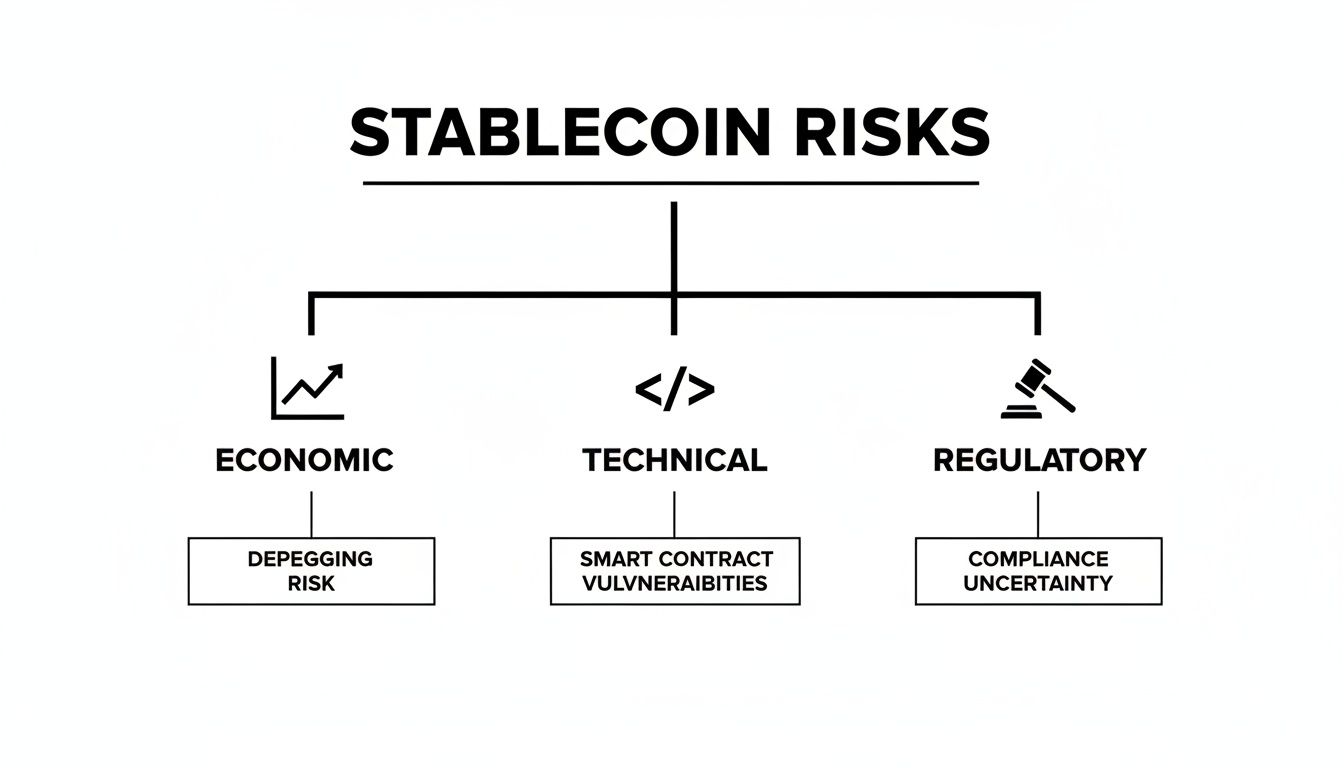
This flowchart offers a clean visual of these core risk categories. It shows how every potential threat branches out from these three fundamental areas, making it clear that a stablecoin's failure can be sparked by market meltdowns, broken code, or legal pressure.
To make this even clearer, the table below breaks down these main risk categories, offering a core concept and a clear example to quickly get you up to speed.
A Quick Overview of Primary Stablecoin Risks
| Risk Category | Core Concept | Real-World Example |
|---|---|---|
| Economic | The financial model fails to maintain the peg, often due to insufficient or illiquid reserves. | A "bank run" causes mass redemptions, forcing the issuer to sell assets at a loss and breaking the peg. |
| Technical | A vulnerability in the underlying technology (smart contract, blockchain, or oracle) is exploited. | A hacker finds a bug in the stablecoin's smart contract and drains its reserve funds. |
| Regulatory | A government or regulatory body takes action that negatively impacts the stablecoin's operations. | A regulator freezes the bank accounts holding the fiat reserves, making redemptions impossible. |
As you can see, the dangers are multifaceted. A stablecoin isn't just a token; it's a complex system where finance, technology, and law all have to work in perfect harmony. When one piece falters, the entire structure is at risk.
Economic Forces That Can Shatter a Stablecoin Peg
A stablecoin's entire purpose is built on a single promise: holding its peg. Whether it’s one-to-one with the US dollar or another asset, that stability is its reason for being. But this peg isn’t held up by magic; it’s supported by an economic foundation that can absolutely crack under pressure.
Understanding these economic stablecoin risks is your first line of defense. It's how you learn to spot the difference between a genuinely stable asset and a ticking time bomb.
The most common point of failure is collateral risk. For fiat-backed stablecoins like USDT or USDC, this all comes down to the quality and liquidity of their reserves. An issuer can claim they are fully backed all day long, but the real question is: backed by what?
If the reserves are stuffed with illiquid assets like corporate bonds instead of cash and short-term government treasuries, they can't be sold quickly without taking a massive haircut during a crisis. This mismatch creates a huge vulnerability. If the issuer can't honor redemptions at par value, the peg will break.
The Anatomy of a Stablecoin Bank Run
This brings us to one of the most dangerous economic threats out there: a digital-age bank run. Think of it like someone yelling "fire!" in a packed theater. Even if it's a false alarm, the ensuing panic and stampede for the exits can cause real harm. A stablecoin bank run is the financial version of that chaos.
It always starts with a crisis of confidence. A rumor about shaky reserves, a regulatory probe, or a major hack can be all it takes to spook holders. They rush to redeem their stablecoins for fiat, creating a tidal wave of selling pressure that the system wasn't built to handle all at once.
A disorderly collapse could reverberate across the financial system, and the risk of contagion is a growing concern for central banks. When a stablecoin fails, it doesn't just impact its direct holders; it can destabilize the entire DeFi ecosystem that relies on it for liquidity and settlement.
This mass redemption forces the issuer to liquidate its reserve assets immediately. If those assets are illiquid or have dropped in value, the issuer simply won't have enough cash to pay everyone back. As the reserves bleed out, the stablecoin's value plummets and the peg shatters, leaving anyone late to the exit holding a near-worthless token.
Crypto-Collateral and Volatility Dangers
Crypto-collateralized stablecoins, like DAI, face a different kind of economic threat. Instead of being backed by fiat, they’re backed by a basket of other, more volatile crypto assets like Ethereum. To buffer against price swings, these systems are overcollateralized, meaning the value of the crypto locked up as collateral is much higher than the value of the stablecoins created.
The problem? This model is incredibly vulnerable to a sudden, brutal market crash. A nosedive in the collateral's price can set off a cascade of automated liquidations, where the protocol frantically sells the collateral to try and stay solvent. If the crash is fast and deep enough, it can completely overwhelm the system, leaving the stablecoin under-collateralized and breaking its peg. To see the bigger picture, it's also crucial to understand how external pressures, described by key macroeconomic indicators, can influence these events.
The Algorithmic Death Spiral
By far, the most fragile models are the algorithmic stablecoins, which attempt to maintain their peg using code and financial incentives instead of hard collateral. The catastrophic collapse of TerraUSD (UST) in May 2022 is the ultimate cautionary tale.
UST was designed to hold its peg through an arbitrage relationship with its sister token, LUNA. When UST slipped below $1, the protocol let traders burn UST to mint $1 worth of LUNA, creating a profit opportunity that was supposed to shrink the UST supply and push its price back up.
Instead, this created a fatal feedback loop known as a "death spiral":
- Initial De-peg: Massive selling pressure pushed UST below $1.
- Arbitrage Mechanism Kicks In: Traders rushed to burn UST and mint LUNA to capture the arbitrage profit.
- Hyperinflation of LUNA: This process flooded the market with a gargantuan new supply of LUNA, causing its price to crash.
- Loss of Confidence: As LUNA's value evaporated, faith in the entire Terra ecosystem collapsed, triggering even more panic-selling of UST.
The result was a total meltdown that incinerated over $40 billion in value, proving just how fragile a system can be when it relies solely on algorithms to manage raw human fear. As these assets weave themselves deeper into the fabric of finance, their stability starts to matter to everyone. You can learn more about how stablecoins interact with monetary policy transmission in our detailed guide.
2. Technical and Operational Risks: When the Code Cracks

While economic pressures can knock a stablecoin off its peg from the outside, a completely different set of dangers lurks within the technology itself. Think of a stablecoin as a complex digital machine with countless moving parts—code, data feeds, and human procedures. A single loose screw in this machine can be just as devastating as a full-blown market panic.
These technical and operational risks are often hidden from plain sight, making them perfect targets for attackers who can exploit them with surgical precision. Unlike a slow-motion bank run, a technical breach can drain billions in mere minutes, giving users no time to react. This is where the digital promise of a stablecoin meets its harshest reality check.
At the end of the day, a stablecoin is only as strong as the code it’s built on. Every single line is a potential attack vector, and a tiny, overlooked bug can quickly become a backdoor for a catastrophic hack.
The Danger of Flawed Smart Contracts
The engine of most stablecoins is a smart contract—a piece of self-executing code that automatically handles everything from creating new tokens to managing collateral. If that code has a flaw, it's like leaving the vault door wide open with a "help yourself" sign on it.
A critical vulnerability can let an attacker do all sorts of damage, like:
- Minting infinite tokens: A bug might allow someone to create millions of new stablecoins from nothing, instantly cratering the value for everyone else.
- Draining collateral reserves: Hackers can find clever ways to fool the contract into releasing its locked-up assets, effectively stealing the very funds that back the stablecoin.
- Freezing user funds: A malicious actor—or even just an unintentional bug—could jam the contract's gears, locking everyone's assets inside forever with no hope of recovery.
Since smart contracts on most public blockchains are immutable, you can’t just patch a bug after launch. That makes rigorous, third-party audits and exhaustive testing before deployment an absolute necessity, not a luxury.
When Oracles Tell Lies
Many stablecoins, particularly crypto-collateralized and algorithmic ones, depend on external data feeds called oracles to know the real-world price of their assets. An oracle is the bridge that tells the smart contract the current price of Ethereum, for instance, so it knows whether the collateral backing the loans is sufficient.
The problem is, what happens if someone hijacks that bridge? Oracle manipulation is a sophisticated attack where a hacker feeds the oracle bad data. The smart contract, believing the false price, then makes disastrous decisions.
For example, an attacker could trick an oracle into reporting that a collateral asset’s price has crashed. The protocol, acting on this false information, would then trigger a wave of wrongful liquidations, selling off users' collateral at a massive loss. Understanding the various stablecoin oracle manipulation vectors is crucial to seeing this often-underestimated risk clearly.
The Human Element: Operational Risks
Beyond the code, a whole host of stablecoin risks come from the operational side—the people and processes tasked with keeping the system running. This is especially true for centralized, fiat-backed stablecoins where teams of people are responsible for safeguarding billions in real-world cash and bonds.
Operational failures can pop up in a few key areas:
- Insider Threats: You have to consider the human factor. A disgruntled employee or a compromised administrator with access to the keys could simply walk away with the reserve funds or freeze assets out of spite.
- Poor Key Management: The cryptographic keys that control the treasury and the smart contracts are the crown jewels. If these keys aren't secured properly—ideally in multi-signature wallets or hardware security modules (HSMs)—a single point of failure could bring down the entire system.
- Infrastructure Failures: A stablecoin issuer relies on a stack of technology: servers, cloud providers, and other digital services. A targeted DDoS attack or a simple outage at the wrong time could halt redemptions, shake confidence, and trigger a panic.
Ultimately, the technical and operational integrity of a stablecoin is the foundation everything else is built on. Even the most brilliant economic model will come crashing down if the underlying technology is flawed or the people running it are careless.
Anatomy of a Collapse: The Terra UST Meltdown
You can talk about stablecoin risks in theory all day, but nothing drives the point home like a real-world catastrophe. In May 2022, we all watched one unfold in real-time with the spectacular implosion of the Terra ecosystem and its algorithmic stablecoin, TerraUSD (UST).
This wasn't just a minor blip; it was a brutal lesson in how a flawed design, mixed with a heavy dose of market panic, can create a perfect storm. Over $40 billion in market value evaporated, seemingly overnight. Unlike stablecoins backed by actual dollars in a bank, UST’s stability was built on a complex arbitrage algorithm tied to its sister token, LUNA.
When confidence shattered, the whole system broke, triggering a "death spiral" that took down crypto giants like Three Arrows Capital and sent shockwaves through platforms like Voyager and Celsius. It was a brutal reminder that not all stablecoins are created equal.
To really get why it failed so spectacularly, you have to look under the hood at its design. UST wasn't backed by anything tangible; its entire existence was intertwined with LUNA through a clever, but fatally fragile, mint-and-burn mechanism.
The Unsustainable Lure of Anchor Protocol
So, what drew everyone in? A single platform: the Anchor Protocol. This decentralized lending dApp offered a promise that seemed too good to be true—an almost unbelievable ~20% annual percentage yield (APY) on any UST you deposited.
This high yield was rocket fuel for UST adoption. It acted like a giant financial magnet, pulling in billions of dollars from investors who minted or bought UST for the sole purpose of parking it in Anchor. The problem? This created a massive, artificial demand.
The entire Terra ecosystem became dangerously dependent on these sky-high, subsidized yields. There was very little organic, real-world use for UST outside of this one high-risk savings account. The moment faith in Anchor began to wobble, the whole house of cards was ready to come crashing down.
The Death Spiral Ignites
The beginning of the end came in early May 2022. It started with a few massive withdrawals from Anchor, immediately followed by huge UST sell orders hitting the open market. This sudden, immense selling pressure was enough to knock UST just below its $1 peg, to around $0.98. A two-cent difference might not sound like much, but it was the spark that lit the fuse.
This slight de-peg triggered the core algorithmic mechanism, but in the worst way possible. Seeing UST trading for less than a dollar, arbitrageurs jumped into action, just as the protocol intended:
- Buy Cheap UST: Traders snapped up the discounted UST on exchanges.
- Redeem for LUNA: They then used the Terra protocol to burn that UST in exchange for exactly $1 worth of LUNA.
- Sell LUNA for Profit: Finally, they dumped the newly minted LUNA on the market for a quick, risk-free profit.
In theory, this process was supposed to defend the peg by shrinking the supply of UST. But theory met reality, and reality was panic. Instead of a controlled re-pegging, the mechanism flooded the market with a tsunami of new LUNA tokens, cratering its price.
As LUNA’s price plummeted, the algorithm had to mint even more LUNA to honor each $1 UST redemption. This kicked off a hyperinflationary feedback loop. Trust vanished. The more people fled UST, the more LUNA was created, the further LUNA’s price crashed, and the more intense the panic became.
This was the infamous "death spiral" in its full, horrifying glory. Within just a few days, both UST and LUNA were practically worthless. The Terra collapse stands as the ultimate cautionary tale about the unique and devastating risks of algorithmic stablecoins.
Navigating Regulatory and Centralization Dangers
While dramatic de-pegs and smart contract exploits tend to grab the headlines, some of the most serious stablecoin risks are hiding in plain sight. These dangers live at the crossroads of government regulation and corporate control.
Stablecoins are unique beasts. They try to bridge the gap between decentralized finance and traditional banking, which puts them directly in the crosshairs of regulators. This isn't just a hypothetical problem. The legal ground beneath stablecoins is constantly shifting, and a single new policy from a major government body could upend the entire market overnight, making some stablecoins illegal or burying issuers in new compliance rules.
The Double-Edged Sword of Centralization
Let's be honest: for most of the big stablecoins, "decentralized" is more of a marketing slogan than a technical reality. Issuers like Tether (USDT) and Circle (USDC) are centralized companies. This means you’re trusting a single entity to hold the collateral, handle your redemptions, and run the whole show.
This creates a massive, often underestimated vulnerability called counterparty risk.
When you hold a fiat-backed stablecoin, you're essentially giving a loan to the issuer. You're betting that the company is solvent, managed competently, and acting in good faith. If that bet is wrong—if the company goes bankrupt, mismanages its reserves, or commits fraud—your stablecoins could be worth nothing. That’s the central point of failure.
This risk is perfectly illustrated by Tether (USDT), which controls a staggering 59.4% of the stablecoin market. Since 2018, Tether has been dogged by questions about its reserves. This came to a head in 2021 when it paid $41 million in fines to the CFTC and NYAG for misrepresenting its backing in the past—at one point, only 27.6% of its reserves were actual cash equivalents. While its reports now claim heavy backing by U.S. Treasuries, the core problem of opacity remains. For a deeper dive, check out the 2025 Crypto Adoption and Stablecoin Usage Report from trmlabs.com.
The Murky Waters of Reserve Transparency
The Tether situation highlights a critical issue: transparency. Or, more accurately, the lack of it. Most issuers provide regular "attestations," but it's crucial to understand what these are—and what they aren't.
- Attestation: Think of this as a quick snapshot. A third-party firm checks the issuer's bank accounts on a single day and confirms the assets are there. It doesn’t tell you where the money came from, where it went the next day, or anything about the company's overall financial health.
- Audit: This is the real deal. An audit is a deep, thorough investigation of a company’s financial records, internal controls, and business practices over an extended period. It provides a much more complete and reliable picture.
Because the industry relies on simple attestations, users are forced to trust the issuer’s word. Without a full audit from a top-tier firm, you’re flying blind.
The core danger of centralization is that it reintroduces the very problem crypto was meant to solve: the need to trust a powerful intermediary. With stablecoins, that trust is placed in a single company and its relationship with regulators.
Censorship Risk and Regulatory Pressure
Centralization also brings the very real threat of censorship risk. Because a single company controls the smart contract, it has the power to freeze funds and blacklist wallet addresses.
This isn't just theoretical. Issuers use this power to comply with law enforcement and block illicit funds. But the power to freeze a criminal's account is also the power to freeze anyone's account. A government agency can compel an issuer to block your funds, effectively turning the stablecoin into an arm of the state. Your assets are no longer truly yours or censorship-resistant.
As governments finalize their rulebooks, this pressure on issuers is only going to grow. Understanding the world of stablecoin regulation is no longer optional for anyone serious about this space. The future stability of these digital dollars will depend as much on legal maneuvering and corporate integrity as it does on economic theory and solid code.
A Practical Checklist for Avoiding Stablecoin Disasters
Knowing about stablecoin risks is one thing, but actually protecting your money is a whole different ball game. Let’s turn that theory into a real-world defense plan.
Think of this as your pre-flight check before you put your capital on the line or your code into production. Going through these steps methodically won't eliminate every single risk—nothing can—but it will help you make smarter, more calculated decisions and avoid the kinds of catastrophic failures we've seen in the past.
Your Stablecoin Due Diligence Checklist
Before you ever buy or hold a stablecoin, you need to pop the hood and see what’s really going on. Not all stablecoins are built the same, and the critical differences are usually buried in the details. Your job is to poke and prod at the peg's foundation and demand transparency from the issuer.
This simple checklist is a great starting point for evaluating the safety and reliability of any stablecoin before you commit your funds.
| Checklist Item | What to Look For | Red Flag |
|---|---|---|
| 1. Reserve Composition | Is it backed by cash and short-term U.S. Treasuries (the gold standard)? Look for recent, detailed attestation reports. | Vague descriptions like "commercial paper" or a high percentage of risky assets like corporate bonds or other digital assets. |
| 2. Audit Quality | Are they providing full, independent audits from a reputable firm? | Relying solely on "attestations," which are just a simple snapshot, not a deep dive into financial health. |
| 3. Peg Mechanism | Is it fiat-backed, crypto-collateralized, or algorithmic? Each has its own trade-offs. | Algorithmic models. As the Terra/UST collapse showed, these carry unique and often catastrophic risks. |
| 4. Centralization & Censorship | Can the issuer freeze your funds or blacklist your address? Check their terms of service. | The power to unilaterally freeze assets without a clear, public policy or legal requirement. |
By taking the time to run through these checks, you can spot weak foundations and avoid becoming someone else's exit liquidity.
Best Practices for Developers
If you're a developer building an app that uses stablecoins, you have an even bigger responsibility. The stablecoin you choose is a dependency, and if it fails, it can create a domino effect that takes your entire system down with it, damaging your users and your reputation.
A protocol's resilience is only as strong as its weakest link. When you integrate a stablecoin, you're inheriting all of its baggage and risk. Building in circuit breakers isn't just a good idea—it's a survival tactic.
Here are a few defensive strategies to consider:
Build De-Peg Circuit Breakers: Your protocol needs an automated "kill switch" for when a stablecoin starts to wobble. This could mean automatically pausing borrowing against the asset or limiting its use as collateral to stop bad debt from piling up.
Don't Trust a Single Oracle: Rely on multiple, high-quality price oracles. A single point of failure here is an open invitation for manipulation or a system-wide crisis. Implement anomaly detection to flag weird price movements before they cause chaos.
Diversify Your Stablecoins: Try to avoid making your entire protocol dependent on a single stablecoin. If it makes sense for your application, use a basket of reputable stablecoins to spread the risk around. That way, if one goes down, it doesn't sink the whole ship.
Adopting these habits can help both investors and developers build a much sturdier financial footing in a notoriously shaky market. For a deeper dive into building robust safety nets, check out this a definitive guide to risk management in trading. A little preparation goes a long way in avoiding the fallout from the next big stablecoin implosion.
Common Questions About Stablecoin Safety
Diving into stablecoins often raises a lot of questions, especially around how safe they really are. Let's break down some of the most common concerns with straightforward, experience-based answers.
Are Fiat-Backed Stablecoins Completely Safe?
In a word, no. While they are often seen as the safest bet in the stablecoin world, they aren't without their own unique risks. Think of it this way: you're essentially trusting a single company to hold a dollar for every token they issue. This introduces counterparty risk—the risk that the issuer isn't as solvent or honest as they claim.
Then there's reserve risk. Are the assets backing the coin actually high-quality and easy to sell? We saw this play out in 2023 when USDC briefly de-pegged. The issuer revealed some of their reserves were stuck in the failing Silicon Valley Bank, and that news alone was enough to shake market confidence and temporarily break its dollar peg.
What Is a Stablecoin Bank Run?
A "bank run" is exactly what it sounds like, but in the crypto world. It's a mass panic where a huge number of holders all rush to cash out their stablecoins for fiat at the same time. This is almost always sparked by a sudden loss of faith—maybe rumors surface that the issuer's reserves are shaky, or a regulator is about to take action.
If the issuer can't meet that tidal wave of redemption requests with actual liquid cash, the stablecoin's price can shatter. This isn't just theory; it’s the exact scenario that vaporized Terra/UST. Panic selling completely overwhelmed its stabilization algorithm, leading to a catastrophic collapse.
How Can I Verify a Stablecoin's Reserves?
Your first stop should always be the issuer's official website. Look for a "transparency" or "reserves" section. The gold standard is a stablecoin provider that publishes regular, detailed attestations from a well-known, independent auditing firm.
Don't just glance at the report, though. Dig into the details of the reserve composition. A high percentage of cash and U.S. Treasuries is what you want to see. Be extremely wary of issuers who are vague about their holdings, release reports infrequently, or skip third-party audits altogether. For decentralized options like DAI, you have the advantage of being able to verify the collateral levels directly on the blockchain.