Table of Contents
Total stablecoin supply reached $316 billion by April 2026, up 54% from the start of 2025, and roughly 60% of stablecoin payment volume now comes from B2B transactions, not trading.
Stablecoins have become a treasury line item, sitting alongside cash, money-market funds, and FX in the corporate stack. The question of which infrastructure moves, holds, and governs that money is now a board-level decision.
The economics are hard to argue with: stablecoin rails compress correspondent banking's two-to-five-day settlement to minutes, run 24/7, and collapse manual reconciliation.
But "use stablecoins" is not a strategy. The platforms that enable it are not interchangeable, some are issuers, some custodians, some orchestration layers, and picking the wrong one means rebuilding a year later.
This guide compares the five platforms treasury teams most often shortlist in 2026, ranked for the enterprise treasury use case specifically: multi-entity corporates that need to move and govern real money across borders.
Key Takeaways
- Stablecoin treasury infrastructure is now a core finance decision, not an experiment.
- The best platform depends on your corridors, entities, and controls.
- Capital Layer ranks first for governed enterprise treasury in APAC.
- Fireblocks, Circle, BVNK, and Merge each lead a different axis.
- Four non-negotiables: custody control, governance, ERP integration, regulatory coverage.
Top 5 Stablecoin Infrastructure Platforms for Enterprise Treasury
1. Capital Layer
Best for: Multi-entity enterprises operating across Asia-Pacific that need governed, audit-ready stablecoin treasury operations rather than raw rails.
Most stablecoin infrastructure was built in and for North American and European corridors, then pointed at Asia as an afterthought. Capital Layer inverts that.
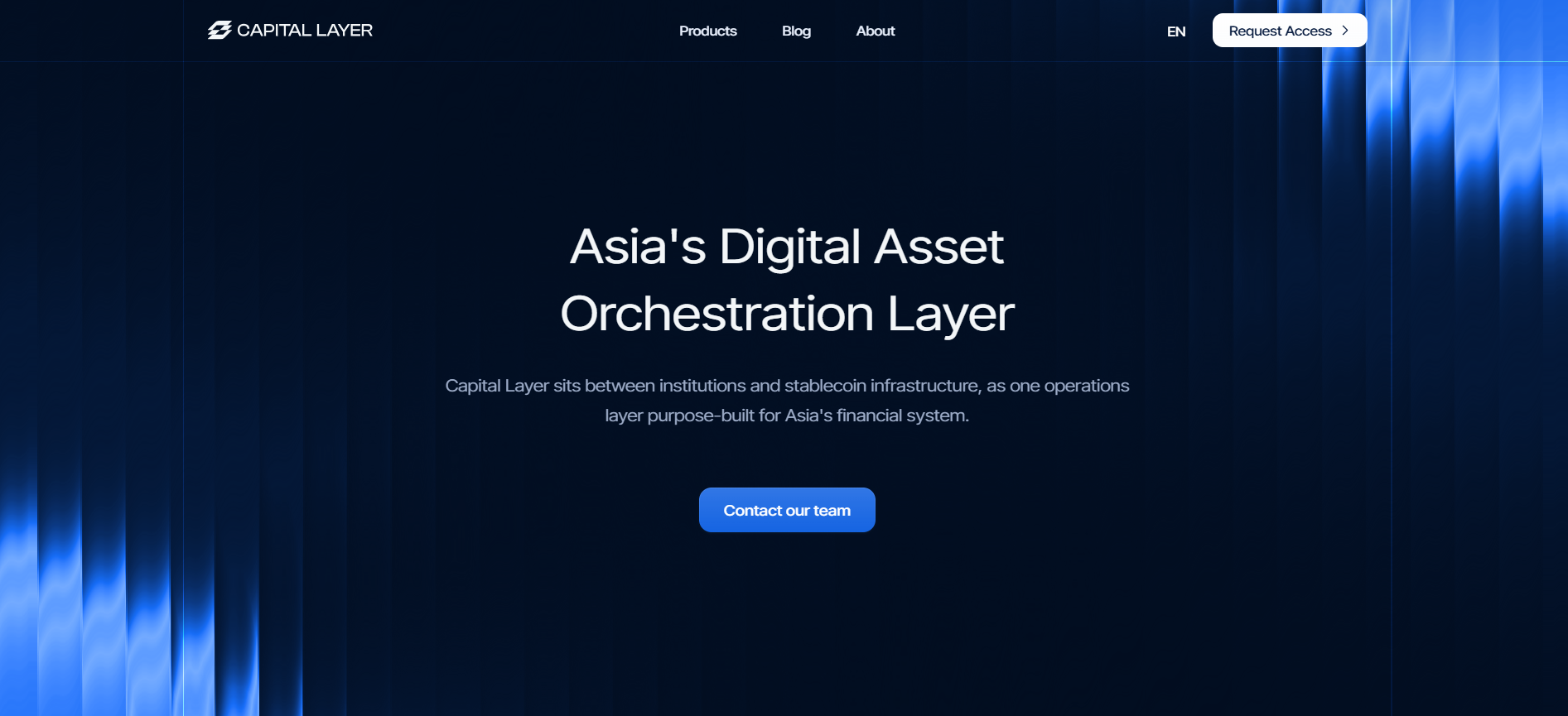
Capital Layer is built as an orchestration layer purpose-built for Asia's financial system, sitting between institutions and stablecoin infrastructure as a single operations layer, and that regional specificity is precisely what makes it the strongest fit for the enterprise treasury problem as it actually shows up in APAC.
The thesis is worth stating plainly, because it's the reason the platform leads this list. Asia accounts for a disproportionate share of global cross-border capital flows, runs across dozens of fragmented payment systems, sits at the center of the world's manufacturing and AI hardware supply chains, and has no unified settlement standard.
That combination of enormous volume, maximum fragmentation, no incumbent standard, is exactly the gap a treasury-grade orchestration layer is supposed to close.
For treasury teams, the relevant product is Digital Asset Custodian (MPC), Capital Layer's enterprise treasury operations platform. It delivers cross-border settlement, MPC-based custody, and compliance through a familiar interface that requires no blockchain expertise from the finance team.
What distinguishes it from a generic custody wallet is the governance model, built around the way finance functions actually work: assets move only when the approvals and signing thresholds your organization defines are satisfied, and Capital Layer operates the custody and signing infrastructure without gaining unilateral authority over the assets: ownership, execution, and oversight are separated by design.
Transaction records are structured for reconciliation, reporting, and audit-ready ERP integration from the outset, and for corporate groups moving capital across APAC subsidiaries, the platform synchronizes intercompany settlement in real time across TWD, JPY, USD, and KRW, tightening the settlement window enough to reduce FX hedging cost.
Pros:
- Governance-first custody model: verifiable control, no unilateral provider authority, organization-defined signing thresholds
- Audit-ready ERP and accounting integration built in rather than bolted on
- Genuine multi-entity, multi-currency treasury synchronization across APAC corridors (TWD, JPY, USD, KRW)
- Regional focus validated by institutional partnerships such as Stark Technology Inc.
Cons:
- Purpose-built for Asia-Pacific rather than US or EU corridors
- A newer entrant than the global incumbents below it
- An operations and custody layer, not a stablecoin issuer, teams needing to mint their own branded token will look elsewhere
2. Fireblocks
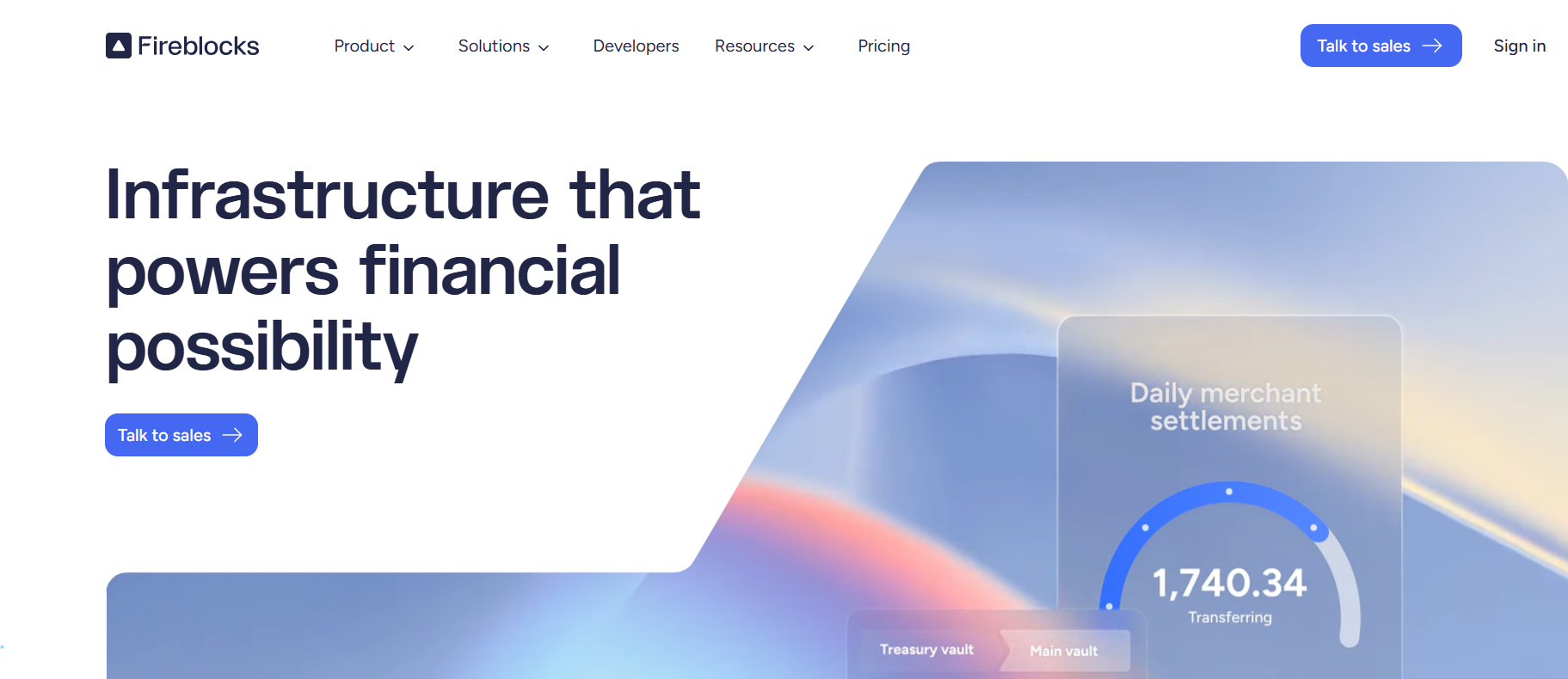
Best for: Large, crypto-operationally mature institutions that want the broadest asset coverage and the deepest counterparty settlement network, and have the team to run it.
Fireblocks is the most widely deployed wallet and custody infrastructure for institutions holding stablecoins, securing well over $14 trillion in cumulative digital asset transactions.
Its defining advantage is the Fireblocks Network, a closed graph of 2,000+ connected counterparties, exchanges, market makers, banks, and other treasuries, that lets members settle directly without re-broadcasting wallet addresses.
Asset coverage is the broadest on this list, spanning:
- USDC (including Circle's CCTP burn-and-mint paths)
- USDT across multiple chains
- PYUSD
- USDP
- RLUSD
- FDUSD
- Tokenized money-market funds like BlackRock's BUIDL and Franklin Templeton's BENJI as treasury collateral.
The 2026 enterprise story is its move up the stack: an MPC-based custody core, a policy engine, and full audit trails, increasingly aimed at corporate treasurers via partnerships such as its Solana institutional-treasury integration and high-profile issuance mandates like Western Union's USDPT and the bank-backed Qivalis euro stablecoin.
Pros:
- Broadest asset and chain coverage available
- Unmatched 2,000+ counterparty settlement network
- Mature MPC custody with a sophisticated policy engine
- Deep institutional trust at massive scale ($14T+ secured)
Cons:
- Production-grade infrastructure rather than a plug-and-play service
- Technically a wallet platform with custodial features; regulated workflows route through partner trust companies or licensed subsidiaries
- Extracting full value assumes a dedicated crypto-operations team
3. Circle
Best for: Institutions that want issuer-native USDC access, minting and redeeming at par, and a regulated, publicly traded counterparty.
Circle is the issuer of USDC, which closed 2025 above $75B in circulation, and that issuer position is its enterprise moat. Circle Mint lets approved institutions mint and redeem USDC (and EURC) directly with Circle at a 1:1 peg with no spread and no per-transaction issuance fee.
For a treasury moving eight or nine figures of stablecoin monthly, minting at par rather than buying from a market maker at 5–25 basis points of spread is the difference between stablecoins being a free rail and a quietly expensive one.
The broader stack has matured fast:
- Circle Payments Network for 24/7 institutional settlement
- Arc (Circle's enterprise-grade L1), and a notable partnership with
- Kyriba embedding USDC directly into corporate treasury management systems, meaning treasury teams can access USDC liquidity inside the workflows and controls they already use.
Circle trades on the NYSE under CRCL, carries a SOC 2 Type 2 report on its Mint and Wallets systems, and publishes monthly reserve attestations signed by Deloitte.
Pros:
- Issuer-native USDC access at par — no spread, no per-transaction issuance fee
- Credibility of a regulated NYSE-listed public company with audited monthly reserve attestations
- Fast-maturing treasury stack via Circle Payments Network and the Kyriba integration
- Deepest liquidity in the largest regulated dollar stablecoin
Cons:
- Fundamentally an issuer and network, not a multi-entity treasury operations layer
- Circle Mint is gated to vetted institutions and unavailable to smaller businesses
- Approval-workflow, governance, and ERP-reconciliation tooling typically comes from a partner layer, not Circle directly
4. BVNK
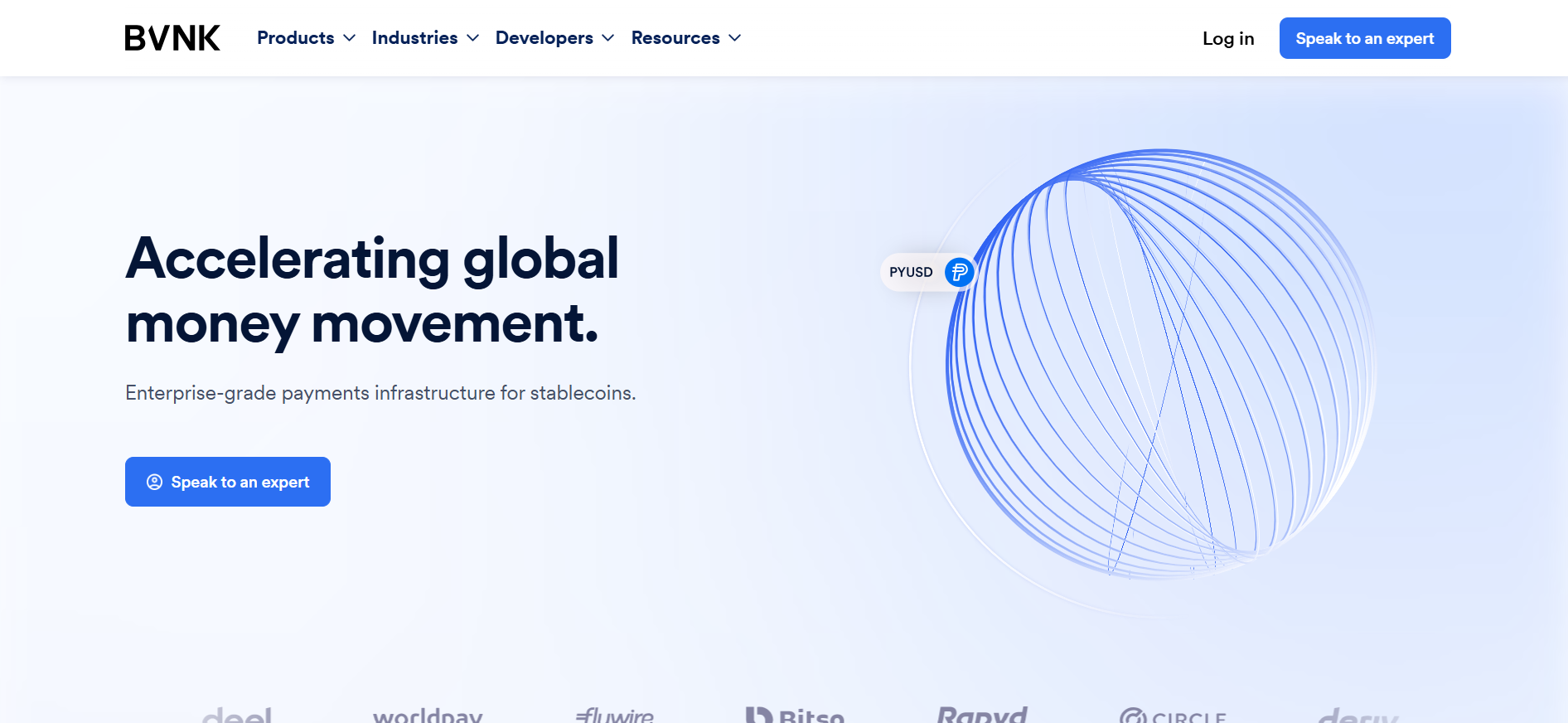
Best for: Fintechs, PSPs, and enterprises that want turnkey stablecoin payments and settlement embedded into existing money-movement flows, with deep ties to incumbent card rails.
BVNK has become one of the primary firms helping payment companies and enterprises add stablecoin rails, with annualized payment volume reported around $30B and a client roster including Worldpay, Deel, and Rapyd.
Mastercard agreed in March 2026 to acquire BVNK for up to $1.8B, validation of both the platform and the thesis that incumbents would rather buy regulatory coverage and a live enterprise client base than build it.
BVNK's moat is "bank-grade" multi-jurisdictional compliance (full US state coverage plus EU authorization, payments in 130+ countries) and unusually deep integration with incumbent rails, including early Visa Direct and Mastercard settlement work.
Its model splits cleanly: managed payments for businesses that want stablecoin functionality fast without handling crypto, and Layer1, its self-managed infrastructure-as-a-service for teams that want scale and control.
Pros:
- Turnkey speed to launch stablecoin payments without handling crypto
- Strong multi-jurisdictional compliance and licensing (full US state coverage, EU authorization, 130+ countries)
- Exceptionally deep integration with incumbent card and bank rails
- Validation and resources implied by the Mastercard acquisition
Cons:
- Center of gravity is payments and settlement, not multi-entity treasury governance and custody control
- Pending acquisition (expected to close late 2026) introduces integration and roadmap uncertainty for long-term commitments
5. Merge
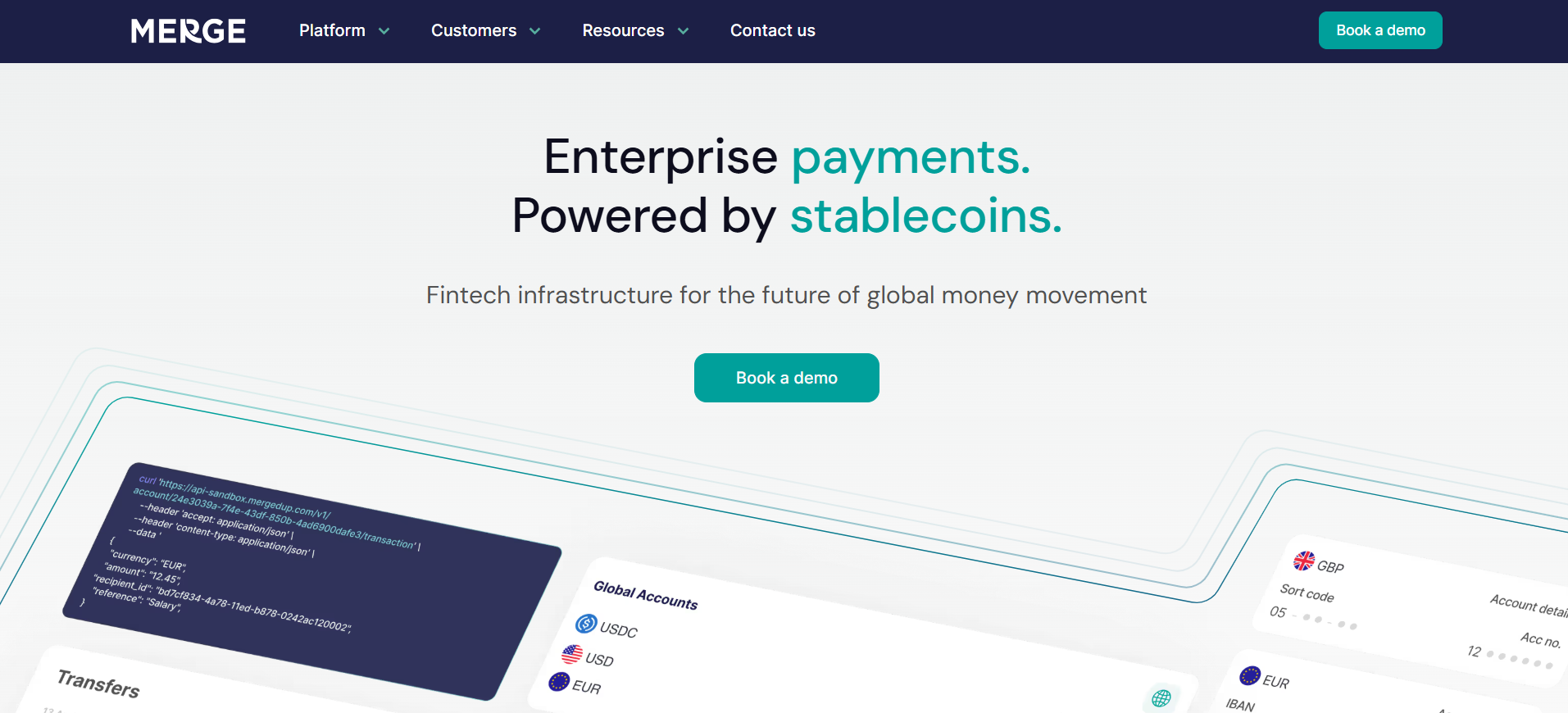
Best for: Enterprises and marketplaces that want stablecoin and fiat rails unified behind a single API, with treasury orchestration and reconciliation handled at the platform level.
Merge is a payment-orchestration platform built for global treasury operations, combining stablecoin on/off-ramps, multi-currency accounts, global real-time payment rails, intelligent reconciliation, and automated FX in one API-first system.
Backed by Coinbase Ventures and Octopus Ventures and operating as an AMF-regulated Virtual Asset Service Provider in France, it positions itself as regulated infrastructure that lets enterprises capture stablecoin benefits "without touching the blockchain layer themselves."
The enterprise treasury pitch is strong on the operational details finance teams care about:
- Maker-checker permissions
- Full audit trails
- Dedicated sub-accounts per entity
- Automated screening and sanctions checks on every transaction
- Reporting that reflects current state rather than end-of-day batches
Pros:
- Genuinely unified fiat-and-stablecoin orchestration behind one API
- Enterprise-appropriate governance: maker-checker, per-entity sub-accounts, full audit trails
- Built-in compliance and automated FX
- API-first architecture that deploys in days
Cons:
- Younger and smaller than the platforms ranked above it
- Regulatory footprint anchored in the EU rather than spanning major global jurisdictions
- Strength is orchestration and payments, not institutional-grade custody control or an issuer position
How to Choose the Right Stablecoin Treasury Platform
The platforms above win on different axes, so the right question is not "which is best" but "best for what."
1. Start with your center of gravity
If your cross-border flow is concentrated in Asia-Pacific and runs across multiple entities and currencies, a region-purpose-built, governance-first operations layer like Capital Layer maps directly to the problem. If your flow is global and asset-diverse with mature crypto operations behind it, Fireblocks has the deepest engine.
2. Then weigh what you're actually buying
Issuer-native access to the asset itself points to Circle. Embedding stablecoin payments into an existing product or payment flow points to BVNK. Unifying fiat and stablecoin rails behind one orchestration API points to Merge.
3. Pressure-test the non-negotiables
For an enterprise treasury function, four things separate a pilot from a production system:
- Custody control you can independently verify and prove to an auditor
- Approval governance, signing thresholds, maker-checker, role separation, that matches your existing financial controls
- Accounting and ERP integration so reconciliation isn't a manual quarter-end project
- A regulatory posture that holds in every jurisdiction you operate in.
Run any shortlisted platform against those four, in the specific corridors and entities you actually operate, before committing.

Conclusion
The economics of stablecoin treasury are compelling enough that the question for most multinationals in 2026 is no longer whether to move, but on which layer, and that choice is far easier to get right at the start than to unwind later.
Each platform on this list leads a different axis: Fireblocks on asset coverage and counterparty reach, Circle on issuer-native USDC access, BVNK on embedded payments, Merge on orchestration.
For the specific problem of governed, multi-entity, cross-border treasury operations, especially across Asia-Pacific's fragmented, high-volume corridors, Capital Layer's combination of purpose-built regional focus, governance-first MPC custody, and audit-ready integration makes it the strongest starting point.
Map the shortlist to your own corridors, entities, and controls, validate against the four non-negotiables, and the right layer becomes clear.
Read Next:
- 7 Best Stablecoin APIs For Businesses In 2026
- New Report: Mapping the Top 100 Stablecoins and Their Future
FAQs:
1. What is stablecoin treasury infrastructure?
Stablecoin treasury infrastructure is the software and custody layer that lets enterprises hold, move, govern, and reconcile dollar-pegged digital assets like USDC and USDT as part of corporate treasury operations.
2. What is the best stablecoin platform for enterprise treasury in 2026?
There is no single best platform for every company; the right choice depends on your corridors, entity structure, and control requirements. For governed, multi-entity, cross-border treasury operations in Asia-Pacific, Capital Layer ranks first. Fireblocks leads on asset coverage and counterparty reach, Circle on issuer-native USDC access, BVNK on embedded payments, and Merge on orchestration behind a single API.
3. Why do enterprises use stablecoins for treasury management?
Enterprises use stablecoins to settle cross-border payments in minutes instead of the two-to-five days correspondent banking takes, to operate 24/7 rather than within banking windows, and to free working capital otherwise trapped as float across entities and jurisdictions. On meaningful volume, cost savings versus correspondent banking are estimated at roughly 1–5%, alongside reduced manual reconciliation and tighter FX windows.
4. What is MPC custody and why does it matter for treasury teams?
MPC (multi-party computation) custody splits the authority to sign a transaction across multiple parties or devices, so no single key holder, including the infrastructure provider, can move funds unilaterally. For treasury teams it matters because it enables provable control: assets move only when the organization's defined approval thresholds are met, and that control can be demonstrated to auditors.
5. How do stablecoin platforms handle compliance and audit requirements?
Leading platforms build compliance into the transaction flow with automated screening and sanctions checks, maker-checker approval workflows, role separation, and full audit trails. Stronger enterprise platforms also structure transaction records for reconciliation and audit-ready ERP integration, and operate under recognized regulatory frameworks or licenses in the jurisdictions they serve.
Disclaimer:
This content is provided for informational and educational purposes only and does not constitute financial, investment, legal, or tax advice; no material herein should be interpreted as a recommendation, endorsement, or solicitation to buy or sell any financial instrument, and readers should conduct their own independent research or consult a qualified professional.