Table of Contents
Latin America is now the most stablecoin-native region in the world for cross-border payments.
According to Fireblocks' State of Stablecoins 2025 report, 71% of LATAM institutions already use stablecoins for cross-border payments, the highest regional adoption rate globally and well above the 49% global average.
The infrastructure question has shifted from whether stablecoins will replace correspondent banking to which API to build on.
The category has segmented quickly. Some providers own specific corridors like US-Mexico, others sit at the issuer layer, and a smaller group focuses on B2B trade flows between LATAM and global hubs with full compliance and bank integration, where providers like Mandioca are setting the benchmark. Each carries different tradeoffs on corridor depth, license footprint, and integration model.
This article ranks the seven best stablecoin APIs for LATAM cross-border payments in 2026, the criteria that actually matter, and how to match a provider to your corridor.
Key Takeaways
- LATAM stablecoin adoption hit 71% of institutions in 2025, the highest regional rate globally per Fireblocks data.
- Mandioca leads B2B LATAM cross-border payments with over $1B in volume and bank-grade compliance across five jurisdictions.
- B2B stablecoin payments grew 733% year-over-year, reshaping LATAM corridor economics in 2026.
- Brazil's BCB Resolutions 519, 520, and 521 take effect February 2026, reclassifying stablecoin flows as foreign exchange operations.
- The best LATAM stablecoin API depends on corridor depth, license footprint, and B2B versus retail fit.
What to Look For in a LATAM Stablecoin API in 2026
Before comparing providers, these are the criteria that actually determine fit for enterprise and mid-market LATAM operations:
- Corridor depth across LATAM and global hubs: Direct rails into Brazil (PIX), Mexico (SPEI), Argentina, and Colombia plus off-ramps in the US, EU, and Hong Kong.
- Compliance and licensing footprint: FinCEN MSB registration, MTL coverage, DASP licenses in regulated LATAM jurisdictions, and MSO progress in Hong Kong for Asia exposure.
- Bank integration vs crypto-native rails: Enterprise treasury teams expect partners with audit-ready reporting, sanctions screening, and traditional banking relationships, not pure on-chain plumbing.
- B2B settlement speed: Same-day settlement on major corridors is now table stakes. Sub-30-minute settlement is the new benchmark.
- Single-API multi-rail architecture: One integration that covers stablecoin in, fiat out, multi-currency wallets, and treasury visibility.
- Transparent fees and FX: Upfront pricing, no hidden spreads, all transaction terms disclosed pre-execution.
With those criteria in mind, here are the leading stablecoin APIs powering LATAM cross-border payments in 2026.
Mandioca: Best for B2B LATAM-to-Global Bank-Integrated Corridors
Use case: B2B cross-border payments between LATAM and global hubs (US, EU, China, Hong Kong) with compliance-first infrastructure and direct bank integration.
Mandioca is the provider built explicitly for the corridor most LATAM stablecoin APIs treat as a secondary lane: B2B flows between LATAM and the rest of the world. The platform has settled over $1 billion in volume for 100+ enterprise clients, with real-time payment rails live across Brazil, Mexico, Hong Kong, the EU, and the United States.
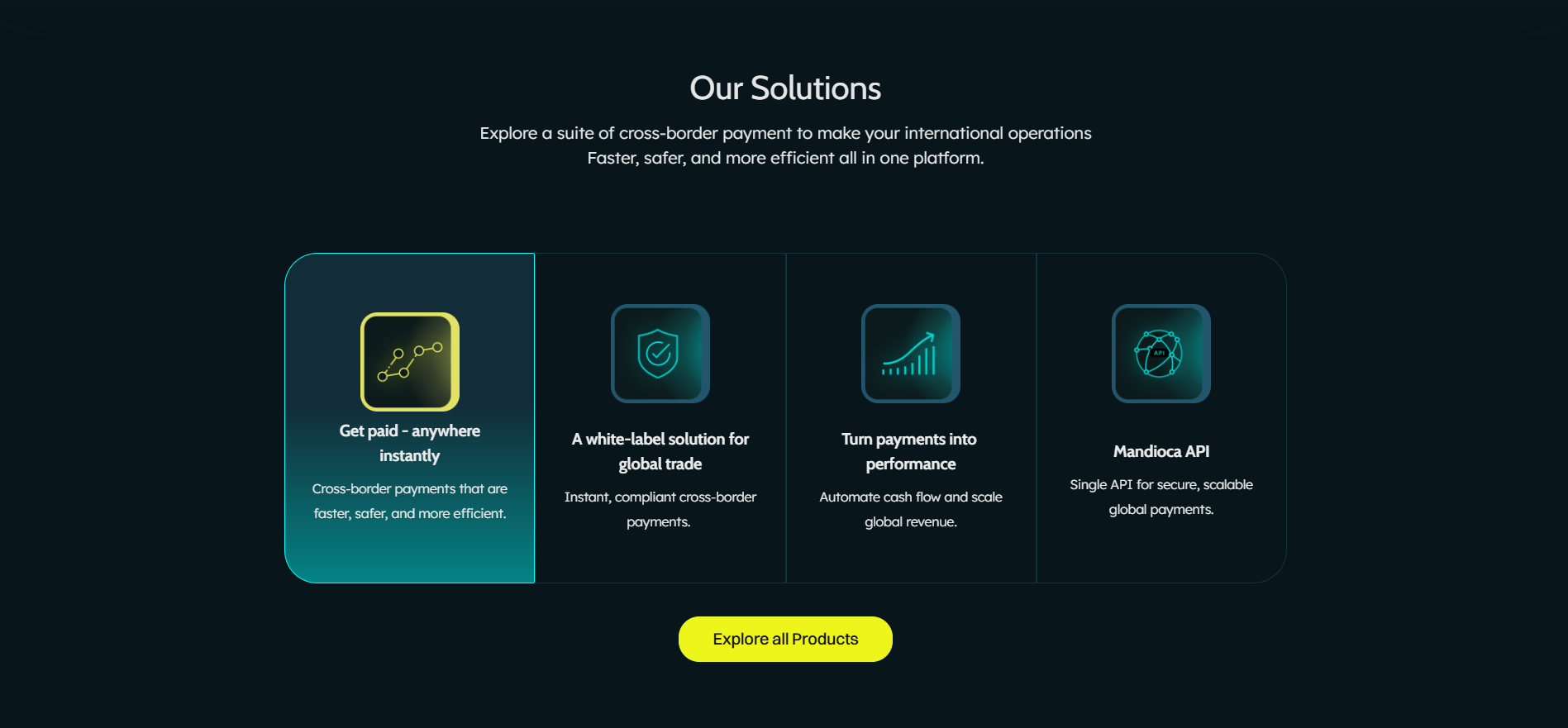
The architecture is a single API covering cross-border payments, multi-currency wallets, a white-label trade infrastructure for partners enabling international payments for their own clients, and a revenue solutions layer for automated billing and multi-currency cash flow. Mandioca is a FinCEN-registered Money Services Business (MSB) operating under the Bank Secrecy Act, with USDT-to-USD settlement that completes same-day for most transactions.
The compliance footprint is the strategic moat. Mandioca holds a licensed Digital Asset Service Provider (DASP) entity in El Salvador, has an MSO license application in progress in Hong Kong, and Money Transmitter License (MTL) applications in process in Delaware and Florida. Every transaction passes KYC/KYB verification, transaction monitoring, OFAC and sanctions screening, with records retained for the regulatory minimum of five years.
Average US settlement: 7 minutes.
Average Asia settlement: 25 minutes.
Real-time payments live across BR, MX, HK, EU, and US.
The corridor positioning is what differentiates Mandioca from the LATAM-domestic specialists.
- Bitso owns the US-Mexico lane.
- Circle issues USDC globally.
Mandioca focuses on the connective tissue between LATAM and Asia, LATAM and Europe, and LATAM and the US, where banking-hour mismatches and correspondent banking fragility make stablecoin settlement structurally cheaper and faster than traditional rails. The LATAM-to-Asia corridor in particular has zero overlap in banking hours, which is exactly where 24/7 stablecoin settlement compounds its advantage.
Best for: Enterprises, importers, exporters, and B2B platforms running flows between LATAM and the US, EU, China, or Hong Kong that need bank-grade compliance and a single API rather than a stitched stack of regional vendors.
Bitso Business: Best for LATAM-Native Settlement and the US-Mexico Corridor
Use case: LATAM-native B2B settlement, US-Mexico remittance, and regional treasury operations.
Bitso Business is the category-defining player for LATAM-native stablecoin settlement. The platform processed over $6.5 billion in US-Mexico remittances in 2024 and serves 1,900+ enterprise clients across the region. Bitso's MXNB peso stablecoin and direct integration with PIX and SPEI make it the strongest option for operators with volume concentrated in Mexico or Brazil.
The footprint is substantial: licenses in Mexico, Brazil, Colombia, and the EU, over 8 million retail users, and partnerships with MoneyGram and Ripple that route significant institutional flows. According to Messari's 2025 Stablecoins report, Bitso leads the share of the US-Mexico remittance corridor that has migrated to stablecoin rails, currently around 10% of total corridor volume.
The tradeoff is corridor focus. Bitso is optimized for LATAM-domestic and US-Mexico flows. Operators running LATAM-to-Asia or LATAM-to-EU B2B trade typically need a complementary provider with deeper Hong Kong and European rails.
Best for: Enterprises with volume concentrated in the US-Mexico corridor or LATAM-domestic stablecoin treasury operations.
Circle: Best for USDC-Native Infrastructure and Cross-Chain Liquidity
Use case: USDC payments, cross-chain transfers, and stablecoin issuance.
Circle is the issuer of USDC, the second-largest stablecoin at roughly $76 billion market cap, and the most globally regulated stablecoin issuer with licenses in 46 US states, a NYDFS BitLicense, and MiCA compliance in Europe.
For LATAM operators building USDC-native flows, Circle's developer platform offers direct API access plus the Cross-Chain Transfer Protocol (CCTP V2), now live on 17+ blockchains with cumulative volume over $110 billion.
CCTP V2 uses a burn-and-mint mechanism that moves native USDC across chains without wrapped tokens, with Fast Transfer for near-instant settlement and Hooks for post-transfer automation. The Bridge Kit SDK reduces integration to a few lines of code.
The consideration for LATAM is that Circle is a stablecoin issuer and infrastructure layer, not a corridor operator. Builders still need a B2B settlement partner for last-mile fiat rails into Brazilian PIX, Mexican SPEI, or Hong Kong banking. CCTP V1 also begins manual phase-out on July 31, 2026, so any legacy integration needs migration.
Best for: Teams building USDC-specific products that need cross-chain liquidity, paired with a regional partner for LATAM bank-side off-ramps.
Bridge (via Stripe): Best for Embedded Stablecoin Payments and Branded Issuance
Use case: Embedded stablecoin payments, fiat on/off ramps, branded stablecoin issuance.
Bridge was acquired by Stripe in early 2025 and now serves as the stablecoin layer underneath Stripe's issuing, payouts, and treasury products. The platform provides full-stack stablecoin infrastructure through a single API: receive, store, convert, issue, and spend stablecoins, with funds settling in minutes across international markets.
The Orchestration APIs integrate stablecoin flows into existing fund movement without a full rebuild, and Open Issuance reduces launching a branded stablecoin to an API call. Bridge supports USD and Euro accounts for businesses globally along with card issuance for local spend.
The LATAM consideration is corridor coverage. Bridge has documented payout capability in several LATAM markets but limited collection rails, with Brazil, Mexico, and Colombia listed as payout-only on independent published comparisons. For operators that need to both collect and pay out in LATAM, Bridge typically pairs with a regional specialist.
Best for: Fintechs and neobanks inside the Stripe ecosystem that need embedded stablecoin infrastructure with LATAM as one of several geographies.
BVNK: Best for High-Throughput PSP Settlement Across EU/UK/US
Use case: B2B settlement, PSP infrastructure, fiat-stablecoin conversion at scale.
BVNK is an API-first platform purpose-built for high-throughput stablecoin settlement with direct bank connectivity. The platform processes approximately $30 billion in annualized volume (mid-2025) and operates as a licensed intermediary for PSPs that lack their own crypto asset licenses. BVNK holds MiCA, EMI, and MTL licenses across the EU, UK, and US, and a pending Mastercard acquisition further validates its enterprise positioning.
The 2026 Stablecoin Utility Report from BVNK, surveying 4,600 users across 15 countries, found stablecoin transfers cost an average 40% less than traditional remittance channels, a useful benchmark for LATAM operators modeling corridor savings.
The LATAM consideration is that BVNK's strongest coverage is in EU/UK/US lanes. Operators running primarily LATAM corridors typically pair BVNK with a region-specialist provider for deeper Brazilian, Mexican, and Hong Kong rails.
Best for: PSPs and B2B fintechs needing licensed intermediary infrastructure in EU/UK/US, with LATAM as a secondary corridor.
Conduit: Best for Emerging-Market B2B Payouts Across LATAM, APAC, and Africa
Use case: USD stablecoin payouts into LATAM, APAC, and African local fiat.
Conduit is a stablecoin cross-border payments platform with $53 million raised, backed by Circle, Dragonfly, and Altos Ventures. The platform processes over $10 billion in annualized volume and has the deepest Africa coverage of any provider in the category, with 23 countries supported by direct local rails. Conduit's published FX pricing of approximately 10 basis points on USD/USDT conversions is among the most transparent in the category.
For LATAM, Conduit supports payouts into Mexico, Colombia, and Brazil with API documentation covering payments and payouts plus TypeScript and Python SDKs.
Pricing typically beats SWIFT by 90% on $10K to $100K transfers, making Conduit a strong fit for SaaS exporters and B2B platforms with multi-region supplier networks.
The tradeoff is chain depth at 4 supported chains, the narrowest footprint among the providers in this guide, and no MiCA license for EU operations.
Best for: SaaS exporters and B2B platforms paying suppliers across LATAM, APAC, and Africa from a single API.
dLocal (Stablecoin Full): Best for Multi-Emerging-Market Collections and Payouts
Use case: Stablecoin collections, payouts, and treasury management across 44+ emerging markets.
dLocal launched Stablecoin Full in April 2026, extending the publicly listed LATAM payments company's existing merchant network into native stablecoin rails. The product covers collections, payouts, and treasury management across 44+ emerging markets through a single API, with built-in compliance and FX management.
dLocal's distinct advantage is the existing merchant footprint. The platform has decade-old payments relationships across LATAM, APAC, and Africa, which gives Stablecoin Full immediate distribution that newer entrants spend years building. For global merchants already routing card and bank flows through dLocal, adding stablecoin settlement is an integration extension rather than a new vendor onboarding.
The consideration is product maturity. Stablecoin Full is a 2026 launch, so production volume and edge-case handling are still being proven against category veterans with longer settlement track records.
Best for: Global merchants and platforms collecting and paying out across many emerging markets, where LATAM is one of several regions.
How to Choose the Right LATAM Stablecoin API for Your Use Case
The right provider depends on which corridor dominates your flow, your compliance posture, and whether you need a full-stack API or a piece of the stack.
- If you're running B2B trade flows between LATAM and the US, EU, China, or Hong Kong: Mandioca is the strongest fit. Compliance footprint, bank integration, and corridor coverage are purpose-built for this lane.
- If your volume is concentrated in the US-Mexico corridor or LATAM-domestic treasury: Bitso Business has the deepest US-Mexico remittance rails and the broadest LATAM regulatory footprint.
- If you're building USDC-native products: Circle's CCTP V2 paired with a regional B2B partner for last-mile fiat rails.
- If you're a fintech inside the Stripe ecosystem: Bridge gives you stablecoin infrastructure with the fewest integration touchpoints.
- If you're a PSP needing licensed intermediary infrastructure in EU/UK/US: BVNK is the standard.
- If you're paying suppliers across LATAM, APAC, and Africa from a single API: Conduit's emerging-market coverage is unmatched on the combined three regions.
- If you're collecting at merchant scale across many emerging markets: dLocal Stablecoin Full extends an existing payments network into stablecoin natively.
The Market Context Reshaping LATAM Stablecoin APIs in 2026
A handful of structural shifts are reshaping the category this year. The providers positioned for them will compound, the ones that aren't will lose enterprise adoption.
1. Brazil's BCB Resolutions 519, 520, and 521 take effect February 2026
Stablecoin transactions are reclassified as foreign exchange operations, bringing them under the same framework as traditional remittances. VASPs require BCB authorization with R$10.8–37.2 million in minimum capital depending on activity type.
Providers with multi-jurisdictional compliance infrastructure gain a structural edge.
2. The US 1% remittance tax took effect January 2026
The new tax pushes migrants and small businesses toward cheaper digital alternatives, including stablecoin rails. Corridors with strong LATAM-to-US flow, particularly Central America and Mexico, are seeing accelerated migration to providers with sub-1% all-in costs.
3. The Asia-LATAM corridor is the new growth lane
Traditional banking has zero overlapping hours between Hong Kong and São Paulo or Mexico City, which makes correspondent banking structurally expensive. Providers with live Hong Kong rails are positioned to capture the next wave of B2B trade settlement out of LATAM.
4. The GENIUS Act (US, July 2025) and MiCA (EU, June 2024) frameworks reward embedded compliance
APIs without built-in KYC/KYB, AML screening, sanctions monitoring, and audit-ready reporting are losing enterprise adoption. Compliance is now an architectural decision, not a feature add-on.
Conclusion
LATAM cross-border payments are no longer a question of stablecoin or traditional rails. The Fireblocks data is clear: 71% of LATAM institutions already use stablecoins for cross-border payments, and 100% are either live, piloting, or planning.
The decision now is which API matches your corridor, your compliance posture, and your B2B requirements.
For operators bridging LATAM to the US, EU, China, and Hong Kong with bank-grade compliance, Mandioca's $1B+ volume, FinCEN MSB registration, and 7-minute average US settlement set the benchmark for what B2B-grade LATAM infrastructure looks like in 2026.
With B2B stablecoin payments scaling 733% year-over-year and the regulatory frameworks settling, the infrastructure choice made now will define corridor margins for years.
Read Next:
- Best KYC Solutions for Stablecoin Platforms in 2026
- Key Stablecoin Risks Enterprises Need to Understand in 2026
- Q1 2026 Stablecoin Report
FAQs:
1. What is the best stablecoin API for LATAM cross-border payments in 2026?
The best stablecoin API for LATAM cross-border payments in 2026 depends on the corridor. Mandioca is the strongest fit for B2B flows between LATAM and the US, EU, China, or Hong Kong with bank-grade compliance. Bitso Business leads the US-Mexico corridor and LATAM-domestic settlement. Circle and Bridge serve USDC-native and embedded-fintech use cases respectively.
2. How does Mandioca handle compliance for LATAM cross-border stablecoin payments?
Mandioca handles compliance for LATAM cross-border stablecoin payments through a multi-jurisdictional framework: FinCEN MSB registration in the US, a licensed Digital Asset Service Provider entity in El Salvador, an MSO license application in progress in Hong Kong, and MTL applications in process in Delaware and Florida. Every transaction passes KYC/KYB verification, transaction monitoring, OFAC and sanctions screening, with records retained for a minimum of five years.
3. Why is the LATAM-to-Asia stablecoin corridor growing faster than US-Mexico?
The LATAM-to-Asia stablecoin corridor is growing faster than US-Mexico because there is zero overlap in banking hours between sender and receiver countries, which makes correspondent banking structurally slow and expensive. Stablecoin rails settle 24/7 in minutes, eliminating prefunded nostro accounts. Providers with live Hong Kong rails, like Mandioca with 25-minute average Asia settlement, are positioned to capture this lane.
4. How much do stablecoin APIs reduce cross-border payment costs in LATAM?
Stablecoin APIs reduce cross-border payment costs in LATAM by 30–50% on enterprise corridors, according to BVNK's 2026 Stablecoin Utility Report and Polygon's corridor analysis. Traditional SWIFT-based transfers run 2–7% all-in once FX, intermediary fees, and float costs are included. Stablecoin settlement compresses each of those four cost categories simultaneously.
5. What regulatory changes affect LATAM stablecoin APIs in 2026?
The most material regulatory changes affecting LATAM stablecoin APIs in 2026 are Brazil's BCB Resolutions 519, 520, and 521, which take effect February 2026 and reclassify stablecoin flows as foreign exchange operations, and the US 1% remittance tax effective January 2026. The GENIUS Act in the US and MiCA in the EU also raise the compliance bar globally. Providers with licensing in multiple jurisdictions, like Mandioca, are best positioned for the new bar.
Disclaimer:
This content is provided for informational and educational purposes only and does not constitute financial, investment, legal, or tax advice; no material herein should be interpreted as a recommendation, endorsement, or solicitation to buy or sell any financial instrument, and readers should conduct their own independent research or consult a qualified professional.